脑机接口

Search documents
403项重要国家标准发布 涉及新兴领域、安全生产等方面
Yang Shi Wang· 2026-02-10 09:57
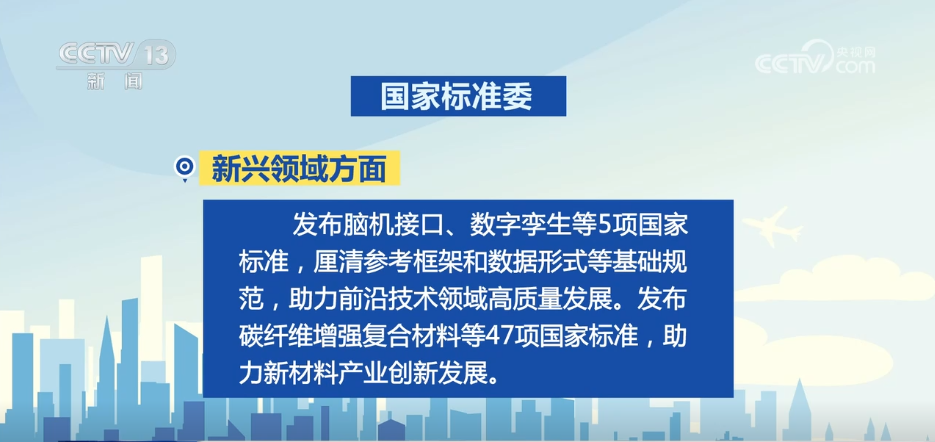
Emerging Fields - The National Standardization Administration has approved the release of 5 national standards related to brain-computer interfaces and digital twins, clarifying reference frameworks and data formats to support high-quality development in cutting-edge technology fields [3] - Additionally, 47 national standards for carbon fiber reinforced composite materials have been published to promote innovation in the new materials industry [3] Transportation and Logistics - Two national standards for intelligent connected vehicles have been released, focusing on performance testing for autonomous driving and automatic parking systems, which will enhance the performance and safety quality of intelligent connected vehicles [5] - Two mandatory national standards for the postal industry have been introduced, addressing safety production operations and equipment configuration for postal and express delivery companies, specifying safety operation norms and equipment requirements for various stages including collection, sorting, transportation, and delivery [5] Ecological and Environmental Protection - Two national standards related to greenhouse gas emission accounting and reporting requirements have been published, aiding companies in accurately calculating and reporting their greenhouse gas emissions, thus providing standard support for greenhouse gas emission management [7] Safety Production - Sixteen mandatory national standards in the fire safety sector have been released, updating technical requirements and inspection rules for related fire safety products, including outdoor fire hydrants and combustible gas detectors [9] Public Welfare - Four national standards for rehabilitation services for children with autism have been published, aimed at improving rehabilitation support for vulnerable groups such as people with disabilities, the elderly, and special children [11]

一批重要国家标准发布,与你息息相关
Xin Hua She· 2026-02-10 09:21
Emerging Fields - The State Administration for Market Regulation (SAMR) has released five national standards related to brain-computer interfaces and digital twins, clarifying reference frameworks and data formats to support high-quality development in cutting-edge technology sectors [1] - A total of 47 national standards have been published for new materials, including aluminum nitride single crystal polishing wafers and carbon fiber reinforced composites, aimed at fostering innovation in the new materials industry [1] Transportation and Logistics - Two national standards for intelligent connected vehicles have been issued, focusing on performance testing for autonomous driving and parking systems, enhancing the performance and safety of smart vehicles [2] - Six national standards have been released for automotive components such as door handles and adaptive cruise control systems, contributing to improved road traffic safety and environmental sustainability [2] - Two mandatory national standards for the postal industry have been introduced, outlining safety operation protocols and equipment requirements for postal and express delivery services, thereby enhancing safety governance in the sector [2] - Four logistics procurement national standards have been published, promoting the green transformation of supply chains [2] Ecological and Environmental Protection - Six national standards have been established for ecological safety, including general requirements for natural protected area signage and drone inspection techniques for forest and grassland fire prevention [2] - Two national standards related to environmental due diligence assessments and environmental report verification have been released, which are significant for promoting green development and enhancing environmental governance efficiency [2] - Two national standards for greenhouse gas emission accounting and reporting requirements have been published, aiding companies in accurately calculating and reporting their emissions [2] Safety Production - Sixteen mandatory national standards in the fire safety sector have been updated, including requirements for outdoor fire hydrants and gas detectors, providing technical guidelines for mitigating major fire safety risks [3] - Fourteen national standards have been released for special equipment safety, ensuring the stable operation of equipment such as gantry cranes and pressure vessels [3] Public Life - Four national standards for services related to disabled individuals have been published, aimed at improving the quality of rehabilitation aids and standardizing services for vulnerable groups such as the elderly and children with autism [3] - Eight national standards have been established for medical laboratories and medical device sterilization processes, regulating practices in medical experimentation and manufacturing [3]
个人的科技未来生存指南|附《2026 前沿科技趋势》电子版下载
腾讯研究院· 2026-02-10 09:03
Group 1 - The core idea of the article emphasizes the transition from passive healthcare to proactive life management through advancements in gene therapy and artificial intelligence, aiming for improved quality of life rather than mere longevity by 2030 [3] - The concept of "Life Force 2030" suggests that individuals aged 80 could possess the vitality of those aged 60, making this a tangible reality rather than a science fiction notion [3] - The article highlights the importance of creating a safe, fair, and sustainable ecosystem for new technologies such as exoskeletons, flying devices, and diving equipment, requiring collaboration among engineers, regulators, and the public [5] Group 2 - The potential for human intelligence to double with AI acting as an external brain is discussed, along with the implications of brain-machine interfaces that could allow seamless collaboration between humans and AI [8] - The future organizations are expected to be designed to unleash human creativity, focusing on how well they can stimulate individual imagination and realization rather than just their scale [11] - The article calls for society, businesses, and individuals to work together to guide technological progress with values of truth, goodness, and beauty, ensuring a positive direction for human civilization [14]

大额BD+技术进步催化,生物医药ETF(512290)收涨超1%,近20日资金净流入超5亿元
Sou Hu Cai Jing· 2026-02-10 08:50
Core Insights - The biopharmaceutical ETF (512290) rose over 1% on February 10, with a net inflow of over 500 million yuan in the past 20 days, driven by significant BD and technological advancements [1] Industry Summary - The 2026 JPM Healthcare Conference showcased numerous Chinese pharmaceutical companies presenting their latest research achievements and progress, alongside a surge in large BD deals and active collaborations with multinational corporations (MNCs) [1] - The development of brain-computer interfaces and AI applications is thriving, with consumer-oriented stocks expected to benefit from domestic demand recovery [1] - The industry faces several risks, including geopolitical risks overseas, potential product development failures, increased pricing pressure from expanded centralized procurement, intense competition leading to price declines, and significant rises in raw material costs [1] - The biopharmaceutical ETF (512290) tracks the CS Biomedicine Index (930726), which selects listed companies involved in biotechnology, pharmaceuticals, medical devices, and services from the Shanghai and Shenzhen markets to reflect the overall performance of related securities [1]
美好医疗跌1.31%,成交额1.88亿元,近5日主力净流入-3797.77万
Xin Lang Cai Jing· 2026-02-10 07:54
Core Viewpoint - The company, Shenzhen Meihua Chuangyi Medical Technology Co., Ltd., is engaged in the design, development, manufacturing, and sales of precision components and products in the medical device sector, with a focus on various medical applications and a significant portion of its revenue coming from overseas markets. Group 1: Company Overview - The company was established on July 15, 2010, and went public on October 12, 2022 [7] - The main business revenue composition includes: home ventilator components (59.48%), home and consumer electronics components (14.61%), other medical product components (10.33%), artificial cochlear implant components (8.16%), precision molds and automation equipment (5.63%), and other categories (1.09%) [7] - As of January 30, the number of shareholders is 29,800, an increase of 0.65% from the previous period [7] Group 2: Financial Performance - For the period from January to September 2025, the company achieved a revenue of 1.194 billion yuan, representing a year-on-year growth of 3.28% [7] - The net profit attributable to the parent company was 208 million yuan, a decrease of 19.25% year-on-year [8] - The company has distributed a total of 293 million yuan in dividends since its A-share listing [9] Group 3: Market Position and Trends - The company is currently focusing on the medical device sector, providing CDMO and CRO one-stop services to top global medical device clients and leading enterprises in niche markets [2] - The company is collaborating with downstream brain-machine interface clients to assist in the efficient commercialization of products from laboratory research to mass production [2] - The company has signed orders for weight loss pens, with automated production lines expected to be operational next year [2] Group 4: Shareholder and Institutional Holdings - As of September 30, 2025, the second-largest shareholder is Guotai Junan Value Advantage Flexible Allocation Mixed A, holding 5.9179 million shares, a new addition to the shareholder list [9] - The third-largest shareholder is Huabao CSI Medical ETF, holding 4.8127 million shares, which has decreased by 881,300 shares compared to the previous period [9] - Several new institutional shareholders have entered the top ten list, indicating a shift in shareholder composition [9]
港通医疗跌1.16%,成交额3358.32万元,后市是否有机会?
Xin Lang Cai Jing· 2026-02-10 07:41
Core Viewpoint - The company, Sichuan Portong Medical Equipment Group Co., Ltd., specializes in medical gas equipment and cleanroom systems, with a focus on providing comprehensive engineering solutions for medical institutions [3]. Group 1: Company Overview - Sichuan Portong Medical Equipment Group Co., Ltd. was established on January 13, 1998, and went public on July 25, 2023 [7]. - The company's main business includes the research, design, manufacturing, integration, and operation services of medical gas equipment and cleanroom systems [3][7]. - The revenue composition of the company is as follows: cleanroom equipment and systems 55.69%, medical gas equipment and systems 37.30%, sales of medical devices and other products 4.06%, operation services 2.81%, and others 0.14% [8]. Group 2: Financial Performance - For the period from January to September 2025, the company achieved operating revenue of 344 million yuan, a year-on-year decrease of 30.06%, and a net profit attributable to the parent company of -10.21 million yuan, a year-on-year decrease of 150.92% [8]. - The company has distributed a total of 48.9973 million yuan in dividends since its A-share listing [9]. Group 3: Market Position and Recognition - The company has been recognized as a "specialized, refined, distinctive, and innovative" small giant enterprise, which is a prestigious title in the evaluation of small and medium-sized enterprises in China [3]. - The company is positioned within the pharmaceutical and biological industry, specifically in the medical device sector [8]. Group 4: Recent Developments - The company has developed the Portong Cloud Monitoring Platform, which utilizes advanced IoT technology to provide real-time monitoring solutions for medical equipment in hospitals [2]. - The company’s medical gas equipment and cleanroom systems are crucial for ensuring the safety and cleanliness standards required for brain-computer interface surgeries [2].
浙商证券:脑机接口触达更广阔市场 国内政策与产业窗口期共振
智通财经网· 2026-02-10 07:35
Core Insights - Neuralink's first product, Telepathy, is expected to enter mass production this year, with over 10,000 applicants for trials, and the company is currently valued at over $9 billion [1][2] - The vision of Neuralink is to enhance communication bandwidth and efficiency by connecting the human brain with AI, potentially allowing ordinary people to interact with AI and control complex machinery through brain-machine interfaces [2] - The Chinese government's ten-year brain plan (2021-2030) is entering a critical implementation phase, positioning brain-machine interfaces as a future industry with significant policy support [3] Group 1: Product Development and Market Potential - Telepathy focuses on severe cases where brain function is normal but communication pathways are disrupted, such as spinal cord injuries and ALS patients [1] - Key conditions for mass production include performance enhancement of the N1 device, improved surgical safety, and reduced costs: the number of electrodes is expected to increase from 1,000 to 3,000 by 2026, and the cost of the needle kit is projected to drop from $350 to $15 [1] - The anticipated advancements in surgical techniques will reduce invasiveness and infection risks, allowing for smoother post-operative operations [1] Group 2: Policy and Industry Landscape - The Chinese government has issued implementation opinions to promote innovation in the brain-machine interface industry, aiming for significant technological breakthroughs by 2027 and enhanced innovation capabilities by 2030 [3] - Technical standards for brain-machine interfaces are being developed, with a roadmap set for completion by 2025, and a standardization committee established by the Ministry of Industry and Information Technology [3] Group 3: Clinical Advancements - The number of registered clinical studies for invasive brain-machine interfaces in China has significantly increased since 2024, with notable advancements from institutions like the Chinese Academy of Sciences [4] - Semi-invasive technologies are progressing rapidly, with successful implant surgeries conducted on numerous patients [4] Group 4: Integration with AI and Technology - The integration of brain-machine interfaces with large models is expected to enhance generalization capabilities and accelerate application deployment, transitioning from specialized models to a more universal intelligent foundation [5] - The combination of brain-machine interfaces with embodied intelligence aims to enhance human-machine interaction, particularly in rehabilitation and robotic control applications [6] Group 5: Market Players - Key players in the secondary market are focusing on non-invasive technology, with medical companies specializing in rehabilitation and tech firms advancing in algorithms and consumer-grade brain-machine products [7] - Notable medical service and device companies include Aipeng Medical, Xiangyu Medical, and Sanbo Brain Science, while tech firms include Entropy Technology and Yanshan Technology [7]

每日市场观察-20260210
Caida Securities· 2026-02-10 06:28
Market Overview - On February 9, the market opened high and closed higher, with the Shanghai Composite Index rising by 1.41%, the Shenzhen Component Index by 2.17%, and the ChiNext Index by 2.98%[3] - The total trading volume reached 2.27 trillion, an increase of approximately 110 billion compared to the previous trading day, indicating a market recovery[1] Sector Performance - Major sectors such as communication, media, electronics, and computers saw significant gains, particularly in AI applications where many stocks hit the daily limit up[1] - The top three sectors for net capital inflow were communication equipment, photovoltaic equipment, and semiconductors, while the sectors with the highest outflows were energy metals, oil service engineering, and agricultural chemicals[4] Investment Trends - The overall market remains cautious, with many stocks experiencing limit-up openings but also significant pullbacks, particularly in the space photovoltaic sector[1] - The current market characteristics suggest stabilization rather than aggressive buying, presenting a potential opportunity for early positioning[1] AI Sector Insights - AI application companies in the U.S. are showing high revenue growth, with domestic models like seedance 2.0 gaining traction, indicating a focus on AI applications in the market[2] Fundraising Activity - A total of 43 funds are set to be launched in February, with 33 being equity funds, accounting for nearly 80% of the total, indicating strong interest in new investment opportunities[13]
科创创新药ETF国泰(589720)涨超2%,10日吸金近5亿元
Mei Ri Jing Ji Xin Wen· 2026-02-10 05:42
Group 1 - The core viewpoint of the news highlights a rebound in innovative pharmaceuticals, with the Guotai Innovation Drug ETF (589720) rising over 2% and attracting nearly 500 million yuan in funds over the past 10 days, currently leading its peers with a total size exceeding 1.5 billion yuan [1] - Recent industry dynamics focus on multinational collaborations and domestic innovations, exemplified by the strategic partnership between Innovent Biologics and Eli Lilly to advance global R&D in oncology and immunology, with Innovent receiving an upfront payment of 350 million USD and potential milestone payments of up to 8.5 billion USD [1] - Additionally, Carl Zeiss announced the launch of its Greater China headquarters project in Shanghai, aimed at integrating and upgrading its core functions in management, R&D, and production to strengthen its innovation network in China [1] Group 2 - Bohai Securities noted that at the 2026 JPM Healthcare Conference, numerous Chinese pharmaceutical companies showcased their latest research achievements, and there has been a surge in large-scale business development (BD) activities, indicating active collaboration with multinational corporations (MNCs) [2] - The report suggests monitoring companies that may experience a bottoming out of performance as earnings forecasts are disclosed, while also highlighting the rapid development of brain-computer interfaces and AI applications, which are expected to benefit consumer-oriented companies amid domestic demand recovery [2] - The industry faces several risks, including geopolitical tensions, product development failures, expanded centralized procurement leading to price pressures, intense competition causing price declines, and significant increases in raw material costs [2]
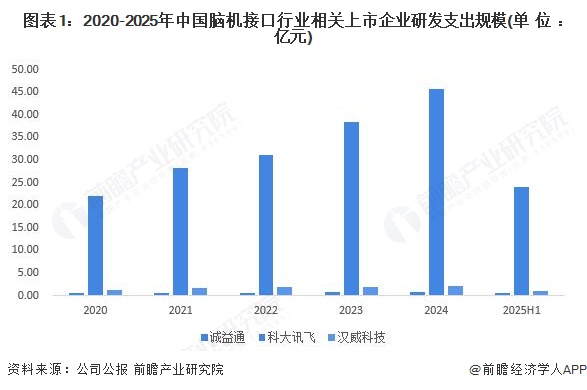
2025年中国脑机接口行业研发现状分析 企业研发投入呈增长趋势【组图】
Qian Zhan Wang· 2026-02-10 05:12
Group 1 - The core viewpoint of the article highlights the increasing investment and research activity in the brain-computer interface (BCI) industry in China, with a focus on key companies and patent trends [1][4][5] Group 2 - The research and development investment in the BCI industry by listed companies in China is steadily increasing from 2020 to 2024, indicating a strengthening of R&D efforts [1] - The number of patent applications in China's BCI industry showed a steady growth trend, peaking at 258 applications in 2021, followed by a decrease to 209 applications in 2024 [4] - Tianjin University is identified as the leading patent applicant in the BCI sector, with a total of 126 related patents, followed by South China University of Technology and Xi'an Jiaotong University with 80 and 78 patents respectively [5][7] - The most popular technology patents in the BCI industry are in the category of electrical digital data processing (G06F), with a total of 1,013 patents, followed by diagnostic and surgical technologies (A61B) with 712 patents, and specific computing models (G06N) with 313 patents [8]