
自动驾驶

Search documents
运达科技:公司参股企业扬斯科技的L4级自动驾驶物流机器人的研发与量产工作正按既定规划推进
Zheng Quan Ri Bao Zhi Sheng· 2026-02-24 10:17
Core Viewpoint - The company is progressing with the research and mass production of L4 autonomous driving logistics robots through its affiliated enterprise, Yangsi Technology, according to responses to investor inquiries on February 24 [1] Group 1 - The development of the new business is influenced by multiple factors including technology, market conditions, suppliers, and customers [1] - There is uncertainty regarding the business progress, and it is stated that there will be no direct impact on the company's performance in the short term [1] - Investors are advised to pay attention to risks and refer to publicly disclosed information for specific updates [1]


刚刚!马年IPO第一审获通过!
梧桐树下V· 2026-02-24 09:41
文/飞云 2月24日,盛合晶微半导体有限公司IPO申请获得科创板上市委审核通过。 单位:万元 | | | | 科创板 | | | | --- | --- | --- | --- | --- | --- | | 公司简称 | 主营业务 | 2024年营收 | 2024年净利润 | 审核结果 | 保荐/律所/审计 | | 盛合晶微 集成电路晶圆级先进封测服务 | | 470,539.56 | 18.740.07 | 通河 | 中金公司 / 锦天城 / 容诚 | 公司于2014年8月19日在开曼群岛注册成立,本次发行前总股本为160,730.79万股。截至2025年6月30日,公司拥有4家控股子公司 及1家分公司,无参股公司。截至2025年6月30日,员工总计5,968人。 二、控股股东、实际控制人 截至招股说明书签署日,公司无控股股东及实际控制人。公司股东主要为产业投资机构、专业投资机构以及员工持股平台等,股 权较为分散,单个主体无法控制股东会或董事会多数席位。第一大股东无锡产发基金持股比例为 10.89%,第二大股东招银系股东 合计控制发行人的股权比例为 9.95%,第三大股东厚望系股东合计持股比例为 6.76 ...

【行业政策】一周要闻回顾(2026年2月9日-2月22日)
乘联分会· 2026-02-24 08:35
Core Viewpoint - The article discusses the solicitation of opinions on the national standardization guidance technical document for solid electrolytes used in solid-state batteries for electric vehicles, highlighting the importance of establishing performance requirements and testing methods for solid electrolytes in the context of the rapid development of solid-state battery technology [2][3][4][5]. Group 1: Solid-State Battery Standards - The draft document for the technical specification of solid electrolytes for electric vehicle solid-state batteries has been prepared and is open for public comments until March 10, 2026 [3]. - The main content of the draft includes five chapters covering scope, normative references, terms and definitions, testing conditions, and requirements, along with six normative appendices detailing various measurement methods [3][4]. - The document aims to standardize key performance indicators such as ionic conductivity, electronic conductivity, electrochemical stability window, air stability, and moisture content, which are critical for the performance of solid-state batteries [4][5]. Group 2: Industry Context and Benefits - The establishment of a technical specification for solid electrolytes is crucial as there is currently no universal technical standard for the performance requirements and testing methods of solid electrolytes in electric vehicle solid-state batteries in China [5]. - The anticipated benefits of developing these standards include creating a common understanding in the field, promoting the standardization of technology research and industrialization processes, and fostering a healthy industry ecosystem [5]. - The implementation of these standards is expected to enhance product quality, reduce accident costs, and achieve economies of scale, ultimately benefiting the industry and society as a whole [16]. Group 3: Related Regulatory Developments - The article also mentions the publication of the "Automotive Industry Price Behavior Compliance Guidelines," which aims to clarify pricing behavior norms and encourage self-regulation within the industry [8][9]. - Additionally, there is an ongoing solicitation for opinions on five mandatory national standards related to intelligent connected vehicles, including safety requirements for autonomous driving systems, which reflects the industry's focus on safety and compliance [13][14].
特斯拉Autopilot败诉的启示
Zhong Guo Qi Che Bao Wang· 2026-02-24 08:14
Core Viewpoint - The Miami federal court upheld a $243 million compensation ruling against Tesla, marking a significant legal precedent in the autonomous driving sector, particularly regarding the responsibilities of car manufacturers in accidents involving their systems [1][3]. Accident Recognition - The fatal accident occurred on April 25, 2019, when a Tesla Model S, driven by George Mackey using the Autopilot system, crashed into a stationary vehicle, resulting in one death and one serious injury. Mackey was found 67% responsible for the accident due to distraction, while Tesla was deemed 33% responsible for system failures [2]. - The jury awarded $243 million in damages, including $43 million in compensatory damages and $200 million in punitive damages, after Tesla rejected a $60 million settlement offer [2]. Case Focus - The court highlighted that Tesla's Autopilot system failed to recognize a stationary vehicle and did not issue warnings or engage emergency braking, indicating a technical flaw. The marketing of the system as capable of full autonomy misled consumers about its actual capabilities [4]. - Tesla's Autopilot is classified as L2-level technology, requiring driver supervision, yet the accident occurred in a scenario not aligned with its intended use [4]. Consumer Misleading - Statements from Tesla's CEO, including claims of "sleeping while driving" within two years, contributed to consumer misconceptions about the system's capabilities, leading to over-reliance and distractions while driving [5]. Evidence Integrity - Tesla's deletion of crucial data related to the accident was viewed as an obstruction of justice, impacting the integrity of the evidence presented in court. This action violated regulations requiring the retention of accident data [6]. Regulatory Differences - The regulatory landscape for autonomous driving differs between the U.S. and China. The U.S. emphasizes commercial viability and has enacted laws to facilitate the production of autonomous vehicles, while China focuses on safety and controlled testing environments [8][9]. - The U.S. has introduced legislation to standardize regulations for autonomous vehicles, while China's policies are still evolving, prioritizing safety and controlled development [9]. Technological Approaches - The U.S. primarily follows a "single vehicle intelligence" approach, relying on onboard sensors and algorithms, while China adopts a "vehicle-road collaboration" model, enhancing decision-making through real-time interactions with roadside equipment [10]. - American consumers show high acceptance of autonomous driving technologies, influenced by continuous investment and marketing from companies like Tesla, whereas Chinese companies focus on cost-effectiveness and practical applications to gain market share [11].

否认FSD虚假广告指控,特斯拉起诉美国加州车管局欲推翻此前裁决
Huan Qiu Wang Zi Xun· 2026-02-24 07:30
Core Viewpoint - Tesla is suing the California Department of Motor Vehicles (DMV) to overturn a ruling that found the company guilty of false advertising regarding its autonomous driving features [1][2]. Group 1: Legal Proceedings - Two months prior, the state's administrative hearing office determined that Tesla engaged in false advertising, allowing the DMV to temporarily revoke the company's license to manufacture or sell vehicles in the state [2]. - The DMV did not directly revoke Tesla's license but required the company to modify its marketing language. On February 17, the DMV stated that Tesla had adequately made the necessary modifications, thus avoiding license revocation [2]. - In a lawsuit filed on February 13, Tesla's lawyers claimed that the DMV incorrectly labeled the company as a "false advertiser" due to its use of the terms "autopilot" and "full self-driving" [2]. Group 2: Future Implications - Tesla is heavily relying on the future of autonomous ride-hailing services, which is why it seeks further action from the DMV [2]. - The DMV has not yet commented on the ongoing legal matter, and Tesla has not responded to requests for comments [2].
马年开工喜迎智驾“大红包”,A股汽车板块政策与产业“共振效应”明显
Feng Huang Wang· 2026-02-24 07:22
Group 1 - The automotive sector in A-shares welcomed a significant boost on the first working day after the Spring Festival, with the automotive complete vehicle index rising over 1% and the smart vehicle index also increasing [1] - The autonomous driving sector is gaining momentum, with local policies and corporate actions setting a strong foundation for the industry's development towards "intelligentization" [1] - Black Sesame Intelligence announced a partnership with Guoqi Zhikong to develop an intelligent driving solution based on their A2000 chip, targeting L2+ to L3 level full-scene intelligent driving functions, with mass production expected by 2026 [1] - Youjia Innovation formed a strategic partnership with Di Shang Tie Green Technology and Shenzhen Gecko New Energy Technology to advance the design, production, and delivery of vehicle-grade unmanned logistics vehicles [1] Group 2 - The strong support for the autonomous driving sector is backed by policies aimed at fostering innovation and market exploration, as highlighted by Guangdong's provincial leadership [2] - Geely Automobile Group's CEO emphasized the importance of intelligentization in their strategic vision, focusing on AI technology, energy diversification, product premiumization, and global expansion by 2026 [2] - Geely's advanced driver assistance system will be applied to more models within the group, particularly extending to Lynk & Co models and related Geely Galaxy models [2] Group 3 - The series of actions on the first working day of the Year of the Horse outlines a promising trajectory for the automotive industry, indicating that the autonomous driving sector is poised for significant growth and A-share automotive intelligentization is expected to yield benefits by 2026 [3]

广东召开“新春第一会” 推动制造业与服务业协同发展
Zhong Guo Xin Wen Wang· 2026-02-24 07:08
中新社广州2月24日电 (记者程景伟)广东省委、省政府24日在广州召开全省高质量发展大会,广东省委 书记黄坤明表示,广东要以制造业之强牵引服务业之优,以服务业之优增进制造业之强,在"制造强 省"与"服务高地"相互成就中打开产业发展新天地。 这是广东省连续第四年召开"新春第一会",以制造业与服务业协同发展为主题。 此外,广东要以深化改革强化新赛道新领域制度供给,着力破解"老规矩管新质生产力"的问题,最大限 度为技术创新和市场探索"松绑",让低空经济"飞"起来、自动驾驶"跑"起来、具身智能"用"起来,确保 既"放得活"又"管得好";要以扩大开放走在两业协同发展最前沿,深度融入全球产业分工网络,加快集 聚全球制造资源、服务资源,在高水平"引进来"、高质量"走出去"中擦亮"广东制造""广东服务"双品 牌。(完) (文章来源:中国新闻网) 黄坤明在会上提及广东到2035年的远景目标:经济总量相比2022年实现倍增、达25.8万亿元(人民币, 下同)左右;人均地区生产总值相比2020年翻一番,达到中等发达国家水平。 据介绍,广东要推动传统优势产业稳规模、提品质、增效益,发展壮大新兴产业、未来产业,"群链一 体化"打造产业 ...
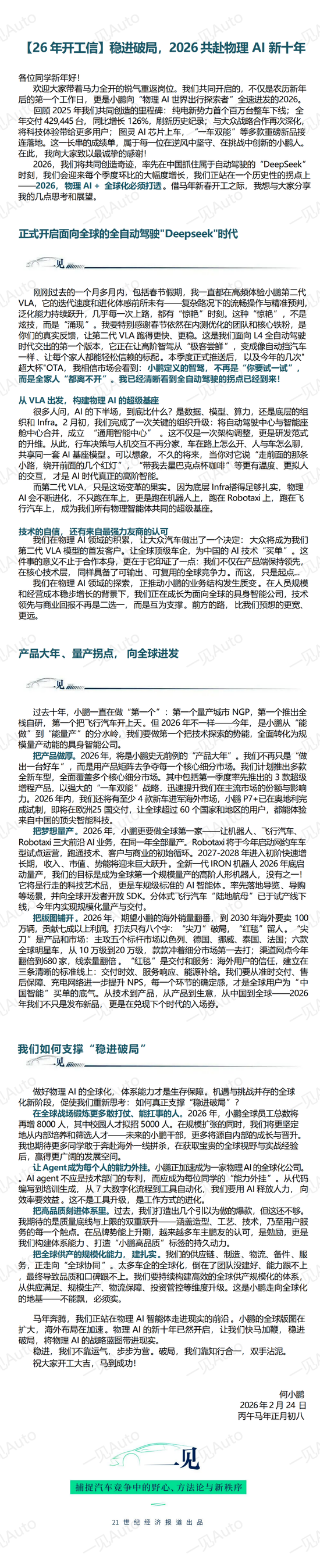
何小鹏内部信:要实现全球首个高阶人形机器人量产
Xin Lang Cai Jing· 2026-02-24 05:51
Core Viewpoint - The CEO of XPeng Motors, He Xiaopeng, emphasizes the company's strategic focus on "steady progress and breaking through" in the new decade of physical AI, aiming to achieve mass production of advanced humanoid robots and other AI technologies by 2026 [1][2][3] Group 1: Physical AI and Product Development - XPeng aims to become the first company globally to mass-produce advanced humanoid robots, with the new generation IRON robot set to start production by the end of 2026 [4][12] - The company plans to launch multiple new models in 2026, including three super-extended range products in the first quarter, to capture various core market segments [31][43] - The second-generation VLA model will be launched with Volkswagen as the first customer, marking a significant step towards full autonomous driving [27][41] Group 2: Sales and Global Expansion - In 2025, XPeng achieved a record sales volume of 429,445 units, a 126% year-on-year increase, and aims to double its overseas sales in 2026, targeting 100,000 units by 2030 [7][32][45] - The company plans to introduce at least four new models to international markets in 2026, focusing on key markets such as Israel, Germany, Norway, Thailand, and France [8][45] - XPeng's overseas delivery volume exceeded 45,000 units in 2025, representing a 96% increase, positioning it as a leader among Chinese electric vehicle manufacturers in international markets [7][32] Group 3: Talent Strategy - XPeng plans to increase its global workforce by 8,000 in 2026, with a focus on recruiting 5,000 campus talents and emphasizing internal talent development [11][36] - The company aims to integrate AI capabilities across all employees, making AI a core competency rather than just a technical department's responsibility [11][36] Group 4: Quality and Operational Excellence - XPeng is committed to enhancing product quality across all aspects, including design, craftsmanship, technology, and user service, to establish a strong brand reputation [47] - The company emphasizes the importance of building a robust global supply chain and operational capabilities to support its international expansion and maintain product quality [35][47]

广东省委书记黄坤明:让低空经济“飞”起来、自动驾驶“跑”起来、具身智能“用”起来
Xin Lang Cai Jing· 2026-02-24 05:21
2月24日,在2026广东省高质量发展大会上,广东省委书记黄坤明表示,要最大限度为技术创新和市场 探索"松绑",让低空经济"飞"起来、自动驾驶"跑"起来、具身智能"用"起来,确保既"放得活"又"管得 好"。 新浪声明:所有会议实录均为现场速记整理,未经演讲者审阅,新浪网登载此文出于传递更多信息之目 的,并不意味着赞同其观点或证实其描述。 2月24日,在2026广东省高质量发展大会上,广东省委书记黄坤明表示,要最大限度为技术创新和市场 探索"松绑",让低空经济"飞"起来、自动驾驶"跑"起来、具身智能"用"起来,确保既"放得活"又"管得 好"。 新浪声明:所有会议实录均为现场速记整理,未经演讲者审阅,新浪网登载此文出于传递更多信息之目 的,并不意味着赞同其观点或证实其描述。 责任编辑:李思阳 责任编辑:李思阳 ...
智能汽车主线周报:特斯拉首辆Cybercab下线,看好智能化-20260224
Soochow Securities· 2026-02-24 05:07
证券研究报告 智能汽车主线周报: 特斯拉首辆Cybercab下线,看好智能化 证券分析师 :黄细里 执业证书编号:S0600520010001 联系邮箱:huangxl@dwzq.com.cn 2026年2月24日 请务必阅读正文之后的免责声明部分 核心结论 注:若无特殊说明,"本周"均代表2026.2.9-2026.2.13 2 ◼ 本周智能汽车行情复盘:我们编撰的智能汽车指数-0.5%,智能汽车指数(除特斯拉)+5.7%,智能汽车指数(除整车) +3.9%。截至2026年2月13日,智能汽车指数PS(TTM)为14.8x,该估值位于2023年初以来98%分位数;智能汽车指数(除 特斯拉)PS(TTM)为6.2x,该估值位于2023年初以来88%分位数;智能汽车指数(除整车)PS(TTM)为10.5x,该估值位于 2023年初以来86%分位数。智能汽车指数标的耐世特、曹操出行、地平线机器人、千里科技、希迪智驾涨幅前五。 ( ◼ 本周行业核心变化:1)工信部公开征求《智能网联汽车自动驾驶系统安全要求》等五项强制性国家标准的意见,也即L3和L4 国标开启征求意见稿;2)中国最高人民法院2月13日首次发布道路交通 ...