
扩内需

Search documents
北京:1—7月全市实现社零总额7674.3亿元,同比下降4.2%
Jing Ji Guan Cha Wang· 2025-08-18 03:33
Group 1 - The total market consumption in Beijing from January to July increased by 0.7% year-on-year, driven by active service consumption in transportation, information, and cultural entertainment sectors, which grew by 4.6% [1] - The total retail sales of social consumer goods (referred to as social retail total) reached 767.43 billion yuan, a decrease of 4.2% year-on-year, influenced by the weakening advantages in key consumption areas [1] - Retail sales of fashion and entertainment goods such as gold and silver jewelry, cosmetics, and sports and entertainment products increased by 32.7%, 8.2%, and 6.1% respectively [1] Group 2 - The retail sales of household appliances and audio-visual equipment grew by 6.9% due to the "old-for-new" policy, while basic living goods like grain and oil food and daily necessities saw increases of 12.1% and 3.1% respectively [1] - The retail sales of communication equipment decreased by 24.4%, primarily due to changes in business models and the establishment of cross-regional operating entities [1] - The automotive retail sales fell by 19%, mainly due to insufficient demand for fuel vehicles, which also affected related petroleum and product sales [1] Group 3 - The social retail total reflects the retail situation of consumer goods and does not fully represent the overall consumption demand [2] - The consumption market in Beijing remains on a growth trajectory, with an ongoing trend of consumption structure upgrading [2] - Future policies aimed at expanding domestic demand and stabilizing growth are expected to boost confidence on both supply and demand sides, enhancing new consumption vitality [2]
政策发力逐步显效 我国消费潜力持续释放
Yang Shi Wang· 2025-08-18 00:28
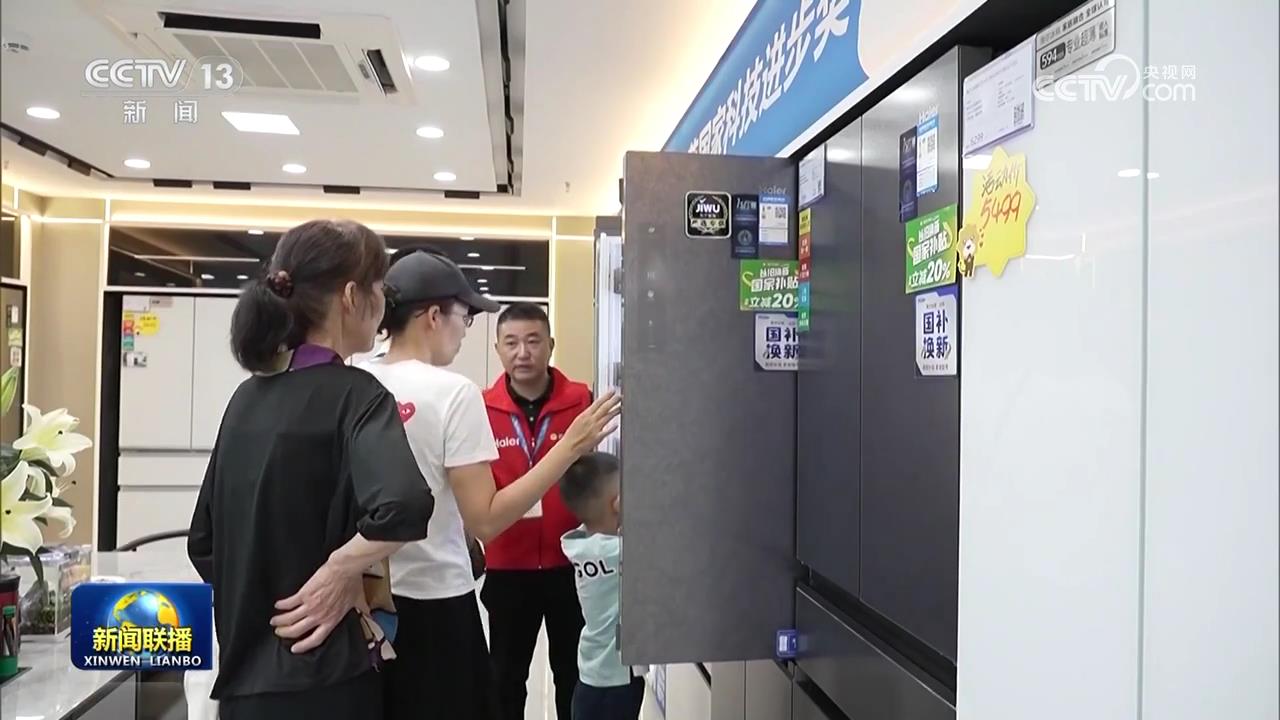
Core Viewpoint - A series of policies aimed at expanding domestic demand and promoting consumption have shown effectiveness this year, leading to stable growth in China's consumption market and highlighting the role of consumption as a key driver of economic growth [1] Group 1: Consumption Policies and Impact - The "trade-in" policy for consumer goods has significantly boosted sales, with related sales exceeding 1.9 trillion yuan (approximately 265 billion USD) and benefiting over 320 million people by August 14, 2023 [1] - The automotive sector saw over 7.3 million vehicles traded in, while home appliances experienced over 110 million units traded in, and digital products like smartphones had over 7.89 million units purchased [1] - High-efficiency appliances are experiencing rapid sales growth, indicating a shift towards higher quality and energy-efficient products [1] Group 2: Service Consumption Trends - There has been a continuous release of demand for service consumption, particularly during the summer travel season, with many people traveling for events [1] - Cultural venues have extended their hours, and new experiences like "Museum Night" have emerged, contributing to a vibrant cultural consumption landscape [1] - In the first seven months of the year, retail sales in tourism, leisure, and related services have shown double-digit growth [1] Group 3: Online Consumption Growth - Online retail has gained momentum, with a year-on-year growth of 9.2% in the first seven months, marking a new high for the year [1]
7月经济数据不乏亮点,宏观政策将适时加力
Di Yi Cai Jing· 2025-08-17 13:39
Group 1 - The core viewpoint emphasizes the need for macroeconomic policies to continuously exert force and adapt as necessary to stabilize and stimulate economic growth, especially in light of recent economic indicators showing a slowdown [2][8][10] - The National Bureau of Statistics reported a decline in key economic indicators for July, including a 3.7% year-on-year growth in retail sales of consumer goods, which is the lowest for the year [3][4] - Investment in fixed assets (excluding rural households) reached 288.229 billion yuan in the first seven months, showing a year-on-year growth of 1.6%, with infrastructure investment growing by 3.2% [4][6] Group 2 - The government is expected to implement new incremental policies, including timely budget increases, interest rate cuts, and measures to support the real estate sector and foreign trade enterprises [2][8][9] - The manufacturing sector, particularly high-tech industries, has shown resilience, with significant year-on-year growth in sectors such as integrated circuit manufacturing (26.9%) and electronic materials (21.7%) [3][6] - The service sector's retail sales remained stable, with a 5.2% growth from January to July, indicating a sustained expansion in consumption [4][6] Group 3 - The government plans to enhance fiscal policies by accelerating the issuance of special bonds and improving the effectiveness of fiscal measures to stimulate economic activity [10][11] - The People's Bank of China aims to maintain a moderately loose monetary policy while optimizing the structure of financial resource allocation to support innovation and advanced manufacturing [11][12] - The focus on expanding domestic demand and enhancing the adaptability of supply and demand in consumer goods is a priority for the Ministry of Industry and Information Technology [12]
政策发力显效 消费潜力持续释放
Yang Shi Wang· 2025-08-16 12:32
Group 1 - The core viewpoint is that a series of policies aimed at expanding domestic demand and promoting consumption have effectively stimulated China's consumption market, leading to stable growth and a stronger role as the "main engine" of economic growth [1] Group 2 - The policy of replacing old consumer goods has significantly boosted sales, with related sales exceeding 1.9 trillion yuan and benefiting over 320 million people by August 14, 2023 [1] - The automotive sector saw over 7.3 million vehicles replaced, while over 110 million home appliances and 789 million digital products were upgraded [1] - High-efficiency home appliances are experiencing rapid sales growth, indicating a trend towards quality large items [1] Group 3 - Service consumption demand has been consistently released, with an increase in tourism during the summer, leading to a new lifestyle where people travel for events [3] - Cultural venues have extended their opening hours, enhancing the cultural experience for visitors [3] - Related consumption in tourism, leisure, and cultural services has shown rapid growth, with retail sales in these sectors maintaining double-digit growth [3] Group 4 - Online consumption has gained momentum, with online retail sales increasing by 9.2% year-on-year in the first seven months of the year, marking a new high for the year [5]

沪指盘中突破3700点,收盘冲高回落
Sou Hu Cai Jing· 2025-08-14 12:35
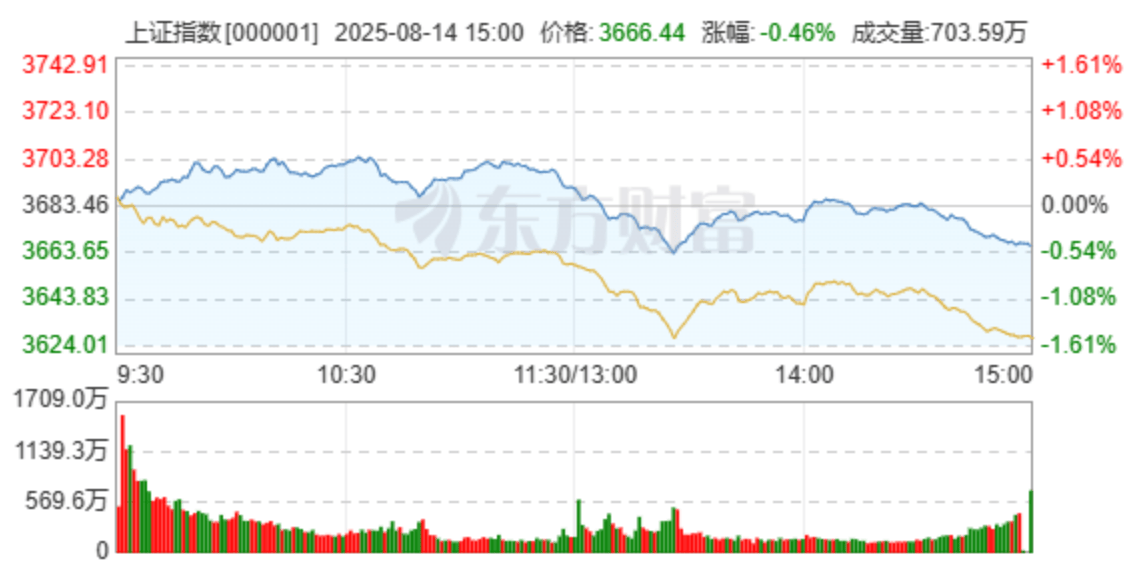
Market Performance - On August 14, the Shanghai Composite Index successfully broke through the 3700-point mark, reaching a high of 3704.77 points, the highest level since December 2021 [1] - The index closed at 3666.44 points, down 0.46%, while the Shenzhen Component and ChiNext Index fell by 0.87% and 1.08%, respectively [3] - The market saw a significant drop in the afternoon, with the military equipment sector leading the decline, followed by automotive parts and communication equipment sectors [3] Trading Volume and Market Sentiment - A-shares trading volume surged to 2.31 trillion yuan, marking the 28th trading day in history to exceed 2 trillion yuan [4] - The two-margin balance is expected to surpass 2 trillion yuan, indicating active market sentiment [4] - Northbound capital recorded a net inflow of 1.034 billion yuan, with the Shanghai-Hong Kong Stock Connect seeing a net inflow of 1.645 billion yuan [4] Economic Factors and Market Outlook - Recent favorable policies aimed at stabilizing growth, expanding domestic demand, and promoting consumption have boosted market confidence [5] - The liquidity environment remains loose, with continuous net inflows from northbound capital and increased willingness from public and private funds to increase positions [5] - Analysts remain optimistic about the medium to long-term market outlook, suggesting that as long as policies do not tighten, there is still upward potential for the A-share market [5]
贴息政策惠民生促消费
Sou Hu Cai Jing· 2025-08-13 22:52
合力拉动消费增长 "消费是经济增长的重要引擎,是畅通国内大循环的关键环节。"廖岷说。近日,财政部联合相关部门发 布《个人消费贷款财政贴息政策实施方案》《服务业经营主体贷款贴息政策实施方案》,支持促消费、 扩内需。 "如果按照1%的贴息比例,意味着1元的贴息资金,可能带动100元的贷款资金用于居民消费,或是消费 领域服务业的供给。"廖岷说。 个人消费贷款贴息政策是中央财政首次对个人消费贷款进行贴息,直接惠及广大人民群众。按照方案, 贴息对象为相关贷款经办机构个人消费贷款中实际用于消费的部分,包括单笔5万元以下日常消费,以 及单笔5万元及以上的家用汽车、养老生育、教育培训等重点领域消费,贴息比例为1个百分点,大体为 当前商业银行个人消费贷款利率水平的三分之一,政策实施期限1年,具体为2025年9月1日至2026年8月 31日。 消费贷款领域的"国补"来了。8月13日,国新办举行新闻发布会介绍个人消费贷款贴息政策和服务业经 营主体贷款贴息政策有关情况。财政部副部长廖岷表示,两项贴息政策通过进一步强化财政和金融协 同,撬动更多信贷资金精准投向消费领域,降低居民和经营主体的信贷成本,在保障和改善民生的同 时,通过提振消 ...
财政金融协同降低居民和经营主体信贷成本——贴息政策惠民生促消费
Jing Ji Ri Bao· 2025-08-13 22:05
Core Viewpoint - The introduction of personal consumption loan interest subsidy policies aims to stimulate consumer spending and enhance economic circulation by reducing credit costs for residents and businesses [1][2][3] Group 1: Policy Overview - The personal consumption loan interest subsidy policy is the first of its kind from the central government, directly benefiting the public by subsidizing loans used for consumption [2][3] - The subsidy rate is set at 1 percentage point, approximately one-third of the current commercial bank personal consumption loan interest rates, with a policy implementation period from September 1, 2025, to August 31, 2026 [2] - The service industry loan subsidy targets eight key consumption service sectors, with a maximum loan amount of 1 million yuan per entity and a subsidy cap of 10,000 yuan [2][5] Group 2: Implementation Process - The application process for the subsidies is designed to be simple and efficient, with loan institutions and local government departments handling the application and review processes [4][5] - For personal consumption loans, borrowers only need to grant permission to the loan institution to access transaction information to calculate the subsidy amount [4] - Service industry borrowers do not need to apply for the subsidy; the bank will return the subsidy amount directly to them after receiving the funds from the government [5] Group 3: Expected Impact - The policies are expected to enhance consumer capacity and expand effective supply, positively impacting consumption, especially in the service sector [3][8] - The People's Bank of China has implemented various monetary policy tools to support consumption, including a 500 billion yuan service consumption and elderly re-loan program [8] - The focus will be on increasing credit support for key service consumption areas such as accommodation, dining, and education, while also improving payment services for consumers [8]
扩内需政策加码 财政金融政策合力激活消费潜能
Zheng Quan Shi Bao· 2025-08-13 17:46
Core Viewpoint - The introduction of the "dual interest subsidy" policy marks the first time the central government has implemented interest subsidies in the consumer sector, aiming to lower credit costs for residents and businesses while boosting consumption and economic circulation [1][2]. Group 1: Policy Implementation - The "dual interest subsidy" policy is designed to support both the supply and demand sides of consumption, directly benefiting households and businesses in the consumer sector [1]. - The personal consumption loan interest subsidy specifically targets the portion of loans used for consumption, breaking from previous practices of blanket subsidies [1][2]. - The policy aims to work in conjunction with existing financial support measures, such as the 500 billion yuan service consumption and pension relending established by the People's Bank of China [2]. Group 2: Financial Coordination - The dual interest subsidy policy is expected to create a synergistic effect with prior financial support policies, reducing financing costs for consumers and businesses [2]. - Financial institutions are encouraged to increase credit supply in the consumer sector, with the central bank providing low-interest relending to commercial banks to stimulate lending [2][4]. - The financial regulatory authority will oversee the implementation of these policies, ensuring that funds are used effectively and in compliance with regulations [3]. Group 3: Focus on Key Sectors - The financial regulatory authority emphasizes the importance of directing credit towards sectors closely related to daily life, such as dining, health, and entertainment [3]. - Special attention will be given to small and micro enterprises, with mechanisms established to facilitate their access to financing [3]. Group 4: Sustainable Development - The sustainability of financial institutions is a key concern, with interest rates for consumer loans determined by banks based on market principles, while the subsidy is provided by the government [4]. - Future efforts will focus on enhancing the attractiveness of consumer financial products and simplifying approval processes to better meet consumer needs [4].
两项贷款贴息政策出台!谁能申请、怎么申请 官方回应
Mei Ri Jing Ji Xin Wen· 2025-08-13 15:00
Core Viewpoint - The introduction of personal consumption loan interest subsidy policies aims to stimulate consumer spending and enhance economic circulation by reducing credit costs for residents and service industry operators [1][2]. Summary by Relevant Sections Personal Consumption Loan Subsidy Policy - The policy provides a 1% interest subsidy on personal consumption loans used for various consumer expenditures, including daily expenses under 50,000 yuan and larger purchases like cars and home renovations [2][3]. - The subsidy is designed to cover the actual consumption portion of loans, with a maximum subsidy of 500 yuan per person for each loan, and multiple loans can be combined for a total subsidy of up to 1,000 yuan for smaller loans and 3,000 yuan for larger loans [3][5]. Service Industry Loan Subsidy Policy - This policy targets loans to service industry operators in key consumption sectors such as dining, health, and tourism, with a similar 1% interest subsidy applicable for one year [2][4]. - Each service entity can receive a maximum subsidy of 10,000 yuan on loans up to 1 million yuan, with the requirement that the loan funds be used for operational activities [3][4]. Application Process and Conditions - To qualify for the personal consumption loan subsidy, borrowers must demonstrate genuine consumption behavior, with the policy effective for one year starting from September [2][6]. - For service industry loans, operators need to have a signed loan agreement and received funds to benefit from the subsidy, which will be applied automatically by the lending institution [4][5]. Implementation and Operational Efficiency - The policies are designed to be straightforward, with minimal burden on borrowers, as the lending institutions will handle the application and subsidy processes [6]. - Borrowers will be informed of their subsidy status through various communication methods, ensuring transparency and ease of access [4][6].
财政金融联动再推新“国补” 撬动信贷资金精准促消费
Di Yi Cai Jing· 2025-08-13 14:22
Core Viewpoint - The Chinese government has introduced two subsidy policies for personal consumption loans and service industry loans to stimulate consumption and expand domestic demand, reflecting the government's commitment to enhancing consumer spending [1][2]. Group 1: Policy Details - The two subsidy policies are the "Personal Consumption Loan Subsidy Policy" and the "Service Industry Operating Entity Loan Subsidy Policy," which aim to support consumption and reduce credit costs for residents and businesses [1][2]. - The subsidy for personal consumption loans is set at 1%, which could potentially leverage 100 times the amount in loans for consumer spending [2]. - The subsidy period for both policies is one year, with a focus on various consumer needs, including daily expenses and significant purchases like home appliances and vehicles [2]. Group 2: Economic Impact - The policies are designed to enhance the vitality of the consumption market, particularly in the service sector, by addressing both demand and supply sides [1][3]. - Service consumption in China has significant growth potential, with per capita service consumption expenditure expected to reach 46.1% of total consumption by 2024, contributing 63% to the growth of consumer spending [3][4]. - The policies aim to improve the quality of service supply to meet the diverse and personalized needs of consumers, thereby promoting overall economic stability [5][6]. Group 3: Implementation and Oversight - The policies emphasize broad coverage and low thresholds for access, ensuring that the application process is straightforward and efficient for consumers [6][7]. - Financial institutions are required to adhere to strict regulatory measures to ensure the proper use of subsidy funds and protect consumer rights [7][8]. - The People's Bank of China is guiding financial institutions to enhance the integration of consumption scenarios and improve the attractiveness of consumer financial products [8].