
生成式AI

Search documents
微软新一代自研AI芯片“Maia 200”出鞘!推理狂潮席卷全球,属于AI ASIC的黄金时代到来
Zhi Tong Cai Jing· 2026-01-27 01:38
Core Viewpoint - Microsoft has launched its second-generation AI chip, Maia 200, aimed at providing a cost-effective alternative to NVIDIA's AI GPU series for cloud AI training and inference tasks [1][3]. Group 1: Product Launch and Specifications - The Maia 200 chip, manufactured by TSMC, is designed for high-performance AI inference tasks and is being deployed in Microsoft's large AI data centers [1][3]. - The chip offers a performance improvement of 30% per dollar compared to Microsoft's latest hardware, with FP4 performance three times that of Amazon's third-generation Trainium and FP8 performance exceeding Google's seventh-generation TPU [5][6]. - Maia 200 is built using TSMC's advanced 3nm process and contains over 140 billion transistors, providing over 10 petaFLOPS of performance at FP4 and over 5 petaFLOPS at FP8 within a power consumption of 750 watts [6]. Group 2: Competitive Landscape - The launch of Maia 200 positions Microsoft as a strong competitor against Amazon's Trainium and Google's TPU, with claims of superior performance in AI inference tasks [3][4]. - Other chip design giants like Marvell, Broadcom, and MediaTek are also focusing on developing custom AI ASIC solutions for cloud giants, indicating a competitive shift towards high-performance, cost-effective AI infrastructure [2]. Group 3: Industry Trends and Future Outlook - The increasing demand for AI data centers and the need for energy-efficient solutions are driving the development of AI ASIC technology across major tech companies [7][8]. - Microsoft is already planning the next generation of AI chips, named Maia 300, and has options to collaborate with OpenAI for exclusive chip designs [6][7]. - The AI ASIC technology route is seen as a critical investment for companies aiming to enhance cost-effectiveness and energy efficiency in AI computing [7][8].

英特尔,“重返”DRAM?
半导体行业观察· 2026-01-27 01:26
Core Viewpoint - The collaboration between Sandia National Laboratories and Intel on advanced memory technology (AMT) indicates a potential return of Intel to the DRAM market, amidst a booming demand driven by AI applications [1][10][11]. Group 1: Intel's Historical Context in DRAM - Intel's involvement in the DRAM market began in 1970 with the launch of the 1103 chip, which became the first commercially successful DRAM product, capturing 90% of the global market share in the 1970s [3][6]. - The company's dominance was challenged in the 1980s by Japanese manufacturers, leading to Intel's exit from the DRAM business in 1985, a decision described as a significant strategic shift in semiconductor history [6][7]. Group 2: Current Market Dynamics - The DRAM industry is experiencing a structural opportunity due to the explosive growth in demand for memory bandwidth and capacity driven by AI workloads, with predictions of a recovery to $100 billion in revenue by 2025 and $150 billion by 2029 [9][10]. - The market is expected to see a significant increase in DRAM contract prices, with general DRAM prices projected to rise by 55-60% and server DRAM prices by over 60% in Q1 2026 [9]. Group 3: AMT Project and Technological Innovations - The AMT project aims to address memory bandwidth and latency issues for critical tasks of the U.S. National Nuclear Security Administration, showcasing Intel's innovative approach to DRAM technology [1][11]. - Intel's Next Generation DRAM Bonding (NGDB) plan introduces a new memory organization and stacking method that enhances performance while reducing power consumption and costs, potentially allowing for broader application of high-bandwidth memory [11][13]. Group 4: Strategic Partnerships and New Ventures - Intel's joint venture with SoftBank, Saimemory, aims to develop low-power stacked DRAM solutions to address the limitations of HBM, with a target of achieving 512GB per chip and reducing power consumption by 40-50% [15][16]. - The project has a total investment of approximately 7 million USD, with significant backing from SoftBank and the Japanese government, highlighting Japan's strategic interest in revitalizing its semiconductor industry [16][17]. Group 5: eDRAM Technology and Future Prospects - Intel's existing expertise in embedded DRAM (eDRAM) positions it well for a return to the storage market, as eDRAM offers low latency and high bandwidth, making it suitable for AI and high-performance computing applications [19][20]. - Despite challenges in eDRAM development, advancements in semiconductor technology are expected to overcome existing limitations, further enhancing Intel's competitive edge in the storage sector [21][22]. Group 6: Conclusion and Future Outlook - Intel's recent activities suggest a multi-faceted approach to re-entering the DRAM market, balancing technological innovation with strategic partnerships [24][25]. - The evolving landscape of memory technology, driven by AI demands, presents Intel with a unique opportunity to redefine its role in the storage industry, potentially leading to a new chapter in its storied history [25].


研判趋势!2026年中国智能设计行业概述、产业链及市场现状分析:政策、技术双轮驱动智能设计革命,智能设计迈向实时迭代新纪元[图]
Chan Ye Xin Xi Wang· 2026-01-27 01:22
Core Insights - The article emphasizes the strategic importance of artificial intelligence (AI) in China's manufacturing sector, highlighting the transformative impact of generative AI and multimodal large models on intelligent design processes [1][7]. Industry Overview - Intelligent design utilizes modern information technology to simulate human cognitive activities, enabling systems to undertake complex tasks and assist designers in decision-making [6]. - The design process consists of three main levels: conventional design, associative design, and evolutionary design [6]. Market Size - The market size of China's intelligent design industry is projected to reach approximately 6.724 billion yuan in 2024, reflecting a year-on-year growth of 20.70% [1][7]. Industry Chain - The upstream of the intelligent design industry chain includes AI chips, servers, specialized design databases, data annotation, algorithmic large models, and development platforms [6]. - The midstream focuses on system integration and service, while the downstream applications span manufacturing, construction, healthcare, consumer electronics, autonomous driving, digital twins, and space design [6]. Key Companies - Alibaba Group leads the industry with its LuBan AI design platform, achieving automated material generation and promoting multimodal design innovation [8]. - Zhongwang Software offers an All-in-One CAx solution for integrated design, simulation, and manufacturing, enhancing autonomous capabilities [8]. - Tianfu Software specializes in industrial simulation, developing software that utilizes AI acceleration algorithms to overcome simulation time bottlenecks [8]. Industry Development Trends 1. The role of designers is shifting from creating static interfaces to defining dynamic "generative rules" and architecting AI agents [10]. 2. Intelligent design will expand from visual and interactive aspects to encompass full sensory experiences and accurate physical world modeling [11]. 3. The industry process is being restructured from linear stages to an end-to-end ecosystem that connects consumer creativity directly to manufacturing [12].




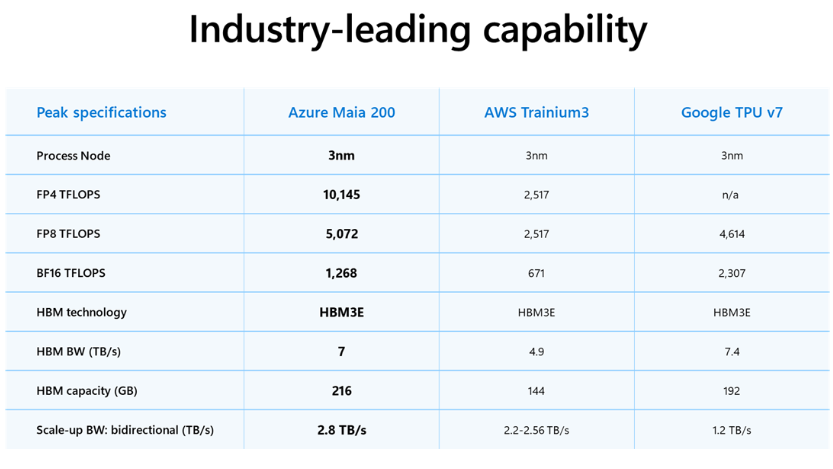
微软(MSFT.US)新一代自研AI芯片“Maia 200”出鞘! 推理狂潮席卷全球 属于AI ASIC的黄金时代到来
智通财经网· 2026-01-27 00:34
Core Viewpoint - Microsoft has launched its second-generation AI chip, Maia 200, aimed at providing a cost-effective alternative to NVIDIA's AI GPU series for cloud AI training and inference tasks [1][3]. Group 1: Product Launch and Specifications - The Maia 200 chip, manufactured by TSMC, is designed for high-performance AI inference tasks and is being deployed in Microsoft's AI data centers [1][3]. - The chip features over 1.4 trillion transistors and is built on a 3nm process, offering more than 10 petaFLOPS of performance at FP4 precision and over 5 petaFLOPS at FP8 precision, all within a power consumption of 750 watts [5][6]. - Maia 200's performance per dollar is reported to be 30% better than Microsoft's current hardware, and it outperforms Amazon's Trainium by three times in FP4 performance [5][8]. Group 2: Competitive Landscape - The launch of Maia 200 positions Microsoft as a strong competitor against Amazon's Trainium and Google's TPU, with claims of superior performance in AI inference tasks [3][4]. - Major chip design companies like Marvell and Broadcom are increasingly focusing on developing custom AI ASIC solutions for cloud giants, indicating a competitive shift in the industry [2]. Group 3: Strategic Importance - The development of Maia 200 reflects Microsoft's serious commitment to in-house chip engineering, driven by the growing energy demands of large AI data centers and the need for cost-effective solutions [9]. - The AI ASIC technology route is becoming crucial for major tech companies, as they aim to enhance the cost-effectiveness and energy efficiency of their AI computing systems [10][11].
前瞻全球产业早报:广东经济总量连续37年全国第一
Qian Zhan Wang· 2026-01-26 23:20
Group 1 - The Ministry of Commerce will initiate the construction of a national digital trade demonstration zone and develop relevant standards for digital trade [2] - The goal is to promote the integration of domestic and international standards, facilitate the digital transformation of service outsourcing, and cultivate digital trade entities [2] Group 2 - In 2025, China's total service retail sales are expected to grow by 5.5%, with sectors like cultural and recreational services, tourism consulting, and transportation showing double-digit growth [3] Group 3 - Guangdong's GDP for 2025 is projected to reach 14.58 trillion yuan, marking a 3.9% growth and maintaining its position as the top economy in China for 37 consecutive years [4] - Various economic indicators in Guangdong, including foreign trade and investment, are showing positive performance [4] Group 4 - A new mandatory national standard for automotive steering systems will be implemented starting July 1, aimed at clarifying technical requirements and testing methods for steering systems, including new technologies like steer-by-wire [5] Group 5 - The Chinese潮玩 (trendy toy) industry is expected to exceed 100 billion yuan in total value by 2026, with an annual growth rate of over 20% [7] Group 6 - By the end of 2025, the number of new energy vehicles in China is projected to reach 43.97 million, accounting for 12.01% of the total vehicle population, with pure electric vehicles making up 68.74% of that figure [8] Group 7 - Tencent's chairman, Ma Huateng, announced the upcoming launch of an AI social feature called "Yuanbao Pai," aimed at enhancing social interactions through AI technology [9] Group 8 - KFC has announced a slight price increase of 0.8 yuan on delivery products starting January 26, while maintaining in-store prices, to better manage operational costs [10] Group 9 - Xi Bei's founder, Jia Guolong, plans to return to frontline operations and focus on core business, expecting a cumulative loss of over 600 million yuan from September 2025 to March 2026 [11] Group 10 - Merck has ceased negotiations to acquire Revolution Medicines, which was valued at approximately 30 billion yuan, due to disagreements on pricing [18]


腾讯研究院AI速递 20260127
腾讯研究院· 2026-01-26 16:03
Group 1: Tencent's Innovations - Tencent launched the Mix Yuan 3.0 model with 80 billion parameters, utilizing MoE architecture for image editing and multi-image fusion, now available on Yuanbao and Mix Yuan official websites [1] - The model exhibits "thinking" capabilities, understanding content before reasoning for editing steps, enabling functions like adding, deleting, modifying, style changes, and old photo restoration [1] - Users can create memes, virtual character collaborations, and e-commerce poster designs, trained on millions of data points covering over 80 tasks [1] Group 2: Yuanbao's Social AI Features - Yuanbao initiated the internal testing of "Yuanbao Club," allowing users to create or join groups and interact with AI for chat summaries and interest tracking [2] - The platform will integrate Tencent Meeting's audio and video capabilities, supporting features like "watch together" and "listen together," with AI available for queries [2] - Tencent announced a 1 billion cash red envelope promotion for the Spring Festival, potentially reviving the popularity of WeChat red envelopes and encouraging users to transition from "single-player AI" to "social AI" [2] Group 3: Clawdbot and Open Source Developments - Clawdbot, an open-source project created by Peter Steinberger, can run locally and integrate with tools like WhatsApp, Telegram, and GitHub, receiving over 30,000 stars on GitHub [3] - MiniMax M2.1 serves as the core engine, demonstrating excellent performance in tool invocation at a low cost, enabling developers to implement complex workflows like car price comparison and email processing [3] - Users praise M2.1 for its remarkable "cost-performance ratio," allowing continuous operation of a super-intelligent workflow for just $10 per month [3] Group 4: Advances in AI Interaction - iFlytek's Starry Sky Intelligent Agent platform announced a major upgrade, fully integrating with the AIUI open platform for rapid customization of voice tones through natural language [4] - The upgrade enhances multimodal hyper-human interaction capabilities, allowing for voice replication and digital avatar creation from a single photo, with automatic expression and action generation [4] - RPA digital employees have upgraded intelligent components to assist with web automation and visual data processing, enabling non-programmers to quickly orchestrate automated workflows [4] Group 5: Insights from Toco AI - Toco AI, founded by former NetEase Cloud Music CTO, aims to introduce modeling methodologies into AI coding, addressing architecture and maintainability challenges [7] - The founder believes that standardized code will become less important, emphasizing the significance of business description, understanding, and long-term planning in the AI era [7] - Toco is positioned to redefine UML with an AI-native approach, embedding architect capabilities suitable for new projects and system restructuring, aiming to become an industry standard like Spring for Java [7] Group 6: Strategic Directions from Jiyue - Jiyue's new chairman, Yin Qi, focuses on foundational model development and terminal commercialization, dedicating over 80% of time to core product technology [8] - He asserts that AGI must interact with the physical world, identifying three core scenarios: individuals, transportation, and home, with vehicles as the primary entry point, ultimately leading to robotics [8] - Jiyue's 2026 strategy emphasizes breakthroughs in foundational models, multimodal integration of text, voice, and images, and differentiated VLA capabilities for terminal execution devices [8] Group 7: AI in Aerospace - The European Space Agency's FLPP program collaborates with German MT Aerospace to utilize AI-driven laser sensors for real-time defect detection, reducing carbon fiber tank weld analysis time by 95% [6] - NASA's Expedition 74 team tests AI-assisted tools for voice-to-text conversion, enhancing communication efficiency between crew members and ground control [6] - Research indicates that AI's "scientific autonomy" concept allows for real-time data analysis in extraterrestrial missions, though over-reliance on synthetic data may lead to "cognitive illusions" affecting reliability [6] Group 8: Palantir's Perspective on AI - Palantir's CEO critiques Silicon Valley's "dopamine economy" in his new work "Tech Republic," advocating a shift from consumer internet to "survival engineering," focusing on defense and energy sectors [11] - He argues that the strategic nature of AI prevents complete privatization, with the coupling of government and enterprise being a key variable in national competitiveness [11] - The article suggests using engineering thinking to combat corporate "spiritual hollowing," including clear objective functions, iterative cultural development, and retaining innovation redundancy [11]

后乔布斯时代结束了,这是库克的接班计划
创业邦· 2026-01-26 11:54
Core Viewpoint - The article discusses the significant management restructuring at Apple as Tim Cook approaches retirement, highlighting potential successors John Ternus and Craig Federighi, and the shift in Apple's focus from design-driven to product-driven and engineering-first strategies [4][39]. Group 1: Management Restructuring - Tim Cook, now 65, is considering retirement, prompting discussions about his succession [4]. - Apple has undergone its most significant management restructuring since Steve Jobs' death, with Ternus and Federighi frequently mentioned as potential successors [4]. - The design team has seen a fragmentation of responsibilities since Jony Ive's departure, leading to a lack of clear leadership and direction [7][10]. Group 2: John Ternus's Role - John Ternus has been given the title of "Executive Sponsor" for design, allowing him to bridge the gap between designers and executives, although he does not directly oversee design [13][14]. - Ternus, who has been with Apple since 2001, is seen as a strong candidate for CEO due to his engineering background and long tenure [15]. - The future of Apple under Ternus is expected to prioritize practicality and product output over design aesthetics, marking a shift from the previous design-centric approach [19][20]. Group 3: Craig Federighi's Role - Craig Federighi, now 58, has taken over the AI department, which has faced challenges in keeping pace with competitors in AI development [23][25]. - Federighi's previous skepticism towards AI has shifted, and he is now focused on integrating AI into Apple's products, including a partnership with Google for AI capabilities [28][29]. - His management style is characterized by cost control and pragmatism, which may lead to a more stable financial performance for Apple in the long run [32][37]. Group 4: Future of Apple - The combination of Ternus and Federighi represents a new leadership model for Apple, focusing on practicality and risk management rather than radical innovation [41][42]. - The article suggests that the era of transformative change at Apple may be over, with a focus on maintaining relevance in a rapidly changing tech landscape [42][45]. - The potential for a co-CEO model between Ternus and Federighi is discussed, indicating a collaborative approach to leadership moving forward [42].

智象未来创始人兼首席执行官梅涛入选2025 ACM Fellow
Ke Ji Ri Bao· 2026-01-26 08:15
Core Insights - The Association for Computing Machinery (ACM) announced the 2025 ACM Fellow list, with Mei Tao, founder and CEO of ZhiXiang Future, being selected for this prestigious honor [1] - Since its establishment in 2023, ZhiXiang Future has focused on key technologies such as multimodal alignment, cross-modal semantic understanding, and multimodal generative foundational models, driving breakthroughs in generative AI from algorithm innovation to industrial application [1] - In April 2025, ZhiXiang Future's self-developed open-source image generation model HiDream-I1 topped the international authoritative ranking Artificial Analysis within 24 hours [1] - In July 2025, the company's open-source image editing model HiDream-E1.1 ranked among the top tier in the Artificial Analysis image editing agent list [1] - ACM, founded in 1947, is an international professional organization for computer science, aiming to promote the development of computer science and information technology. The ACM Fellow is the highest honor awarded to members, selected through peer review, with a strict annual limit on the number of inductees [1] - This year, a total of 71 scholars from 14 different countries were inducted into the ACM Fellow program [1]
黄仁勋:无知是一种超能力,“没有终极目标” 成就了英伟达
Ge Long Hui· 2026-01-26 04:31
Core Insights - Huang Renxun, CEO of Nvidia, reflects on his 30+ years leading the AI chip giant, emphasizing the company's growth from adversity to becoming one of the most valuable tech companies globally [1] Group 1: Personal Reflections and Leadership Philosophy - Huang views "ignorance" as a superpower that allowed him to pursue entrepreneurship without being deterred by the challenges ahead [3][4] - He believes that the current generation of young people is overly exposed to information, leading to increased cynicism compared to his own generation [5] - Huang emphasizes that Nvidia's lack of a definitive long-term goal has been a strength, with the primary focus being on survival and operational continuity [6][7] Group 2: Company Culture and Resilience - The character of a company is forged in times of hardship, and Huang shares that he distributes the burden of challenges among his team rather than shielding them from difficulties [8] - He describes the role of a CEO as one filled with vulnerability, stating that they are often the most fragile members of the organization [9][11] - Huang highlights that Nvidia's decisive advantage lies not in technological superiority but in the culture developed through enduring challenges [13] Group 3: Market Position and Future Outlook - Nvidia has officially become TSMC's largest customer, surpassing Apple, which is a significant milestone for the company [15][17] - Huang asserts that the investments in AI will fundamentally change how computers operate, transitioning from human-programmed to self-learning systems guided by humans [18] - He predicts that while all job roles will evolve due to AI, the overall workload will increase rather than decrease, suggesting that AI could provide new opportunities for those currently unemployed [19][21] Group 4: Importance of the Chinese Market - Huang's recent visit to China underscores the significance of the Chinese market for Nvidia, especially in the context of AI and high-performance computing [27] - The U.S. government has allowed Nvidia to sell its H200 AI chips to China, subject to a 25% fee, highlighting the complexities of international trade and the importance of the Chinese market for Nvidia's growth [25][26][27]

快手-W(01024):可灵专题报告:全球 AIGC 视频商业化加速,可灵打通技术-生态-变现闭环释放长期价值
GUOTAI HAITONG SECURITIES· 2026-01-26 02:27
Investment Rating - The report assigns an "Accumulate" rating to Kuaishou-W with a target price of 104 HKD, based on a valuation of 15x PE for traditional business and 30x PS for Kuaishou's AI video model [2][11]. Core Insights - The report highlights the acceleration of AIGC (AI Generated Content) video commercialization, emphasizing Kuaishou's ability to integrate technology, ecosystem, and monetization to unlock long-term value [1][11]. - Kuaishou's revenue is projected to grow from 142 billion RMB in 2025 to 170 billion RMB by 2027, with adjusted net profit expected to increase from 20.6 billion RMB to 28.1 billion RMB during the same period [5][11]. - The global video streaming revenue is anticipated to reach 214.6 billion USD in 2025, with AI video penetration expected to contribute significantly to the total addressable market (TAM) of approximately 25 billion USD [27][11]. Summary by Sections 1. AIGC Video Generation Technology - AIGC is transitioning from a creative tool to a core productivity driver in the content industry, supported by advancements in deep learning and multimodal models [13][15]. - The demand for efficient content supply in industries like media, e-commerce, and advertising is driving the adoption of AIGC technologies [15][23]. 2. Competitive Landscape - The AIGC video generation market is entering a phase of differentiation among general models, vertical capabilities, and platform ecosystems [34][36]. - Kuaishou's Kling 2.5 Turbo ranks highly in performance and cost-effectiveness compared to competitors, showcasing its advantages in integrated audio-visual generation and understanding of the Chinese context [34][36]. 3. Kuaishou's Value Creation - Kuaishou has established a closed loop of technology, ecosystem, and monetization, with significant revenue growth from its AI video model, which reached an annualized revenue run rate of 240 million USD by December 2025 [11][44]. - The report notes that Kuaishou's AI model has generated over 600 million videos and collaborated with more than 30,000 enterprise users, indicating strong commercial potential [11][44]. 4. Financial Projections and Valuation - Kuaishou's financial forecasts indicate a steady revenue growth trajectory, with adjusted net profit expected to grow at a compound annual growth rate (CAGR) of 16% from 2025 to 2027 [5][11]. - The report suggests a conservative valuation approach, applying a 15x PE for traditional business and a 30x PS for the AI segment, reflecting the company's growth potential in the AIGC space [11][11].
