
碳达峰碳中和

Search documents
电新周报:算力与降碳合力驱动,全球电力源网共振,电新景气开新篇-20251109
SINOLINK SECURITIES· 2025-11-09 12:48
Investment Rating - The report maintains a positive investment outlook for the clean energy sector, particularly focusing on storage, wind, and solar energy [1][5][19]. Core Insights - The global electricity shortage narrative continues to evolve, driven by AI computing power demands and carbon reduction goals, which will collectively drive a significant cycle in clean energy and new grid construction over the next 3-5 years [1][5]. - Storage solutions are identified as critical for adapting to changes in power source structures and load characteristics, while green hydrogen and ammonia are seen as key pathways for carbon reduction in non-electric sectors [1][5]. - The report emphasizes the importance of top-level design documents in China, reinforcing the strategic direction for energy transition and carbon neutrality [6][7]. Summary by Relevant Sections Energy Storage - North America continues to experience electricity shortages, with a resonance between the Chinese and U.S. markets; the white paper on carbon peak and carbon neutrality in China further establishes the key role of storage [6][7]. - Tesla is expected to procure 30GWh of storage batteries from Samsung SDI, indicating a strong demand for storage solutions [8][9]. Lithium Battery - The price of lithium hexafluorophosphate (6F) continues to rise, with a notable increase of 4.19% in the average price of lithium iron phosphate batteries; the overall lithium battery supply chain remains optimistic [12][16]. - Tianqi Lithium announced significant orders totaling nearly 400 billion yuan for electrolyte products, indicating robust demand in the lithium battery sector [13]. Wind Energy - Wind turbine prices and volumes are exceeding expectations, with a focus on the profitability recovery of the turbine manufacturing segment; the report recommends key companies in this area [17][19]. - The government of Yancheng has released a green electricity direct connection plan, with a wind power capacity of 35.8GW planned, predominantly from offshore sources [20][21]. Solar Energy - The solar industry is experiencing a seasonal slowdown in production, but the decline is less than previously predicted; the report suggests bottom-fishing strategies in the solar sector, particularly in glass and low-cost silicon materials [23][24]. - The report highlights the potential for demand recovery in the solar market due to ongoing electricity shortages and domestic carbon reduction targets [23][26]. Hydrogen and Fuel Cells - The solid oxide fuel cell (SOFC) sector is experiencing unexpected growth, with new supply chain opportunities emerging; the report emphasizes the importance of green hydrogen and ammonia in future energy strategies [26][28]. - The report identifies a significant opportunity for green methanol production, driven by upcoming projects and the demand for green shipping fuel [27][28]. AIDC (Advanced Industrial Computing) - Major electrical giants are expanding their liquid cooling business through acquisitions, indicating a growing market for thermal management solutions in data centers [29][30].





央行,重磅来袭!
Zheng Quan Shi Bao· 2025-11-09 11:08
Macro Economic Data - The National Bureau of Statistics reported that in October, the Consumer Price Index (CPI) rose by 0.2% month-on-month and year-on-year, with the core CPI (excluding food and energy) increasing by 1.2%, marking the sixth consecutive month of growth [3] - The Producer Price Index (PPI) saw a month-on-month increase of 0.1%, the first rise this year, while the year-on-year decline narrowed to 2.1%, a reduction of 0.2 percentage points from the previous month [3] Foreign Exchange Reserves - As of the end of October 2025, China's foreign exchange reserves reached $3.3433 trillion, an increase of $4.7 billion from September, marking the highest level since December 2015 [4] - The official gold reserves increased by 30,000 ounces to 7.409 million ounces, the lowest growth rate since the resumption of accumulation in November 2024 [4] Financial Policies - The Ministry of Finance emphasized the need for a more proactive fiscal policy, focusing on boosting consumption and providing financial subsidies for personal loans in key sectors [8][7] - The China Securities Regulatory Commission announced new regulations for the management of the securities settlement risk fund, effective December 8, 2025, aimed at enhancing risk prevention and internal management [6] Industry Developments - The State Council issued an implementation opinion to accelerate the cultivation and application of new scenarios in various industries, focusing on five key areas and proposing 22 categories for development [9] - The white paper on "China's Actions on Carbon Peak and Carbon Neutrality" highlighted significant achievements in green and low-carbon transformation over the past five years [10] Semiconductor Industry - The Chinese government responded to the Netherlands regarding semiconductor supply chain stability, emphasizing the need for constructive actions to restore order in the global semiconductor supply chain [13] Upcoming Financial Data - The People's Bank of China is set to release financial data for October, with expectations of new social financing at 1.1 trillion yuan, a decrease of 200 billion yuan year-on-year [15] - The National Bureau of Statistics will announce industrial value-added, fixed asset investment, and retail sales data for October on November 14 [16] Oil Price Adjustments - A new round of domestic fuel price adjustments will take effect on November 10, with an expected increase of 130 yuan per ton based on the average crude oil price of $62.52 per barrel [17] Market Strategies - Citic Securities noted increased market volatility since October, attributing it to changes in the underlying structure of incremental capital, with a focus on the stability of the overseas environment for enterprises and the impact of AI on various sectors [18] - Guosen Securities highlighted the rise of silicon photonics technology, which is reshaping the investment focus within the optical module industry [19]
央行,重磅来袭!
证券时报· 2025-11-09 10:56
Macro Economic Data - The People's Bank of China will release financial data for October, including M2, new loans, and social financing [1][17] - The National Bureau of Statistics will announce October's industrial value added, fixed asset investment, and retail sales data on November 14 [3][18] - In October, the Consumer Price Index (CPI) rose by 0.2% month-on-month and year-on-year, while the core CPI (excluding food and energy) increased by 1.2% year-on-year, marking the sixth consecutive month of growth [4] - The Producer Price Index (PPI) saw a month-on-month increase of 0.1%, the first rise this year, while the year-on-year decline narrowed to 2.1% [4] Foreign Exchange and Reserves - As of the end of October, China's foreign exchange reserves reached $3.3433 trillion, an increase of $4.7 billion from September, marking the highest level since December 2015 [5] - The official gold reserves increased by 30,000 ounces to 7.409 million ounces, the lowest growth rate since the resumption of purchases in November 2024 [5] Policy Announcements - The Ministry of Commerce announced the suspension of certain export controls on dual-use items to the United States until November 27, 2026 [6] - The State Council issued an implementation opinion to accelerate the cultivation and application of new scenarios, focusing on five key areas and proposing 22 priority fields [10] Investment Strategies - CITIC Securities noted increased market volatility since October, emphasizing the importance of stable overseas environments and AI developments in investment strategies [21] - Guosen Securities highlighted the rise of silicon photonics technology, shifting investment focus from packaging to chip design and wafer manufacturing [21] - Guojin Securities pointed out that the lithium battery industry chain is experiencing unprecedented growth opportunities driven by technological breakthroughs and market demand [22]


【财联社早知道】国务院新闻办公室发布《碳达峰碳中和的中国行动》白皮书,要求推动源网荷储一体化发展,机构称AI驱动储能行业迎大发展
财联社· 2025-11-09 10:49
①国务院新闻办公室发布《碳达峰碳中和的中国行动》白皮书,要求推动源网荷储(电源、电网、负荷、 储能)一体化发展,机构称AI驱动储能行业迎来大发展,这家公司2025年上半年储能电芯出货量稳居全球 前九; ②力箭一号遥九运载火箭发射成功,机构称我国商业航天产业加速期已经到来,这家公司积极布 局"商业航天+卫星应用"产业化发展模式; ③这家公司签署战略合作共同开发部署总规模达1GWh的储能 项目。 今日复盘+明日前瞻,精选更有价值的投资资讯!财联社重磅推出《财联社早知道》栏目,每个交易日 复盘今日热点,前瞻明日市场,更有主力资金动向分析,一文汇总你关心的所有信息,帮助每一位"股 侠"精神饱满征战A股! 前言 ...

受益矿区绿色转型政策扶持 兆新股份领跑瓦斯利用新征程
Zheng Quan Shi Bao Wang· 2025-11-09 10:48
Core Viewpoint - The National Energy Administration has issued guidelines to promote the integration of coal and new energy, establishing a core path for green energy transition during the 14th Five-Year Plan period. Zhaoxin Co., Ltd. has announced a project for low-concentration gas recovery, aligning with national strategies and aiming to become a benchmark in the coal and new energy integration sector [1][2]. Policy and Industry Context - The dual national policies create a solid development moat for the low-concentration gas utilization industry. The guidelines emphasize "strengthening the full concentration utilization of coal mine gas" and "promoting deep integration of coal and new energy," incorporating green transformation of mining areas into the new energy system framework. The revised emission standards for coalbed methane complement the carbon peak and carbon neutrality action plan, focusing on clean and efficient coal utilization and control of non-CO2 greenhouse gases [1]. - The new policies provide robust support for addressing technological transformation and commercial closure challenges in the industry, establishing a development direction of "energy security + low-carbon transition" during the 14th Five-Year Plan period [1]. Company Strategy and Market Potential - Zhaoxin Co., Ltd. is pioneering a differentiated development path by focusing on the resource utilization of low-concentration gas in mining areas. The company has developed a three-dimensional collaborative model of "resource efficient recovery + energy utilization + carbon asset appreciation" through the Qianjiaying project, utilizing core technology for safe and harmless treatment of low-concentration gas and waste heat recovery [2]. - The low-concentration gas and new energy collaborative development is expected to enter a period of explosive growth. By 2025, the national processing demand is projected to reach 1.8 billion cubic meters, requiring approximately 100 new operational projects annually, which could generate over 5 billion yuan in market growth. The industry scale is expected to grow from 28 billion yuan in 2023 to 80 billion yuan by 2030, with a compound annual growth rate of 12% [2]. - Currently, wind-blown gas accounts for 81% of methane emissions from coal mines in China, but the utilization rate is below 10%, indicating a significant supply-demand gap and vast market potential for improvement [2]. Financial Performance and Competitive Advantage - Zhaoxin Co., Ltd. has established a robust competitive advantage through a mature profit model and forward-looking layout. The company has created a multi-revenue closed loop consisting of "treatment service fees + power/heat income + CCER carbon revenue," with the Qianjiaying project expected to achieve a capital return rate of 17%. The CCER could further enhance the internal rate of return (IRR) of the entire investment by over 3.5%, significantly improving the project's profitability and risk resilience [3].

国办发文,加快场景培育和开放推动新场景大规模应用|周末要闻速递
2 1 Shi Ji Jing Ji Bao Dao· 2025-11-09 09:26
要闻速递国办发文,加快场景培育和开放推动新场景大规模应用日前,国务院办公厅印发《关于加快场 景培育和开放推动新场景大规模应用的实施意见》,对相关工作作出部署。意见聚焦打造一批新领域新 赛道应用场景、建设一批产业转型升级的新业态应用场景、推出一批行业领域应用场景、创新社会治理 服务综合性应用场景、丰富民生领域应用场景等5方面,提出22类场景培育和开放重点领域。国家统计 局:10月份CPI同比上涨0.2%据国家统计局,2025年10月份,全国居民消费价格同比上涨0.2%。其中, 城市上涨0.3%,农村下降0.2%;食品价格下降2.9%,非食品价格上涨0.9%;消费品价格下降0.2%,服 务价格上涨0.8%。1—10月平均,全国居民消费价格比上年同期下降0.1%。10月份,全国居民消费价格 环比上涨0.2%。其中,城市上涨0.2%,农村上涨0.1%;食品价格上涨0.3%,非食品价格上涨0.2%;消 费品价格上涨0.2%,服务价格上涨0.2%。财政部:继续实施好提振消费专项行动财政部发布《2025年 上半年中国财政政策执行情况报告》提出,下一步,用好用足更加积极的财政政策。压实预算执行责任 链条,将提高资金使用效益和 ...
聚焦碳达峰碳中和的中国行动,ESG债券数量持续攀升
Huan Qiu Wang· 2025-11-09 01:09
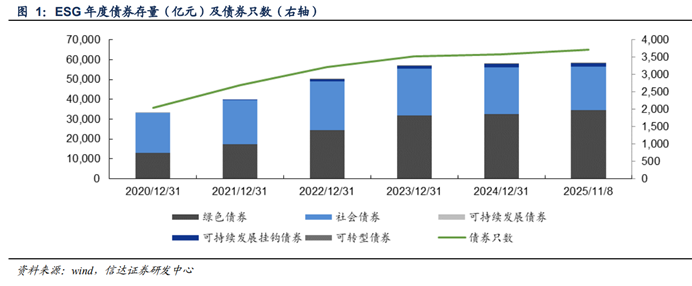
Group 1 - The white paper titled "China's Actions on Carbon Peak and Carbon Neutrality" was recently released by the State Council Information Office, outlining six key sections related to carbon neutrality efforts [1] - Significant achievements have been made in China's green and low-carbon energy transition, emphasizing the implementation of renewable energy and the establishment of a new energy system while ensuring energy security [1] - As of now, China has issued 3,725 ESG bonds, with a total outstanding amount of 5.61 trillion RMB, where green bonds account for the largest share at 61.80% [1] Group 2 - The market currently has 940 existing ESG products, with a total net value of 11,564.34 billion RMB, and ESG strategy products represent the largest share at 45.30% [3] - In the past year, 234 ESG public funds were issued, totaling 1,582.65 billion shares [3] - Major ESG indices have shown varying performance, with the CSI 300 ESG Leading Index outperforming the market, while others lagged behind, indicating mixed results in ESG investment performance [3]
重要数据,今日公布;下周一,巴菲特发声
Zhong Guo Zheng Quan Bao· 2025-11-09 00:38
Group 1: Economic Indicators - The National Bureau of Statistics released the Consumer Price Index (CPI) and Producer Price Index (PPI) data for October [1] - The CPI and PPI data are crucial for understanding inflation and production costs in the economy [1] Group 2: Semiconductor Industry - The Chinese Ministry of Commerce responded to the Netherlands' recent statements regarding ASML, emphasizing the need for concrete actions to stabilize the global semiconductor supply chain [1] - China has announced exemptions for certain exports to support the semiconductor supply chain, highlighting the responsibility of the Netherlands for current disruptions [1] Group 3: Carbon Neutrality Initiatives - The State Council Information Office published a white paper on China's actions towards carbon peak and carbon neutrality, outlining significant progress in energy transition and low-carbon development [2] - The white paper emphasizes the importance of renewable energy and energy efficiency in achieving carbon reduction goals [2] Group 4: REITs Performance - As of November 8, 63 public REITs have distributed dividends 133 times, totaling 8.639 billion yuan [2] - Some REITs experienced a decline in distributable amounts by over 10% year-on-year, while others saw increases exceeding 10% [2] Group 5: Mining Industry - A significant discovery of a super-large magnesium limestone deposit in Gansu Province was reported, with a resource volume exceeding 700 million tons [3] - The average magnesium oxide grade of the ore is 20.67%, indicating high-quality resources suitable for open-pit mining [3] Group 6: Tourism Development - Heilongjiang Province announced a winter tourism initiative aimed at increasing visitor numbers and total spending by over 10% and 15%, respectively, during the 2025-2026 winter season [4] Group 7: Corporate News - Berkshire Hathaway will release a statement from Warren Buffett on November 10, addressing charity and company matters, clarifying misinformation circulating on social media [5] - Zhaolong Interconnect reported progress in the construction and operation of its production base in Thailand, with ongoing development of smart manufacturing projects [5] - Lichung Group stated that its aluminum product pricing is linked to market prices, indicating resilience against raw material price fluctuations [5] - Yangjie Technology confirmed stable product pricing, reflecting a cautious pricing strategy based on various market factors [6] Group 8: Lithium Battery Industry - Guojin Securities highlighted unprecedented opportunities in the lithium battery industry driven by technological advancements and market demand, particularly in solid-state battery technology [7] - The explosive growth of the global energy storage market is expected to provide significant capacity for the lithium battery sector, creating a positive feedback loop for innovation and development [7]
新华财经早报:11月9日
Xin Hua Cai Jing· 2025-11-09 00:31
《碳达峰碳中和的中国行动》白皮书:中国能源绿色低碳转型取得显著成效重点降碳路径全面落地见效 商务部回应安世半导体问题:中方同意荷方派员来华磋商请求 美国食品救济金"断供风波"升级最高法院介入:暂停全额发放食品救济金 国务院新闻办公室8日发布的《碳达峰碳中和的中国行动》白皮书显示,中国能源绿色低碳转型取得显著成效。白皮书指出,中国立足基本国情和发展阶 段,在保障能源安全的前提下,大力实施可再生能源替代,推进新型能源体系和新型电力系统建设,为实现"双碳"目标提供有力支撑。白皮书强调,实现碳 达峰碳中和,是中国站在对人类文明负责的高度,基于实现可持续发展的内在要求作出的重大决策部署。作出碳达峰碳中和重大宣示五年来,中国牢固树立 和践行绿水青山就是金山银山的理念,采取有力行动、付出艰苦努力,推动绿色低碳转型取得历史性成就。(新华社) 商务部新闻发言人就安世半导体问题答记者问。有记者问:近日,荷兰经济大臣卡雷曼斯在个人社交媒体账户发布关于安世半导体问题的声明,请问商务部 对此有何评论?商务部新闻发言人表示,中方注意到荷兰经济大臣卡雷曼斯于11月6日发表的声明,但截至目前尚未见到荷方在停止侵害中国企业合法权益 和恢复全球 ...

新华时评丨推进碳达峰碳中和,中国是坚定的行动派
Xin Hua Wang· 2025-11-09 00:18
新华社北京11月8日电 题:推进碳达峰碳中和,中国是坚定的行动派 新华社记者魏玉坤 国务院新闻办公室8日发布的《碳达峰碳中和的中国行动》白皮书显示,作出碳达峰碳中和重大宣示五 年来,中国推动绿色低碳转型取得历史性成就,探索出一条发展中国家绿色低碳发展的有效路径。推进 碳达峰碳中和,中国始终是坚定的行动派和重要的贡献者。 绿色发展是中国式现代化的鲜明底色。推进碳达峰碳中和,意味着中国作为世界上最大的发展中国家, 将完成全球最高碳排放强度降幅,用全球历史上最短的时间实现从碳达峰到碳中和。这是用实际行动践 行多边主义,展现了中国共建清洁美丽世界的坚定决心。 推进碳达峰碳中和,中国一直在努力。中国将碳达峰碳中和作为国家战略,广泛深入开展碳达峰行动, 深入推进重点领域低碳发展,构建了全球最系统完备的碳减排政策体系,建成了全球最大、发展最快的 可再生能源体系,形成了全球最大、最完整的新能源产业链,贡献了全球约四分之一的新增绿化面积, 成为全球能耗强度下降最快的国家之一。 地球是人类赖以生存的家园,应对气候变化、推动可持续发展关系人类前途和未来。过去五年,中国以 碳达峰碳中和为牵引,协同推进降碳、减污、扩绿、增长,深度参与 ...