
绿色经济

Search documents
【金工】TMT主题产品净值表现占优,被动资金减仓科技板块ETF——基金市场与ESG产品周报20250915(祁嫣然/马元心)
光大证券研究· 2025-09-15 23:04
Market Performance Overview - The domestic equity market indices generally rose during the week of September 8 to September 12, 2025, with the CSI 500 increasing by 3.38%, while the bond market experienced a pullback [4] - The electronic, real estate, and agriculture sectors saw the highest gains, whereas the comprehensive, banking, and oil & petrochemical sectors faced the largest declines [4] Fund Product Issuance - A total of 40 new funds were established this week, with a combined issuance of 21.794 billion units. This included 18 equity funds, 13 mixed funds, 6 bond funds, and 3 FOF funds [5] - Overall, 55 new funds were issued across the market, categorized as 21 bond funds, 16 equity funds, 13 mixed funds, 3 FOF funds, 1 REIT, and 1 international (QDII) fund [5] Fund Performance Tracking - Most industry-themed funds, except for the pharmaceutical sector, saw net asset value increases, with TMT-themed funds showing significant gains of 4.63% [6] - The median net asset value change for passive index funds was 1.91%, with chip, information technology, and electronic ETFs performing particularly well [6] ETF Market Tracking - Domestic stock ETFs experienced continued net outflows, particularly in broad-based themes like the STAR Market, while financial real estate and new energy sector ETFs saw significant net inflows [7] - The median return for stock ETFs was 1.93%, with a net outflow of 4.352 billion yuan, while Hong Kong stock ETFs had a median return of 3.09% and a net inflow of 21.168 billion yuan [7] Fund Positioning Monitoring - The estimated positioning of actively managed equity funds increased by 0.3 percentage points compared to the previous week, with increased allocations to non-ferrous metals, basic chemicals, and telecommunications [9] - Conversely, sectors such as pharmaceuticals, national defense, and electronics saw reductions in funding [9] ESG Financial Products Tracking - This week, 23 new green bonds were issued, totaling 17.202 billion yuan, contributing to a cumulative issuance of 4.78 trillion yuan across 4,119 green bonds [10] - The median net asset value changes for ESG funds were 2.10% for actively managed equity funds, 0.94% for passive index funds, and -0.08% for bond funds, with green and low-carbon economy funds performing notably well [10]


解读北京“十四五”成绩单,市发改委回答八大关键问题
Xin Jing Bao· 2025-09-15 11:17
Economic Resilience and Growth - Beijing's economy has shown resilience and potential for stable growth despite previous disruptions from the pandemic, with a focus on digital and green economy initiatives [2][3] - The information service industry has become the largest pillar of Beijing's economy, with an added value exceeding 1 trillion yuan, while the financial sector's asset scale surpasses 220 trillion yuan, accounting for about half of the national total [2] - By 2025, total market consumption in Beijing is expected to exceed 3 trillion yuan, with fixed asset investment projected to surpass 1 trillion yuan [2] Technological Development - Beijing is enhancing its innovation ecosystem, with significant investments in national laboratories and collaborations with over 92 universities and 1,000 research institutions [4] - The information service, technology service, and advanced manufacturing sectors are projected to increase their GDP contribution from 32.7% in 2020 to 38.8% by 2024 [4] - The city is home to over 2,400 AI companies, making it a leading hub for artificial intelligence in China [5] Social Welfare and Public Services - Public service spending in Beijing has increased at a rate higher than general public budget revenue, focusing on enhancing citizens' sense of well-being and security [6] - The city has achieved full coverage of public cultural facilities, with a significant increase in museum visits and sports participation rates [6][7] - Healthcare access has improved, with a notable increase in medical facilities and services in suburban areas [7] Green Development - Beijing is committed to ecological and green development, with energy consumption per unit of GDP at 0.163 tons of standard coal, and nearly 30% of electricity coming from renewable sources [8] - The city has seen significant improvements in air quality, with a nearly 70% reduction in annual average concentrations of fine particulate matter over the past decade [8] - The number of electric vehicles has surged to over 1.19 million, nearly tripling since the end of the 13th Five-Year Plan [8] Rural Revitalization - Rural residents' disposable income is projected to reach nearly 40,000 yuan by 2024, growing faster than urban residents' income [9] - The introduction of high-throughput crop breeding technology has significantly reduced breeding time, enhancing agricultural productivity [9][10] - The implementation of the "Hundred Thousand Project" has led to increased collective income in demonstration villages, with rural tourism revenue exceeding 3.5 billion yuan [9] Economic System Reform - Beijing has implemented reforms to facilitate market access and promote investment, including the establishment of a regulatory sandbox for the AI sector [12] - The city has seen a significant increase in private enterprise participation in major projects, with private sector exports rising from 225.1 billion yuan in 2020 to 435.3 billion yuan in 2024, marking a 93.4% increase [12][13] - The establishment of the Beijing Service brand has improved the business environment, addressing nearly one million enterprise requests [13] Urban Development and Infrastructure - The development of new urban areas has improved economic capacity and public services, with significant investments in transportation and healthcare facilities [14][15] - The construction of new educational institutions and healthcare facilities is underway to enhance service quality in emerging urban areas [15] - The integration of urban and rural development has been emphasized, with collaborative efforts between Beijing and surrounding regions to enhance economic and social outcomes [16][17]
“十四五”期间,北京三大支柱行业支撑有力
Xin Jing Bao· 2025-09-15 06:03
新京报讯(记者周怀宗)9月15日,北京市召开"十四五"时期经济社会发展成就发布会。记者从发布会上 获悉,北京市先后启动数字经济和绿色经济标杆城市建设,形成"双标杆引领、双引擎驱动",为优势产 业发展提供了强劲动能。 北京市发改委相关负责人介绍,信息服务业、金融业、制造业是北京国民经济前三大支柱。其中,信息 服务业增加值突破万亿、成为全市第一大支柱产业,规模稳居全国首位,自启动全球数字经济标杆城市 建设以来,信息服务业保持了每年至少跨越一个千亿级台阶的速度。金融业资产规模超220万亿元、约 占全国的一半。制造业中,集成电路、新能源汽车等165个重大产业项目落地显效,2024年集成电路产 量较2020年增长51.2%,汽车市场增量部分的新能源渗透率超过50%。 ...
2025年服贸会“全球绿色经济发展论坛”热议SDGs实现路径
Zhong Guo Jing Ji Wang· 2025-09-15 05:57
Group 1 - The "Global Green Economy Development Forum" was held on September 12, 2025, with over 300 participants including officials from the UN, EU, and diplomats from 10 countries, focusing on green economy innovation and global cooperation to achieve the UN's 2030 Sustainable Development Goals (SDGs) [1][2] - The forum discussed four main topics: "SDGs and Green Economy," "Green Trade and Carbon Footprint," "Green Innovation and Industrial Transformation," and "Zero Carbon Park Construction and Development," aiming to build consensus on green innovation and cooperation [1] - The establishment of the "UN Sustainable Development Goals Green Economy Solutions Ecological Partnership Alliance" was announced, along with the release of the "2025 Green Development Report" and four other research outcomes to guide global green economic development [3] Group 2 - The UN's 2030 Sustainable Development Agenda has only five years left, urging immediate action from the international community, with China recognized for its achievements in green economy and AI [2] - The Beijing government aims to create an international green economy benchmark city, focusing on green technology, industry cultivation, industrial transformation, and a favorable policy environment [2] - The importance of ESG principles and frameworks was emphasized, with a call for a scientific, Chinese-characteristic, and internationally aligned ESG evaluation system to promote collaborative governance [2]
为维护国际多边贸易秩序贡献力量——写在第22届中国—东盟博览会、中国—东盟商务与投资峰会开幕之际
Jing Ji Ri Bao· 2025-09-15 04:18
Group 1 - The 22nd China-ASEAN Expo and China-ASEAN Business and Investment Summit will focus on "Digital Intelligence Empowering Development, Innovation Leading the Future," aiming to enhance regional economic integration [1] - The Aidiankou Port in Ningming, Chongzuo City, has seen significant growth in trade, with a total cargo volume of 1.2971 million tons and a total value of 77.423 billion yuan, marking year-on-year increases of 137.61% and 150.84% respectively [1] - The implementation of "24/7 appointment + on-demand inspection" services at the Aidiankou Port has streamlined customs processes, ensuring zero delays for fresh product clearance [1] Group 2 - The Expo and Summit have attracted over 1.3 million business visitors and hosted more than 200 trade activities, significantly enhancing economic cooperation [2] - In the first seven months of this year, trade between China and ASEAN reached 597 billion dollars, a year-on-year increase of 8.2%, with China maintaining its position as ASEAN's largest trading partner for 16 consecutive years [2] - The cumulative bilateral investment between China and ASEAN has exceeded 450 billion dollars, driven by significant projects like the "Two Countries, Twin Parks" initiative and the SAIC-GM-Wuling manufacturing base in Indonesia [2] Group 3 - The Expo will feature a dedicated 10,000 square meter artificial intelligence pavilion and will host the China-ASEAN AI Ministerial Meeting, enhancing collaboration in key sectors [3] - The Summit will implement five AI empowerment actions to facilitate high-level dialogues and international cooperation, focusing on deepening collaboration in artificial intelligence between China and ASEAN [3] - The upcoming events aim to counter unilateralism and protectionism, reinforcing the importance of free trade and multilateral trade systems in building a closer China-ASEAN community [3]
项昊宇:东亚区域经济发展呼唤新型“雁群模式”
Huan Qiu Wang· 2025-09-14 22:58
Core Insights - The East Asian regional cooperation is at a critical juncture, facing challenges from de-globalization, technological competition, and geopolitical tensions, necessitating a shift from the traditional "Flying Geese" model to an innovative "Flying Flock" model for economic resurgence [1][10] Group 1: The "Flying Geese" Model - The "Flying Geese" model, proposed by Japanese economist Akamatsu, describes a linear industrial transfer from advanced economies to lower-cost regions, characterized by vertical division of labor and export-driven growth [2][3] - This model has historically driven East Asia's economic miracle, but its foundational conditions have changed, leading to a lack of new "Little Dragons" and "Little Tigers" [2][3] Group 2: Changes in Economic Dynamics - China's rapid development has transformed East Asia's economic landscape, positioning it as a "leading goose" and disrupting the traditional gradient transfer model [3] - The global value chain is undergoing restructuring, with modular division of labor replacing complete industrial transfers, making it harder for latecomer countries to achieve comprehensive industrialization [3] - Revolutionary changes in technology paradigms, with digital and green economies emerging as new growth engines, require countries to build digital and green infrastructures to keep pace with development [3][4] Group 3: Geopolitical Impacts - Geopolitical tensions, particularly the U.S. push for economic decoupling from China, are reshaping global supply chains and disrupting the previously stable regional industrial division [4] Group 4: Lessons from the "Flying Geese" Model - Despite the decline of the "Flying Geese" model, its successful experiences can inform current strategies, emphasizing the need for East Asian economies to embrace openness and inclusivity against protectionism [5] - A new development framework, termed the "multi-core innovation collaborative network," is proposed, moving away from a linear model to a decentralized structure with multiple core nodes [5][6] Group 5: Implementation of the New Model - To realize the new "Flying Flock" model, regional cooperation is essential, including upgrading trade agreements like RCEP, investing in new infrastructure, and establishing regional innovation funds [8][9] - Countries must actively engage in regional governance, with China playing a pivotal role as a network hub, while developed economies like Japan and South Korea should act as key nodes to facilitate regional industrial upgrades [9] Group 6: Political Consensus and Cooperation - The advancement of East Asian regional cooperation is not solely an economic issue; it also requires rebuilding political consensus and cooperation to counteract the resurgence of Cold War mentalities [10]
为维护国际多边贸易秩序贡献力量 ——写在第22届中国—东盟博览会、中国—东盟商务与投资峰会开幕之际
Jing Ji Ri Bao· 2025-09-14 22:39
贸易自由化与便利化是区域经济一体化的核心要义。依托东博会、峰会形成的"南宁渠道",各方加强沟 通协调,在海关通关、检验检疫、物流运输等环节简化流程,提高了物流通关效率。 同时,东博会、峰会积极搭建贸易促进平台,为企业提供了大量商机。据统计,21年来,东博会吸引了 130多万名客商参展参会,持续提升经贸合作水平;峰会框架下举办200多场商界经贸活动,推动了一批 重大项目合作。 金秋时节,广西南宁迎来四海宾朋。将于9月17日开幕的第22届中国—东盟博览会和中国—东盟商务与 投资峰会,聚焦"数智赋能发展,创新引领未来——以中国—东盟自贸区3.0版新机遇助建命运共同 体"主题,将为区域经济一体化发展注入更多确定性因素。 "第22届东博会将举办中国—东盟经贸合作对话活动,引导企业围绕中国—东盟自贸区3.0版涵盖的数字 经济、绿色经济等重点领域加强对接合作。"中国—东盟博览会秘书处秘书长韦朝晖说。 在南宁迎接东博会、峰会时,距南宁市200余公里的崇左市宁明爱店口岸也是一派繁忙。货车队伍首尾 相接,车厢周围散发着榴莲、山竹等水果的香气。去年10月,爱店口岸进境水果指定监管场地启用后, 为越南水果便捷进入中国市场打通了重要通 ...
国际观察|数智服贸 互惠共赢——中国高水平对外开放为全球服务贸易描绘新图景
Xin Hua She· 2025-09-14 13:48
Core Insights - The China International Fair for Trade in Services (CIFTIS) emphasizes the importance of service trade in the global economy, showcasing China's commitment to high-level opening-up and international cooperation in service trade [1][5][7] Group 1: Event Overview - The 2025 CIFTIS in Beijing focuses on the theme "Digital Intelligence Leading, Service Trade Renewed," highlighting the broad cooperation prospects, deep innovation, and high openness perceived by international participants [1] - The event serves as a platform for enhancing international service trade cooperation networks amid pressures on goods trade growth [1][5] Group 2: Global Service Trade Trends - The global digital service trade is projected to reach $4.64 trillion in 2024, with an annual growth rate of 8.3%, indicating a continuous expansion of service trade [2] - The CIFTIS has become a key international platform for policy exchange and innovation cooperation in the service economy, reflecting China's determination to strengthen international service trade [3][5] Group 3: Technological Empowerment - China is accelerating the development of digital service trade and new business models like "AI + service trade," injecting new vitality into global service trade through technological empowerment and innovation [4][5] - The integration of digital technologies such as AI, 5G, and big data is transforming production and lifestyle, showcasing China's leadership in high-value service trade [4][5] Group 4: International Cooperation - China is fostering an inclusive, efficient, and sustainable global digital service trade ecosystem by building digital infrastructure and promoting digital finance and payment ecosystems [5][6] - The continuous hosting of CIFTIS is seen as a means to expand global economic relations and provide opportunities for emerging economies, particularly in AI technology [5][6] Group 5: Contribution to Global Economy - China's robust service trade development is viewed as a solution to structural challenges in the global economy, promoting a more open, inclusive, and balanced economic globalization [7]
2025年服贸会落幕:达成900余项成果,超25万人次入场
Xin Jing Bao· 2025-09-14 10:40
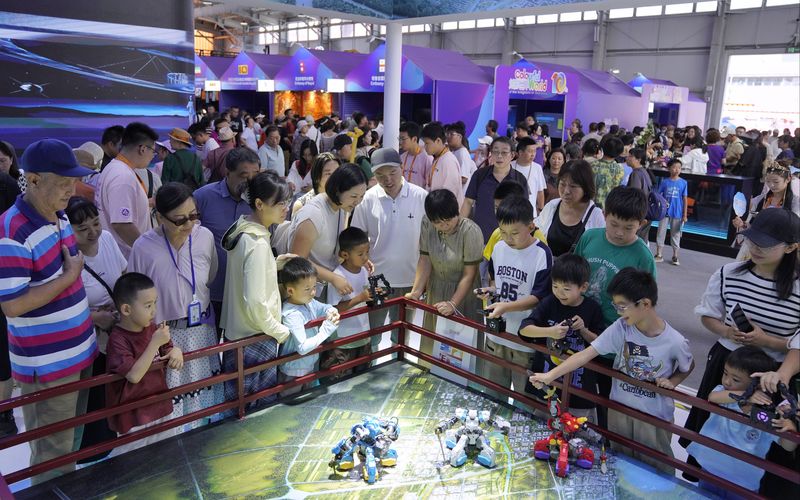
Core Insights - The 2025 China International Service Trade Fair (CIFTIS) concluded on September 14, showcasing a focus on digitalization, intelligence, and sustainability, with participation from nearly 2,000 companies and over 5600 online exhibitors, attracting more than 250,000 attendees and achieving over 900 results in various sectors [1][3][15] Group 1: Event Overview - The event was held at the Shougang Park for the first time, emphasizing a unified venue approach [1] - The theme "Digital Intelligence Leading, Service Trade Renewed" highlighted key trends in the service trade industry [1] - The fair saw participation from nearly 800 international guests from over 30 countries, enhancing its global engagement [3] Group 2: Participation and Exhibitors - Over 480 Fortune 500 and leading industry companies participated, accounting for more than 25% of exhibitors, surpassing previous years in both quantity and quality [3] - The event featured significant representation from various provinces and regions, with a focus on leading enterprises in quantum technology and artificial intelligence [3] Group 3: Innovations and Achievements - The fair showcased groundbreaking innovations such as the world's first photon counting CT and various smart healthcare products, demonstrating the vitality of technology-driven service development [3][7] - A total of 198 new achievements were released across sectors like artificial intelligence, fintech, and green technology [7] Group 4: Reports and Discussions - Key reports were published, including the China Service Trade Development Report and the Global Service Trade Inclusive Development Trend Report, providing insights into service trade trends [4][5] - Discussions among over 260 international leaders focused on e-commerce development, new service trade trends, and global green economy initiatives [4] Group 5: International Cooperation - Australia led the largest guest country delegation, facilitating 15 cooperation intentions in finance and education [9] - The event's digital platform facilitated over 3,000 project matches and nearly 8,500 business invitations, enhancing direct connections between clients and service providers [9] Group 6: Audience Engagement - The fair featured interactive experiences, including a "Food Passport" initiative that encouraged attendees to explore various culinary offerings while engaging with the event [11][10] - The use of AI and smart technologies improved visitor services, including real-time traffic monitoring and multilingual support [12]
数智服贸 互惠共赢——中国高水平对外开放为全球服务贸易描绘新图景
Xin Hua She· 2025-09-14 05:18
Core Viewpoint - The China International Service Trade Fair (CIFTIS) highlights the importance of service trade in the global economy, emphasizing cooperation, innovation, and high-level openness as key themes for future development [1][2][5]. Group 1: Importance of Service Trade - Service trade is increasingly vital in the global trade landscape, especially as goods trade faces challenges [1][2]. - The CIFTIS serves as a platform to expand international cooperation in service trade, responding to the global demand for high-quality service trade development [2][3]. Group 2: Digital and Intelligent Empowerment - China is accelerating the development of digital service trade and new business models like "AI + service trade," injecting new vitality into global service trade [4][5]. - The integration of digital technologies such as AI, 5G, and big data is transforming production and lifestyle, showcasing China's leadership in high-value service trade [4][5]. Group 3: Global Cooperation and Economic Growth - The CIFTIS promotes a collaborative approach to building an open world economy, contributing to global economic growth through service trade [5][7]. - China's commitment to open cooperation and technology transfer is crucial for maintaining an open international market and avoiding disruptions [6][7]. Group 4: Contributions to Global Service Trade - Over the past decade, China has made significant progress in reducing barriers to service trade, enhancing its role as a major contributor to global service trade [6][7]. - The continuous hosting of CIFTIS reflects China's determination to strengthen international service trade and cultivate new growth drivers globally [3][6].