光子计数CT

Search documents
GE HealthCare Technologies (NasdaqGS:GEHC) FY Conference Transcript
2026-03-10 13:02
Summary of GE HealthCare Technologies FY Conference Call Company Overview - **Company**: GE HealthCare Technologies (NasdaqGS:GEHC) - **Date of Conference**: March 10, 2026 Key Industry Insights - **Middle East Exposure**: - GE HealthCare's exposure to the Middle East is less than 5% of its overall business, indicating limited risk from regional disruptions [5][7] - The company is focused on ensuring safety and continuity of operations amidst regional conflicts [3][4] - **Oil Price Impact**: - The company is monitoring the implications of rising oil prices but has multiple levers to offset potential impacts, including pricing strategies and productivity initiatives [12][13] - Logistics costs are more affected by oil prices than the cost of goods sold, as the company does not have a significant resin component in its products [15] - **Tariff Management**: - Tariff expenses were approximately $250 million last year and are expected to decrease this year [18] - The company successfully mitigated initial tariff impacts from $1 billion to $250 million through strategic supply chain management [19] - Recent tariff changes, including the replacement of IEEPA tariffs with Section 122 tariffs, are expected to have similar financial impacts [20][21] Product and Innovation Highlights - **Product Launches**: - GE HealthCare has launched several innovative products, including: - **Vivid Pioneer**: A cardiovascular ultrasound device that reduces echocardiograph time and enhances image quality [34] - **Allia Moveo**: A next-generation X-ray machine for interventional procedures [35] - **LOGIQ R5**: A general ultrasound imaging device that significantly reduces scan time and clicks [36] - **Future Product Expectations**: - Anticipated launches of **total body PET** and **photon-counting CT** are expected to drive significant revenue growth, primarily in 2027 [40][41] - The company has a record backlog of $2 billion year-over-year, supporting its growth forecast of 3%-4% for the current year [32] Competitive Landscape - **Generic Competition**: - Amneal's entry into the market with a generic version of GE HealthCare's iohexol product is acknowledged, but the company remains confident in its market position due to consistency of supply, product quality, and brand recognition [28][29] Financial Outlook - **Growth Projections**: - The company expects a growth rate of 3%-4% driven by commercial initiatives and a strong product pipeline, with a focus on maintaining a resilient supply chain [30][32] - The impact of new product innovations is expected to be more pronounced in 2027, with some contributions anticipated in the latter half of 2026 [41][42] Conclusion - GE HealthCare Technologies is navigating current geopolitical and economic challenges while focusing on innovation and strategic supply chain management to sustain growth and mitigate risks. The company is well-positioned to leverage its product pipeline and market leadership in the medical devices sector.

1430亿!GE医疗公布2025全年业绩
思宇MedTech· 2026-02-06 04:58
Core Viewpoint - GE Healthcare's 2025 annual report shows revenue and earnings per share exceeding market expectations, with clear guidance for growth and profit recovery in 2026 despite macroeconomic challenges [1][2]. Annual Performance - In 2025, GE Healthcare achieved revenue of $20.6 billion (approximately ¥143 billion), a year-on-year increase of 4.8%, with organic revenue growth of 3.5% [3]. - The growth was supported by three core business segments, indicating a structural foundation rather than reliance on single products or short-term projects [4]. - The order performance is promising, with a backlog providing good visibility for 2026 [5][6]. Fourth Quarter Insights - In Q4 2025, GE Healthcare reported revenue of $5.7 billion, a 7.1% year-on-year increase, with organic growth of 4.8% [8]. - However, profit margins faced short-term pressure due to rising tariff costs and unfavorable product mix changes [9][10]. - The net profit margin was 10.3%, down 320 basis points year-on-year, while adjusted EBIT margin was 16.7%, down 200 basis points [11]. Profitability Analysis - The decline in profit margins is attributed to external factors rather than operational inefficiencies, with management emphasizing that excluding tariff impacts, profit margins were higher than in 2024 [14][15]. - This context supports GE Healthcare's guidance for a 50-80 basis point profit margin recovery in 2026 [16]. Regional and Demand Analysis - Growth in 2025 was primarily driven by the U.S. and EMEA markets, aligning with long-term healthcare system demands for imaging equipment upgrades and advanced diagnostic capabilities [17][18]. - GE Healthcare's diversified revenue streams provide stronger resilience against cyclical fluctuations [18]. Cash Flow and Capital Allocation - GE Healthcare maintained a solid cash flow position, with $4.5 billion in cash and $3.5 billion in available credit lines, allowing for ample space for acquisitions and long-term investments [22]. - The company announced plans to acquire Intelerad for $2.3 billion, enhancing its enterprise imaging capabilities [24]. Product and Innovation Strategy - In 2025, GE Healthcare focused on platform-based innovations rather than merely launching new products, emphasizing long-term value creation in imaging and diagnostics [25]. - The company reported operating cash flow of $2 billion and free cash flow of $1.5 billion, with a cash flow conversion rate of 95% [26]. 2026 Guidance - GE Healthcare's guidance for 2026 indicates a focus on profit recovery and cash flow improvement while maintaining steady revenue growth [30]. - The company aims for organic revenue growth of 3%-4%, adjusted EBIT margin of 15.8%-16.1%, and adjusted EPS of $4.95-$5.15 [31].


2025年辽宁医药制造业增加值增长4.1% 迎发展机遇
Zhong Guo Xin Wen Wang· 2026-02-02 07:48
Core Insights - The meeting highlighted significant advancements in Liaoning's pharmaceutical innovation and quality, with the province's pharmaceutical manufacturing value-added growth at 4.1%, surpassing both the provincial and national averages [1] - The internationalization of China's pharmaceuticals is accelerating, with projections indicating that by 2025, innovative drug licensing transactions will exceed $135 billion [1] - The pharmaceutical industry in Liaoning is positioned to support national strategies and improve public welfare while seizing opportunities for transformation and development [1] Summary by Sections Industry Development - Liaoning's pharmaceutical manufacturing value-added growth of 4.1% is notably higher than the provincial growth rate of 3.5% and the national rate of 1.7% [1] - The introduction of the first "Photon Counting CT" and the world's first "Cardiac Cryoablation Device" in Liaoning signifies a leap in medical technology [1] Regulatory Environment - The regulatory body aims to deepen reform, reduce burdens on enterprises, and stimulate innovation [1] - There is a commitment to strengthen legal frameworks to provide a fair and stable policy environment for businesses [1] Business Strategy - Liaoning's pharmaceutical companies are encouraged to focus on core competencies, innovate, and maintain integrity in operations to foster a fair market ecosystem [2] - Companies are urged to contribute to social welfare while pursuing high-quality development and achieving competitive advantages [2]
沈阳向新向优强动能
Xin Lang Cai Jing· 2026-01-26 22:08
Core Viewpoint - Shenyang aims for strategic emerging industries to account for 33.5% of the city's industrial output by 2025, marking a significant increase from previous years and indicating a shift towards innovation-driven economic growth [4][5]. Group 1: Economic Development and Industry Growth - The proportion of strategic emerging industries in Shenyang's industrial output has increased by 2.2 percentage points from the previous year and by 9.2 percentage points since 2020, surpassing the one-third threshold for the first time [5]. - Industrial technological transformation investment in Shenyang is projected to grow by 12.2% by 2025, with the number of technology-based enterprises exceeding 30,000 and "Four Up" enterprises surpassing 10,000 for the first time [5]. - Shenyang is focusing on nurturing new growth drivers while revitalizing traditional industries, aiming to build a resilient and secure modern industrial system [5][11]. Group 2: Technological Innovation and Product Development - Neusoft Medical has launched the first photon-counting CT in China and the world's first 8 cm wide-body photon-counting CT, positioning China as the third country to master this technology [8][10]. - The introduction of innovative products like the 1024-layer ultra-high-definition CT demonstrates Shenyang's commitment to technological advancement in the medical equipment sector [9][10]. - Shenyang's biopharmaceutical and medical equipment sectors are experiencing rapid growth, with companies focusing on innovation rather than price competition, leading to significant advancements in technology and product offerings [10]. Group 3: Strategic Industry Layout - Shenyang's industrial layout is defined by a "3+4+3" strategy, which includes optimizing traditional industries and nurturing four emerging sectors: aerospace, new-generation information technology, biomedicine, and new energy [11][12]. - The city is also focusing on future industries such as embodied intelligence, advanced materials, and deep-sea and deep-space equipment to secure a competitive edge [11][12]. Group 4: Policy Support and Economic Environment - New policies aimed at promoting digital economy development and reducing operational burdens for companies are set to take effect, enhancing the business environment in Shenyang [21][22]. - The "Intelligent Transformation and Digital Transition Action Plan" outlines measures to support manufacturing enterprises in their digital transformation efforts, with specific targets for 2027 [22][23]. - Shenyang is actively working to improve its investment environment and attract talent, aiming to create a city that is friendly to youth development and innovation [26].

医疗ETF(159828)涨超1%,行业进入创新兑现与全球布局的关键阶段
Mei Ri Jing Ji Xin Wen· 2026-01-08 07:04
Core Insights - The medical ETF (159828) has risen over 1%, indicating that the pharmaceutical and biotechnology industry is entering a critical phase of innovation realization and global expansion [1] - The industry is expected to experience a convergence of industrial, policy, and capital cycles by 2026, transitioning from "innovation narrative" to "value realization," which may lead to performance inflection points and valuation restructuring [1] Industry Trends - The next generation of innovative therapies, including ADCs, bispecific/multispecific antibodies, cell and gene therapies, and small nucleic acids, are highlighted as key areas of focus [1] - The impact of centralized procurement on medical devices is diminishing, with over half of the policy coverage achieved; the coverage rates for high-value consumables, low-value consumables, in vitro diagnostics, and medical equipment are 58%, 35%, 23%, and 3% respectively [1] - Domestic medical device companies are making breakthroughs in high-end fields such as photon-counting CT and aortic regurgitation valves, with rapid growth in exports expected (medical device exports are projected to grow by 7.3% year-on-year from January to November 2025) [1] Investment Recommendations - Companies that can quickly achieve volume growth through price adjustments post-centralized procurement, as well as those benefiting from equipment upgrades driving procurement growth, are recommended for attention [1] - The medical ETF tracks the CSI Medical Index (399989), which selects listed companies in medical devices, medical services, and medical information technology, reflecting the overall performance of the medical theme [2] - The index is characterized by high growth attributes and industry concentration, influenced by aging trends, consumption upgrades, and policy guidance [2]
创新破局 国产高端医疗器械崛起正当时
Xin Hua Wang· 2026-01-06 11:37
Core Insights - The article highlights the rise of domestic high-end medical devices in China, with a significant increase in innovation and production, supported by favorable policies and regulatory reforms [1][2][3] Industry Transformation - The high-end medical device industry in China is transitioning from reliance on imports to domestic production, with a focus on innovation and quality improvement [2][4] - The number of approved innovative medical devices reached 76 in 2025, maintaining a high level for three consecutive years, covering various advanced fields [1][2] Regulatory Support - The National Medical Products Administration (NMPA) has implemented reforms to streamline the approval process for innovative medical devices, enhancing efficiency and encouraging innovation [3][6] - Key measures include special reviews, priority approvals, and a focus on early-stage guidance for companies, which have significantly shortened the time from development to market [3][6] Breakthrough Innovations - Several notable products were approved in 2025, including a transcatheter aortic valve system and advanced imaging technologies, showcasing the capabilities of domestic companies to break import monopolies and achieve competitive technical standards [5][6] Market Integration - The improvement of the medical insurance system and procurement mechanisms has made high-end medical devices more accessible to grassroots hospitals, reducing costs and enhancing availability [6][7] - Since the 14th Five-Year Plan, 292 innovative medical devices have been approved, representing a 3.3-fold increase compared to the previous five-year period [6][7] Global Expansion - Chinese medical device exports accounted for approximately 8% of the global market in 2024, positioning China as the fourth-largest exporter [7] - Chinese companies are increasingly participating in international regulatory discussions and establishing overseas R&D centers, facilitating global market integration [7]
辽宁五一劳动奖表彰大会召开
Liao Ning Ri Bao· 2025-11-12 00:59
Core Points - The Liaoning May Day Labor Award ceremony was held on November 11, recognizing outstanding collectives and individuals in the province for their contributions to economic revitalization [1] - A total of 50 units, including Shenyang Yuanda Compressor Co., Ltd., received the Liaoning May Day Labor Award, while 400 workers, including Ma Chaoyang, were awarded the Liaoning May Day Labor Medal [1] - The event emphasized the importance of labor spirit and encouraged workers to actively participate in economic development and high-quality growth initiatives [1] Summary by Categories - **Recognition and Awards** - 50 units awarded the Liaoning May Day Labor Award, including Shenyang Yuanda Compressor Co., Ltd. [1] - 400 individuals awarded the Liaoning May Day Labor Medal, including Ma Chaoyang [1] - 50 collectives, such as the Neusoft Medical Photon Counting CT R&D team, received the Liaoning Worker Pioneer title [1] - **Call to Action** - Recognized collectives and individuals are urged to cherish their honors and continue their efforts [1] - Workers are encouraged to implement the decisions of the Central Committee and engage in economic construction [1] - Emphasis on overcoming challenges in major strategies, projects, and key industries to promote high-quality development [1] - **Leadership and Support** - Local party committees are called to enhance leadership over union activities and create favorable conditions for unions to fulfill their roles [1]
西门子医疗大中华区总裁王皓:从产品供应商到“价值合作伙伴”,在中国医疗产业的深刻变革中锚定新坐标
Cai Jing Wang· 2025-11-08 12:35
Core Viewpoint - Siemens Healthineers showcases its advanced technologies and strategic initiatives at the 8th China International Import Expo, emphasizing its commitment to local innovation and partnerships in the healthcare sector [1][11]. Group 1: Strategic Positioning - Siemens Healthineers maintains growth through a forward-looking strategy, focusing on "National Intelligence Innovation" and transitioning from a product provider to a value partner [2][5]. - The "National Intelligence Innovation" strategy emphasizes local production and innovation, with a goal of achieving full product line localization [4][11]. Group 2: Product and Innovation - The company has nearly achieved full localization of its product line, with plans for local mass production of photon counting CT devices by 2026 [4]. - Siemens Healthineers collaborates with local medical institutions to develop innovative solutions, creating a closed loop from clinical needs to product implementation [5][6]. Group 3: AI Integration - The company integrates AI deeply into its devices and clinical applications, showcasing advancements in AI-assisted diagnostics and imaging technologies at the expo [7][8]. - Siemens Healthineers aims to create an "automated driving" experience for imaging devices, enhancing efficiency and accuracy in clinical settings [8][10]. Group 4: Future Directions - The new five-year plan focuses on closer clinical integration, deeper collaboration, and sustainability, aiming to become a core partner in disease management and hospital administration [13]. - Siemens Healthineers is committed to fostering local innovation ecosystems and supporting the growth of domestic medical technology startups [12][11].


西门子医疗王皓:八年参展进博,以创新科技筑牢健康中国基石
2 1 Shi Ji Jing Ji Bao Dao· 2025-11-07 06:21
Core Insights - The China International Import Expo (CIIE) has evolved into a crucial platform for multinational companies to integrate into the Chinese market and share development opportunities since its inception in 2018 [1][14] - Siemens Healthineers has participated in the CIIE for eight consecutive years, showcasing its commitment to the Chinese market and emphasizing the importance of innovation and local collaboration [2][14] Company Strategy - Siemens Healthineers aims to combine global innovations with local clinical needs through its "National Intelligence Innovation" strategy, transitioning from global technology introduction to local innovation output [2][7] - The company has established a comprehensive medical ecosystem in China, focusing on R&D, production, clinical application, and patient care [7][8] Product Innovations - At this year's CIIE, Siemens Healthineers launched several groundbreaking products, including the new photon-counting CT family, which will enhance China's manufacturing capabilities in high-end medical equipment [3][4] - The ARTIS icono ceiling Xpand system significantly reduces imaging time in tumor interventions and stroke emergencies, improving clinical efficiency [6][12] Local Development - Siemens Healthineers has invested over 1 billion RMB in a new high-end medical equipment R&D and manufacturing base in Shenzhen, expected to triple its current scale by 2027 [7][8] - The company has localized over 130 products and filed more than 1,000 patents in China, demonstrating its commitment to local innovation [7][8] Market Potential - China is a key market for Siemens Healthineers, with a projected increase in the middle-income population from 400 million to 800 million over the next decade, driving demand for high-end medical services [12][14] - The company plans to focus on four core disease areas: cardiovascular diseases, cancer, neurodegenerative diseases, and stroke, aligning with national health strategies [12][13] Sustainability Efforts - Siemens Healthineers is committed to green and sustainable development, with initiatives like the DryCool technology that significantly reduces energy consumption and environmental impact [10][11] - The company aims for net-zero emissions by 2050 and is actively working on establishing green standards in the medical equipment industry [10][11]
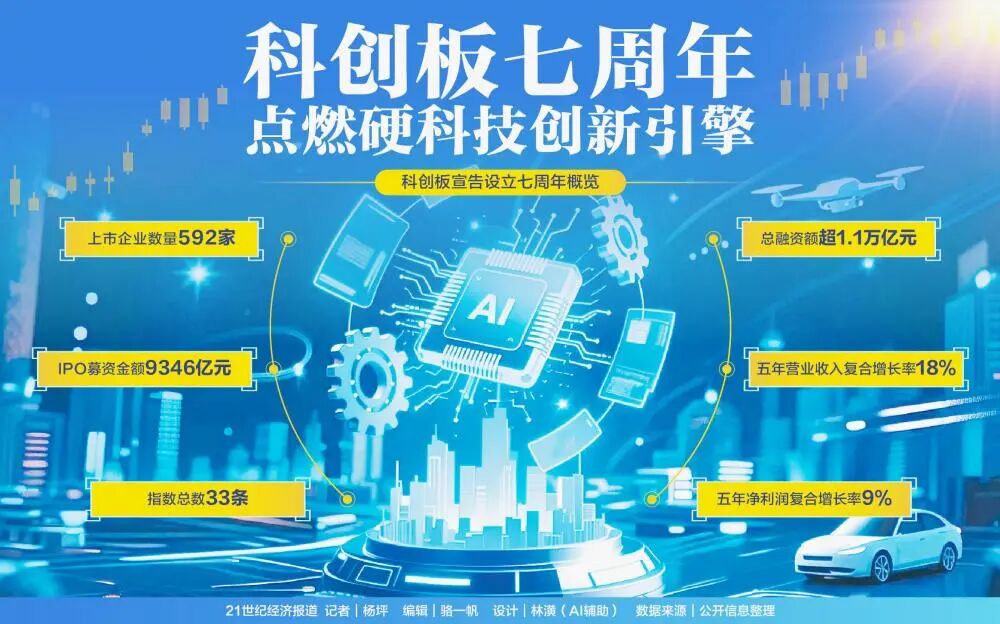
科创板累计IPO募资规模达9346亿
2 1 Shi Ji Jing Ji Bao Dao· 2025-11-06 08:15
Core Insights - The establishment of the Sci-Tech Innovation Board (STAR Market) has significantly enhanced China's capital market's ability to support technological innovation, with 592 listed companies and total fundraising exceeding 1.1 trillion yuan by October 2025 [1][3] - The STAR Market has demonstrated strong growth, with a compound annual growth rate (CAGR) of 18% in revenue and 9% in net profit for listed companies over the past five years [3][4] - The board has successfully fostered a vibrant ecosystem for hard technology, with over 80% of companies in emerging industries such as new-generation information technology and biomedicine [4][5] Company Performance - As of 2025, 22 out of 57 unprofitable companies listed on the STAR Market have achieved profitability, indicating a positive trend in financial performance [3] - The integrated circuit sector has over 120 listed companies, with revenue and net profit growth of 27% and 83% respectively in the first three quarters of 2025 [4] - In the biopharmaceutical sector, 21 out of 22 companies have received approval for 48 drugs/vaccines, contributing significantly to the innovation landscape [4] R&D Investment - The total R&D investment by STAR Market companies reached 1,680 billion yuan in 2024, more than three times their net profit [5] - In the first three quarters of 2025, R&D investment amounted to 1,133.45 billion yuan, a year-on-year increase of 9.01% [5] - The average number of invention patents per company on the STAR Market is 230, with 30% of companies having products or projects that are industry-first [5][6] Ecosystem Development - The STAR Market has created a virtuous cycle of "technology-industry-capital," enhancing the efficient allocation of innovative resources [7] - Over 60% of the founding teams of STAR Market companies consist of scientists or industry experts, fostering a strong innovation culture [7] - The market has seen a significant increase in cash dividend proposals, with a total of 38.8 billion yuan in dividends planned for 2024 [8] Institutional Innovation - The STAR Market has pioneered various institutional innovations, including diverse listing standards and mechanisms for rapid financing, which serve as a model for other markets [9] - Recent reforms have expanded the scope of the STAR Market to include more cutting-edge fields, enhancing its inclusivity [9] - The growth of the STAR Market's "growth layer" has accelerated, with companies showing revenue growth of 35.09% and a median R&D intensity of 44.34% [9] Future Outlook - The Shanghai Stock Exchange aims to further leverage the STAR Market as a testing ground for identifying high-quality tech companies, particularly in emerging fields like artificial intelligence and aerospace [10]