价值股

Search documents
华尔街迷失方向,过时数据仍有可能引爆市场恐慌?
Jin Shi Shu Ju· 2025-11-17 04:21
Group 1 - The upcoming economic data releases, particularly the September non-farm payroll report and CPI, are expected to create volatility in the stock market due to concerns over a weak job market and persistent inflation [1][2] - The delay in economic data release caused by the government shutdown may lead to market misinterpretation, with investors potentially focusing on negative trends rather than positive indicators [2][3] - Investors are currently shifting towards value stocks, moving away from high P/E growth stocks, which has led to the Dow Jones index reaching a historical high [4] Group 2 - The September non-farm employment report is anticipated to have less impact on the market compared to previous reports, as the November employment data will be released before the Federal Reserve's policy meeting [2] - The overall annual inflation rate has risen to 3%, raising concerns about future price increases, as indicated by the CPI report [3] - The recent market sell-off has led to uncertainty among investors regarding the short-term outlook and the next catalysts for market direction, especially with limited economic data available [4]
风格的巨轮继续滚动 - 2026年A股投资策略展望
2025-11-16 15:36
Summary of Key Points from the Conference Call Industry Overview - The report discusses the A-share market and its investment strategy outlook for 2026, highlighting a potential shift from growth to value investment styles around mid-2026 [1][2][3]. Core Insights and Arguments - **Market Style Shift**: A significant transition from growth to value investment styles is anticipated around June 2026, with growth stocks currently favored until then [2][16]. - **Performance of Key Indices**: Since September 2024, major indices like the Sci-Tech 50, North Exchange 50, and ChiNext have seen gains exceeding 100%, driven by sectors such as TMT, power equipment, and non-ferrous metals, benefiting from AI, new energy, and global demand growth [1][3]. - **Investment Focus**: Institutional investors are advised to focus on the rotation between growth and value styles rather than market capitalization. The current phase is characterized by a bull market in technology growth stocks [5][21]. - **Global and Domestic Factors**: The pricing of growth stocks is influenced by global interest rates and industry trends, while value stocks are more reliant on domestic pricing. Changes in the US dollar interest rates can significantly impact market dynamics [1][6][8]. - **Liquidity and Market Impact**: The flow of funds and liquidity conditions have a substantial effect on market performance. The phenomenon of "deposit migration" reflects how domestic investors react to foreign capital flows [9][10][12]. Important but Overlooked Content - **"Deposit Migration" Explained**: This phenomenon indicates a shift in asset allocation from real estate to the stock market, closely tied to global capital movements rather than just domestic savings trends [10][11]. - **Historical Context**: Past market behaviors during periods of strong industry trends but weak liquidity (e.g., 2009-2010) and strong trends with ample liquidity (e.g., 2019-2021) illustrate the complex interplay between liquidity and market performance [13][14]. - **PPI and Market Dynamics**: The Producer Price Index (PPI) turning positive is crucial for the market's transition from growth to value styles. The timeline for this transition is projected based on historical patterns [20][21]. - **Sector Focus for 2026**: The upcoming 15th Five-Year Plan is expected to drive significant trading activity in the first half of 2026, with potential adjustments in the second half [19][23]. Future Investment Strategy - **Key Investment Themes**: Emphasis on technology and safety, along with reform and growth, should guide investment decisions. Monitoring government reports and fiscal spending will be critical for identifying catalysts [24]. - **Market Outlook**: If no breakout applications emerge in the AI sector by mid-2026, a mid-term adjustment may occur, impacting stock prices significantly due to concentrated positions in AI-related stocks [18][24]. This summary encapsulates the essential insights and projections regarding the A-share market and investment strategies leading into 2026, emphasizing the importance of understanding market dynamics and sector performance.
高盛:日经指数暴涨30%跑赢美股,美资涌入速度创“安倍经济学”后之最
Zhi Tong Cai Jing· 2025-11-09 23:41
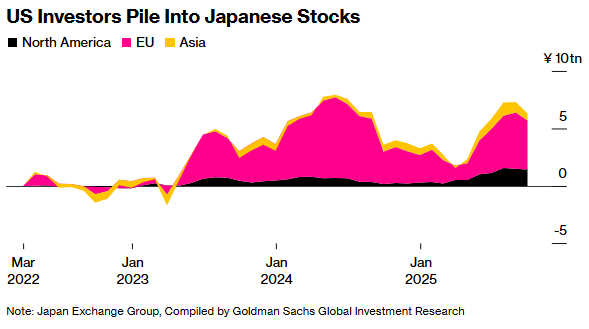
Core Insights - U.S. investors are increasingly buying Japanese stocks focused on technology and artificial intelligence due to high returns compared to U.S. markets [1] - The influx of U.S. funds into Japan has reached its fastest pace since the implementation of "Abenomics" [1] - The Nikkei 225 index has risen approximately 30% in U.S. dollar terms this year, significantly outperforming the S&P 500's 14% increase [1] Group 1 - The participation of U.S. investors in the Japanese stock market is at its highest level since October 2022, indicating a potential shift in market dynamics from value stocks to growth stocks [1] - The strong performance of the Japanese stock market is supported by a 2.5% appreciation of the yen and optimistic sentiment from Prime Minister Kishida's stimulus policies [1] - Foreign investors net purchased 384 billion yen (approximately $2.5 billion) of Japanese stocks in the last two weeks of October [3] Group 2 - There is still room for further inflow of foreign funds into Japanese stocks, as global investors' net holdings remain lower than the peak during the "Abenomics" era [3] - The ongoing demand for diversified investment from global investors may sustain the trend of increasing participation in the Japanese market [3] - The Nikkei index entered an overbought territory in late October, suggesting potential market consolidation [3]

成长股的疯牛,和价值股的慢牛,止盈技巧有什么区别?| 螺丝钉带你读书
银行螺丝钉· 2025-11-08 13:50
Core Viewpoint - The article discusses the characteristics and investment strategies associated with growth and value stocks, particularly in relation to their performance during bull and bear markets, as well as their lifecycle stages. Group 1: Growth and Value Stock Characteristics - Companies exhibit different growth and value characteristics based on their lifecycle stages [2] - Growth stocks tend to have high volatility and can experience significant price increases or decreases [8][9] - Value stocks generally show lower volatility and often follow a "slow bull" trend, with more stable and gradual price increases [5][6] Group 2: Market Behavior and Lifecycle Impact - The differences in price movement between growth and value stocks are linked to their lifecycle stages [14] - Growth stocks are typically in the early stages of their lifecycle, characterized by high potential for growth but also significant uncertainty [15][16] - Value stocks are usually in the later stages of their lifecycle, representing mature industries with stable financial metrics and lower growth potential [23][24] Group 3: Investment Strategies and Techniques - Investment strategies differ for growth and value stocks due to their distinct price behaviors [30] - For growth stocks, investors should be prepared for high volatility and should take profits when stocks become overvalued to avoid significant losses in bear markets [31] - Value stocks require less active management regarding profit-taking, as they tend to have stable valuations and can be held for dividends over the long term [32][33]

Why CarMax Plunged in September
Yahoo Finance· 2025-10-08 20:00
Core Insights - CarMax shares fell 26.9% in September, significantly underperforming the market [1] - The company reported disappointing earnings, with a revenue decline of 6% to $6.59 billion and a 24.7% drop in earnings per share to $0.64, both missing analyst expectations [3] - Management is implementing cost-cutting measures aiming for $150 million in reductions over the next 18 months and launched a new marketing campaign to enhance competitiveness [4][5] Financial Performance - CarMax's second quarter results showed a revenue decline of 6% to $6.59 billion and earnings per share down 24.7% to $0.64, both figures falling short of expectations [3] - The stock is currently trading at 14 times this year's earnings estimates and 11.8 times next year's expectations, suggesting it may be undervalued [8] Market Environment - The company faces challenges from a declining consumer confidence index, which fell to 94.2 from 97.8, below the expected 96.0 [6] - Economic conditions, including a weakening job market and high inflation, may lead consumers to delay big-ticket purchases like automobiles [7] Strategic Initiatives - Management is optimistic about new initiatives, including cost-cutting and a marketing campaign titled "Wanna Drive?" aimed at improving market position against online competitors [4][5] - Despite the current challenges, CarMax may be viewed as a value stock for investors looking for alternatives to high-tech valuations [10]

This chart shows just how badly value stocks are getting left in the dust this year
MarketWatch· 2025-10-03 14:18
Core Insights - Expensive stocks are becoming more expensive, indicating a trend where high valuation companies are gaining more investor interest [1] - Conversely, cheaper stocks are being neglected, suggesting a divergence in market performance based on valuation [1] Summary by Category Market Trends - The current market environment shows a clear preference for high-priced stocks, which are experiencing increased demand and higher valuations [1] - In contrast, lower-priced stocks are not attracting the same level of interest, leading to a potential widening gap in performance between these two categories [1]

摩根士丹利首予安能物流(09956)“增持”评级 目标价11.7港元 看好零担快运龙头成长潜力
智通财经网· 2025-09-17 02:04
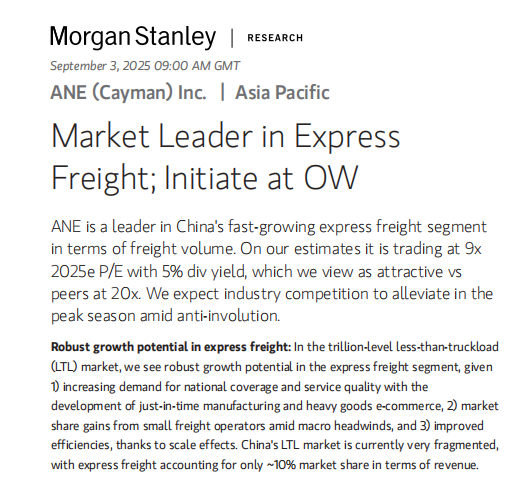
Core Viewpoint - Morgan Stanley initiated coverage on Aneng Logistics (09956) with an "Overweight" rating and a target price of HKD 11.7, indicating a potential upside of 44% from the closing price of HKD 8.10 as of September 2 [1][3] Company Performance - In the first half of 2025, Aneng Logistics demonstrated robust growth with total LTL freight volume reaching 6.82 million tons, a year-on-year increase of 6.2%; revenue of CNY 5.625 billion, up 6.4%; and adjusted net profit of CNY 476 million, reflecting a 10.7% increase, with a stable gross margin of 15.6% [3][4] - The company is expected to achieve a freight volume of 14.15 million tons in 2024, representing an 18% year-on-year growth [4] Market Opportunity - The LTL market in China is projected to reach CNY 1.7 trillion by 2024, characterized by a highly fragmented landscape where 90% of revenue is held by 200,000-300,000 small and local freight companies [3][4] - The express delivery segment, which has a higher gross margin, is anticipated to grow at a compound annual growth rate (CAGR) of 8% from 2024 to 2027, with market share expected to increase from 9% to 11% [3][4] Competitive Advantage - Aneng Logistics is positioned as a leader in the LTL express market, with a nationwide coverage of 99.6% of towns, significantly outperforming peers [4] - The company focuses on optimizing its product structure by emphasizing high-margin small and light goods, which has led to a 25.2% increase in total ticket volume year-on-year [4] Profitability - Aneng Logistics exhibits strong profitability metrics, with a projected return on equity (ROE) of 30% in 2024, significantly higher than the industry average of 10% [5] - The company is expected to achieve a CAGR of 15% in adjusted net profit from 2025 to 2027, with gross margin increasing from 15.9% in 2024 to 16.2% in 2027 [5] Industry Dynamics - The LTL freight industry is entering a phase of stock competition, with a pronounced Matthew effect, where Aneng Logistics' advantages in network coverage, product structure, and profitability will allow it to gain market share as smaller players exit the market [6] - The company is characterized as a "value stock" due to its stable dividend policy and potential for dual release of value and performance as industry consolidation deepens [6]
暴涨!“牛市旗手”重磅榜单来了
Zhong Guo Ji Jin Bao· 2025-08-31 06:07
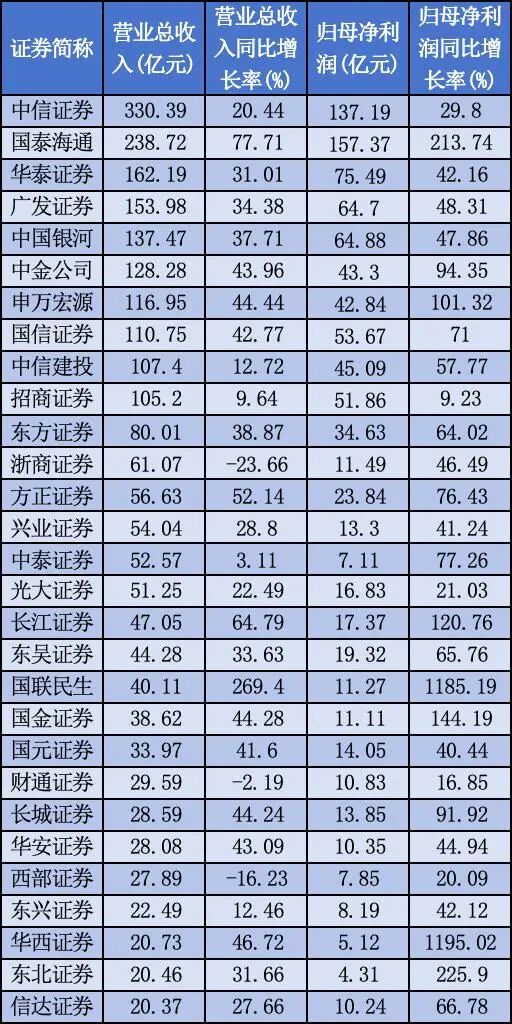
Core Viewpoint - The securities industry delivered a performance exceeding market expectations in the first half of 2025, with significant growth in revenue and net profit driven by market recovery and increased activity [1] Group 1: Financial Performance - A total of 42 A-share listed brokerages reported a combined operating income of 251.87 billion yuan, a year-on-year increase of 30.8%, and a net profit attributable to shareholders of 104.02 billion yuan, up 65.08% [1] - 37 brokerages achieved positive year-on-year growth in both revenue and net profit, while only a few experienced revenue declines [1] - The top ten brokerages, including CITIC Securities and Guotai Junan, all surpassed 10 billion yuan in revenue, with CITIC Securities leading at 33.04 billion yuan [2] Group 2: Business Segments - The self-operated investment business and brokerage services were the main drivers of growth, with self-operated income for 36 listed brokerages showing year-on-year increases [5] - The average daily trading volume increased by 61% year-on-year to 1.39 trillion yuan, reflecting heightened market participation [4] - Investment banking revenue for the 42 listed brokerages reached 15.53 billion yuan, a year-on-year increase of 11% [7] Group 3: Market Trends - The market is shifting from traditional volatile "beta" trading products to "value stocks" with long-term investment potential [1][6] - The number of new A-share accounts opened reached 12.6 million, a year-on-year increase of 32.8% [4] - The IPO market showed signs of recovery, with an increase in the number of new listings and financing amounts [7][8] Group 4: Notable Performers - Among smaller brokerages, Guolian Minsheng reported a revenue of 4.01 billion yuan, a staggering year-on-year increase of 269.4% [2] - Several smaller firms, including Northeast Securities and Huayin Securities, also reported significant net profit growth, with increases ranging from 120.76% to 225.9% [2] - However, some brokerages like Zheshang Securities and Xibu Securities experienced revenue declines of 23.66% and 16.23%, respectively [2][3]






暴涨!“牛市旗手”,重磅榜单来了
Zhong Guo Ji Jin Bao· 2025-08-31 05:36
Core Insights - The securities industry in China has reported a strong performance for the first half of 2025, with total revenue reaching 251.87 billion yuan, a year-on-year increase of 30.8%, and net profit attributable to shareholders amounting to 104.02 billion yuan, up 65.08% [1][2][3] Group 1: Performance of Major Securities Firms - Ten leading securities firms, including CITIC Securities and Guotai Junan, reported revenues exceeding 10 billion yuan, with CITIC Securities leading at 33.04 billion yuan, marking its best mid-year performance [2][3] - Guotai Junan's revenue reached 23.87 billion yuan, showing a significant year-on-year growth of 77.71% [3] - Other firms like Huatai Securities and GF Securities also reported revenues above 15 billion yuan, with growth rates of 31.01% and 34.38% respectively [3] Group 2: Growth Drivers - The increase in revenue and net profit is attributed to a recovery in the market, with a notable rise in self-operated investment income and brokerage fees [1][8] - The number of new A-share accounts opened reached 12.6 million, a 32.8% increase year-on-year, contributing to a 61% rise in average daily trading volume to 1.39 trillion yuan [7][10] Group 3: Investment Banking Recovery - The investment banking sector also showed signs of recovery, with total investment banking fees reaching 15.53 billion yuan, an 11% increase compared to the previous year [13] - CITIC Securities led the investment banking fees with 2.098 billion yuan, reflecting a 20.91% increase [14] - Smaller firms like Huazhong Securities and Zhongyin Securities reported over 100% growth in their investment banking revenues, indicating a shift towards comprehensive investment banking services [15]

暴涨!“牛市旗手”,重磅榜单来了
中国基金报· 2025-08-31 05:30
Core Viewpoint - The securities industry in China has shown significant growth in the first half of 2025, with a total revenue of 251.87 billion yuan, representing a year-on-year increase of 30.8%, and a net profit of 104.02 billion yuan, up 65.08% [1][2]. Group 1: Performance of Major Securities Firms - Ten major securities firms, including CITIC Securities and Guotai Junan, reported revenues exceeding 10 billion yuan, with CITIC Securities leading at 33.04 billion yuan, marking its best mid-year performance [3][4]. - Guotai Junan's revenue reached 23.87 billion yuan, showing a year-on-year growth of 77.71%, while Huatai Securities and GF Securities both surpassed 15 billion yuan in revenue [4][5]. Group 2: Growth Drivers - The growth in the securities industry is primarily driven by self-operated investment income and brokerage business, with a notable increase in daily trading volume and new account openings [8][9]. - The average daily trading volume increased by 61% to 1.39 trillion yuan, and new A-share accounts reached 12.6 million, up 32.8% year-on-year [8][9]. Group 3: Investment Banking Recovery - The investment banking sector has shown signs of recovery, with total investment banking fees reaching 15.53 billion yuan, a year-on-year increase of 11% [14][16]. - CITIC Securities led the investment banking fees with 2.098 billion yuan, reflecting a growth of 20.91% compared to the previous year [15][16]. Group 4: Performance of Smaller Securities Firms - Smaller securities firms also demonstrated impressive growth, with Guolian Minsheng reporting a revenue increase of 269.4% to 4.01 billion yuan and a net profit surge of 1185.19% [5][6]. - Other smaller firms like Dongbei Securities and Hualin Securities also reported significant net profit growth, with increases of 225.9% and 172.72% respectively [5][6]. Group 5: Challenges Faced - Some firms experienced revenue declines, such as Zhejiang Securities, which saw a 23.66% drop in revenue due to decreased market prices of derivative financial instruments [6][7]. - Other firms like Xibu Securities and Caitong Securities also reported revenue declines, indicating challenges in certain segments of the market [6][7].