化工行业反内卷

Search documents
资金买爆!规模增长8倍,极致抱团下化工ETF的三重逻辑
Sou Hu Cai Jing· 2025-08-29 07:51
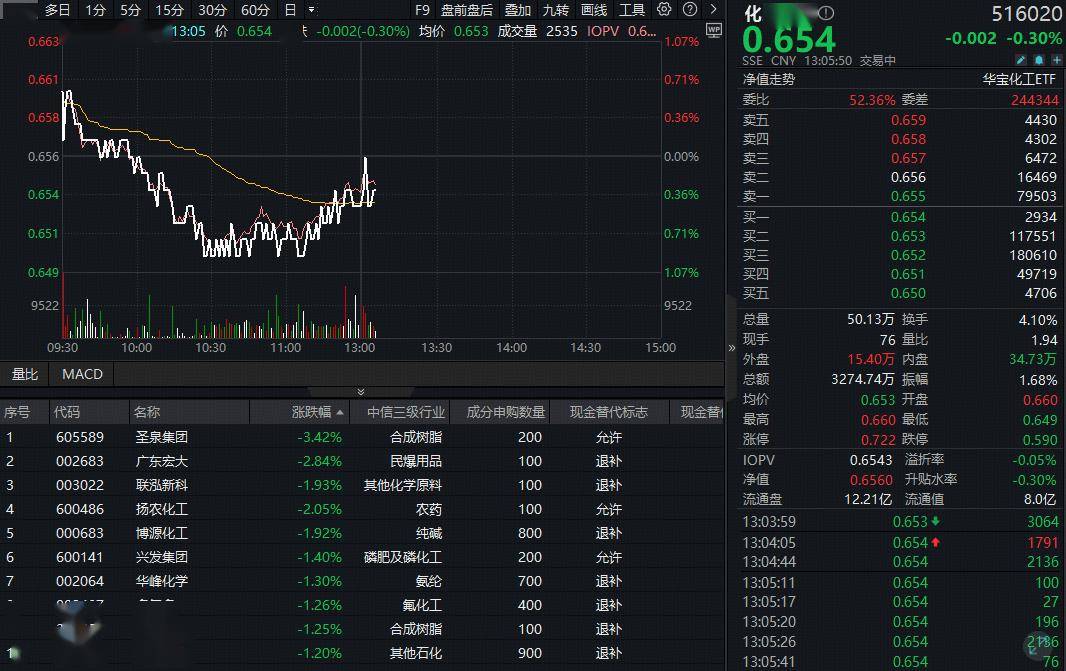
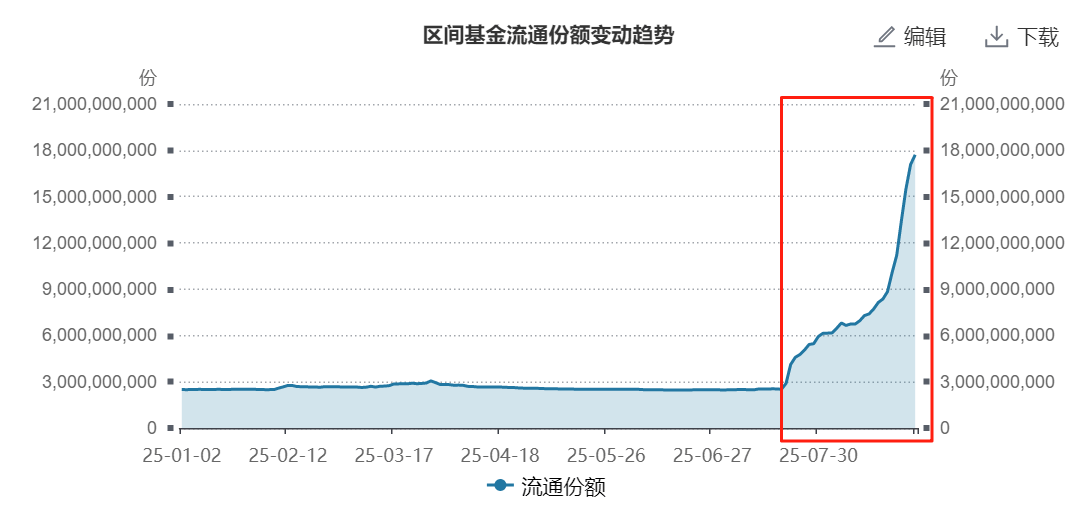
Core Viewpoint - The chemical industry has recently attracted significant attention from institutional investors, particularly through the Penghua CSI Sub-Industry Chemical ETF, which saw its scale grow from 1.4 billion to over 10 billion in just one month, indicating a shift in market dynamics and investment interest [1][4]. Group 1: Market Dynamics - The chemical sector has historically been viewed unfavorably due to its complex linkages with various industries and macroeconomic cycles, but recent policy changes are reshaping its fundamentals [1][4]. - The Chinese government is actively promoting the elimination and upgrading of outdated petrochemical facilities, which is part of a broader "anti-involution" strategy aimed at optimizing industry structure and reducing inefficient competition [4][7]. - Similar trends are observed globally, with Europe and South Korea also undergoing significant capacity reductions in the chemical sector, creating opportunities for Chinese refining companies [4][7]. Group 2: Institutional Investment - The "national team" of institutional investors, including major insurance funds and social security funds, has shown strong support for the chemical sector, with significant holdings in the Penghua CSI Sub-Industry Chemical ETF [8][10]. - The top five holders of the ETF include Central Huijin, China Life Insurance, and other institutional investors, indicating a robust backing from large financial entities [9][10]. Group 3: Valuation and Investment Potential - The chemical sector is currently trading at historically low valuation levels, with a price-to-book (PB) ratio of 2.23, positioning it favorably for long-term investment [13]. - Analysts are optimistic about the sector's potential for recovery, with expectations of improved profitability as policies take effect and supply-side adjustments occur [14][15]. - The Penghua CSI Sub-Industry Chemical ETF is highlighted as a unique investment vehicle due to its scale and liquidity, while other ETFs like the Fortune CSI Sub-Industry Chemical ETF and Huabao Chemical ETF have also shown strong performance [17][18].

ETF盘中资讯|化工板块盘中猛拉!政策严控产能+盈利底部回升,机构看好中长期配置机遇
Sou Hu Cai Jing· 2025-08-26 02:48
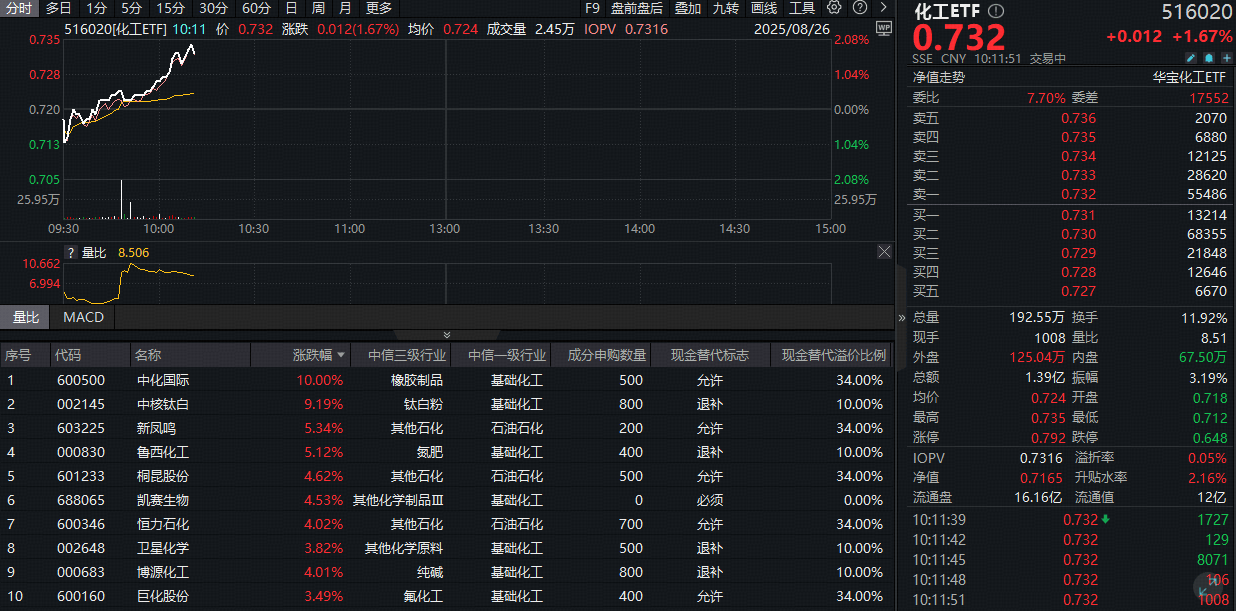
Group 1 - The chemical sector experienced a significant rally on August 26, with the Chemical ETF (516020) rising over 2% at one point and closing up 1.67% [1][2] - Key stocks in the sector included Zhonghua International, which hit the daily limit, and Zhongke Titanium, which surged over 9%, while several others like Xin Fengming and Luxi Chemical rose over 5% [1][2] - Recent trends indicate a push towards "anti-involution" in various chemical sub-industries, suggesting that both administrative and self-regulatory measures are needed for improvement [1][3] Group 2 - Huatai Securities noted that the industry's profitability is at a low point, and with policy guidance, supply-side adjustments are expected to accelerate, potentially improving profitability for bulk chemical products [3] - The chemical sector is anticipated to benefit from increased demand driven by economic growth in regions like Africa and Latin America, with exports becoming a crucial growth engine [3] - Current valuations for the chemical sector are attractive, with the Chemical ETF's underlying index trading at a price-to-book ratio of 2.22, which is at a low percentile compared to the last decade [3][4] Group 3 - Open-source Securities highlighted that as specific policies are implemented, some outdated capacities in the chemical industry may be eliminated, leading to an optimized competitive landscape and improved profitability [4] - The Chemical ETF (516020) is positioned to provide efficient exposure to the sector, with nearly 50% of its holdings in large-cap leading stocks, allowing investors to capitalize on strong performance opportunities [4]


化工板块盘中猛拉!政策严控产能+盈利底部回升,机构看好中长期配置机遇
Xin Lang Ji Jin· 2025-08-26 02:39
Group 1 - The chemical sector experienced a significant rally on August 26, with the Chemical ETF (516020) rising over 2% at one point and closing up 1.67% [1] - Key stocks in the sector included Zhonghua International, which hit the daily limit, and Zhongke Titanium, which surged over 9% [1] - Other notable gainers included Xin Fengming and Luxi Chemical, both rising over 5%, while several other stocks increased by more than 4% [1] Group 2 - Recent trends indicate that various sub-sectors within the chemical industry are pushing for a "de-involution" strategy, suggesting a need for both administrative and self-regulatory measures [1] - Successful cases in the refrigerant industry highlight the importance of policy in driving industry changes, with potential for similar outcomes in polyester and viscose sectors [1] - Huatai Securities noted that the industry is at a profit bottom, with supply-side adjustments expected to improve profitability for bulk chemical products [3] Group 3 - The chemical industry is anticipated to benefit from a slowdown in global capacity expansion, with strong cash flow potentially leading to higher dividend yields [5] - The Chemical ETF (516020) tracks a comprehensive index covering various chemical sub-sectors, with nearly 50% of its holdings in large-cap stocks [6] - The ETF provides an efficient way for investors to gain exposure to the chemical sector, which includes leading companies in phosphate, fluorine, and nitrogen fertilizers [6]
反内卷整治深化,化工行业大逆转?磷肥、氟化工爆发,化工ETF(516020)摸高1.29%!
Xin Lang Ji Jin· 2025-08-22 06:28
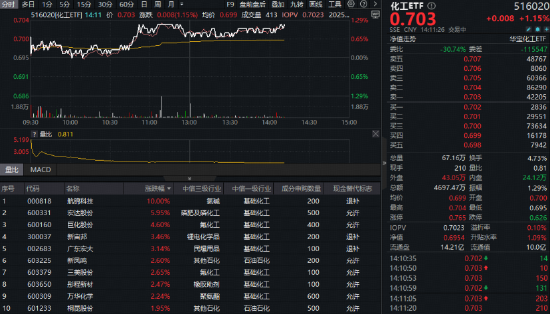
Group 1 - The chemical sector is experiencing a strong upward trend, with the Chemical ETF (516020) showing a price increase of 1.15% as of the latest report [1] - The Chemical ETF has a significant portion of its holdings in large-cap stocks, including Wanhu Chemical and Salt Lake Shares, allowing investors to capitalize on strong market leaders [4] - Key stocks in the chemical sector, such as Hanjin Technology and Hongda Shares, have seen substantial gains, with Hanjin Technology hitting the daily limit and Hongda Shares rising over 5% [1][3] Group 2 - Zhongyuan Securities indicates that the chemical industry is moving towards a phase of recovery as the issue of overcapacity and excessive competition is expected to ease [3] - Debon Securities notes that the current cycle of chemical capacity expansion is nearing its end, with capital expenditure and fixed asset growth rates showing a downward trend [3] - Donghai Securities highlights that the domestic chemical industry is likely to see structural optimization, with significant cost advantages and technological advancements positioning Chinese companies to fill gaps in the global supply chain [3]


规模最大的化工ETF(159870)涨超1.3%,盘中净申购7.4亿份
Xin Lang Cai Jing· 2025-08-21 03:03
Group 1 - The chemical industry is experiencing a significant upward trend, with the China Securities Subdivision Chemical Industry Theme Index (000813) rising by 1.45% as of August 21, 2025, and key stocks such as Zhongke Titanium White (002145) and Satellite Chemical (002648) seeing increases of 5.84% and 5.78% respectively [1] - The energy chemical sector has a substantial impact on the Producer Price Index (PPI), accounting for 25%-30% of its composition. The current negative PPI growth of -3.6% in July 2025 indicates that a rebound in energy chemical prices could be crucial for boosting overall industrial inflation [2] - The chemical industry is facing dual pressures of declining product prices and reduced capacity utilization, leading to a profit squeeze. By 2024, nearly 25% of chemical companies are projected to incur losses, with profits in the chemical raw materials and products manufacturing sector dropping by 9.0% year-on-year in the first half of 2025 [2] Group 2 - The supply-demand dynamics in the chemical sector are improving, with the current capital expenditure and fixed asset growth rates showing a downward trend since 2021. Demand is expected to gradually recover due to policy support for real estate stabilization and easing of tariffs between China and the U.S. [2] - The current price-to-book (PB) ratio for the chemical industry is 2.0, which is at the lower end of the range observed over the past decade. This suggests that stock prices may lead the fundamentals out of the cyclical bottom, indicating significant upside potential [2] - The China Securities Subdivision Chemical Industry Theme Index consists of seven sub-indices, including those for non-ferrous metals and machinery, and is designed to reflect the overall performance of listed companies in the chemical sector. As of July 31, 2025, the top ten weighted stocks in this index accounted for 43.54% of the total [3]
规模最大的化工ETF(159870)开盘涨超1.2%,机构称行业景气度有望回升
Xin Lang Cai Jing· 2025-08-21 01:54
Group 1 - The chemical sector is experiencing a rise in opening prices, with institutions indicating that the "anti-involution" trend may lead to a recovery in chemical industry prosperity, benefiting leading companies [1] - Key factors for potential investment opportunities in the chemical industry include stricter new project approvals, the positive impact of old facility renovations, attempts at industry self-discipline, and rising energy consumption standards [1] - As of August 21, 2025, the CSI Sub-Industry Chemical Theme Index (000813) increased by 1.25%, with notable stock performances including: Nucor Titanium (002145) up 8.76%, Rongsheng Petrochemical (002493) up 5.24%, and Dongfang Shenghong (000301) up 3.24% [1] Group 2 - The Chemical ETF (159870) closely tracks the CSI Sub-Industry Chemical Theme Index, which consists of seven sub-indices reflecting the overall performance of listed companies in related sub-industries [2] - As of July 31, 2025, the top ten weighted stocks in the CSI Sub-Industry Chemical Theme Index (000813) accounted for 43.54% of the index, including companies like Wanhua Chemical (600309) and Yilong Co. (000792) [2]
开源证券金益腾:政策和自律双轮驱动 化工行业周期拐点临近
Zhong Guo Zheng Quan Bao· 2025-08-14 22:23
Core Viewpoint - The chemical industry is transitioning from a focus on market share to profitability, indicating a potential new cycle as production expansion comes to an end and policies are gradually implemented [1][7]. Industry Challenges - Since 2022, the chemical industry has faced price declines and increased competition, leading to many companies experiencing revenue growth without profit [2]. - Despite domestic demand stabilization from various policies, supply-side competition has intensified, resulting in lower product prices and utilization rates, which has kept overall profit levels low [2][3]. Current Industry Position - The bottom position of the industry appears to be well-defined, with high concentration in most sub-industries limiting further optimization through concentration increases [3]. - The driving force of the chemical market is shifting from demand stimulation to supply-side reform, necessitating a focus on optimizing supply-demand dynamics for high-quality development [3]. Self-Regulation and Policy Coordination - The current phase of the chemical industry's anti-involution process is at the initial stage of policy and industry assessment, with industry associations promoting self-regulation among companies [4]. - Historical experiences suggest that self-regulation effects are often short-lived, and temporary production cuts can lead to a rebound in operating rates, returning to a supply surplus situation [4]. Specific Industry Insights - The polyester filament industry is entering a period of slow capacity growth, with profitability improvements driven by policies to eliminate about 10% of outdated capacity and joint production cuts by leading companies [5]. - The viscose staple fiber industry has seen no new capacity in the past five years, maintaining a stable supply-demand balance, with strict carbon emission policies curbing new capacity as a driving factor [5][6]. Future Industry Outlook - The anti-involution direction for the chemical industry is clear, with a shift towards profitability through capacity elimination and enhanced self-regulation [7]. - The industry is currently in a policy vacuum, but as more policies are implemented, the issues of internal competition are expected to improve [7]. - Investment opportunities are anticipated in major sectors like petrochemicals and coal chemicals, with a focus on leading companies in these areas [7][8].
开源证券金益腾: 政策和自律双轮驱动 化工行业周期拐点临近
Zhong Guo Zheng Quan Bao· 2025-08-14 22:11
Core Viewpoint - The chemical industry is transitioning from a focus on market share to profitability, indicating a potential new cycle as production expansion comes to an end and policies are implemented [1][7]. Industry Challenges - Since 2022, the chemical industry has faced price declines and increased competition, leading to many companies experiencing revenue growth without profit [2]. - Despite domestic demand stabilization from various policies, intensified competition and limited overseas demand have exacerbated price weakness and low capacity utilization, resulting in overall low profit levels [2][3]. Current Industry Position - The bottom position of the industry is considered relatively certain, with high concentration in most sub-industries limiting further optimization through concentration increases [3]. - The driving force of the chemical market is shifting from demand stimulation to supply-side reform, necessitating breakthroughs from the supply side to improve the supply-demand structure and promote high-quality development [3][6]. Self-Regulation and Policy Coordination - The current phase of the chemical industry's anti-involution process is at the initial stage of policy and industry assessment, with industry associations promoting self-regulation among companies [4]. - Historical experiences suggest that self-regulation effects are often short-lived, and temporary production cuts can lead to a rebound in operating rates, returning to a state of oversupply [4]. Specific Industry Insights - The polyester filament industry is entering a period of slow capacity growth, with profitability improvements driven by policies to eliminate about 10% of outdated capacity and joint production cuts by leading companies [5][6]. - The viscose staple fiber industry has seen no new capacity in the past five years, maintaining a stable supply-demand balance, with strict carbon emission policies curbing new capacity as a driving factor [5]. Future Industry Outlook - The chemical industry is expected to enter a new cycle as it shifts focus from market share to profit, with measures such as eliminating outdated capacity and enhancing industry self-regulation [7]. - The importance of pricing power is emphasized, as high concentration in many sub-industries means that if leading companies cease harmful competition, prices can stabilize and potentially gain global pricing power [7]. - Investment opportunities are anticipated in major sectors like petrochemicals and coal chemicals, with a focus on sub-industries nearing cyclical turning points, such as polyester filament [7][8].
政策和自律双轮驱动 化工行业周期拐点临近
Zhong Guo Zheng Quan Bao· 2025-08-14 20:16
Core Viewpoint - The chemical industry is transitioning from a focus on market share to profitability as production expansion nears its end and policies are gradually implemented, indicating a potential new cycle for the industry [1][4]. Industry Challenges - Since 2022, the chemical industry has faced a supply-demand mismatch leading to declining prices and increased competition, resulting in many companies experiencing revenue growth without profit [1][2]. - Despite domestic demand recovery from various policies, intensified competition on the supply side and limited overseas demand have exacerbated low product prices and capacity utilization rates, keeping overall profit levels low [1][2]. Historical Context and Trends - The chemical industry has experienced cyclical fluctuations, with significant recoveries driven by demand stimulus and supply-side structural reforms in the past [2]. - Currently, the industry is at a bottom position, with high concentration in most sub-industries limiting further optimization through increased concentration [2][3]. Supply-Demand Dynamics - The primary issue in the domestic chemical industry is the supply-demand mismatch, which needs to be addressed to help the industry recover from its bottom state [3]. - The "new pricing method" aims to eliminate long-term losses across the industry, which could subsequently raise the profit bottom line for leading companies [3]. Self-Regulation and Policy Collaboration - The current phase of the chemical industry's anti-involution process is at the initial stage of policy and industry assessment, with industry associations promoting self-regulation among companies [3][5]. - Historical experiences suggest that self-regulation may not be sustainable without strong policy support, as temporary production cuts can lead to a rebound in operating rates, returning to a supply surplus situation [3]. Sector-Specific Insights - The polyester filament industry is in a period of slow capacity growth, with profitability improvements driven by policies to eliminate about 10% of outdated capacity and joint production cuts by leading companies [4]. - The viscose staple fiber industry has seen no new capacity in the past five years, maintaining a stable supply-demand balance, with carbon emission control policies acting as a driving factor [4]. Future Outlook - The chemical industry is expected to enter a new cycle focused on profitability through the elimination of outdated capacity and enhanced industry self-regulation [4][5]. - The industry is currently in a policy vacuum, but as more policies are implemented, the issues of internal competition are likely to improve [5]. - Investment opportunities are anticipated in leading companies within large sectors like petrochemicals and coal chemicals, as well as in sub-industries nearing a cyclical turning point, such as polyester filament [5].
ETF盘中资讯|中场盘整期至?化工ETF(516020)震荡走低,近10日吸金超1.5亿元!
Sou Hu Cai Jing· 2025-08-07 05:35
化工板块今日(8月7日)又陷回调,反映化工板块整体走势的化工ETF(516020)开盘后震荡下行,盘中场内价格一度跌近1%,随后略有回升,截至 发稿,跌0.3%。 华安证券指出,当前化工行业面临产能过剩、同质化竞争加剧的问题,部分企业依赖低价策略争夺市场,导致行业整体利润率下滑。此次政策明确要求 优化产业布局,加快淘汰低效产能,并鼓励市场化兼并重组,这将有助于行业集中度提升,龙头企业有望凭借技术、规模和环保优势进一步扩大市场份 额。短期来看,部分中小企业可能面临淘汰压力,部分"长期内卷行业"价格有望抬头,长期将促进行业结构优化,减少无效竞争。 天风证券指出,在行业"反内卷"背景下,参照供给侧改革时期的"成本要素"定价。化工领域有望针对绿色低碳、节能减排、工艺优化等"成本要素"的重 新定价,推动化工领域"反内卷",并实现类似于供给侧改革五年间的成效。建议重点关注周期属性较强的基础化工产品,以及与之对应的拥有成本优势 的化工龙头上市公司。 如何把握化工板块反弹机遇?借道化工ETF(516020)布局效率或更高。公开资料显示,化工ETF(516020)跟踪中证细分化工产业主题指数,全面覆 盖化工各个细分领域。其中近 ...