反胁迫工具

Search documents
特朗普发黑白照:我是关税之王!他威胁欧洲多国:得不到格陵兰岛 就征关税;欧洲议会议员呼吁:用反胁迫工具回应
Mei Ri Jing Ji Xin Wen· 2026-01-18 15:01
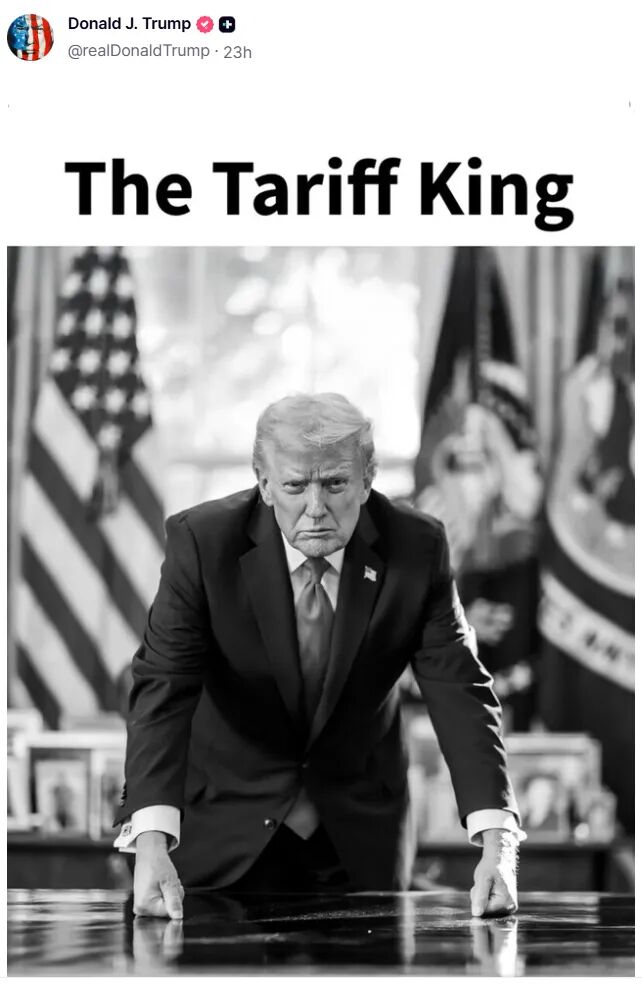
当地时间1月17日,美国总统特朗普在"真实社交"平台发布一张个人黑白照片,并自诩为"关税之王"。 特朗普"真实社交"账号截图 同日,特朗普在社交媒体上宣布,将从2月1日起对来自丹麦、挪威、瑞典、法国、德国、英国、荷兰和 芬兰的输美商品加征10%关税,并宣称加征关税的税率将从6月1日起提高至25%,直到相关方就美 国"全面、彻底购买格陵兰岛"达成协议。 据《今日美国》(USA Today)报道,当地时间1月16日,特朗普在白宫一场与格陵兰岛议题无关的农 村医疗健康活动上,提到自己曾通过以医药关税相要挟,向欧洲国家施压。 "对于格陵兰岛问题,我或许也会如法炮制,"特朗普称,"要是有国家不配合我们拿下格陵兰岛,我可 能会对它们加征关税,因为格陵兰岛对美国的国家安全至关重要。所以我确实有可能这么做。" 报道提到,美国最高法院随时可能对特朗普单方面在全球范围内征收关税的合法性做出裁决,这些关税 已通过对外国进口商品征税筹集了数千亿美元。 对此,特朗普16日表示:"我是'关税之王',本'关税之王'干得非常出色。我希望我们能赢得最高法院的 官司,因为如果我们输了,那将是我们国家的耻辱。" 多名欧洲议会议员1月17日说,鉴于 ...

欧洲8国集体回应特朗普关税威胁:将继续以团结协调的方式应对,决心捍卫我们的主权
Sou Hu Cai Jing· 2026-01-18 14:49
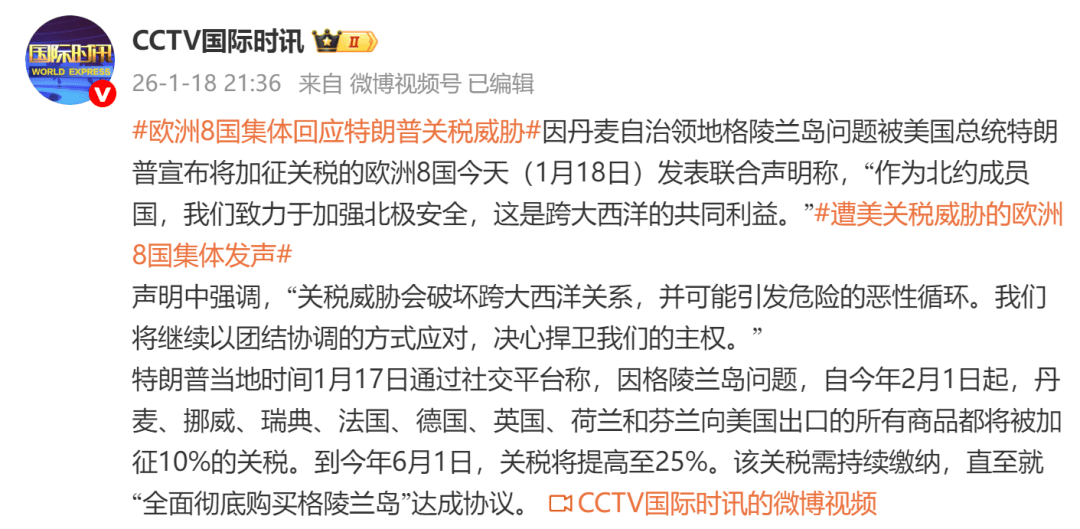
据CCTV国际时讯:因丹麦自治领地格陵兰岛问题被美国总统特朗普宣布将加征关税的欧洲8国今天(1月18日)发表联合声明称,"作为北约成员国,我 们致力于加强北极安全,这是跨大西洋的共同利益。" 声明中强调,"关税威胁会破坏跨大西洋关系,并可能引发危险的恶性循环。我们将继续以团结协调的方式应对,决心捍卫我们的主权。" 特朗普当地时间1月17日通过社交平台称,因格陵兰岛问题,自今年2月1日起,丹麦、挪威、瑞典、法国、德国、英国、荷兰和芬兰向美国出口的所有商 品都将被加征10%的关税。到今年6月1日,关税将提高至25%。该关税需持续缴纳,直至就"全面彻底购买格陵兰岛"达成协议。 当地时间1月17日,美国总统特朗普在"真实社交"平台发布一张个人黑白照片,并自诩为"关税之王"。 特朗普"真实社交"账号截图 据新华社:荷兰外交大臣戴维·范韦尔18日表示,美国为得到格陵兰岛而向欧洲国家加征关税是"不正当"的"勒索"行为,不排除欧盟采取反制措施的可能 性。 范韦尔18日在荷兰公共广播公司一档访谈节目中说,他对美国总统特朗普这一决定"非常不满",盟友之间不应以施压的方式相处。他说,将关税用于与贸 易毫无关系的事务是不正当的。范韦 ...
欧洲八国,联合声明
Xin Lang Cai Jing· 2026-01-18 14:18
转自:扬子晚报 新华社消息,据丹麦媒体18日报道,欧洲8个国家当天发表联合声明指出,威胁加征关税破坏跨大西洋 关系,并有可能导致危险的恶性循环。丹麦、芬兰、法国、德国、荷兰、挪威、瑞典和英国共同签署了 这份声明。 马克龙回击特朗普:不排除启动最强硬反制工具 荷兰外交大臣:美国加征关税是"勒索"行为 荷兰外交大臣戴维·范韦尔18日表示,美国为得到格陵兰岛而向欧洲国家加征关税是"不正当"的"勒 索"行为,不排除欧盟采取反制措施的可能性。 范韦尔18日在荷兰公共广播公司一档访谈节目中说,他对美国总统特朗普这一决定"非常不满",盟友之 间不应以施压的方式相处。他说,将关税用于与贸易毫无关系的事务是不正当的。 范韦尔还表示,荷兰将在欧盟框架内推动美国在2月1日撤销加征关税的决定。若不能成功,欧盟不排除 采取反制措施。 特朗普17日在社交媒体上宣布,将从2月1日起对来自丹麦、挪威、瑞典、法国、德国、英国、荷兰和芬 兰的输美商品加征10%关税,并宣称加征关税的税率将从6月1日起提高至25%,直到相关方就美国"全 面、彻底购买格陵兰岛"达成协议。 近日,挪威、瑞典、法国、德国、英国、荷兰和芬兰等欧洲国家宣布向格陵兰岛派兵,参 ...
特朗普发黑白照:我是关税之王!他威胁欧洲多国:得不到格陵兰岛,就征关税;欧洲议会议员呼吁:用反胁迫工具回应
Mei Ri Jing Ji Xin Wen· 2026-01-18 12:31
Group 1 - The core point of the news is that President Trump announced a plan to impose a 10% tariff on goods imported from Denmark, Norway, Sweden, France, Germany, the UK, the Netherlands, and Finland starting February 1, with the rate increasing to 25% on June 1, contingent on negotiations regarding the purchase of Greenland [4][5] - Trump referred to himself as the "Tariff King" and expressed confidence in winning a potential Supreme Court case regarding the legality of his unilateral tariffs, which have raised hundreds of billions of dollars through foreign import taxes [4][6] - European Parliament members indicated that the escalating tensions due to the U.S. threats regarding Greenland would prevent the approval of a previously negotiated trade agreement between the U.S. and Europe [5][6] Group 2 - The previously negotiated U.S.-EU trade agreement required the EU to eliminate tariffs on U.S. industrial goods and provide preferential market access for U.S. seafood and agricultural products in exchange for a 15% tariff on most EU goods imported to the U.S. [5] - The European People's Party, the largest party group in the European Parliament, stated that the current tensions mean they cannot support the trade agreement, and measures to eliminate zero tariffs on U.S. products must be suspended [5][6] - Several European political leaders called for the activation of the EU's anti-coercion tool in response to U.S. economic threats, emphasizing the need for deterrent measures against U.S. actions [6]
美国对欧洲8国加征关税 欧盟领导人称或将导致恶性循环
Yang Guang Wang· 2026-01-18 00:16
央广网北京1月18日消息 据中央广播电视总台中国之声《新闻和报纸摘要》报道,美国总统特朗普 17日表示,宣布美国将从2月1日起对丹麦、挪威、瑞典、法国、德国、英国、荷兰和芬兰的输美商品加 征10%关税。 特朗普说,加征关税的税率将从6月1日起提高到25%,直到相关方就美国"全面、彻底购买格陵兰 岛"达成协议。他还表示,美国对即刻与上述欧洲8国进行谈判持开放态度。 欧洲理事会主席科斯塔和欧盟委员会主席冯德莱恩17日发表联合声明,表示美国宣布的加征关税措 施将削弱跨大西洋关系,并可能导致"危险的恶性循环"。欧洲议会国际贸易委员会主席朗格17日敦促欧 盟委员会立即启动反胁迫工具相关程序,作出"明确回应"。 英国首相斯塔默发表声明说,美国总统特朗普对盟友加征关税的做法"完全错误",英方将直接与美 国政府交涉。 数千名丹麦人17日在首都哥本哈根举行游行示威,抗议美国企图控制格陵兰岛的行径。记者在现场 了解到,示威者中有人来自丹麦本土,有人来自格陵兰岛。游行人群喊着"格陵兰岛不出售"等口号,表 达丹麦人团结一致反对美国夺岛企图的立场。 法国总统马克龙表示,关税威胁"不可接受",欧洲将团结应对。 瑞典首相克里斯特松表示,正 ...
欧洲议会要员:欧盟应动用反胁迫工具回应美国加征关税
Yang Shi Xin Wen· 2026-01-17 19:30
朗格敦促欧盟委员会立即启动反胁迫工具相关程序,推动欧盟尽快动用这一反制工具,作出"明确回 应"。 欧洲议会国际贸易委员会主席贝恩德·朗格17日在社交媒体上发文说,美国总统特朗普当天宣布对支持 格陵兰岛的欧洲国家加征关税,令他"难以置信"。这是将关税作为政治武器使用的"新维度"。 (文章来源:央视新闻) ...
8000亿欧元贸易额说断就断?马克龙盯上中国稀土,德国人第一个不答应
Sou Hu Cai Jing· 2025-11-03 18:38
Group 1 - The core issue in Europe is the potential use of the "anti-coercion tool" against China, which has been dormant for nearly two years, raising questions about the unity of EU member states in this gamble [3][6] - Macron's focus is on China's rare earth export controls, as he seeks to shift domestic political attention and secure a share in the global supply chain restructuring [3][6] - The economic interdependence between Europe and China is significant, with the EU-China trade volume reaching €800 billion before 2024, making China the largest source of imports for the EU and the second-largest export market [3][4] Group 2 - The "anti-coercion tool" includes measures such as tariffs, public procurement restrictions, and investment limitations, but its implementation requires a majority vote from EU member states, complicating its use [6][9] - The tool is perceived more as a bargaining chip rather than a weapon, as any retaliatory measures from China could adversely affect various European industries, including agriculture and automotive [6][9] - Macron's push for a hardline stance is seen as a political strategy to divert attention from domestic issues, but it risks escalating tensions in a globally interconnected economy [6][9] Group 3 - China's response to the situation has been calm, with advancements in semiconductor self-research and a willingness to engage with European companies in green transitions [7][9] - The broader European challenge is not unique to France, as the entire continent faces transformation pains, and blaming external factors will not resolve underlying issues [9] - A more pragmatic approach to China is suggested, emphasizing cooperation amidst competition and seeking consensus rather than confrontation [9]

欧盟放狠话:稀土再谈不拢就对中国动用非常手段,中方亮明态度
Sou Hu Cai Jing· 2025-10-31 08:42
Core Viewpoint - China's new regulations on rare earth exports have tightened control over a critical resource, prompting strong reactions from Europe, particularly from French President Macron and European Commission President von der Leyen, indicating a complex geopolitical struggle where both sides are weighing their options [1][3][4]. Group 1: Impact on European Industries - Rare earth magnets and related materials are essential for Europe's renewable energy, military, wind power, and semiconductor industries, with China holding a dominant position in the global rare earth supply chain [3][4]. - The new regulations signal China's intent to further control this key resource, leading to heightened concerns within the EU, as the region has made little progress in developing its own rare earth supply capabilities since the establishment of the "Critical Raw Materials Alliance" in 2020 [3][4][21]. - European companies, particularly in the electric vehicle sector, are already feeling the pressure of potential supply issues, which could lead to increased costs and impact profitability [4][15]. Group 2: European Response and Strategy - The EU's response has been characterized by strong rhetoric, with calls for using all available tools to counter China's actions, but actual implementation of these measures is complex and time-consuming [3][10][19]. - The so-called "anti-coercion tool" introduced by the EU is more of a warning than a practical solution, as it requires consensus among all 27 member states, which is challenging to achieve [10][19][21]. - There is a growing realization within the EU that aggressive trade measures could backfire, harming their own industries, particularly in the context of the green transition [15][21]. Group 3: China's Position and Strategy - China has maintained a calm stance, emphasizing that resource export management is a common international practice aimed at ensuring industrial safety and rational resource use [6][10]. - The Chinese government has signaled a shift from being a mere supplier of raw materials to focusing on technology and value-added products, indicating a strategic change in how it engages with global markets [15][21]. - The ongoing geopolitical struggle over rare earths is seen as a psychological battle, with both sides calculating their moves carefully, but China appears to have gained the upper hand in the initial stages of this contest [8][10].
欧洲直接迁怒中国!德法选择支持荷兰,要求谈判,中国提一个条件
Sou Hu Cai Jing· 2025-10-29 21:54
Core Points - The Netherlands government signaled a desire to negotiate with China regarding ASML, but this was met with a unified hardline stance from the EU, particularly Germany and France, indicating a collective approach to counter China [1][8][24] - China responded firmly to European pressure, stating that if Germany does not ease restrictions on high-tech exports to China, it will not relax its own export controls on rare earths [1][18] Group 1: Semiconductor and Technology Cooperation - In June, the Netherlands announced restrictions on ASML's exports of advanced lithography machines to China under U.S. pressure, severely impacting Sino-Dutch technological cooperation [3] - China retaliated by implementing export controls on critical metals gallium and germanium, essential for semiconductor manufacturing, with over 90% of gallium and 60% of germanium sourced from China [3][5] Group 2: European Industry Impact - The new export controls from ASML took effect on September 1, and by December 1, high-purity graphite was added to the restricted list, crucial for electric vehicle batteries, highlighting Europe's dependency on these materials during its green transition [5][10] - Germany's automotive industry, already suffering from chip shortages, faced production halts, indicating significant distress among major manufacturers like Mercedes, BMW, and Volkswagen [6][10] Group 3: Political Dynamics and Internal EU Tensions - The EU summit on October 23 marked a turning point, with German Chancellor Merz expressing a desire for a mutually acceptable solution while simultaneously criticizing China's rare earth controls, revealing internal contradictions within the EU [8][10] - France's President Macron suggested the EU should consider all retaliatory measures against China, while the European Commission President indicated readiness to use all available tools, reflecting a unified yet conflicted stance [8][10] Group 4: Economic Realities and Strategic Dependencies - Despite political rhetoric, European industries are increasingly aware of their reliance on Chinese resources, with reports indicating that Germany has submitted a "white list" to China for sectors like automotive and electronics, seeking to restore rare earth supplies [10][18] - The EU's internal discussions reveal a struggle to balance political posturing against the economic realities of dependence on Chinese markets and resources, with many companies reconsidering their supply chains [16][22] Group 5: Broader Implications for Sino-European Relations - The ongoing tensions over semiconductors and rare earths reflect deeper geopolitical and economic struggles, with European politicians exhibiting a duality of wanting to be tough on China while needing to maintain economic ties [20][24] - China's clear stance emphasizes that cooperation must be based on mutual respect and equality, rejecting one-sided benefits while asserting its position in the global supply chain [18][26]

欧盟放狠话:稀土再谈不拢,就对中国动用非常手段,中方亮明态度
Sou Hu Cai Jing· 2025-10-28 12:47
Core Viewpoint - The EU is reacting strongly to China's increased export controls on rare earths, with leaders like Macron and von der Leyen calling for all possible measures against China, indicating a tense geopolitical situation [1][3][5] Group 1: EU's Response to China's Export Controls - The EU is heavily reliant on China for rare earths, with 90% of its rare earth magnets sourced from China, which is critical for industries like electric vehicles and military [3][5] - Macron has labeled China's actions as "economic coercion" and urged the EU to utilize its "anti-coercion tool" [5][7] - Despite strong rhetoric, there is a lack of consensus within the EU on how to respond, particularly from Germany, which is cautious due to its economic ties with China [7][9] Group 2: China's Position and Strategy - China maintains that its export controls are a normal enhancement of its export management system and not aimed at any specific country [9][11] - Chinese officials emphasize a rational approach, indicating a willingness to negotiate while also standing firm against pressure [11][13] - The upcoming high-level talks between China and the EU are expected to address not only rare earths but also semiconductor issues, reflecting broader geopolitical tensions [13][15] Group 3: Broader Implications for EU-China Relations - The rare earth dispute is seen as a pivotal moment in the restructuring of EU-China relations, with potential implications extending to electric vehicles, semiconductors, and energy policies [17][19] - The EU faces internal divisions regarding its approach to China, with differing views among member states complicating a unified strategy [15][17] - The challenge lies in balancing competition and cooperation within the global supply chain, as the rare earth issue may be just the beginning of a larger geopolitical contest [20][21]