对赌协议

Search documents
科德教育(300192) - 300192科德教育投资者关系管理信息20251202
2025-12-02 12:42
Group 1: Company Overview and Investment - Suzhou Kede Education Technology Co., Ltd. holds a 5.53% stake in Zhonghao Xinying, a company specializing in TPU architecture AI chip technology and mass production [4][8]. - Zhonghao Xinying has initiated the process for its IPO and is currently undergoing a share reform [7][20]. - In 2024, Zhonghao Xinying is expected to contribute an investment income of 5.9299 million CNY to Suzhou Kede, based on its shareholding [20]. Group 2: Market Strategy and Value Management - The company emphasizes value management, having established a value management system to enhance corporate governance and improve information disclosure quality [3]. - Suzhou Kede aims to leverage AI technology in education, focusing on integrating new technologies and products to enhance competitiveness [10][16]. - The company is actively seeking to optimize its business operations and explore new market opportunities to ensure sustainable growth [15][16]. Group 3: Financial Performance and Investment Insights - The company's R&D expenses for the first three quarters of 2025 reached 18.7236 million CNY, reflecting a 52.03% increase compared to the previous year [21]. - The company reported a decrease in accounts receivable compared to the beginning of the year, while inventory saw a slight increase due to preparations for the National Day holiday [20]. - The company has a long-term investment strategy focused primarily on Zhonghao Xinying, which is expected to enhance its investment value [6][12].

读懂IPO|长鹰硬科对赌余波:两名创始人退出董监高,实控人股份锁定期缩短至一年
Sou Hu Cai Jing· 2025-11-28 11:48
Core Viewpoint - The company Kunshan Changying Hard Material Technology Co., Ltd. (referred to as "Changying Hard Science") has submitted an IPO application to the Beijing Stock Exchange, following a previous unsuccessful application to the Shanghai Stock Exchange. The company has undergone significant changes in its shareholding structure and governance prior to this new application [2][3][8]. Group 1: IPO Application and History - Changying Hard Science's IPO application was accepted by the Beijing Stock Exchange on June 30, 2025, and the company received its first round of inquiry on July 28, 2025 [2]. - The company previously submitted an IPO application to the Shanghai Stock Exchange on March 1, 2023, but withdrew it in June 2024 after responding to inquiries [2][8]. - Before the current IPO application, the founders executed a buyback obligation to external investors, repurchasing shares at a price of 18.98 yuan per share [2][9]. Group 2: Shareholding and Governance Changes - The controlling shareholders, Huang Qijun and Chen Bi, have reduced their share lock-up period from 36 months to 12 months compared to their previous IPO application [3][15]. - Two other founders, Yang Tiefei and Dai Xinguang, have exited their positions in the board and management prior to the IPO, which the company claims is part of governance optimization [3][16]. - As of the signing date of the prospectus, Huang Qijun and Chen Bi control 68.55% of the company, while Yang Tiefei and Dai Xinguang hold 16.63% and 8% respectively [5][13]. Group 3: Financial Obligations and Agreements - The founders signed multiple agreements with external investors, including buyback rights, which allow investors to require the original shareholders to repurchase shares if certain conditions are not met [6][7]. - The total amount required for the buyback obligations, if triggered, could reach approximately 99.91 million yuan [15]. - The company has stated that the special rights of investors will automatically terminate upon the acceptance of the IPO application by the Beijing Stock Exchange [14].


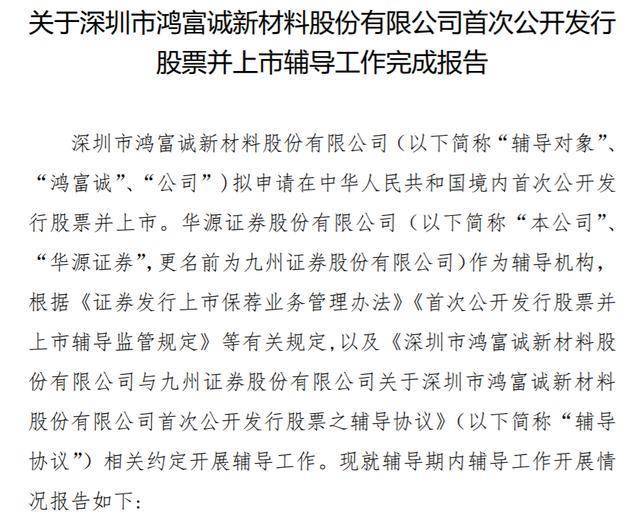
鸿富诚完成IPO辅导:增资相关对赌协议已终止,董事长孙爱祥持股51%
Sou Hu Cai Jing· 2025-11-28 10:28
Core Insights - Shenzhen Hongfucheng New Materials Co., Ltd. has completed its IPO counseling report with Huayuan Securities as the counseling institution [2] - The company signed a counseling agreement with Huayuan Securities on February 7, 2023, and conducted eleven counseling sessions up to the report date [2] Company Overview - Hongfucheng was established in May 2003 and specializes in the research, manufacturing, and sales of thermal interface materials [4] - The company's main products include shielding materials, thermal interface materials, and wave-absorbing materials, which are essential for electronic devices [4] - These materials have wide applications in mobile phones, tablets, new energy vehicles, and network communications [4] Shareholder Information - The company is primarily controlled by Sun Aixiang, who holds a 51% stake, while Zhao Jianping holds a 49% stake [5] - Sun Aixiang serves as the chairman of the company, and Zhao Jianping is a director [5] Financial Agreements - The counseling report indicates that certain agreements with shareholders contained performance-based clauses and special rights, which have been terminated and deemed invalid [4] - The termination of these clauses occurred before the issuance of the financial report and prior to the submission of the listing application materials [4]
量化派95%募资用于支付上市费,18亿对赌压力下的生死抉择
Sou Hu Cai Jing· 2025-11-28 04:47
Group 1 - The core point of the article highlights that Quantipai has finally listed on the Hong Kong Stock Exchange after an eight-year journey, but the IPO is characterized by significant financial strain, with 95% of the raised funds consumed by listing expenses [1][3]. - The company raised approximately HKD 124 million through its IPO, but after accounting for listing expenses of HKD 118 million, the net proceeds amount to only HKD 5.8 million, making it the smallest IPO in terms of issuance scale this year [3][5]. - Quantipai faces a critical financial challenge with a redemption obligation of RMB 1.839 billion due by September 2025, stemming from previous financing agreements, which poses a severe liquidity risk given its cash reserves of only RMB 362 million [5][9]. Group 2 - The company has undergone a significant business transformation from a lending platform to a consumer e-commerce platform, with its core product now being "Yang Xiaomei" [3][7]. - The revenue from its original lending services has drastically decreased from 76.8% in 2021 to just 3.2% in 2024, while the contribution from product trading has surged to 98.1% [7][9]. - Despite the transformation, there are concerns regarding the sustainability of its business model, particularly due to ongoing related-party transactions and a high volume of user complaints [9][11]. Group 3 - The company plans to allocate 55% of the net proceeds from the IPO to research and development and 45% to business promotion, but the amount raised is insufficient for substantial growth, covering only about 10% of its annual R&D expenses [13][15]. - The performance of its secondary growth initiative, the "Consumption Map" platform, has been disappointing, generating only RMB 1.447 million in revenue in the first half of 2024, which is just 3.8% of total revenue [13][15]. - The company is heavily reliant on a single revenue stream, which poses risks for future operations, especially in a competitive e-commerce landscape dominated by larger players [15].

95%募资用于支付上市费,量化派18亿对赌重压下“流血”IPO
Di Yi Cai Jing· 2025-11-26 10:17
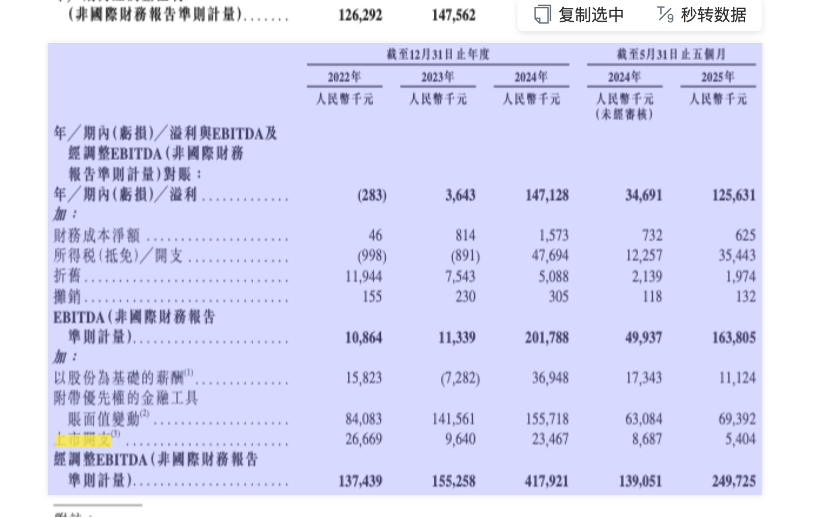
Core Viewpoint - The company, Quantitative派, is facing significant financial pressure due to high IPO costs and a looming debt burden from a redemption agreement with early investors, which could lead to a potential crisis if the IPO fails. Group 1: IPO Details - Quantitative派 plans to raise approximately HKD 124 million by issuing 13.3475 million shares at a price range of HKD 8.8 to 9.8 per share, with the listing expected on November 27 [2][3]. - The total IPO expenses are projected to be around HKD 107 million, which constitutes 94.6% of the total funds raised, leaving only about HKD 5.8 million for business development [3][5]. - The company has incurred substantial listing expenses over the past few years, with amounts of RMB 26.669 million, RMB 9.64 million, and RMB 23.467 million for the years 2022 to 2024, respectively [3]. Group 2: Financial Pressure and Debt - The company has a significant potential debt burden due to a redemption agreement tied to financial instruments valued at RMB 18 billion, which could be triggered if the IPO does not succeed [2][8]. - As of September 30, the company reported only RMB 2.1 billion in cash, raising concerns about its ability to meet short-term liabilities, which include bank loans and other debts totaling RMB 37.31 million, RMB 5.096 million, and RMB 19.916 million [10][11]. - The financial instruments' value has been increasing, with recorded values of RMB 14 billion, RMB 16 billion, RMB 17 billion, and RMB 18 billion from 2022 to May 2025 [8]. Group 3: Cost Structure and Market Comparison - The underwriting costs for Quantitative派 are unusually high, with approximately HKD 73.5 million allocated for underwriting fees, which is significantly above the typical range of 1.5% to 4% for similar IPOs [6][7]. - The company’s issuance costs deviate from market norms, where over 80% of companies have kept their issuance costs below 20% of the total funds raised [5][6]. - The high costs are attributed to the need for extensive legal and accounting due diligence due to the company's complex business model and previous failed IPO attempts [6][8].
月均营收超一亿!河南一景区有望达成11亿元对赌目标
2 1 Shi Ji Jing Ji Bao Dao· 2025-11-24 11:46
Core Insights - The Wansui Mountain Wuxia City scenic area has surpassed 17 million visitors as of October 31, generating a total revenue of 1.068 billion yuan, nearing the annual target of 1.1 billion yuan [1] - The current operational trend suggests that the revenue could reach between 1.2 billion to 1.25 billion yuan by the end of the year [1] - The revenue target is part of a "bet" agreement signed with Jinshangtianhua Cultural Tourism Group, which stipulates that if the scenic area achieves 1.1 billion yuan in total revenue by 2025, a design fee will be paid; otherwise, no payment will be made [1] Revenue Performance - As of October 31, the scenic area has achieved a revenue of 1.068 billion yuan [1] - The projected revenue by year-end is estimated to be between 1.2 billion to 1.25 billion yuan [1] Visitor Statistics - The total number of visitors to the Wansui Mountain Wuxia City has exceeded 17 million [1] - The visitor count includes unlimited entries over a three-day period [1]
上市即失效,失败就“复活”!视涯科技对赌协议引监管关注,IPO进程或添变数|透市
Hua Xia Shi Bao· 2025-11-14 09:52
Core Viewpoint - The company, Shiya Technology, is a leading player in the domestic silicon-based OLED microdisplay sector and is currently undergoing an IPO process, facing challenges such as continuous losses, rising debts, and related party transactions [2][3][4]. Group 1: IPO and Financial Performance - Shiya Technology's IPO aims to raise approximately 2.015 billion yuan, with funds allocated for expanding production lines and building a research center [2]. - The company has reported continuous revenue growth over the past three years, with revenues of 190 million yuan, 215 million yuan, and 280 million yuan for 2022, 2023, and 2024 respectively, but has incurred cumulative losses exceeding 798 million yuan during the same period [3][4]. - The company’s net profit for the same years was -247 million yuan, -304 million yuan, and -247 million yuan, indicating ongoing financial struggles [3][4]. Group 2: Market Position and Competition - Shiya Technology is recognized as the first company globally to achieve mass production of silicon-based OLED microdisplays using 12-inch wafers and holds a significant market share of 35.2%, ranking second globally and first in China [3]. - The global sales of silicon-based OLED microdisplays are projected to reach 1.27 billion yuan in 2024, with a shipment volume of approximately 6.365 million units, primarily driven by XR device applications [3]. Group 3: Research and Development - The company has invested heavily in R&D, with cumulative R&D expenditures amounting to 793 million yuan over the past three years, representing 115.61% of its total revenue during the same period [6]. - R&D personnel constitute 29.79% of the total workforce, indicating a strong focus on innovation [6]. Group 4: Risks and Concerns - The company faces scrutiny regarding its ability to achieve profitability, as continuous losses may raise concerns among regulators about its long-term viability [4][5]. - Related party transactions have been highlighted, with a significant portion of procurement costs attributed to related parties, raising potential governance issues [11][12]. Group 5: Future Outlook - The company’s gross profit margins have fluctuated, with margins of 19.12%, 17.03%, and 21.52% over the reporting period, influenced by various factors including market competition and raw material costs [13][14]. - The company plans to invest approximately 1.24 billion yuan in new projects, which may lead to increased depreciation costs, further impacting profitability if sales do not scale effectively [14].

溜溜果园两月狂奔上市 2.6亿对赌压顶与渠道利润困局
Zhi Tong Cai Jing· 2025-11-12 08:13
Core Viewpoint - Liuliu Fruit Garden Group Co., Ltd., the parent company of the "Liuliu Mei" brand, is urgently seeking to enter the capital market, having submitted its listing application to the Hong Kong Stock Exchange for the fourth time after previous attempts failed [1][3]. Group 1: Listing Attempts and Financial Pressure - The company has made multiple attempts to go public, including a withdrawal of its A-share application in December 2019 due to revenue decline and short-term profit pressure [2][3]. - A significant buyback obligation arose from a previous investment agreement, leading to a total payment of approximately 261 million yuan, which severely impacted the company's cash flow [3][4]. - As of the end of 2024, the company's cash and cash equivalents were only 78.05 million yuan, while interest-bearing bank loans reached 321 million yuan, indicating a deteriorating financial position [5][6]. Group 2: Revenue Growth and Channel Transformation - The company has shown steady revenue growth, achieving revenues of 1.174 billion yuan in 2022, 1.322 billion yuan in 2023, and 1.616 billion yuan in 2024 [7][8]. - In the first half of 2025, the company reported revenues of 959 million yuan, a year-on-year increase of approximately 25%, with net profits rising by 75.4% to 106 million yuan [8]. - The sales channel transformation has been significant, with the share of revenue from traditional distribution channels dropping from 74.5% to 31.2%, while revenue from snack specialty stores surged from 1.1% to 35.3% [8][10]. Group 3: Profitability Challenges - Despite revenue growth, the company's gross margin has been declining, from 38.6% in 2022 to 34.6% in the first half of 2025 [11][12]. - The gross margin for core products, such as dried plums, has also decreased significantly, indicating challenges in maintaining profitability amid a shift to lower-margin sales channels [11][12]. - The company faces dual pressures from the D-round financing deadline for listing and declining profitability due to its low-price volume strategy in new sales channels [12][13].

新股前瞻|溜溜果园两月狂奔上市 2.6亿对赌压顶与渠道利润困局
智通财经网· 2025-11-12 08:08
Core Viewpoint - Liuliu Fruit Garden Group Co., Ltd., the parent company of the "Liuliu Mei" brand, is urgently seeking to enter the capital market, having submitted its listing application to the Hong Kong Stock Exchange for the fourth time after previous attempts failed due to various challenges [1][3]. Group 1: Listing Attempts and Financial Pressure - The company has faced significant pressure from a bet agreement with investors, which requires it to go public by the end of 2025 or face substantial financial penalties [2][3]. - Liuliu Fruit Garden's cash flow has been severely impacted by the repayment of 261 million yuan, which includes the original investment and interest, far exceeding the initial investment of 135 million yuan [3][4]. - As of the end of 2024, the company's cash and cash equivalents were only 78.05 million yuan, while interest-bearing bank loans reached 321 million yuan, indicating a deteriorating financial position [5][6]. Group 2: Revenue Growth and Channel Transformation - The company has shown steady revenue growth, achieving 1.174 billion yuan in 2022, 1.322 billion yuan in 2023, and 1.616 billion yuan in 2024, with a net profit increase from 68.43 million yuan in 2022 to 148 million yuan in 2024 [7][8]. - A significant shift in sales channels has occurred, with the revenue share from traditional distribution channels dropping from 74.5% to 31.2%, while revenue from snack specialty stores surged from 1.1% to 35.3% [8][10]. - The company’s reliance on a few major clients has increased, with the top five clients accounting for 43.7% of revenue in the first half of 2025, raising concerns about potential revenue volatility if these relationships change [10]. Group 3: Profitability Challenges - Despite revenue growth, the company's gross margin has been declining, from 38.6% in 2022 to 34.6% in the first half of 2025, primarily due to a low-price volume strategy adopted to compete in new sales channels [11][12]. - The gross margin for core products, such as dried plums, has also decreased significantly, indicating challenges in maintaining profitability amid aggressive pricing strategies [11][12]. - The company faces a critical need to balance expansion and profitability while navigating the pressures from both capital requirements and market competition [13].

强一股份单一客户依赖八成:对赌协议暗藏隐忧,韩国公司曾被调查
Sou Hu Cai Jing· 2025-11-12 02:10
Core Viewpoint - The company, Qiangyi Semiconductor (Suzhou) Co., Ltd., is preparing for its IPO on the Sci-Tech Innovation Board, with significant revenue concentration from a single major client, raising concerns about sustainability and independence [2][8]. Financial Performance - The company reported sales revenue from probe cards of 2.17 billion, 3.1 billion, 6.07 billion, and 3.59 billion CNY for the years 2022 to 2025 (first half), accounting for over 96% of total revenue during these periods [3][5]. - The total revenue for the same periods was 2.54 billion, 3.54 billion, 6.41 billion, and 3.74 billion CNY, with net profits of 156.22 million, 186.58 million, 2.33 billion, and 1.38 billion CNY respectively [5][6]. - For the first nine months of 2025, the company achieved a revenue of 6.47 billion CNY, a year-on-year increase of 65.88%, and a net profit of 2.48 billion CNY, up 100.13% [5]. Customer Concentration - Over 80% of the company's revenue comes from a single major client, referred to as Company B, with sales to the top five clients accounting for 62.28%, 75.91%, 81.31%, and 82.84% of total revenue during the reporting periods [7][8]. - The company has established a long-term procurement agreement with Company B, which has significantly influenced its revenue growth [8][9]. Product Sales Breakdown - The sales revenue from 2D/2.5D MEMS probe cards was 1.24 billion, 2.32 billion, 4.78 billion, and 3.17 billion CNY, representing 57.12%, 74.74%, 78.82%, and 88.37% of total sales respectively [4]. - The sales of cantilever probe cards showed a decrease in quantity but an increase in revenue due to prioritizing higher-value products [4][5]. Supply Chain and Related Transactions - The company has a high concentration of suppliers, with the top five suppliers accounting for 49.14%, 40.19%, 60.67%, and 64.27% of total procurement [11]. - The company has been involved in significant related-party transactions, with a notable portion of sales and purchases linked to Company B and a related entity, Nantong Yuan Zhou Li [10][12]. Future Outlook - The company plans to raise 1.5 billion CNY through its IPO, with 1.2 billion CNY allocated for R&D and production of probe cards, and 300 million CNY for the construction of its headquarters and R&D center [16]. - The company aims to reduce customer concentration by expanding its product offerings and market reach, particularly in the storage sector [9].