
生态优先

Search documents
十年来 优良水质比例增近三成 地区生产总值翻一番多 长江经济带绿色发展成效显著
Jing Ji Ri Bao· 2026-01-05 22:49
Core Insights - The Yangtze River Economic Belt has seen a significant improvement in water quality, with the proportion of good water quality rising from 67% to 96.5% over the past decade, while the regional GDP has more than doubled, increasing its share of the national GDP from 42.2% to 47.3% [1] Group 1: Environmental Protection and Green Development - The principle of "coordinated protection, not large-scale development" has been firmly established in the Yangtze River Economic Belt, leading to enhanced ecological quality [2] - Over the past decade, more than 1,300 national nature reserves have completed rectification of key ecological issues, and 17 integrated ecological protection and restoration projects have been implemented [2] - The region has established 24 national carbon peak pilot cities and parks, and 14 zero-carbon parks, while supporting the scrapping and updating of approximately 10,000 old operating vessels [2] Group 2: Technological and Industrial Innovation - The Yangtze River Economic Belt has become a hub for technological resources and innovation, with the establishment of 3 technology innovation centers and 8 national laboratories, leading to breakthroughs in key core technologies [3] - The region has cultivated 41 national advanced manufacturing clusters and 30 strategic emerging industry clusters, contributing nearly half of the national GDP while accounting for about one-third of energy consumption and carbon emissions [3] Group 3: Infrastructure and Transportation - The development of the Yangtze River Economic Belt has focused on enhancing the functionality of the Yangtze Golden Waterway, with the high-grade navigable waterways increasing from 8,000 kilometers to 11,500 kilometers [3] - The cargo throughput of major ports has increased by 71%, reaching 4.2 billion tons, maintaining its position as the world's leading inland waterway [3] Group 4: Social Welfare and Livelihood Improvement - The implementation of a 10-year fishing ban has led to improved biodiversity and stable management of fishing resources, with nearly 100% employment rate for retrained fishermen [4] - Measures have been taken to ensure social security for 231,000 retrained fishermen, including pension insurance and basic living guarantees for 12,000 low-income fishermen [4] Group 5: Cultural Heritage and Community Development - The Yangtze River Economic Belt emphasizes the protection and promotion of cultural heritage, with initiatives to enhance the cultural landscape and integrate traditional culture with modern development [5] - The region has achieved a harmonious coexistence between people and nature, fostering industrial upgrades and cultural tourism [5] Group 6: Future Development Plans - The Yangtze River Economic Belt is entering its second decade of development, with plans to implement a comprehensive development strategy focusing on ecological, innovative, open, cultural, and happy development [6]
10年来,长江经济带走出一条生态优先、绿色发展的新路子 优良水质比例提升近30个百分点,地区生产总值翻一番多(权威发布)
Ren Min Ri Bao· 2026-01-05 22:28
Core Insights - The development of the Yangtze River Economic Belt has led to significant improvements in ecological quality, economic growth, and social welfare over the past decade, with a focus on green development and ecological protection [1][2][3][4][5]. Economic Development - The per capita disposable income of residents increased from 23,000 yuan to 44,000 yuan, a growth of 91% [3][5]. - The regional GDP more than doubled, with its share of the national total rising from 42.2% to 47.3% [1][5]. Ecological Improvements - The proportion of good water quality in the Yangtze River increased from 67% to 96.5% [5]. - The water quality of the main river has been maintained at Class II for six consecutive years, and the population of flagship species like the Yangtze River dolphin has increased [4][6]. Infrastructure and Transportation - The high-grade navigable waterways of the Yangtze River increased from 8,000 kilometers to 11,000 kilometers, with cargo throughput at trunk ports growing by 71% to reach 4.2 billion tons, maintaining the world's leading position in inland river transport [3][8]. - The construction of a comprehensive transportation corridor along the river has accelerated, enhancing connectivity and trade [3]. Industrial Transformation - The Yangtze River Economic Belt has seen the establishment of 41 national-level advanced manufacturing clusters and 30 strategic emerging industry clusters, accounting for 51% and 45% of the national totals, respectively [7]. - Traditional industries such as steel and petrochemicals are undergoing green transformation, with 24 national carbon peak pilot cities and parks established [7]. Cultural and Social Development - Efforts to protect and promote the cultural heritage of the Yangtze River have been emphasized, including the establishment of the Yangtze National Cultural Park [3]. - Water projects have effectively protected the safety of people's lives and property, with over 840 billion cubic meters of water supplied through the South-to-North Water Diversion Project, benefiting 1.95 million people [3].
十年护江路,一部山河志
Jiang Nan Shi Bao· 2026-01-05 15:00
Core Viewpoint - The publication of the long-form report literature "Wind from the River" highlights the ecological protection practices in Jiangsu as part of the national strategy of "promoting major protection and not major development" for the Yangtze River, marking a significant shift in development paths and emphasizing the importance of ecological preservation in China's modernization journey [1][2]. Group 1: Jiangsu's Role in Ecological Protection - Jiangsu, as the last stop before the Yangtze River flows into the sea, has the longest river coastline in the country and has historically been economically prosperous due to its connection with the river [3]. - The province has faced severe ecological challenges due to intensive development, with 47% of its area accommodating 60% of the population, 70% of investments, and 80% of economic output [3]. - Since 2016, Jiangsu has closed over 50,000 "scattered and polluting" enterprises and shut down more than 4,900 low-quality chemical companies, significantly increasing the ecological shoreline to 64.5% [4]. Group 2: Achievements in Water Quality and Biodiversity - The water quality of the Yangtze River in Jiangsu has consistently met Class II standards for seven consecutive years, with 100% of tributaries achieving Class III quality [4]. - The ecological restoration efforts have led to the return of the Yangtze River dolphin and improved aquatic life, showcasing a harmonious relationship between urban development and nature [4]. Group 3: Literary Contribution and Societal Impact - The author, Zhang Maolong, spent nearly three years documenting the ecological transformation along the Yangtze River in Jiangsu, emphasizing the collaborative efforts across regions and sectors [5][6]. - The work illustrates the successful integration of ecological protection with economic development, arguing that green transformation is essential for achieving a higher quality and more sustainable future [7].
十年,十个字,重塑长江
Xin Lang Cai Jing· 2026-01-05 14:33
Core Viewpoint - The development of the Yangtze River Economic Belt is crucial for the overall national development strategy, emphasizing ecological protection over extensive development [3][4]. Group 1: Ecological Protection and Governance - The Yangtze River, as a vital waterway, faces severe ecological challenges due to long-term extensive development, leading to issues like droughts in key lakes and a decline in biodiversity [1]. - The concept of "coordinated protection" has been established to address fragmented governance, promoting a collaborative approach across provinces for ecological compensation and joint management of river basins [6][7]. - Over the past decade, significant progress has been made in ecological protection, including the closure of illegal docks and improvements in water quality, with the Yangtze's water quality upgraded from class V to class II [9]. Group 2: Economic Development and Innovation - The principle of "coordinated protection, not extensive development" aims to enforce ecological priorities, driving industrial transformation and achieving high-quality development [10]. - The Yangtze River Economic Belt is positioned as a key area for ecological priority and green development, fostering innovation and the growth of competitive industries, such as automotive manufacturing and electronics [10]. - By 2025, the cargo throughput of the Yangtze River's mainline ports is projected to reach 4.2 billion tons, maintaining its status as the world's leading inland river [10].

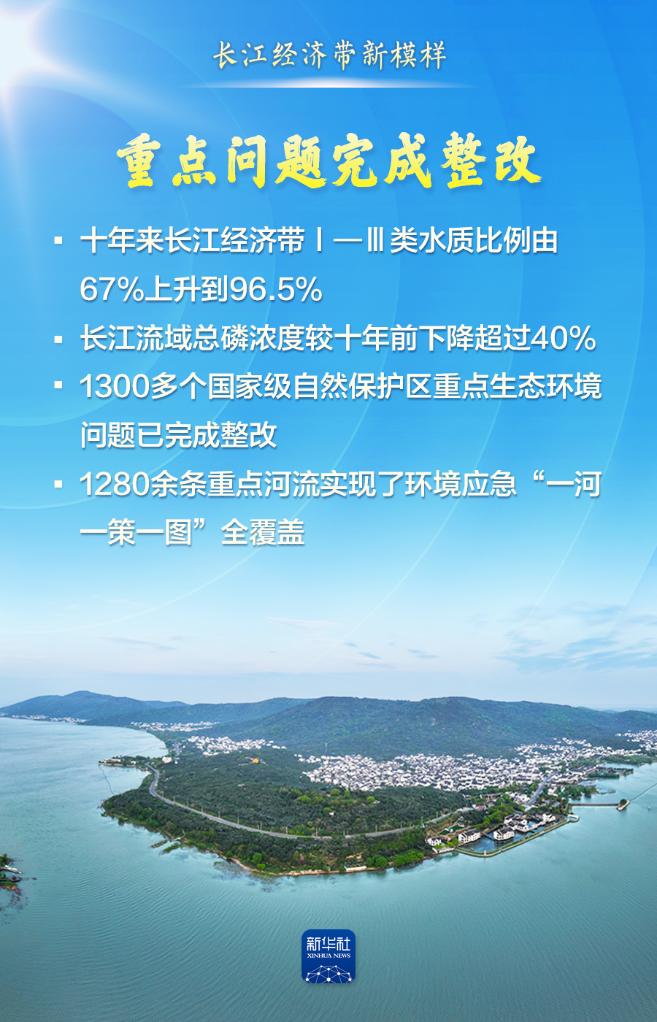
这组数据,描绘长江经济带新模样!
Xin Hua Wang· 2026-01-05 12:51
Core Viewpoint - The Yangtze River Economic Belt has achieved significant ecological and economic advancements over the past decade, emphasizing ecological priority and green development, leading to a harmonious coexistence of nature and human activities [1]. Environmental Protection and Quality Improvement - The proportion of water quality classified as good has increased from 67% to 96.5% [4]. - Total phosphorus concentration in the Yangtze River basin has decreased by over 40% compared to ten years ago [4]. - More than 1,300 national nature reserves have completed key ecological environment issue rectifications [4]. - Over 1,280 key rivers have achieved full coverage of environmental emergency management [4]. Infrastructure and Economic Development - The high-grade navigable waterway mileage has reached 11,500 kilometers [6]. - By 2025, the throughput of Yangtze River mainline ports is expected to reach 4.2 billion tons, with the number of major ports increasing to 18 [6]. Flood Control and Water Resource Management - Successfully managed the 2020 regional flood by preventing 49 billion cubic meters of floodwater, protecting 1,752 million people and 1.1 million hectares of farmland [8]. - Ensured safe drinking water for urban populations and irrigation for 1.83 million acres of autumn crops [8]. Green and Low-Carbon Industrial Transformation - Three technology innovation centers and eight national laboratories have been established along the river [11]. - By 2025, the production of new energy vehicles in Shanghai, Jiangsu, Zhejiang, Anhui, and Chongqing is expected to exceed one million units each [11]. - 24 cities and parks have been designated as national carbon peak pilot areas, with 14 zero-carbon parks established [11]. Pollution Control and Regulatory Framework - Over 160,000 kilometers of river and lake shorelines have been inspected, with more than 200,000 pollution outlets accurately identified [12]. - A comprehensive supervision management system for pollution outlets has been established [12]. Fisheries and Biodiversity Conservation - The release of over one million Chinese sturgeons is planned for 2024 and 2025 [13]. - The population of Yangtze River dolphins is steadily increasing, with the distribution range expanding [13]. - A total of 344 fish species have been monitored in the Yangtze River basin from 2021 to 2024, an increase of 36 species compared to before the fishing ban [13]. Multi-Modal Transport and Connectivity - The implementation of a comprehensive transport system has led to significant improvements in multi-modal transport [14]. - By the "14th Five-Year Plan" period, the railway port rate for major ports along the Yangtze River is expected to exceed 90%, with an annual growth rate of over 30% for container rail-water intermodal transport [14]. Flood Prevention Infrastructure - More than 300 large reservoirs have been built in the Yangtze River basin, with a flood control capacity of 80 billion cubic meters [15]. - Over 1,000 kilometers of riverbanks have been treated to stabilize the river flow in the middle and lower reaches [15].
国家发展改革委:长江经济带十年来地区生产总值占全国比重从42.2%提升到47.3%
Xin Hua Cai Jing· 2026-01-05 06:59
Core Viewpoint - The Yangtze River Economic Belt has achieved significant ecological and economic progress over the past decade, with a focus on ecological priority and green development, leading to improved water quality and increased GDP contribution to the national economy [1] Group 1: Ecological Progress - The proportion of good water quality in the Yangtze River Economic Belt has increased from 67% to 96.5% over the past ten years [1] - The GDP of the region has more than doubled, rising from 42.2% to 47.3% of the national total [1] - The concept of "big protection, not big development" has been effectively implemented, leading to significant pollution control in key areas such as industrial and agricultural sectors [1] Group 2: Technological and Industrial Innovation - The integration of technological and industrial innovation in the Yangtze River Economic Belt has accelerated, with a focus on fostering emerging and future industries [2] - The length of high-level navigable waterways has increased from 8,000 kilometers to 11,000 kilometers, and cargo throughput at mainline ports has grown by 71% to reach 4.2 billion tons [2] - The establishment of international technology innovation centers in Shanghai, Wuhan, and Chengdu-Chongqing regions has led to the emergence of competitive innovative enterprises [2] Group 3: Cultural Heritage and Community Well-being - The cultural heritage along the Yangtze River has been preserved and promoted, with significant archaeological discoveries and the establishment of the Yangtze National Cultural Park [3] - The flood control and disaster reduction system in the Yangtze River basin has been improved, protecting lives and property [3] - The per capita disposable income of residents has increased from 23,000 yuan to 44,000 yuan, representing a growth of 91% [3]
确保一江清水绵延后世、惠泽人民
Xin Hua Wang· 2026-01-05 01:51
Core Viewpoint - The development of the Yangtze River Economic Belt over the past decade has focused on ecological protection and high-quality development, emphasizing the need for sustainable practices and environmental restoration [1][3][30]. Group 1: Ecological Restoration and Economic Transformation - The ecological environment of the Yangtze River has significantly improved, with over 96% of national control sections showing good water quality, and the population of Yangtze finless porpoises increasing to 1,249 [13]. - The shift from coal mining to agriculture, such as the successful cultivation of oranges in Fengjie County, exemplifies the region's transition to a green economy [2][3]. - The implementation of the "Ten-Year Fishing Ban" aims to restore aquatic biodiversity, allowing fish populations to recover and providing new livelihoods for former fishermen [16][17]. Group 2: Policy and Legal Framework - The introduction of the "Yangtze River Protection Law" in March 2021 provides a legal foundation for ecological protection efforts, reinforcing the commitment to sustainable development [9]. - A series of policies and planning documents have been released to support the ecological and economic goals of the Yangtze River Economic Belt, creating a cohesive strategy for development [9][24]. Group 3: Collaborative Governance and Community Involvement - The establishment of a river chief system has mobilized local communities to participate in river management, fostering a culture of environmental stewardship [10][11]. - Cross-regional cooperation among provinces along the Yangtze River has improved water quality management and ecological restoration efforts, demonstrating the importance of collaborative governance [7][8]. Group 4: Economic Development and Innovation - The Yangtze River Economic Belt has become a hub for the automotive industry, with the region accounting for 40% of China's new energy vehicle production [22]. - Technological innovation is driving economic transformation, with cities like Chengdu and Hefei focusing on advanced manufacturing and quantum technology [23][24]. - The economic output of the Yangtze River Economic Belt is projected to exceed 63 trillion yuan, contributing over 50% to national economic growth [24][27].
确保一江清水绵延后世、惠泽人民——写在推动长江经济带发展座谈会召开十周年之际
Xin Hua Wang· 2026-01-04 17:08
Core Viewpoint - The development and protection of the Yangtze River, referred to as the "mother river" of the Chinese nation, is a priority for sustainable economic growth and ecological preservation, emphasizing the need for a balance between environmental protection and economic development [1][3][24]. Group 1: Ecological Restoration and Economic Transformation - The Yangtze River Economic Belt has undergone significant ecological restoration over the past decade, with a focus on high-level protection and high-quality development [1][4]. - The shift from coal mining to agriculture, such as the cultivation of oranges in Chongqing, exemplifies the successful transition to a green economy [2][3]. - The ecological environment has improved, with the proportion of good water quality monitoring points exceeding 96%, and the number of native fish species increasing [13]. Group 2: Policy and Legal Framework - The implementation of the "Yangtze River Protection Law" in 2021 provides a legal framework for ecological protection, emphasizing ecological priority and green development [9]. - A series of policies and planning documents have been introduced to support the sustainable development of the Yangtze River Economic Belt [9]. Group 3: Collaborative Governance - Collaborative governance among upstream and downstream regions is essential for effective ecological protection, with initiatives like joint river patrols and cross-province cooperation being established [7][8]. - The establishment of an ecological compensation system has been initiated, with 16 cross-province ecological protection compensation mechanisms in place [8]. Group 4: Economic Development and Innovation - The Yangtze River Economic Belt has become a hub for the automotive industry, with the region accounting for 40% of China's new energy vehicle production [22]. - Technological innovation is driving economic transformation, with cities like Chengdu and Hefei focusing on advanced manufacturing and quantum technology [23][24]. Group 5: Future Outlook - The Yangtze River Economic Belt is positioned as a critical area for China's high-level opening-up strategy, with significant contributions to national trade and economic growth [26][27]. - Continued efforts in ecological protection and economic development are expected to yield long-term benefits for future generations [30].
深入推进大保护 打造引领高质量发展生力军——推动长江经济带发展座谈会召开四年间
Si Chuan Ri Bao· 2026-01-04 07:05
Core Viewpoint - The development of the Yangtze River Economic Belt is a significant strategy aimed at ecological protection and high-quality economic growth, emphasizing the importance of prioritizing ecological restoration over development [2][6][7]. Group 1: Ecological Protection and Economic Growth - From January to November 2019, the proportion of good water quality in the Yangtze River Economic Belt reached 82.5%, exceeding the national average by 6.1 percentage points [3]. - The GDP growth rate of the 11 provinces and cities along the river in the first three quarters was 7.1%, 0.9 percentage points higher than the national average, with the economic total accounting for 44.5% of the national total [3]. - The implementation of a 10-year ban on commercial fishing in 332 natural reserves and fishery resource protection areas in the Yangtze River Basin began on January 1, 2020 [4]. Group 2: Legislative and Regulatory Framework - The draft of the "Yangtze River Protection Law" was submitted for review, marking a significant step towards comprehensive ecological protection in the Yangtze River Basin [4]. - The establishment of a problem account and monitoring mechanism for 163 ecological issues was initiated, with 115 issues rectified as of now [9]. Group 3: Infrastructure and Pollution Management - By mid-December 2019, the length of sewage collection networks in cities along the Yangtze River increased by 3,954 kilometers compared to the end of 2018 [10]. - A total of 579 tailings ponds have been closed, and 958 chemical enterprises have been relocated or transformed since 2019 [10]. Group 4: Community and Environmental Improvements - The ecological restoration of the Yangtze River's banks has improved the happiness and sense of gain among local residents, with significant water quality improvements noted in areas like the Dianchi Lake [11]. - The removal and consolidation of over 300 various docks in Wuhan have revealed long-hidden riverbanks, enhancing urban aesthetics [11]. Group 5: Strategic Development Initiatives - The release of the "Yangtze River Delta Regional Integration Development Plan" on December 1, 2019, represents a new national strategic blueprint [12]. - The Yangtze River Economic Belt is becoming a crucial growth engine for high-quality development, with initiatives to enhance industrial collaboration and innovation [13][16].
双赢的“绿色答卷”
Xin Lang Cai Jing· 2026-01-03 19:18
(来源:内蒙古日报) 转自:内蒙古日报 □本报记者 胡芳 韩雪茹 曾几何时,陈巴尔虎旗在草原利用与生态保护之间寻找着"平衡点"。过度放牧导致草场退化、沙化面积 逐年扩大,黄沙漫过草场、侵蚀家园的景象,成为当地牧民心中的痛。 如何破局"沙进草退",考验着决策者的智慧与担当。面对这道时代考题,陈巴尔虎旗锚定生态优先、绿 色发展,在守住生态底线的前提下,探索可持续发展模式。 当呼伦贝尔大草原被皑皑白雪裹上银装,莫尔格勒河勾勒出"天下第一曲水"的冰雪奇观,冬日的陈巴尔 虎草原更显纯净辽阔。 陈巴尔虎旗,是镶嵌在"世界四大草原"之一呼伦贝尔大草原腹地的明珠。绿色,是这片草原的美丽容 颜、生态风骨,也是这片土地的天然禀赋、宝贵价值。 特殊的生态环境,赋予其特殊的使命。陈巴尔虎旗将生态优先、绿色发展理念深度融入经济社会发展各 方面、全过程,持续推进生态保护与修复工作,交出了一份生态文明建设的靓丽答卷。 护"绿"有方 夯实永续发展根基 "这片地曾经是沙地,你信吗?"陈巴尔虎旗林业和草原局局长陈永洁指着比膝盖还高的茂密植被,语气 中满是自豪。 在位于呼和诺尔镇白音布日德嘎查的陈巴尔虎旗退化草原人工种草生态修复国家试点项目(重度 ...