
芯片设计

Search documents
兆易创新港股IPO获中国证监会备案
Zhi Tong Cai Jing· 2025-12-09 12:21
Group 1 - The China Securities Regulatory Commission has issued a notice regarding the overseas issuance and listing of shares for Zhaoyi Innovation Technology Group Co., Ltd. [1] - Zhaoyi Innovation plans to issue no more than 51,796,900 overseas listed ordinary shares and list them on the Hong Kong Stock Exchange [1] Group 2 - The company is a global leader in diversified chip design, providing a range of products including Flash, niche DRAM, MCU, analog chips, and sensor chips, along with corresponding algorithms and software solutions [3] - The company operates under a fabless business model, focusing on integrated circuit design and R&D to maintain technological leadership [3] - According to a report by Frost & Sullivan, the company is a market leader in multiple fields and is the only integrated circuit design company globally ranked in the top ten for NOR Flash, SLC NAND Flash, niche DRAM, and MCU based on 2024 sales [3]


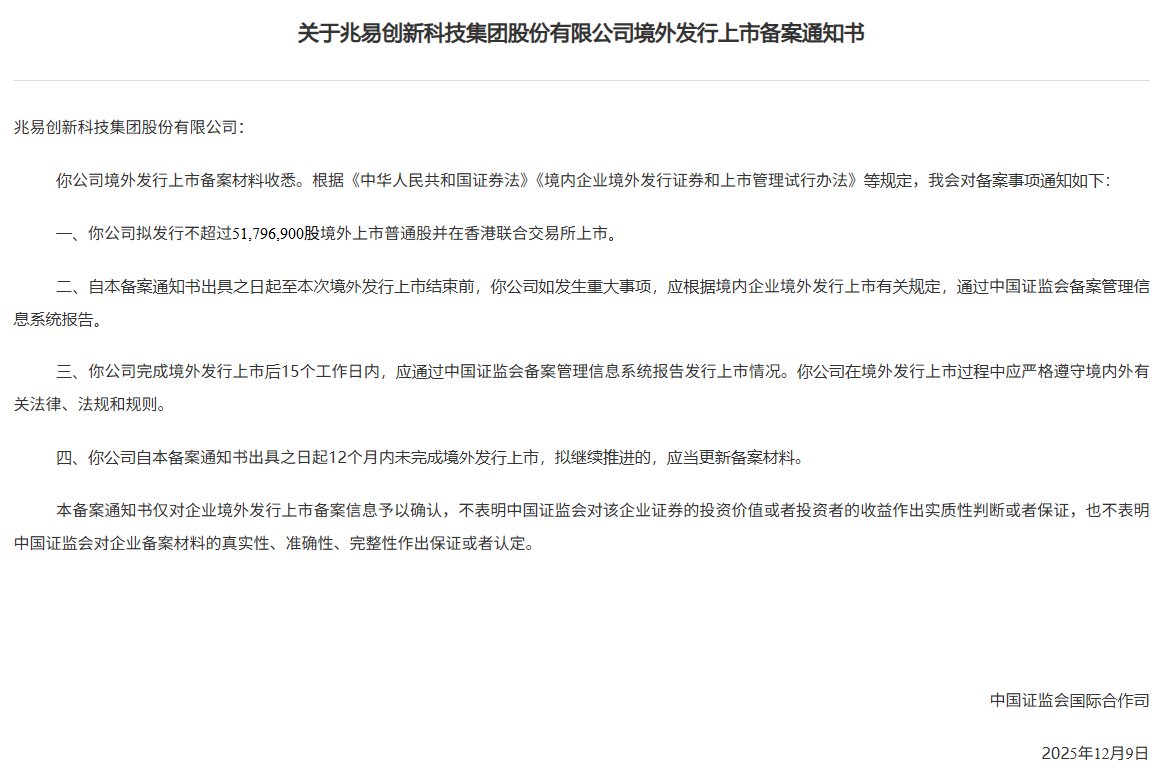
新股消息 | 兆易创新(603986.SH)港股IPO获中国证监会备案
智通财经网· 2025-12-09 12:16
Group 1 - The China Securities Regulatory Commission has issued a notice regarding the overseas issuance and listing of Zhaoyi Innovation Technology Group Co., Ltd., allowing the company to issue no more than 51,796,900 overseas listed ordinary shares and list on the Hong Kong Stock Exchange [1] Group 2 - The company is a global leader in diversified chip design, providing a wide range of chip products including Flash, niche DRAM, MCU, analog chips, and sensor chips, along with corresponding algorithms and software solutions [3] - The company operates under a fabless business model, focusing on integrated circuit design and R&D to maintain technological leadership [3] - According to a report by Frost & Sullivan, the company is a market leader in multiple fields and is the only integrated circuit design company globally ranked in the top ten for NOR Flash, SLC NAND Flash, niche DRAM, and MCU based on 2024 sales [3]
Marvell股价暴跌
半导体行业观察· 2025-12-09 01:50
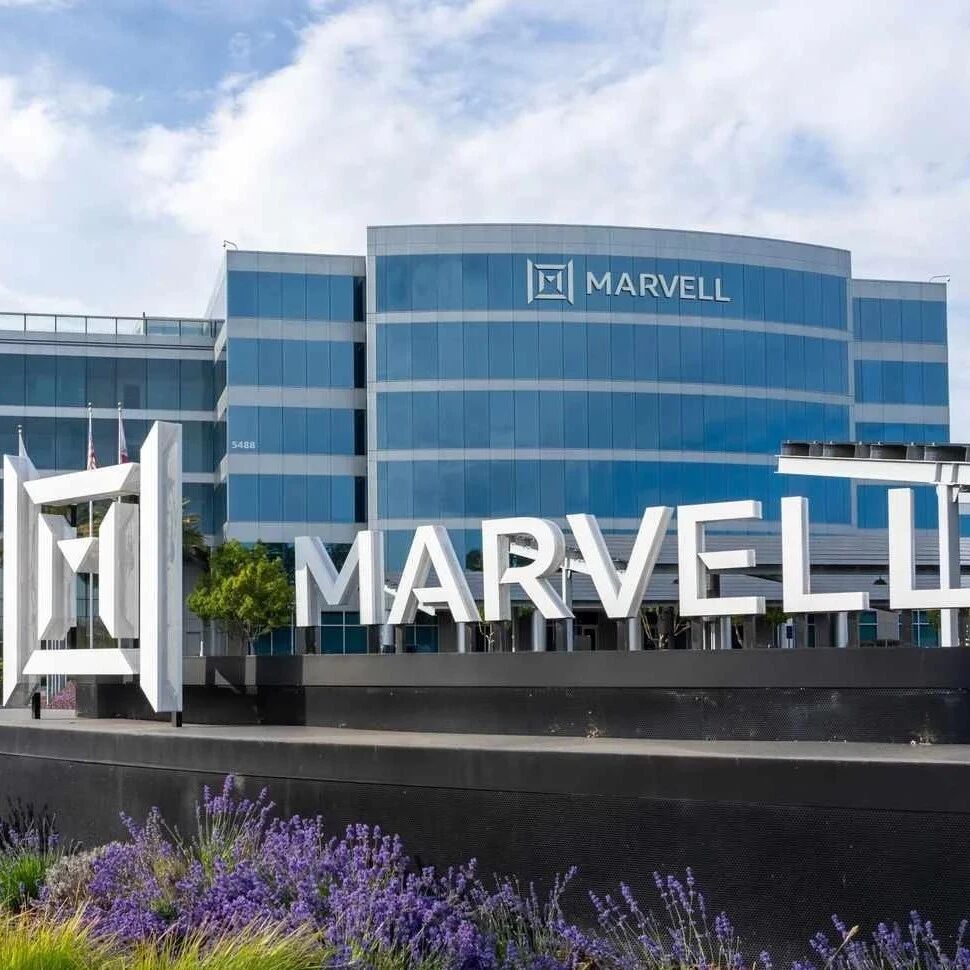
Core Viewpoint - Marvell Technology's competitive position has become a focal point of discussion on Wall Street, with investors showing increasing pessimism regarding the company's collaboration with Amazon and Microsoft [2][3]. Group 1: Stock Performance and Analyst Ratings - Marvell's stock price fell by 6.99% on Monday, reflecting market concerns about its business with Amazon and Microsoft [2]. - Benchmark analyst Cody Acree downgraded Marvell's stock rating from "Buy" to "Hold," citing a high level of confidence that the company has lost design contracts for Amazon's Trainium 3 and Trainium 4, which may shift to Alchip [2][3]. - Acree suggested that investors should take profits, as the market may have been overly optimistic about recent signals from Amazon regarding stability [2]. Group 2: Revenue Outlook and Client Relationships - Acree acknowledged that the downgrade is controversial, especially since Marvell emphasized during its earnings call that it does not expect a revenue "cliff" from Amazon next year [3]. - Amazon is Marvell's largest customer for XPU (custom chips), and Marvell previously indicated high visibility for future orders, which could drive annual revenue [3]. - Acree believes that Marvell's revenue growth guidance from Amazon is sincere but primarily relies on continued shipments of Trainium 2 and the Kuiper low-orbit satellite project, rather than a successful transition to Trainium 3 [3]. Group 3: Future Prospects and New Clients - Marvell anticipates that its XPU business will see a resurgence in fiscal year 2028, driven by a new large-scale cloud customer, with incremental growth expected in subsequent years [4]. - Marvell's CEO, Matt Murphy, stated that data center revenue for fiscal year 2028 could accelerate significantly compared to the previous year [4]. - TD Cowen analyst Joshua Buchalter noted that Marvell's outlook for 2028, along with the acquisition of Celestial AI, provides bullish arguments, with speculation that the new customer could be Microsoft for its Maia AI accelerator [4].
【快讯】每日快讯(2025年12月5日)
乘联分会· 2025-12-05 08:39
Domestic News - China has released an international standard for a universal simulation model for renewable energy generation, which will support the safe integration of large-scale renewable energy into the grid [7] - Hubei's 14th Five-Year Plan emphasizes the development of event economy, exhibition economy, and performing arts economy to enhance consumption and economic growth [8] - Zhiji Auto has introduced a year-end purchase tax subsidy plan, offering up to 15,000 yuan for customers who complete orders by December 31, 2025 [9] - Dongfeng Fengxing has launched a year-end purchase incentive policy with a maximum vehicle replacement subsidy of 35,000 yuan [10] - Changan Automobile plans to introduce its Avita and Nevo brands in the European market within the next two years [11] - BYD aims to expand its dealer network in South Africa to 60-70 by the end of 2026 [12] - Li Auto has achieved the milestone of 20,000 supercharging piles in 2 years and 8 months, becoming the leading company in supercharging infrastructure in China [13] - Hello's first L4 autonomous driving model is expected to go into mass production in June 2026 [14] Foreign News - Former President Trump announced a reduction in fuel economy standards for vehicles produced in the U.S., with the new standard set at approximately 34.5 miles per gallon by 2031, down from 50.4 miles per gallon [16] - The UK energy regulator has allocated £28 billion for upgrading the energy network, with £17.8 billion for gas network maintenance and £10.3 billion for strengthening the transmission network [17] - Volkswagen Group plans to transform its Dresden factory into an AI and chip technology center after ceasing vehicle production [18] - Stellantis CEO announced a strategic shift towards hybrid vehicles as a core focus in the U.S. market, moving away from the previous emphasis on fully electric vehicles [19] Commercial Vehicles - Iveco's off-road vehicle, the Eurocargo, has been awarded "Off-Road Vehicle of the Year" at the 2026 China Commercial Vehicle Annual Model event [20] - The first locally manufactured Scania Super trucks have officially rolled off the production line in Jiangsu, marking a significant milestone for Scania in the Chinese market [21] - All models of the Maxus commercial vehicles have received a five-star safety rating from Euro NCAP, establishing a new safety benchmark in the global commercial vehicle sector [22] - Guangzhou has launched the second batch of fuel cell vehicle demonstration operation subsidies for 2025, with subsidies up to 100,000 yuan for heavy hydrogen fuel cell vehicles [23]

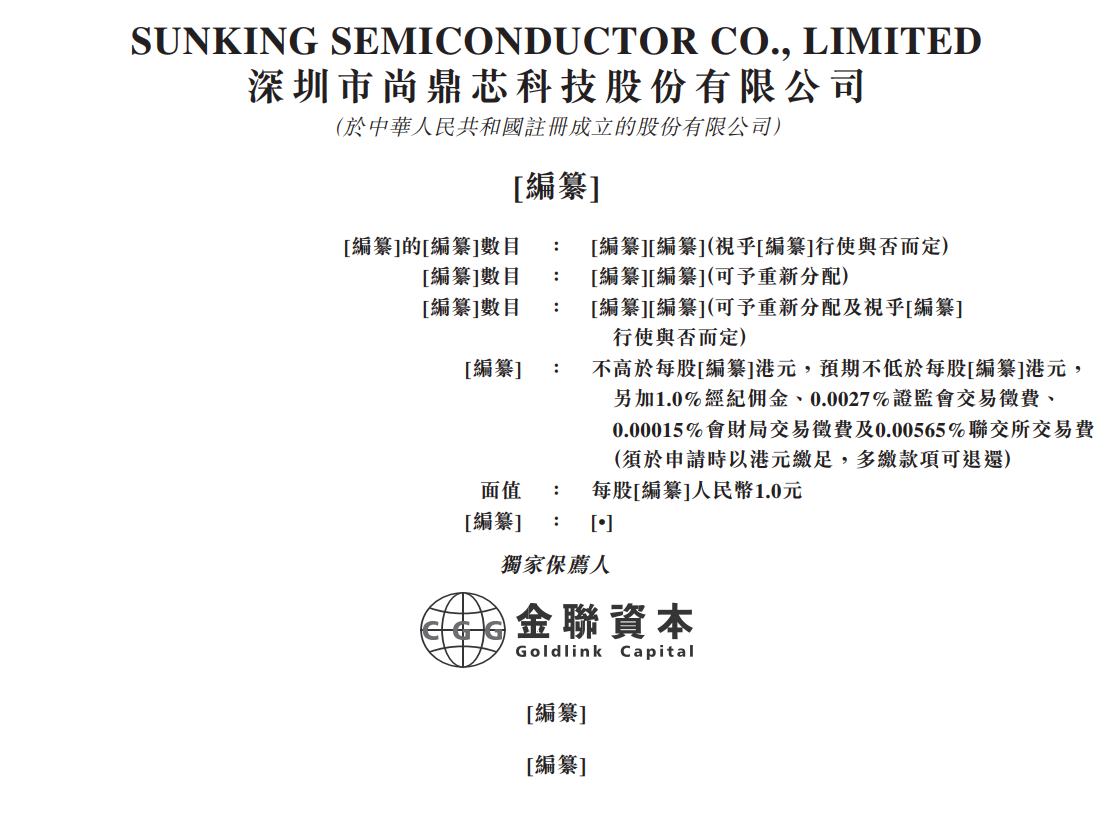
新股消息 | 尚鼎芯二度递表港交所 为无晶圆厂功率半导体供应商
智通财经网· 2025-12-03 01:09
Company Overview - Shangdingxin is a fabless power semiconductor supplier specializing in the development and supply of customized power device products, primarily focusing on MOSFETs, IGBTs, GaN MOSFETs, and SiC MOSFETs [3][4] - The company provides tailored technical application solutions for clients, enhancing the functionality of electrical devices and products used in various applications, including consumer electronics, industrial control, automotive electronics, renewable energy, and medical devices [3] Industry Insights - The global power device market, which includes components like thyristors, transistors, and diodes, is projected to grow from approximately $23 billion in 2019 to about $28.8 billion by 2024, with a compound annual growth rate (CAGR) of around 4.6% [9] - The Chinese MOSFET market is expected to grow from approximately $3.3 billion in 2019 to about $5.9 billion by 2024, reflecting a CAGR of approximately 12.2% [11] - The IGBT market in China is projected to increase from about $1.8 billion in 2019 to approximately $3.1 billion by 2024, with a CAGR of around 11.7% [13] Financial Performance - The company recorded revenues of RMB 167.3 million, RMB 113.1 million, RMB 121.7 million, and RMB 105.2 million for the fiscal years 2022, 2023, 2024, and the nine months ending September 30, 2025, respectively [5] - The profit figures for the same periods were RMB 53.6 million, RMB 31.0 million, RMB 35.1 million, and RMB 30.3 million [6] - The gross profit margins for the years 2022, 2023, 2024, and the nine months ending September 30, 2025, were 55.8%, 55.0%, 56.9%, and 57.1%, respectively [7] Market Trends - The demand for MOSFETs is expected to continue growing due to their applications in consumer electronics, automotive, and renewable energy systems, driven by advancements in third-generation semiconductor materials like SiC and GaN [4][11] - The automotive industry, particularly electric vehicles, is anticipated to be a significant growth driver for power devices, supported by stricter emissions regulations in regions like the EU and China [9]
浙商大佬又捐股票:市值超36亿元
Mei Ri Jing Ji Xin Wen· 2025-12-02 23:57
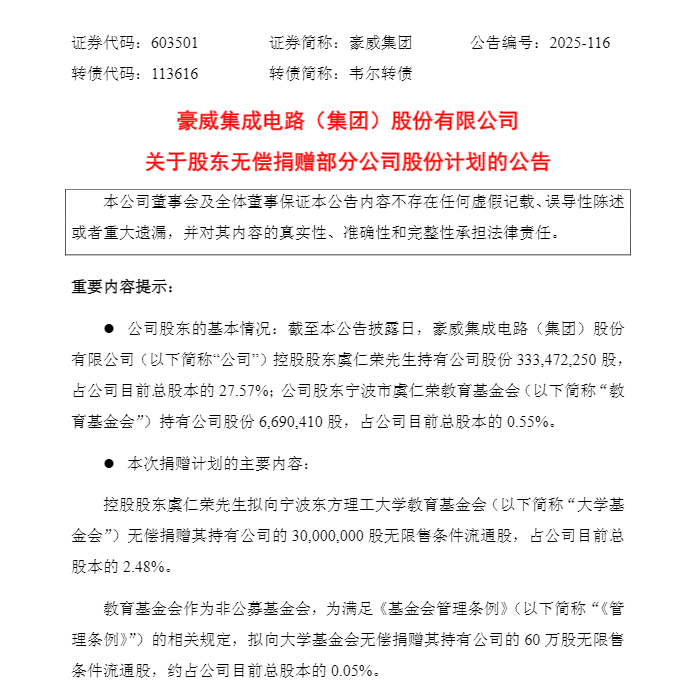
Core Viewpoint - The controlling shareholder of Haowei Group, Yu Renrong, plans to donate 30 million shares of the company, representing 2.48% of the total share capital, to the Ningbo Dongfang University Education Foundation, which will increase the foundation's shareholding from 3.36% to 5.89% [1][3]. Shareholding Changes - After the donation, Yu Renrong's shareholding will decrease from 27.57% to 25.09%, while the Education Foundation's shareholding will drop from 0.55% to 0.50% [3][4]. - The donation is valued at over 3.6 billion yuan based on the closing price of 121.08 yuan per share [4]. Previous Donations - This is not the first donation by Yu Renrong to the Education Foundation; he has previously donated a total of 50 million shares, valued at approximately 5.3 billion yuan, over the past year [8]. - The Ningbo Dongfang University was established with significant investment, including 300 billion yuan donated by Yu Renrong's foundation [8][10]. Company Overview - Haowei Group specializes in chip design, including semiconductor discrete devices and power management ICs, with a market capitalization exceeding 146.4 billion yuan [11]. - For the first three quarters of the year, Haowei Group reported a revenue of 21.783 billion yuan, a year-on-year increase of 15.2%, and a net profit attributable to shareholders of 3.21 billion yuan, up 35.15% [11].

历时半年争议收购告吹,国科微弃购中芯宁波后如何破亏损困局?
Xin Lang Cai Jing· 2025-12-01 03:41
Core Viewpoint - The acquisition of SMIC's subsidiary by Guokewai has failed after six months of controversy, with both companies announcing the termination of the asset transaction due to inability to reach an agreement within the expected timeframe [1] Group 1: Acquisition Details - Guokewai aimed to acquire SMIC Ningbo to create a dual-driven system of "digital chip design + analog chip manufacturing," intending to enhance production capabilities in high-end filters and MEMS, and expand into downstream markets like smartphones and smart connected vehicles [3][12] - The acquisition faced skepticism from the market due to limited synergy between Guokewai's digital chip design and SMIC Ningbo's analog chip manufacturing, raising doubts about the effectiveness of integration [3][4] Group 2: Financial Performance and Challenges - SMIC Ningbo has been operating at a significant loss since its establishment in 2016, with projected revenues of 213 million yuan, 454 million yuan, and 108 million yuan for 2023, 2024, and Q1 2025, respectively, while net losses are expected to be -843 million yuan, -813 million yuan, and -150 million yuan during the same periods [6] - Guokewai's financial situation is also concerning, with a revenue drop of over 50% to 1.978 billion yuan in 2024 and a net profit decline of approximately 90% to 7.4054 million yuan in the first three quarters of 2025 [8][12] Group 3: Strategic Implications - The termination of the acquisition allows Guokewai to avoid the risks associated with integrating a loss-making entity while still facing pressure to improve its own financial performance [12] - Guokewai is focusing on adjusting its business strategy, reducing low-margin product sales, and increasing R&D investment, which accounted for 43.6% of its revenue in the first half of 2025 [12]

江波龙:公司在芯片设计、固件算法开发、存储器设计以及封测制造上均有深入布局
Zheng Quan Ri Bao Wang· 2025-11-27 13:49
Core Viewpoint - The company, Jiangbolong, is recognized as a global leader in the semiconductor storage industry, with significant investments in chip design, firmware algorithm development, memory design, and packaging and testing manufacturing [1] Group 1 - The company has established a comprehensive layout in various aspects of semiconductor storage, including chip design and firmware algorithm development [1] - The company is involved in memory design and packaging and testing manufacturing, indicating a well-rounded approach to the semiconductor storage market [1]
ETF简称统一规范落地,非货基“T+0.5”赎回时代来临【国信金工】
量化藏经阁· 2025-11-24 00:09
Market Overview - The A-share market saw a decline across major indices last week, with the Shanghai Composite Index down by -3.90% and the ChiNext Index down by -6.15% [6][14] - The banking, food and beverage, and media sectors performed relatively better, with returns of -0.87%, -1.36%, and -1.39% respectively, while the comprehensive, electric equipment and new energy, and basic chemicals sectors lagged behind with returns of -9.47%, -9.41%, and -8.24% [19][21] Fund Issuance and Performance - A total of 41 new funds were established last week, with a combined issuance scale of 356.35 billion yuan, marking an increase from the previous week [4] - 54 funds were reported for issuance, including 1 REITs and 3 FOFs, indicating a decrease in the number of new fund applications compared to the previous week [5][6] - The median returns for active equity, flexible allocation, and balanced mixed funds were -4.95%, -4.04%, and -3.13% respectively last week [35] Fund Manager Changes - There were changes in fund managers for 113 fund products across 41 fund companies last week, with notable changes at E Fund (12 funds), Changsheng Fund (11 funds), and Ping An Fund (8 funds) [45] Bond Market - The central bank's net reverse repurchase was 554 billion yuan, with a total of 16,760 billion yuan in net open market operations last week [22] - The yield on government bonds of various maturities decreased, with the yield spread widening by 1.22 basis points [24] ETF Developments - The first bond ETF in China surpassed 700 billion yuan in scale, reaching 723.73 billion yuan, a 147% increase from the end of 2024 [11] - The Shanghai and Shenzhen Stock Exchanges issued a revised notice on fund business operations, standardizing ETF naming conventions [10]
硬科技ETF批量获批,广发基金两芯片产品在列
Mei Ri Jing Ji Xin Wen· 2025-11-22 08:23
Core Insights - 16 hard technology-themed funds, including the GF SSE STAR Chip ETF and GF SSE STAR Chip Design Theme ETF, have been approved, indicating a strong market focus on semiconductor and AI sectors [1][2] - The approval of these funds is seen as a move to channel resources into hard technology fields, enhancing capital market support for technological innovation and the real economy [1] Group 1: Fund Details - The GF SSE STAR Chip ETF tracks the SSE STAR Chip Index (000685.SH), which includes companies across the semiconductor value chain, reflecting the overall performance of the chip industry [1] - As of November 21, the top three industries in the index by weight are digital chip design (50.0%), semiconductor equipment (17.5%), and integrated circuit manufacturing (15.6%) [1] - The index has shown a cumulative increase of 138.78% since its base date (December 31, 2019), with a year-to-date increase of 47.40% [1] Group 2: Chip Design Focus - The GF SSE STAR Chip Design Theme ETF focuses specifically on the chip design sector, tracking the SSE STAR Chip Design Theme Index (950162.CSI) [2] - The index has a high concentration in digital chip design, with over 80% weight in this area, featuring leading companies like Cambricon and Montage Technology [2] - Since its base date (December 31, 2019), the index has achieved a cumulative increase of 68.60%, with a year-to-date increase of 45.00% [2] Group 3: Company Performance - GF Fund Management has launched six products focused on the STAR Market indices, covering major indices like STAR 50, STAR 100, and popular thematic indices such as AI [3] - The STAR 50 ETF (588060) and AI ETF (588760) rank among the top in terms of scale and liquidity within their categories [3] - The STAR 100 Enhanced ETF (588680) has delivered a return of 43.21% year-to-date as of November 21, outperforming the STAR 100 index's 37.83% increase, ranking first among 13 similar ETFs [3]