
量子信息

Search documents
国家市场监督管理总局:纵深推进质量强企强链强县建设
Zheng Quan Ri Bao· 2026-01-29 16:55
Group 1 - The core viewpoint of the news is that the National Market Supervision Administration has made significant progress in quality development during the "14th Five-Year Plan" period, providing a solid quality support for high-quality development [1][2] - The quality work mechanism has been continuously optimized, and the macro policy system has become more robust [1] - There has been a substantial increase in quality supply, with solid efforts made in quality enhancement [1] - The effectiveness of quality infrastructure has been released, highlighting its supporting role in the industry [1] - Quality safety supervision has been continuously strengthened, further solidifying the safety defense for people's livelihoods [1] Group 2 - Small and micro enterprises are recognized as an important force in building a quality strong nation [2] - The administration has implemented the "Quality Certification Improvement Action for Small and Micro Enterprises," achieving notable results [2] - Moving into the "15th Five-Year Plan," the focus will be on enhancing quality governance effectiveness and strengthening quality capabilities to lay a solid foundation for modernization [2]
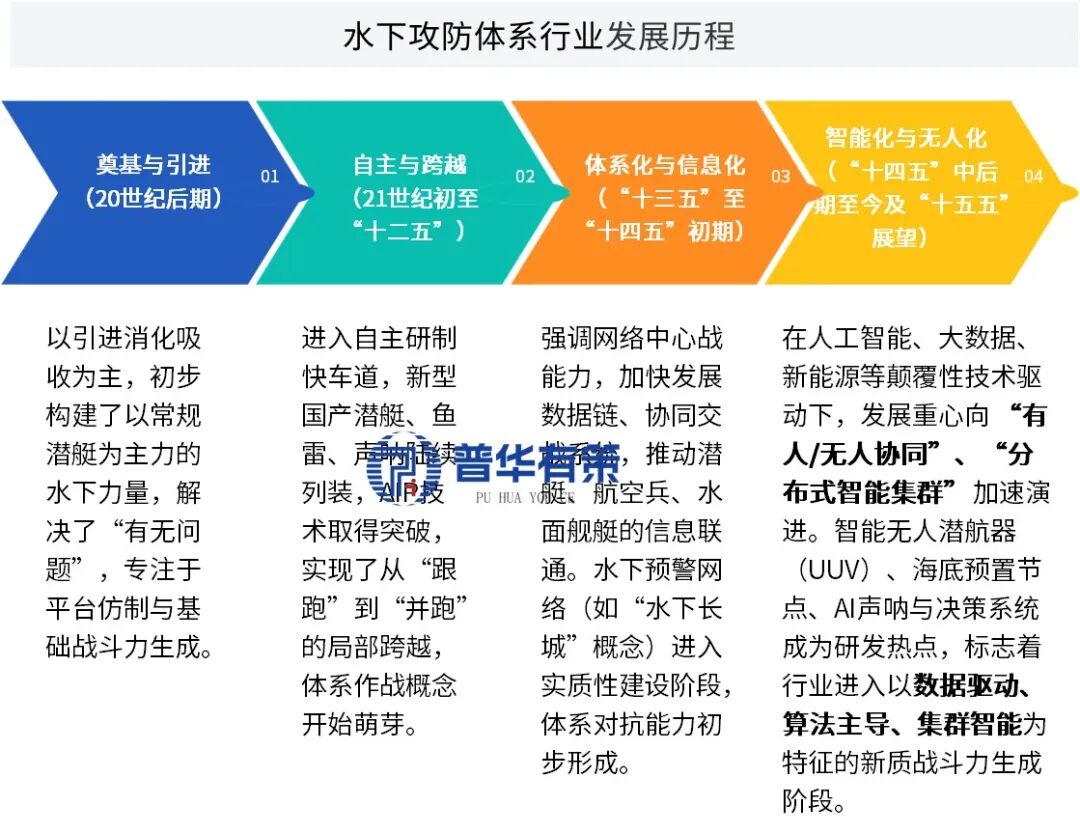
“十五五”水下攻防体系前沿技术与未来产业链发展趋势预判报告
Xin Lang Cai Jing· 2026-01-29 12:12
Core Insights - The underwater defense system is a strategic and systematic equipment and capability collection that integrates manned/unmanned platforms, detection networks, communication systems, intelligent weapons, and command control systems to safeguard national maritime sovereignty and security [1][23]. Industry Overview - The underwater defense system industry is a long-term pursuit and innovation history spanning several decades in China [2][24]. - The industry is characterized by a "pyramid" structure, with upstream focusing on special materials and core components, midstream on system integration, and downstream on military and civilian applications [5][28]. Industry Development Factors - The rigid demand for national strategic security and maritime rights drives the construction of the underwater defense system, ensuring the safety of strategic nuclear deterrence and maintaining maritime strategic channels [9][34]. - Breakthroughs in disruptive technologies and continuous advancements in deep-sea frontier technologies are crucial for the industry's capability leap [10][35]. - Strong support from top-level strategic planning and policy resources is essential for the development of the underwater defense system [11][36]. - The large-scale innovation and deepening military-civilian integration act as market accelerators for the industry [12][37]. Industry Trends - The industry is transitioning towards intelligent, unmanned, and distributed networks, reshaping rules and competitive landscapes [1][40]. - The integration of AI, advanced materials, and new energy sources is becoming a core manifestation of new productive forces in the underwater defense field [1][40]. Technological Characteristics - China has reached or is close to world-class levels in conventional submarine technology, certain underwater detection devices, and launch weapons, but still lags in nuclear submarine stealth technology and high-power persistent power systems [7][30]. - AI applications are primarily focused on signal processing and target classification, with a rapid expansion into more complex decision support areas [7][30]. Market Structure and Competitive Landscape - The global underwater defense system market is characterized by oligopolistic competition, with major military groups dominating the market [5][5]. - In China, the market is led by state-owned enterprises, while private companies are rapidly penetrating niche segments [5][5].

市场监管总局:“十四五”时期国家标准总数达4.8万项
Zhong Guo Xin Wen Wang· 2026-01-29 11:48
Core Viewpoint - The National Market Regulation Administration announced that during the "14th Five-Year Plan" period, the total number of national standards in China reached 48,000, with 13,000 new or revised standards established [1][2] Group 1: Quality Standards and Infrastructure - The quality standard system in China has been continuously improved, with 13,000 national standards established during the "14th Five-Year Plan" period [1] - The total number of national standards has reached 48,000 [1] - China has established 219 national measurement benchmarks and recognized 2,010 calibration and measurement capabilities internationally [1] Group 2: Quality Safety and Regulation - Quality safety supervision has been strengthened, with 14 categories of 27 types of industrial products under production license management [2] - High-risk products such as mobile power supplies and electric bicycle helmets are now included in mandatory certification management, with CCC certification covering 106 types of products [1][2] - A pilot reform for the "CCC certification mark" has been initiated for 11 high-risk products, including power banks [1] Group 3: Defective Product Recall System - The defective product recall system has been improved, resulting in 1,074 recalls of automobiles affecting 38.0352 million vehicles and 4,190 recalls of consumer goods affecting 40.4019 million items over the past five years [2] Group 4: Focus on Emerging Industries - The market regulation department has focused on strategic emerging industries such as artificial intelligence, quantum information, and new energy vehicles, launching ten key quality projects [2] - As of now, 12 international standards and 103 national standards have been developed, along with various technical specifications in measurement, inspection, testing, and certification [2] - In the automotive chip sector, 25 key chip certifications have been completed, with over 20 million chips installed, helping vehicle manufacturers reduce selection and verification costs significantly [2]
离量子世界更进一步!科研人员发现新规律
Xin Hua She· 2026-01-29 00:09
此项研究中,科研人员发现,量子系统在热化过程中,存在一个预热化的中间阶段。它短暂、相对稳 定,且可以调控,为量子信息保存提供可能。相关成果已发表于国际学术期刊《自然》。 (文章来源:新华社) 量子系统在演化过程中,如果热化过快,会导致量子计算结果难以可靠保存和读取。理解热化规律有助 于设计可控量子操作、延长量子态寿命,直接影响量子计算的实用性。 现实中的量子计算机也能像科幻片里的超级智能体一样预知未来?记者1月29日获悉,中国科学院物理 研究所联合北京大学等组成的科研团队,通过在超导芯片"庄子 2.0"上进行实验,发现了量子系统的预 热化阶段和可控规律,有望进一步理解和控制高度复杂的量子世界。 ...
市人社局局长:聚力建设高质量充分就业首善之区
Xin Jing Bao· 2026-01-28 12:28
Employment Initiatives - Beijing has created 330,000 new urban jobs in the year, with a target of developing 450,000 various employment positions throughout the year [1][2] - The city will support enterprises in stabilizing and expanding jobs, focusing on sectors like the night economy and silver economy to tap into job creation potential [2] - New employment service stations will be established to create a "15-minute" employment service circle for job seekers [2] Support for New Employment Groups - Measures will be introduced to enhance services for new employment groups, including the establishment of warm service stations in high-traffic areas [2][3] - The city aims to provide more accessible employment services and strengthen rights protection for new employment groups [2] Skills Development - Beijing plans to enhance the "Beijing Housekeeping" skills brand and develop specialized training courses for various household services, targeting 15,000 trainees this year [4] - The city will implement a "Skills Beijing" training action plan and promote the establishment of new skill evaluation systems in educational institutions [4] International Talent Support - New policies will be introduced to facilitate international talent coming to Beijing, including an updated directory for international qualifications and a streamlined process for innovation and entrepreneurship [4] Social Security Services - A "social security planner" team will be established to provide personalized services regarding social security contributions and benefits [6] - The city will expand the pilot program for occupational injury protection and implement a "quick compensation" mechanism for minor injuries [6] Wage and Income Distribution - Beijing will improve the wage guidance system to ensure fair and transparent income distribution, focusing on dynamic salary data publication [7] - The city will continue to address wage arrears and enhance labor rights protection through various initiatives [7] Regional Collaboration - The scope of social security "same standards" in the Beijing-Tianjin-Hebei region will be expanded, enhancing interconnectivity of social security services [9] - Efforts will be made to establish a unified professional evaluation standard and improve collaborative mechanisms for talent management across the region [9]
广东省政协常委陆海:绘制“大湾区产业地图”,杜绝同质竞争
Nan Fang Du Shi Bao· 2026-01-28 06:43
Core Viewpoint - The global technology industry competition has evolved into a comprehensive contest of innovation ecosystems and urban clusters, with the Guangdong-Hong Kong-Macao Greater Bay Area being a crucial strategic force for China's technological self-reliance and global competitiveness [1] Group 1: Importance of Technological Innovation - The deep integration of technological innovation and industrial innovation is vital for the Greater Bay Area to become a world-class bay area and urban cluster, fostering new productive forces and solidifying the foundation for high-quality development [1] - Talent is identified as the primary resource for innovation, with a particular emphasis on the shortage of strategic scientists and top-tier technological talents [1] Group 2: Recommendations for Development - It is suggested that leading enterprises should establish basic research funds and explore new models of "application-driven basic research" to facilitate the initial link from basic research to industrial application [2] - Concentrating resources to cultivate international leading enterprises in fields such as large models, advanced computing power, artificial intelligence, and quantum information is recommended to create globally influential benchmark application scenarios [2] Group 3: Efficient Cross-Border Flow of Resources - The key to ensuring efficient cross-border flow of resources lies in collaboration and connectivity, with a proposal to create a "Bay Area Industrial Collaborative Development Map" to clarify industrial positioning and collaboration priorities among cities [3] - Suggestions include promoting soft connectivity of rules, achieving breakthroughs in areas such as research project management, intellectual property recognition, tax incentives, and talent evaluation standards [3] - Recommendations for optimizing collaborative decision-making mechanisms include delegating authority for clearly defined matters and simplifying approval processes to significantly enhance the efficiency of decision-making and implementation of major issues [3]
聚焦五大核心战略方向 贡献成渝力量
Xin Lang Cai Jing· 2026-01-27 17:52
Core Strategy Directions - The focus is on five core strategic directions: innovation-driven development, industrial collaboration, open leadership, green development, and collaborative governance to establish a significant economic and technological innovation center in the region [2][3]. Innovation and Production Capacity - The strategy aims to address the issues of dispersed scientific innovation resources and inefficient results transformation by building a high-level innovation platform matrix and enhancing collaboration between Chongqing and Chengdu [2]. - Key areas of focus include artificial intelligence, low-altitude economy, and biomanufacturing, with plans to establish new research institutions and attract high-end talent [2]. Modern Industrial System - The goal is to construct a modern industrial system that emphasizes both quality and efficiency, transitioning from mere scale expansion to a balanced approach [3]. - Collaborative efforts will be made to build world-class industrial clusters in electronic information and advanced materials, with specific roles for Chengdu and Chongqing in research and high-end manufacturing [3]. Open Economy and Connectivity - The initiative aims to create a new inland open highland by enhancing the logistics network, including the Western Land-Sea New Corridor and the China-Europe Railway Express [3]. - There will be a focus on innovative institutional frameworks in cross-border service trade and digital trade, alongside efforts to attract multinational companies to establish regional headquarters [3]. Green Development - The strategy includes establishing a collaborative governance mechanism for environmental protection, focusing on pollution control in cross-border rivers and air quality [3]. - There will be an emphasis on energy-saving transformations in traditional industries and the cultivation of green industrial clusters [3]. Integrated Governance - The approach advocates for a unified strategy across the Sichuan-Chongqing region, promoting market-oriented reforms for resource allocation and enhancing public service integration [4]. - The aim is to create a one-hour commuting circle and establish a mechanism for integrated planning and project assessment to maximize collaborative development benefits [4].
李国平:着力建设现代化人民城市
Xin Jing Bao· 2026-01-26 22:52
1月26日,北京市第十六届人民代表大会第四次会议审查了《北京市国民经济和社会发展第十五个五年 规划纲要(草案)》(以下简称"十五五"规划)。规划提出,"十五五"时期是基本实现社会主义现代化 夯实基础、全面发力的关键时期,战略机遇和风险挑战并存。同时提出今后五年要实现的主要目标,包 括首都功能持续提升、高质量发展迈上台阶、全面深化改革取得新突破、群众生活品质不断提高、首都 文化影响力明显增强、美丽北京建设取得更大成效、首都安全水平不断提升等。 面对挑战与机遇,北京如何在未来五年实现"十五五"规划擘画的未来场景?北京大学首都发展研究院院 长李国平表示,"十五五"时期,北京将以"四个中心"功能建设为统领,构建以科技创新为核心支撑的现 代化经济体系,全力打造高水平开放新格局,构建区内外协同联动的首都高质量发展新格局,建设创 新、宜居、美丽、韧性、文明、智慧的现代化人民城市。 一张图,首善标准下的城市样板 新京报:在"十四五"收官与"十五五"开局的重要节点,你认为"十五五"规划展现出一个什么样的未来? 李国平:"十五五"规划体现出北京作为首都的更高站位和更大责任担当,其核心是积极主动服务国家发 展大局,引领京津冀协同发 ...
2025年,我国共授权发明专利97.2万件 人工智能专利有效量居全球前列(权威发布)
Ren Min Ri Bao· 2026-01-23 22:25
1月23日,国务院新闻办举行新闻发布会,介绍2025年知识产权工作进展。2025年,我国共授权发明专 利97.2万件,受理PCT国际专利申请7.8万件,注册商标420.6万件。截至2025年底,我国国内发明专利 有效量达532万件,每万人口高价值发明专利拥有量达到16件。 信息技术管理方法、计算机技术、医学技术等领域有效发明专利增速最快 创新质量持续提升,重点区域创新活跃。国家知识产权局副局长芮文彪介绍,在国内有效发明专利中, 信息技术管理方法、计算机技术、医学技术等领域的有效发明专利增速最快,人工智能专利有效量居全 球前列。截至2025年底,长三角地区、京津冀地区和广东省的发明专利有效量分别为173.4万件、91.6万 件和89.9万件,合计约占国内总量的2/3。 截至2025年底,我国国内高价值发明专利拥有量达到229.2万件,占国内有效发明专利比重达到43.1%, 较"十三五"末提高2.9个百分点。 "战略性新兴产业的国内有效发明专利达到153.4万件,28万家企业拥有176.4万件高价值发明专利,成为 创造高价值发明专利的'主力军'。"国家知识产权局战略规划司司长梁心新认为,我国专利结构正在向 优转变 ...
新质生产力驱动构建济南未来产业“基金+基地+服务”培育模式
Xin Lang Cai Jing· 2026-01-23 16:48
Core Insights - The article discusses the transformation of industrial structure driven by new productive forces such as artificial intelligence, quantum information, and space technology, emphasizing the need for Jinan to enhance resource utilization and innovation conversion for sustainable industrial development [1] Group 1: Investment Strategies - Jinan's future industrial development focuses on sectors like aerospace information, quantum technology, and biomanufacturing, with a capital support system centered around strategic areas [1] - By the end of Q3 2025, Jinan's municipal government aims to establish 116 operational funds with a total scale exceeding 100 billion, supporting key local industries [1] - In 2025, eight targeted investment funds in the aerospace technology sector are expected to be established, with a total scale of 1.745 billion, fully implemented to support key technological breakthroughs and product development [1] Group 2: Industrial Base Development - The aerospace information industrial park in Jinan needs to enhance its satellite manufacturing supply chain, including precision component manufacturing and environmental testing facilities [2] - The precision manufacturing area will be equipped with controlled environments, while the R&D testing area will integrate common technology testing platforms and collaborative design centers [2] - Local leading manufacturing enterprises will guide innovation and resource allocation, facilitating targeted R&D and capacity layout [2] Group 3: Service System Optimization - Jinan's future industrial development will leverage AI computing power centers to provide on-demand computational resources for innovation entities [3] - A restructured service process will streamline project lifecycle management, including pre-approval and expedited construction permits [3] - The establishment of specialized technology intermediary services will address gaps in technology maturity and accelerate the commercialization of innovative results [3] Group 4: Future Directions - Jinan aims to create a three-in-one model of "funds + bases + services" to build a future industrial ecosystem, focusing on core technology breakthroughs and industrial conversion efficiency [4] - The city should enhance financial tool innovation and deepen the integration of application scenarios to create a resilient development paradigm for new productive forces [4] - Future recommendations include focusing on the integration of "AI+" and aerospace information industries, improving cross-regional technology transfer networks, and establishing a dynamic evaluation system for industrial ecosystems [4]