
金融市场

Search documents
特朗普对关税“松口”,亚洲股市集体反弹,日元跌破146
Hua Er Jie Jian Wen· 2025-07-08 03:02
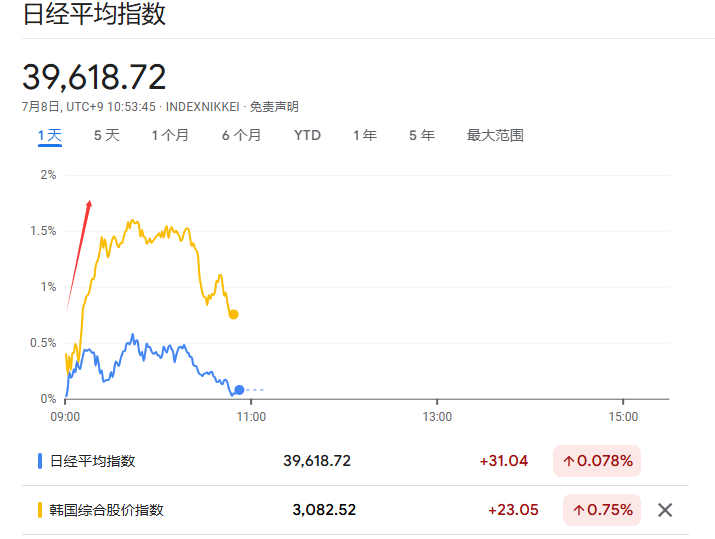
Group 1 - The core point of the article is that President Trump signed an executive order to extend the tariff delay until August 1, alleviating tensions in global financial markets [1] - Following the announcement, Asian stock markets showed a significant rebound, with the Hang Seng Tech Index increasing by 1%, and the South Korean KOSPI rising over 1.5% before settling around 0.8% [1] - The Nikkei 225 index initially rose by 0.5% but later experienced a slight pullback, while major indices in Thailand and Vietnam also saw gains [1] Group 2 - In the foreign exchange market, the euro and pound rebounded, leading to a weaker dollar, although the yen fell to a two-week low against the dollar [1][6] - The euro appreciated by 0.3% to 1.1742, and the pound rose by 0.24% to 1.3631, while the dollar index declined by approximately 0.2% [6] - The Japanese yen and South Korean won both experienced fluctuations, with the yen continuing to face pressure, dropping to 146.44 against the dollar [9] Group 3 - Trump's announcement included a warning of potential tariffs on imports from Kazakhstan, Malaysia, South Africa, Laos, and Myanmar, with rates ranging from 25% to 40% [15] - The market interpreted Trump's actions as a negotiation strategy rather than a definitive stance on tariffs, with analysts suggesting that investors are overlooking the latest tariff announcements [15] - The August 1 deadline for tariff negotiations is confirmed but not absolute, as Trump indicated openness to alternative proposals from other countries [15]

南方基金:金价大跳水,过去一周累跌2.8%!
Sou Hu Cai Jing· 2025-06-30 03:12
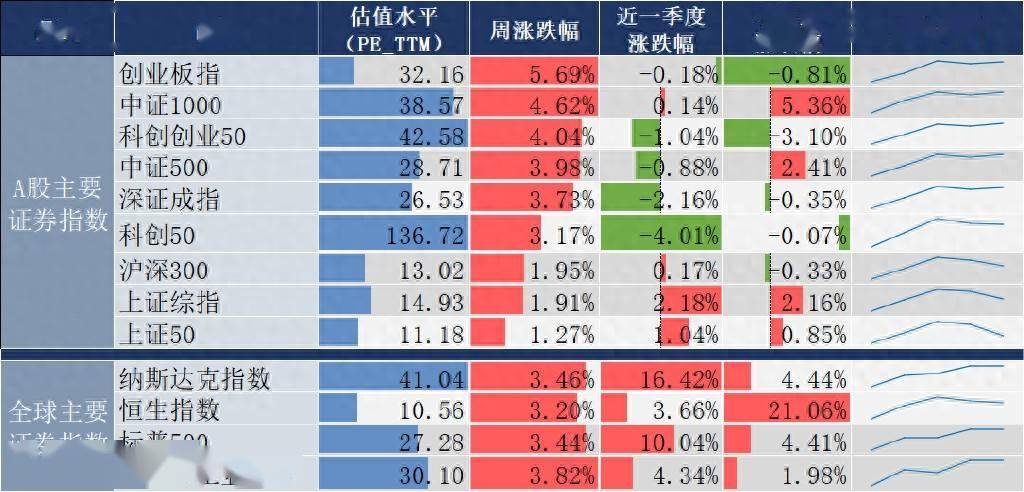
Market Overview - The overall market rebounded last week, with major indices mostly rising. The Shanghai Composite Index closed at 3424.23 points, up 1.91% for the week, while the ChiNext Index closed at 2124.34 points, up 5.69% [1] Sector Performance - In the CITIC industry sectors, comprehensive finance, computer, and comprehensive indices had the highest gains, while transportation, food and beverage, and oil and petrochemical indices experienced the largest declines [1] - The valuation levels and weekly performance of major A-share indices were as follows: ChiNext Index at 32.16 (up 5.69%), CSI 1000 at 38.57 (up 4.62%), and CSI 500 at 28.71 (up 3.98%) [2] Bond Investment Trends - As of the end of May, the bond investment balance of large Chinese banks reached approximately 49.54 trillion yuan, marking a growth of 2.65 trillion yuan this year [3] - Meanwhile, the bond investment balance of small and medium-sized Chinese banks rose to 46.41 trillion yuan, with a year-to-date increase of 3.6 trillion yuan [4] Gold Market Dynamics - Last Friday, gold prices saw a significant drop, with spot gold falling over 2% at one point and ultimately closing down 1.63%, dipping below $3300 per ounce [6] - Over the past week, spot gold has decreased by 2.8%, influenced by easing tensions in the Middle East and progress in tariff negotiations, which shifted some funds to the stock market [7] Hong Kong Market Changes - The Hong Kong market will implement a new share trading fee structure starting June 30, 2025, increasing the fee from 0.002% to 0.0042% of the transaction amount, while removing the minimum and maximum fee limits [8] Trade Relations - The U.S. has announced the cessation of all trade negotiations with Canada due to Canada's insistence on a digital services tax targeting U.S. tech companies [9][10] ETF Growth - The first batch of benchmark market-making credit bond ETFs has seen explosive growth, with three ETFs surpassing 20 billion yuan in scale, indicating strong market interest due to lower credit risk and higher tracking efficiency [11]
X @外汇交易员
外汇交易员· 2025-06-27 10:28
Monetary Policy Stance - The People's Bank of China (PBOC) suggests increasing the intensity of monetary policy regulation [1] - The PBOC will flexibly grasp the strength and rhythm of policy implementation based on domestic and international economic and financial situations [1] Real Estate Market - The PBOC recommends increasing the revitalization of existing commercial housing and land [1] Financial Instruments & Support - The PBOC will utilize securities, funds, insurance company swap facilities, and stock repurchase and increase relending, exploring normalized institutional arrangements [1] - The PBOC will increase support for technological innovation, boost consumption, and support key areas such as "two-heavy" (重大项目) and "two-new" (新型基础设施) projects with financing [1]
第三次财富大转移,要来了!
大胡子说房· 2025-06-25 12:00
Core Viewpoint - The article discusses the concept of wealth transfer during economic crises, emphasizing that each crisis presents an opportunity for ordinary individuals to advance their wealth through strategic investments in real estate and emerging industries [1][2]. Group 1: Historical Wealth Transfers - The first major wealth transfer occurred in the 1990s following the collapse of the Soviet Union, driven by industrialization and urbanization, which shifted wealth, population, and land resources from rural to urban areas [1][2]. - The second wealth transfer happened after the 2008 global financial crisis, primarily fueled by the internet industry transformation, where wealth shifted from real estate to online platforms, benefiting tech giants and their employees [2]. Group 2: Future Wealth Transfer - A potential third wealth transfer is anticipated in the next 5-10 years, influenced by the current economic downturn, with a focus on the flow of funds from bank deposits to other sectors [3][4]. - The Chinese government aims to redirect these funds into the capital market, particularly the financial market, to support industrial growth and technological advancements [3][8]. Group 3: Economic Development Stages - The article outlines two critical stages for a country to become a major power: first, becoming an industrial power to ensure economic security, and second, evolving into a financial power to protect national wealth [5][6][7]. - The future certainty is that China will replace the U.S. as the leading global power, leveraging its financial market to amplify its industrial advantages [8][9]. Group 4: Capital Market Dynamics - The article highlights the importance of the capital market in attracting significant deposits, suggesting that a mere 10 trillion yuan influx could stabilize the market at 3400 points, with further inflows potentially pushing it to 3500 points [15][16]. - The potential for the A-share market to become a new tool for wealth transfer and distribution is discussed, with a cautionary note against speculative trading in the current market environment [17][20].

韩国央行:将密切关注中东局势发展对金融市场和经济的影响。
news flash· 2025-06-23 00:49
Core Viewpoint - The Bank of Korea will closely monitor the developments in the Middle East and their potential impacts on financial markets and the economy [1] Group 1 - The Bank of Korea is particularly concerned about the implications of the Middle East situation on financial stability [1] - The central bank emphasizes the need for vigilance in assessing risks associated with geopolitical tensions [1] - The focus on the Middle East reflects broader concerns about global economic conditions and their influence on domestic markets [1]
AP优卡专家分析:美联储为何连续四次利率不变?逻辑推演
Sou Hu Cai Jing· 2025-06-20 12:55
Economic Overview - The Federal Reserve has maintained the federal funds rate in the range of 4.25% to 4.5% for the fourth consecutive time since the end of 2024, reflecting a cautious approach amid economic uncertainties [3][4] - The U.S. economy has shown resilience with a projected GDP growth rate of approximately 2.8% for 2024, despite challenges, and the unemployment rate remained low at 4.2% in December 2024 [4][5] - Inflation remains a concern, with the core PCE price index dropping to 2.1% in early 2024 but rebounding to 2.8% by May 2025, prompting the Fed to adopt a wait-and-see approach [4][5] Monetary Policy Dynamics - The Fed's dual mandate focuses on maximizing employment and maintaining price stability, leading to a shift from aggressive rate hikes to a more cautious stance [5] - Following a series of rate increases from near-zero to a peak of 5.33%, the Fed has since implemented three rate cuts in 2024, bringing the current rate to 4.25% to 4.5% [5] - Economic forecasts for 2025 indicate a GDP growth adjustment from 1.7% to 1.4% and a slight rise in unemployment to 4.5%, highlighting the need for careful policy balancing [5][6] External Influences - Global economic uncertainties, particularly changes in trade policies and tariffs, have impacted the Fed's decision-making process, necessitating a cautious approach to rate adjustments [6] - The Fed's policy contrasts with other central banks, which have initiated rate cuts, reflecting the relative strength of the U.S. economy and the dollar's status as a global reserve currency [6] Market Reactions - Following the Fed's decision on June 18, 2025, U.S. stock markets reacted moderately, with the Dow Jones Industrial Average rising by 0.2% and the S&P 500 slightly declining by 0.03% [7] - Market expectations suggest two potential rate cuts in 2025, with probabilities of maintaining rates in July at 89% and a 61% chance of a cut in September [7] Impact on Consumers - The current interest rate environment, while lower than 2023 peaks, remains high, affecting borrowing costs for consumers, particularly in housing and auto loans [8] - The average 30-year mortgage rate stood at approximately 6.7% in March 2025, significantly higher than 3.0% in 2021, leading to reduced demand in the housing market [8] - High interest rates benefit savers with yields above 4% on high-yield savings accounts, but potential future rate cuts may compress these returns [8] Future Outlook - The Fed's cautious stance is expected to continue into the latter half of 2025, with core inflation projected to rise to 3.1% and unemployment slightly increasing [9] - The Fed's policy will remain flexible, adapting to economic data and external factors, including geopolitical risks and climate change [9]

日本央行行长植田和男:必须关注贸易政策对金融市场、外汇市场、日本经济和物价的影响。
news flash· 2025-06-17 06:41
Core Viewpoint - The Governor of the Bank of Japan, Kazuo Ueda, emphasized the necessity to monitor the impact of trade policies on financial markets, foreign exchange markets, the Japanese economy, and prices [1] Group 1 - The focus on trade policy's influence indicates a proactive approach to managing economic stability [1] - The statement suggests potential implications for currency valuation and market volatility in response to trade dynamics [1] - Monitoring these factors is crucial for formulating effective monetary policy and ensuring economic resilience [1]
日本央行:必须密切关注贸易政策对金融市场和外汇市场的影响。
news flash· 2025-06-17 03:36
Core Viewpoint - The Bank of Japan emphasizes the need to closely monitor the impact of trade policies on financial and foreign exchange markets [1] Group 1 - The Bank of Japan is concerned about the implications of trade policies on market stability [1] - There is a recognition that trade policies can significantly influence financial market dynamics [1] - The foreign exchange market is particularly sensitive to changes in trade policies [1]
周度金融市场跟踪:周五以色列突袭伊朗,全球避险情绪升温;债券市场低位震荡(6月9日~6月13)-20250616
Bank of China Securities· 2025-06-16 09:41
Market Performance - A-shares experienced an overall decline, with the Shanghai Composite Index down 0.3% and the CSI 1000 down 0.8% for the week[2] - The Hang Seng Index rose slightly by 0.4%, while the Hang Seng Tech Index fell by 0.9%[2] - The S&P 500 Index decreased by 0.4% and the Nasdaq 100 Index fell by 0.6% during the week[2] Sector Performance - The metals, petrochemical, and agriculture sectors led gains, while food and beverage, home appliances, and construction sectors lagged[2] - The pharmaceutical sector rose by 1.4%, marking its eighth consecutive week of gains[2] Trading Volume and Valuation - Average daily trading volume increased to 1.37 trillion yuan, up 13% from the previous week[4] - The turnover rate for the entire A-share market was 1.6%, with a Z-score increase from 0.4 to 0.8, indicating higher trading activity compared to the historical average[4] - The price-to-earnings (P/E) ratio for the Shanghai Composite Index was 12.7, while the CSI 1000 had a P/E ratio of 39.9[4] Bond Market and Economic Indicators - The bond market showed low volatility, with the central bank injecting 173.8 billion yuan into the market on June 9, leading to a decrease in the DR007 rate to 1.54%[4] - Social financing growth remained stable at 8.7%, with a slight decline in new loans and M2 growth compared to the previous month[4] Commodity Market - The US dollar index fell by 1.1%, while the offshore RMB appreciated slightly by 0.02% against the dollar, closing at 7.19[4] - Gold prices surged by 3.7% to $3,433 per ounce, driven by geopolitical tensions following Israel's attack on Iran[4] - WTI crude oil prices increased by 13.0%, reaching $73.2 per barrel, marking the largest weekly gain since November 2022[4]
英国央行货币政策委员会(MPC)成员Mann:需要对金融市场作出明确表态。需要排除市场噪音的干扰。
news flash· 2025-06-03 09:38
Core Viewpoint - The Bank of England's Monetary Policy Committee (MPC) member Mann emphasizes the need for a clear statement regarding financial markets to eliminate noise interference [1] Group 1 - Mann highlights the importance of providing clarity to financial markets to ensure effective communication and decision-making [1]