
AI超级入口

Search documents
高盛眼中的2026年中国互联网:AI超级入口争夺战全面打响,三大主题锁定阿尔法机会
Hua Er Jie Jian Wen· 2026-01-19 13:25
Core Viewpoint - Goldman Sachs predicts that 2026 will be a strategic turning point for Chinese internet giants, with increased investment in consumer-facing AI and competition around "AI super entry" while focusing on defending their core market positions [1] Group 1: Industry Transition - The industry transition in 2026 is fundamentally driven by ByteDance's comprehensive breakthroughs, which are reshaping competitive dynamics [2] - ByteDance is projected to achieve a profit of $50 billion in 2025, significantly surpassing Tencent's $36 billion and Alibaba's $15 billion [2] - In the AI sector, ByteDance's Doubao app has over 100 million daily active users and is the leading consumer-level AI application in China [2] Group 2: Strategic Responses from Giants - In response to ByteDance's advancements, Alibaba and Tencent are compelled to pivot their strategies, increasing AI investments to over $60 billion collectively by 2026 [3] - Alibaba aims to maintain its leading position in e-commerce GMV, while Tencent accelerates AI features in WeChat and explores social AI applications through QQ [3] - The competitive landscape is expected to rationalize, improving unit economics in sectors like food delivery [3] Group 3: Key AI Themes Restructuring the Industry - Six key AI themes identified by Goldman Sachs will reshape the industry ecosystem in 2026, including advertising transformation, model competition, and the emergence of consumer AI entry points [4] - The advertising budget is shifting towards ROI-driven ads, with new strategies like AEO and GEO gaining traction [4] - The competition in AI models is intensifying, focusing on long context, multi-modal, and low-cost architectures [4] Group 4: Investment Framework - The investment landscape is shifting from a "broad market rally" to an "alpha era" focused on selective stock picking, emphasizing EPS delivery/growth, AI, and globalization narratives [6] - Companies benefiting from improving order trends and rationalized competition, such as Alibaba and JD.com, are highlighted for their potential in profit growth [7] - The focus is also on AI technology breakthroughs and global business expansion, with companies like Kuaishou and Baidu identified as key players [8] Group 5: Shareholder Returns - Companies with stable cash flows and strong shareholder return capabilities are prioritized, particularly those with sufficient net cash and potential for dividend increases [9]


欢迎AI“卷王”
Bei Jing Shang Bao· 2026-01-15 16:32
Group 1 - The core viewpoint of the articles emphasizes the competition among major tech companies like Alibaba and ByteDance in the AI super entrance battle, with the launch of Qianwen App integrating various Alibaba ecosystem services as a significant move [1][2] - Qianwen App will provide over 400 AI service functions, enabling users to perform tasks such as food delivery, shopping, and booking flights, thus transforming the AI assistant from a simple Q&A tool to a comprehensive service provider [1][3] - The AI entrance competition is not just about traffic channels but involves deep user decision-making processes, indicating a shift in how users interact with applications and services [1][3] Group 2 - The article discusses the importance of establishing new rules and order in the AI era, highlighting the need for collaboration among platform providers, hardware manufacturers, and regulatory bodies to address challenges posed by AI technology [4] - Companies must balance the protection of commercial innovation with the need to ensure consumer benefits and compliance with personal information processing regulations [4] - The competition for the "last mile" connection with users will determine the next phase of the internet, with companies needing to refine product experiences and deepen ecosystem collaboration to meet core user needs [3][4]
【西街观察】千问点外卖 AI入口之争打响
Bei Jing Shang Bao· 2026-01-15 14:48
Core Insights - Qianwen App has integrated with Alibaba's ecosystem, including Taobao, Alipay, and Fliggy, to enhance AI shopping functionalities, offering over 400 AI service features for user testing [1] - The AI assistant aims to streamline Alibaba's business operations, moving beyond simple Q&A to executing complex tasks across applications and engaging in actual transactions [1] - The competition for AI entry points is intensifying, with smaller manufacturers struggling to compete against major players like Alibaba and ByteDance, which have significant ecosystem advantages [1][2] Group 1 - The AI era's entry point competition is not merely about traffic channels but involves becoming a central intelligent hub that influences user decision-making [1] - Traditional entry points require users to input specific keywords for targeted results, leading to fragmented decision-making across different apps [1] - In the AI era, user needs are simplified, allowing AI to deconstruct demands and generate solutions, effectively providing a service that assists users in completing tasks [1] Group 2 - The competition landscape includes various players, with Tencent leveraging its WeChat and QQ platforms, while DeepSeek remains relevant despite some setbacks [3] - Success in the AI space will depend not only on the quality of the underlying technology but also on product experience, ecosystem collaboration, and understanding core user needs [3] - The emergence of AI super entry points raises challenges for platform providers, hardware manufacturers, and regulators, necessitating a new set of rules and order for the AI era [4] Group 3 - The balance between fostering commercial innovation and ensuring consumer protection is crucial for the seamless integration of AI and consumer services [4]
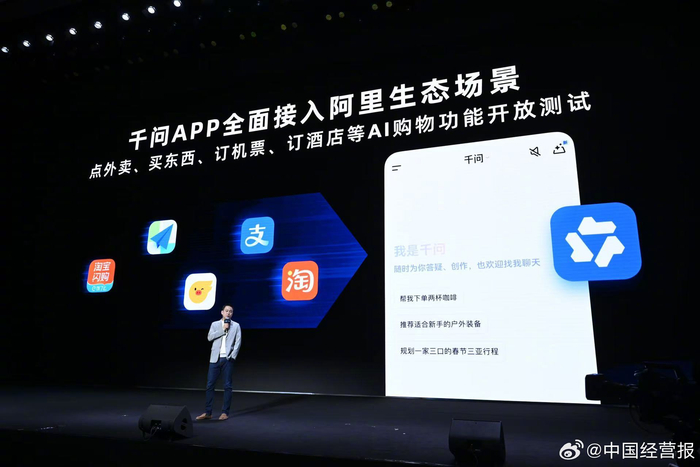
千问App接入阿里生态上线400项AI功能
Zhong Guo Jing Ying Bao· 2026-01-15 13:51
Core Insights - Alibaba's Qianwen App is undergoing a significant update, integrating over 400 AI service functions across its ecosystem, including Taobao, Alipay, and Fliggy, marking a shift from conversational AI to practical applications [1] Group 1: Product Development - The Qianwen App aims to become a personal AI assistant capable of handling various tasks such as food delivery, shopping, and travel bookings, with a vision to create a comprehensive AI lifestyle entry point [1] - The app has achieved over 100 million monthly active users shortly after its launch, indicating rapid user adoption and engagement [1] Group 2: Market Positioning - The update signifies a strategic move in the competition for AI super entry points, transitioning the focus from entertainment to practical utility in AI applications [1] - Industry experts view this rapid development as a critical step in establishing a competitive edge in the AI market [1]

千问接入AI购物、点外卖 “超级入口”争夺战趋于白热化
Zhong Guo Jing Ying Bao· 2026-01-15 12:47
Core Insights - Alibaba's Qianwen App has undergone a significant update, integrating over 400 AI service functions and connecting with various Alibaba platforms, marking a shift from conversational AI to practical applications [1][2] - The app has achieved over 100 million monthly active users, indicating rapid user growth and excitement for future developments [1][2] - The integration aims to create a comprehensive AI assistant capable of handling various daily tasks, thus enhancing user experience and engagement [1][4] Group 1: AI Functionality and Integration - Qianwen App can now facilitate tasks such as ordering food, booking flights, and making hotel reservations through seamless integration with Alibaba's ecosystem [2][3] - Users can input requests in natural language, and the app will automatically process orders, payments, and provide recommendations based on real-time data [2][3] - The app's ability to understand user intent and provide tailored recommendations enhances its utility, making it a powerful tool for consumers [3][4] Group 2: Strategic Implications - The upgrade represents a crucial step in Alibaba's AI strategy, positioning the company in the competitive landscape of AI super applications [4][5] - The focus is shifting from merely having advanced AI models to effectively utilizing them within a comprehensive ecosystem, emphasizing practical applications in daily life [5][6] - Industry experts note that while Alibaba has a robust ecosystem, challenges remain in achieving seamless internal collaboration and user engagement [6][7] Group 3: Competitive Landscape - The competition among major players like Alibaba, ByteDance, and Tencent is characterized by their unique strengths: Alibaba excels in transaction capabilities, ByteDance in content and user engagement, and Tencent in social connectivity [6][7] - The ongoing battle for the "super entrance" in AI applications will depend on who can effectively integrate AI into real-world transactions and services [6][7] - The current market dynamics suggest a differentiation where Alibaba focuses on transactions, ByteDance on content, and Tencent on social interactions, shaping the future of AI applications [6][7]
AI一键点外卖、订机票…阿里千问要干大事!
Hua Er Jie Jian Wen· 2026-01-15 01:36
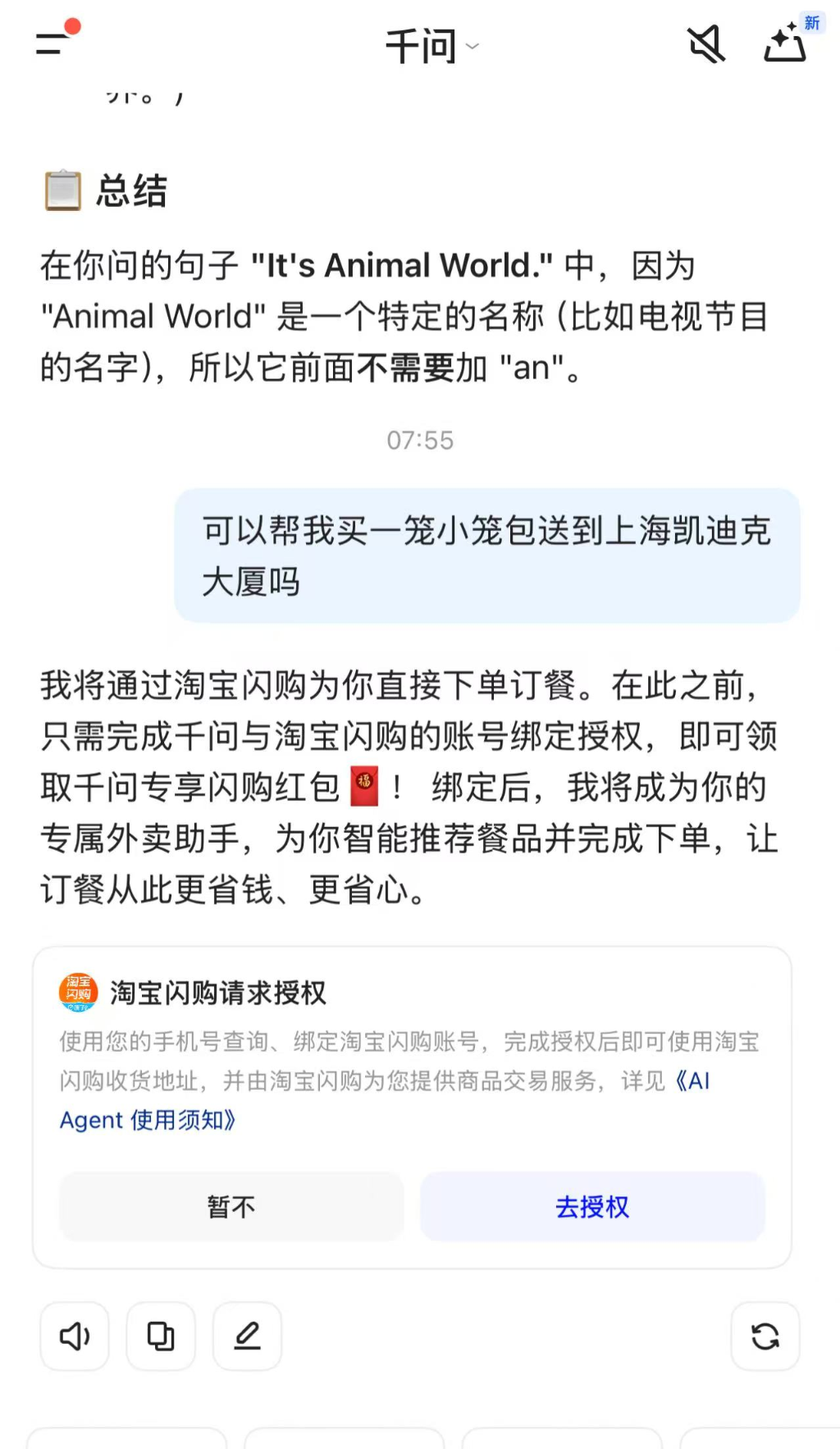
Core Insights - Alibaba's Qianwen App is set to revolutionize the way users interact with services, allowing for seamless transactions through natural language commands, marking the beginning of a new "service era" [4][6] - The competition among tech giants like Google, OpenAI, and Amazon for AI-driven e-commerce is intensifying, as they aim to establish the next generation of internet "super entry points" [6][27] Group 1: AI and E-commerce Integration - The integration of AI with e-commerce is transitioning from "discriminative recommendations" to "generative recommendations," fundamentally changing how consumers find and purchase products [8] - The Qianwen App exemplifies a significant shift where user intent can directly translate into transactions, potentially diminishing the relevance of traditional e-commerce platforms [16] - Morgan Stanley predicts that by 2030, AI-driven commerce could reach $385 billion, accounting for 20% of total U.S. e-commerce, indicating a major shift in consumer spending habits [16] Group 2: Alibaba's Ecosystem and Competitive Advantage - Qianwen App leverages Alibaba's extensive ecosystem, integrating various high-frequency life scenarios, positioning itself as a central control hub for Alibaba's commercial empire [17][18] - The Qwen model behind the app has surpassed 600 million downloads and outperforms some metrics of GPT-5, benefiting from Alibaba's vast data resources accumulated over years [19] - Unlike competitors, Alibaba combines top-tier AI models with a robust infrastructure for e-commerce and logistics, creating a unique competitive moat [21] Group 3: Monetization Strategies - The shift in AI's narrative from mere conversation to actionable outcomes presents clear monetization pathways, particularly through direct integration with e-commerce [22] - Utilizing AI for direct transactions can significantly enhance conversion rates, as evidenced by a 60% increase in purchase conversion rates when using Amazon's AI assistant [23] - The entire industry is experiencing a surge in activity, with Alibaba's Qianwen App achieving over 100 million monthly active users, reminiscent of a gold rush in the tech space [25] Group 4: Competitive Landscape - Major tech companies are engaged in a fierce competition for the "AI super entry point," with each attempting to secure their position in the evolving market [27] - Amazon is focusing on a closed ecosystem with its Rufus shopping assistant, while OpenAI and Google are also making strides to capture market share through innovative features [28][29] - ByteDance's Doubao is attempting to penetrate the market but faces challenges in integrating with Alibaba's ecosystem [30][31] Group 5: Future Implications - The upcoming launch of the Qianwen App is seen as a pivotal moment that could redefine the landscape of e-commerce and consumer interaction [32] - The urgency for market players is to identify and position themselves within this "service revolution," as missing out on AI-driven e-commerce could mean losing significant future opportunities [34] - The onset of the "service era" driven by AI is anticipated to bring transformative changes to consumer behavior and industry dynamics [35]
专访雷鸟创新CEO李宏伟:电信巨头押注下一代“手机”
Hua Er Jie Jian Wen· 2026-01-05 00:13
Core Insights - The article discusses the rapid growth and investment in the smart glasses sector, particularly in the context of AI and AR technologies, with a focus on the company Thunderbird Innovation [2][3][11] - It highlights the competitive landscape, emphasizing that while many players are entering the market, only a few will succeed in achieving sustainable sales and user retention [2][3][11] Investment and Market Dynamics - Thunderbird Innovation has secured a new round of financing, significantly oversubscribed, indicating strong investor interest in the smart glasses market [2][3][23] - The company holds a 24% global market share in AR smart glasses as of Q3 2025, maintaining its position as the market leader for two consecutive quarters [3][17] - The investment from major Chinese telecom operators marks a strategic shift, as they view smart glasses as the "next generation of mobile phones" [3][19] Product Development and Strategy - Thunderbird plans to showcase its first eSIM AR glasses at CES 2026, which will feature dual full-color displays and an integrated eSIM module [4][19] - The company aims to develop "killer applications" for its smart glasses, focusing on enhancing user experience and functionality through AI integration [10][30][36] - The CEO believes that 2026 will be the true breakthrough year for smart glasses, with products finally meeting user experience standards [6][12] Competitive Landscape and Future Outlook - The smart glasses industry is expected to evolve through three phases, with the first phase focusing on identifying who can create the next "iPhone" of smart glasses [15][17] - The article suggests that the current excitement in the industry does not equate to maturity, as many products still lack the necessary user experience [6][14] - Thunderbird's strategy includes a strong emphasis on global expansion, with expectations that overseas revenue will exceed 50% by 2026 [3][26] Technological Advancements - The company is investing heavily in R&D to enhance optical display technology, AI capabilities, and overall product performance [7][30][22] - Future products will focus on achieving low power consumption and high performance to ensure all-day wearability [30][32] - The integration of AI into smart glasses is seen as a critical area for development, with the goal of creating transformative applications that leverage AI's capabilities [31][36]
阿里千问买量投放反超腾讯元宝
第一财经· 2025-12-11 12:41
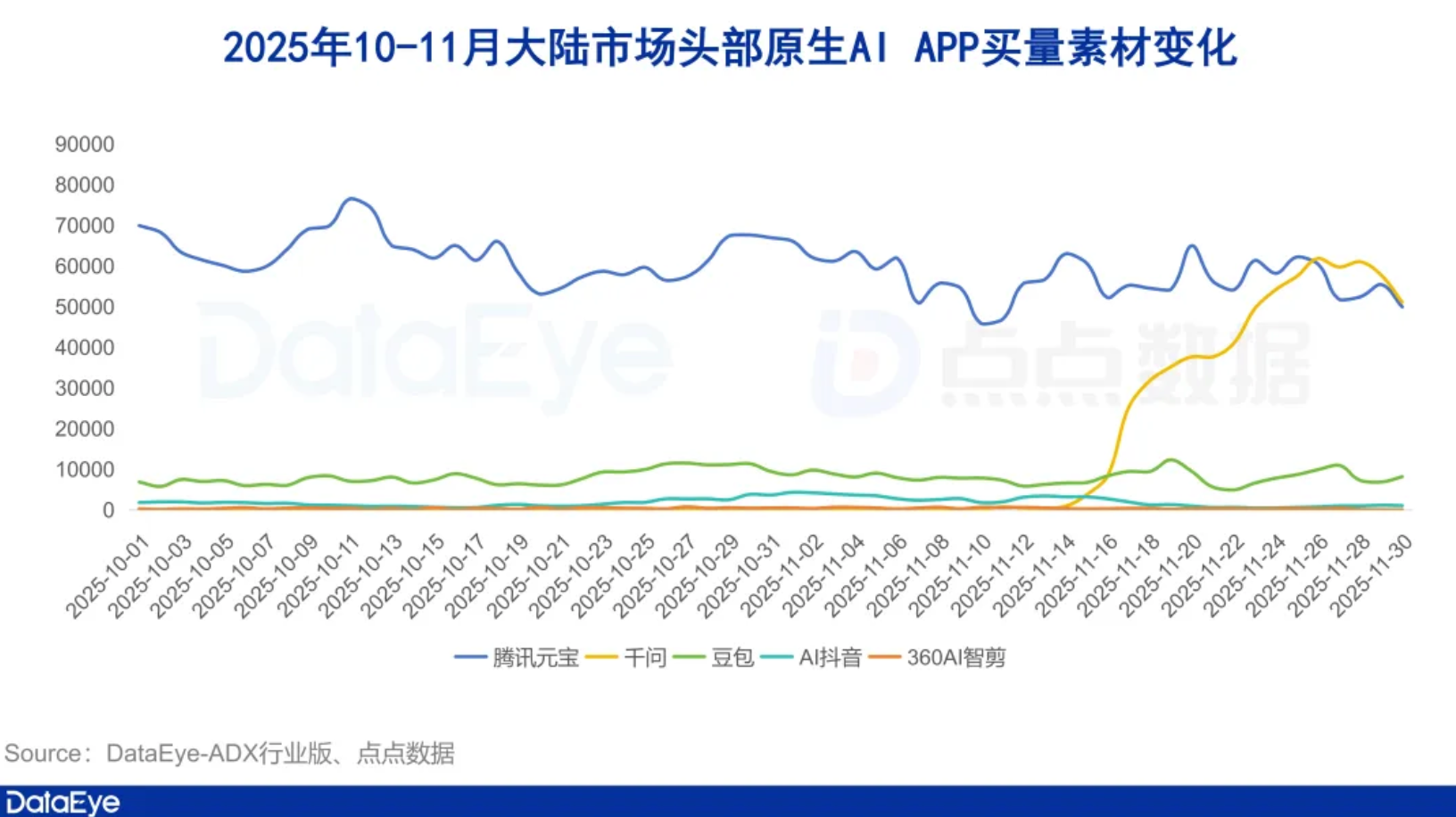
Core Insights - The competition in the AI sector is intensifying, with Tencent and Alibaba making significant investments in user acquisition for their respective AI applications, Yuanbao and Qianwen [3][8] - Qianwen's download volume surged dramatically in November, attributed to Alibaba's aggressive marketing and user curiosity, with daily downloads increasing from around 10,000 to approximately 150,000 [8][9] - Major AI model providers are exploring new paths for growth, focusing on scaling computing power and optimizing architectures, as the efficiency of foundational model training reaches a bottleneck [3][12] Group 1: Market Performance - In November, the top five AI apps in the mainland market by download volume included Doubao, Jimeng AI, Tencent Yuanbao, Qianwen, and DeepSeek, with Doubao leading at around 200,000 daily downloads [8][9] - Qianwen's public beta launched on November 17, leading to over 10 million downloads in its first week and achieving over 30 million monthly active users [8][9] - The total advertising material for native AI products in the mainland market reached 891,000 sets in November, with Tencent Yuanbao and Qianwen leading the material volume [9][10] Group 2: Competitive Landscape - Tencent Yuanbao and Qianwen accounted for 46% and 34% of the advertising material volume, respectively, significantly ahead of other products [9][10] - Despite the late entry of Qianwen, its rapid growth indicates strong potential, while the competition remains tight among major players like ByteDance and Tencent, with no significant technological gaps [10][14] - The global market for native AI apps saw an estimated total download of 350 million in November, with ChatGPT and Google Gemini leading the downloads [12][13] Group 3: Strategic Directions - Major companies are focusing on creating AI super entry points, with ByteDance leveraging AI phones and Alibaba integrating Qianwen with its ecosystem [14] - The industry is witnessing a shift towards practical applications and user engagement, as companies prioritize active user data and frequency of use over theoretical advancements [13][14] - The competitive landscape is expected to solidify as companies leverage their ecosystems and user data, enhancing their market positions [14]


阿里千问买量投放反超腾讯元宝,大厂迈入超级入口争夺战
Di Yi Cai Jing· 2025-12-11 10:20
Core Insights - The competition in the AI sector is intensifying, with major companies leveraging their ecosystems to create AI super entry points [1][10] - Tencent and Alibaba are leading the charge, with Tencent's Yuanbao and Alibaba's Qianwen showing significant growth in user downloads and advertising investments [4][5] Group 1: Market Dynamics - The battle for traffic in the AI sector has reached a critical stage, with Tencent and Alibaba making substantial investments in user acquisition [1] - According to DataEye, in November, the top native AI apps in the mainland market included Tencent's Yuanbao and Alibaba's Qianwen, with Qianwen experiencing a dramatic increase in downloads [4] - Qianwen's daily downloads surged from approximately 10,000 to around 150,000 after its public beta launch, indicating strong user interest and effective marketing strategies [4][5] Group 2: Advertising and User Engagement - In November, the total advertising material for native AI products in the mainland market reached 891,000 sets, with Tencent's Yuanbao and Qianwen leading the market [5] - Qianwen's advertising material increased significantly, with daily material rising to 60,000 sets by the end of November, reflecting aggressive promotional efforts [5] - The monthly active users for Qianwen have surpassed 30 million, showcasing its rapid growth and user engagement [4] Group 3: Global Trends and Competitive Landscape - In the international market, the total estimated downloads for native AI apps reached 350 million in November, with ChatGPT and Google Gemini leading the pack [8] - Despite ChatGPT's large user base, its growth rate has slowed, while Google Gemini has struggled to maintain momentum after an initial surge [8] - The industry is witnessing a shift as major players explore new paths for application and user engagement, moving away from traditional model updates [9] Group 4: Future Outlook - Major companies like Alibaba and ByteDance are focusing on creating AI super entry points, leveraging their existing ecosystems to enhance user experience [10] - Alibaba is integrating Qianwen with various services such as Taobao and Alipay to address user needs more effectively [9][10] - The competitive landscape is expected to solidify as companies enhance their ecosystem barriers while maximizing the value of user data [10]
大模型开始“点击”屏幕!智谱、字节抢滩“手机操作”,AI超级入口争夺战升级
Mei Ri Jing Ji Xin Wen· 2025-12-10 14:52
Core Insights - The AI industry is experiencing an accelerated competition for terminal entry points, particularly in mobile devices, with major players like Zhiyu and ByteDance making significant advancements in AI capabilities [1][2][3] Group 1: AI Model Developments - Zhiyu has open-sourced its AutoGLM model, aiming to make AI capabilities accessible for the entire industry, thereby lowering entry barriers [2][5] - ByteDance's Doubao team has introduced a mobile assistant that integrates deeply with the operating system, showcasing capabilities such as executing tasks based on user commands [2][3] Group 2: Industry Challenges - Both companies acknowledge that the performance of AI agents in real-world scenarios is still far from perfect, with significant challenges remaining in model intelligence and task execution [3][5] - Concerns regarding user privacy and data security are paramount, especially as AI systems gain access to sensitive applications like payment software [3][5] Group 3: Strategic Implications - The competition for AI super entry points is not limited to mobile phones; it is expanding to wearable devices and native applications, indicating a strategic battle for the next generation of traffic entry [6][7] - Companies like Xiaomi and Alibaba are exploring new hardware forms, such as AI glasses, to redefine user interaction with digital environments [6][7] Group 4: Future Directions - The evolution of applications into super AI applications is underway, with Alibaba focusing on both AI for businesses and consumers, potentially transforming how users interact with services [8] - The shift towards AI agents as super entry points raises questions about the future value of traditional app advertising and the willingness of major apps to share data with AI systems [8]