贸易逆差

Search documents
机构:对欧洲出口商来说,美国是一个难以取代的市场
news flash· 2025-07-15 13:16
金十数据7月15日讯,牛津经济研究院分析师Matthew Swannell在一份研究报告中写道,随着关税推高 价格,欧洲出口商恐将难以弥补美国需求的减少。特朗普威胁要对欧盟进口商品征收高达30%的进口关 税,这是他纠正美国与主要合作伙伴的贸易逆差并支持国内制造业计划的一部分。Swannell指出,美国 是欧盟最大的外部市场,对汽车和药品等关键出口部门至关重要。这将使欧洲难以转向其他市场。 机构:对欧洲出口商来说,美国是一个难以取代的市场 ...
欧盟对美关税反制再延期,强硬反击为何“底气不足”
2 1 Shi Ji Jing Ji Bao Dao· 2025-07-14 13:34
Group 1 - The EU has chosen to handle the new round of US tariffs with restraint, extending the suspension period for countermeasures until early August, indicating a preference for negotiation over confrontation [1][2] - The US plans to impose tariffs ranging from 25% to 50% on imports from various countries, including Mexico and the EU, starting August 1, which has raised concerns among European leaders about inflation and uncertainty [2][3] - Experts suggest that the EU's hesitation in negotiations stems from its limited leverage due to the intertwined economic and defense interests with the US, making it unlikely for the EU to gain significant benefits from any trade agreement [1][8] Group 2 - The EU is facing pressure from the US to reduce the trade deficit, particularly in sectors like aerospace and automotive, but the EU's ability to make concessions is constrained by strong domestic industries [4][5] - The EU's trade surplus with the US is substantial, estimated at over €190 billion in 2024, but the EU's reliance on the US market complicates its negotiating position [8][9] - The ongoing trade negotiations are influenced by broader geopolitical considerations, with the EU's defense dependency on the US limiting its willingness to adopt a confrontational stance [9][10] Group 3 - The potential for a trade agreement between the US and EU remains, but the likelihood of reaching a deal before the August 1 deadline is uncertain, and any agreement may not significantly enhance trade relations [10][11] - Experts predict that the EU may have to accept higher baseline tariffs as part of any agreement, with estimates suggesting a range of 15% to 20% for the EU [11]
特朗普30%关税威胁下欧盟为何暂缓反制?专家:一场“心知肚明”的较量|特朗普关税风云第二季
Di Yi Cai Jing· 2025-07-14 10:48
Core Points - The European Union (EU) has extended the suspension period for countermeasures against U.S. tariffs until early August in response to President Trump's threat of a 30% tariff on EU imports starting August 1 [1][4] - EU Commission President Ursula von der Leyen emphasized the importance of negotiations, stating that if no agreement is reached, the EU will prepare countermeasures [3][5] - French President Emmanuel Macron expressed strong opposition to the U.S. tariffs and called for the EU to demonstrate its commitment to defending its interests [4][5] Trade Relations - The total trade in goods and services between the EU and the U.S. is projected to reach €1.7 trillion in 2024, averaging €46 billion daily [7] - In 2024, the EU is expected to export €531.6 billion worth of goods to the U.S. while importing €333.4 billion, resulting in a trade surplus of €198.2 billion [7] - The EU's exports to the U.S. have increased by 5.5% compared to 2023, while imports have decreased by 4.0% [7] Negotiation Dynamics - Trump's administration is focused on reducing the trade surplus the EU has with the U.S., which is seen as a key objective behind the tariff threats [7][10] - The EU is exploring various trade relationships and is seeking to diversify its trade partnerships beyond the U.S. [10] - Macron's statements reflect the voice of EU member states, emphasizing the need for a united front against U.S. trade policies [6][5]

日本摸索对美关税谈判如何破局
日经中文网· 2025-07-14 03:12
在日本自民党"关于美国关税措施的综合对策总部"会议上,日本经济财政相赤泽汇报了与美国关税谈判的情况(7月9日,日本自 民党总部) 日美关税谈判在汽车方面仍存在明显分歧。日本政府内部已经有声音认为"(让美方)撤销关 税存在困难"。因此,作为破局的方案,日方提出的是根据对美国经济的贡献度下调税率的方 案。不过,日本需要的可能是打出能缩小美国贸易逆差的新牌…… 日美关税谈判中,双方围绕作为两国基础产业的汽车仍存在明显分歧。日本提出了根据在美 国的生产和就业等贡献度下调税率的方案。一方面,优先考虑削减贸易逆差的美国总统特朗 普多次对日本进口美国车的数量少表示不满,双方立场存在差异。日本方面将以对等关税加 征宽限期的8月1日为节点,探索妥协的可能性。 7月7日,特朗普向日本发出通知,称自8月1日起征收25%的对等关税。这比4月公布的24% 进一步提高了1%。自4月3日起,汽车已经被另行加征25%的关税,加上原来的2.5%,总税 率达到27.5%。 汽车是日本的基础产业,占国内就业人口的约1成。日本在汽车方面难以接受高关税。在特朗 普第一任期内,日本通过降低进口美国牛肉等的关税,达成了贸易协议,避免了美国对日本 车加征关 ...

对美出口价格暴跌,日本车企面临抉择时刻
Huan Qiu Shi Bao· 2025-07-13 22:54
Group 1 - The Japanese government prioritized the removal or reduction of auto tariffs in negotiations with the U.S., but the U.S. announced a new 25% tariff starting August 1, which has led Japanese automakers to significantly lower export prices to maintain competitiveness [1][3] - The price index for Japanese passenger cars exported to North America fell to 86.8 (2020=100), a year-on-year decrease of 19.4%, marking the largest drop since 2016 [3] - In May, Japan's exports of cars to the U.S. decreased by 24.7% year-on-year, amounting to 363.4 billion yen, with an average price per vehicle dropping by 21.7% compared to the previous year [3] Group 2 - Despite lowering prices, Japanese car brands in the U.S. are still affected by tariff costs, with Toyota raising prices by an average of $270 per vehicle and Mitsubishi increasing prices by an average of 2.1% [4] - Analysts suggest that Japanese automakers could build new factories in the U.S. to avoid tariffs, but this requires significant investment and time, along with restructuring their global supply chains [4] - The Japanese government may abandon efforts to lower auto tariffs and instead seek to negotiate reductions on other items, as the U.S. seems unwilling to lower auto tariffs due to trade deficit concerns [4]

2024年第四季度第二产业拖累喀麦隆GDP增长
Shang Wu Bu Wang Zhan· 2025-07-12 01:53
Economic Growth Overview - Cameroon’s GDP growth for Q4 2024 is projected at 1.6%, a decrease of 0.6 percentage points from 2.2% in the same period of 2023 [1] - The slowdown in economic growth is primarily attributed to the decline in the secondary sector, which shrank from 1.1% to -0.7% during the same period [1] Sector Performance - The mining and extraction sector experienced a significant contraction of 19.2%, contributing to the overall decline in the secondary sector [1] - The extraction industry has been in recession since Q2 2023, facing challenges from aging oil fields and international price fluctuations [1] Revenue Adjustments - The government has revised its expected revenue for 2025 from an initial budget of 734.8 billion CFA francs (approximately $1.225 billion) down to 641.5 billion CFA francs (approximately $1.069 billion), reflecting a reduction of 93.3 billion CFA francs (12.7% decrease) [1] Resilience in Other Sectors - The tertiary sector showed strong performance with a growth rate of 4.4%, while the primary sector grew by 3% [2] - Growth in the tertiary sector is driven by robust development in financial and administrative services, while the primary sector benefits from strong outputs in food crops, export agricultural products, fisheries, and livestock [2] Structural Limitations - The weakness in the secondary sector highlights the structural limitations of Cameroon’s economy, which remains heavily reliant on the export of primary raw materials and lacks local deep processing capabilities [2]
美国“群发”关税通知,施压换不来平等与信任
Zhong Guo Xin Wen Wang· 2025-07-11 13:05
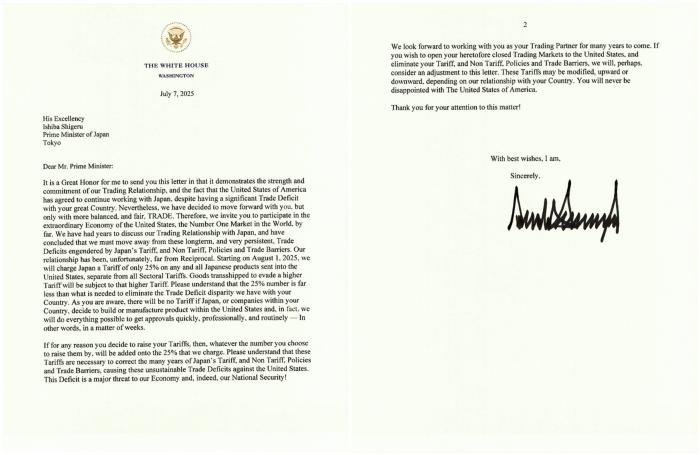
Core Viewpoint - The article discusses the recent unilateral tariff warnings issued by the Trump administration to various countries, highlighting the lack of negotiation and the implications for international trade relationships [2][5][10]. Group 1: Trade Negotiations - Japanese representatives have made seven trips to Washington in three months, covering over 150,000 kilometers in an effort to negotiate "reciprocal tariffs" [1] - Since April, Asian trade negotiators have visited Washington over 20 times, accumulating more than 770 hours of flight time and over 350,000 kilometers, equivalent to circling the globe 14 times [1] Group 2: Tariff Warnings - The U.S. issued a stern, template-like tariff warning letter to Japan, stating that the U.S.-Japan relationship is "far from reciprocal" and announcing a unilateral 25% tariff on Japanese goods [6][8] - Brazil received a similar letter two days later, despite having a trade surplus with the U.S. exceeding $410 billion over the past 15 years, and the Brazilian government formally rejected the letter [6][8] Group 3: Economic Implications - The letter emphasizes the narrative of "trade deficit," blaming trade partners for high tariffs and barriers, while many economists argue that the U.S. trade deficit is primarily due to domestic spending exceeding output [7] - The letter's format transforms negotiations into a "unilateral notification," lacking terms like "consultation" or "discussion," and presents the tariffs as a mere "courtesy" [7][8] Group 4: International Reactions - The letter suggests that tariffs may fluctuate based on the U.S. relationship with each country, increasing uncertainty in the international trade system [8] - Countries like Brazil and South Africa have expressed their intent to retaliate against unilateral tariff increases, indicating a potential escalation in trade tensions [8]
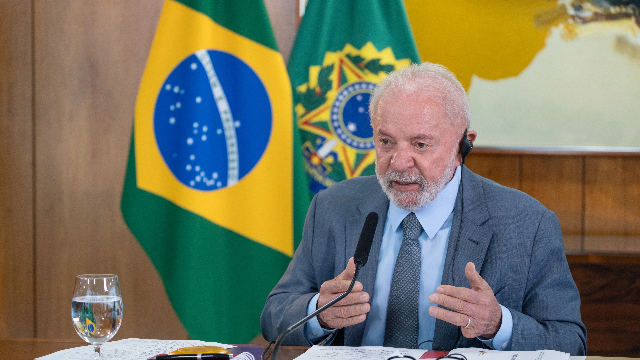
对美国贸易逆差就能躲过关税战吗?巴西的答案是否定的,卢拉批特朗普关税信"内容失实"
Di Yi Cai Jing· 2025-07-11 10:11
Group 1: Trade Relations - Brazil's trade surplus with the U.S. is approximately $7 billion for 2024, with a total trade surplus of about $410 billion over the past 15 years [1][3] - The U.S. has maintained a significant trade surplus with Brazil, which has been a long-standing goal of former President Trump [1][3] - Brazil's exports to the U.S. were around $40 billion, while imports were about $47 billion, resulting in a $7 billion surplus for the U.S. [3] Group 2: Tariff Implications - Trump announced a 50% tariff on all goods imported from Brazil starting August 1, which could significantly impact U.S. industries, particularly the restaurant sector [1][3] - Brazil exports nearly 8 million bags of coffee to the U.S. annually, and over half of the orange juice sold in the U.S. comes from Brazil, indicating potential price increases for these products due to tariffs [4] Group 3: Political Context - The tariff threats come amid tensions between Trump and Brazilian President Lula, with Trump accusing Brazil of unfair trade practices [3][5] - Lula emphasized Brazil's ability to protect its domestic industries and suggested that Brazil could seek new markets in response to U.S. tariffs [3][5] - Trump's actions are seen as an attempt to influence Brazil's internal politics, particularly regarding investigations into former President Bolsonaro [6]