
量化投资

Search documents
融资余额下降14亿,聪明钱却悄悄布局这些ETF!
Sou Hu Cai Jing· 2025-11-27 11:33
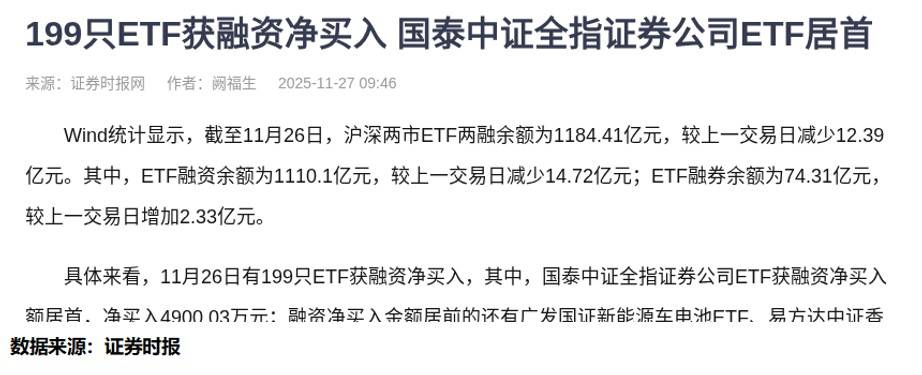
Group 1 - The recent ETF financing data shows significant net inflows, particularly in the Guotai CSI All-Share Securities Company ETF with a net inflow of 49 million, indicating a strategic positioning by professional investors in the brokerage and new energy sectors [1][3] - Despite an overall decrease of 1.4 billion in financing balances, professional players are quietly accumulating positions in the brokerage and new energy sectors, highlighting a divergence between market sentiment and actual investment behavior [3][4] - The data suggests that while retail investors focus on index fluctuations, smart money is utilizing industry ETFs for precise allocations, reflecting a shift in investment strategies [12] Group 2 - The article emphasizes three key lessons from past market experiences: the importance of active participation, the need to move beyond concept-driven speculation, and the superiority of behavioral analysis over technical indicators [4][5][6] - Quantitative data reveals that many stocks perceived as risky may actually be undergoing institutional accumulation, while others may be experiencing retail-driven sell-offs, underscoring the value of understanding market dynamics [10][12] - The analysis of ETF flows indicates a growing interest in sectors like brokerage and new energy vehicles, suggesting a potential trend in capital allocation towards these industries [12]

AI 赋能资产配置(二十六):AI 添翼:大模型增强投资组合回报
Guoxin Securities· 2025-11-27 11:09
Core Insights - The report analyzes three representative AI asset management products: AIEQ, ProPicks, and QRFT, assessing whether AI can deliver excess returns for investors [2] - Overall, while overseas AI asset management products have improved quality and efficiency, they should not be overly "mythologized" [2] - AI's more reliable value lies in enhancing information processing efficiency and standardizing investment research processes rather than consistently outperforming indices [2] Group 1: AI-Driven Asset Management: Progress and Cases - The evolution of global financial markets reflects a historical contest between computational power and data processing capabilities [3] - Traditional quantitative investment relies on linear regression and statistical arbitrage, while AI-driven asset management represents a fundamental paradigm shift [3][4] - New AI stock selection strategies utilize deep learning, reinforcement learning, and natural language processing, enabling the identification of non-linear market patterns [4] Group 2: Case Study 1: AIEQ ETF Introduction - AIEQ is the world's first actively managed ETF entirely driven by AI, launched on October 17, 2017 [5] - The fund's investment strategy involves high-frequency scanning and sentiment analysis of the entire market information environment [5] - AIEQ's model processes millions of unstructured texts daily, aiming to capture undervalued stocks before market sentiment changes [5] Group 3: AIEQ Performance Analysis - As of November 2025, AIEQ's performance shows it has underperformed the S&P 500 index, with a YTD return of approximately 9.38% compared to the S&P 500's 12.45% [10] - Over one year, AIEQ returned about +6.15%, while the S&P 500 returned +11.00% [13] - AIEQ's annual turnover rate reached an astonishing 1159%, which significantly erodes fund value due to transaction costs [18] Group 4: Case Study 2: Investing ProPicks - ProPicks represents a different AI investment approach through a signal subscription model, allowing users to retain execution rights [21] - The platform utilizes a vast historical database and AI algorithms to provide monthly stock selection lists [21] - The "Tech Titans" strategy under ProPicks has achieved a cumulative return of 98.7% since its launch, significantly outperforming the S&P 500 [25] Group 5: Case Study 3: QRFT - QRFT is an AI-enhanced ETF that optimizes traditional factor investment frameworks using AI models [39] - The fund's performance has been slightly better than the S&P 500, with a year-to-date return of approximately +21% as of November 2025 [45] - QRFT's annual turnover rate is around 267%, indicating a high-frequency rebalancing strategy [48]


AI 赋能资产配置(二十六):AI ”添翼“:大模型增强投资组合回报
Guoxin Securities· 2025-11-27 09:56
Core Insights - The report analyzes three representative AI asset management products: AIEQ, ProPicks, and QRFT, assessing whether AI can deliver excess returns for investors [2] - Overall, while overseas AI asset management products have improved quality and efficiency, they should not be overly "mythologized" [2] - AI's more reliable value lies in enhancing information processing efficiency and standardizing investment research processes rather than consistently outperforming indices [2] Group 1: AI-Driven Asset Management: Progress and Cases - The evolution of global financial markets reflects a historical contest between computational power and data processing capabilities [3] - Traditional quantitative investment relies on linear regression and statistical arbitrage, while AI-driven asset management represents a fundamental paradigm shift [3][4] - New AI stock selection strategies utilize deep learning, reinforcement learning, and natural language processing, enabling the identification of non-linear market patterns [4] Group 2: Case Study 1: AIEQ ETF Introduction - AIEQ is the world's first actively managed ETF entirely driven by AI, launched on October 17, 2017 [5] - The fund's investment strategy involves high-frequency scanning and sentiment analysis of the entire market information environment [5] - AIEQ's model processes millions of unstructured texts daily, aiming to capture undervalued stocks before market sentiment changes [5] Group 3: AIEQ Performance Analysis - As of November 2025, AIEQ's performance shows it has underperformed the S&P 500 index, with a YTD return of approximately 9.38% compared to the S&P 500's 12.45% [10] - Over one year, AIEQ returned about +6.15%, while the S&P 500 returned +11.00% [13] - AIEQ's high turnover rate of 1159% significantly impacts its performance, leading to cost erosion [18] Group 4: Case Study 2: Investing ProPicks - ProPicks represents a different AI investment approach through a subscription model, providing users with monthly stock selection lists [21] - The strategy leverages a vast historical database and AI algorithms to evaluate stocks based on over 50 financial indicators [21] - The "Tech Titans" strategy under ProPicks has achieved a cumulative return of 98.7%, significantly outperforming the S&P 500 by 55% [25] Group 5: Case Study 3: QRFT - QRFT employs AI to optimize a traditional factor investment framework, focusing on quality, size, value, momentum, and low volatility [39] - The fund's performance has been slightly better than the S&P 500, with a year-to-date return of approximately +21% as of November 2025 [44] - QRFT's high turnover rate of 267% indicates a high-frequency rebalancing strategy, which poses challenges in terms of cost and performance [48]
金融科技·量化机构金牛奖,明日揭晓!
Zhong Guo Zheng Quan Bao· 2025-11-27 07:16
由中国证券报主办,华鑫证券、西岸集团联合承办,深圳数据经济研究院提供独家学术支持的2025量化行业高质量发展大会暨金融科技·量化机构金牛奖 颁奖典礼,将于11月28日在上海徐汇西岸举行。 本次大会以"创新驱动·责任担当"为主题,将围绕AI技术应用、GPU算力升级、合规风控等前沿议题展开深度对话,共同探索证券行业发挥金融+技术优 势、助力新质生产力发展的路径。 金融科技·量化机构金牛奖的评选,旨在以服务国家金融战略为核心,构建金融科技领域专业评价生态;聚焦国内量化行业发展需求,建立并完善科学评 价体系,搭建高效交流合作平台。 -12 11 . . us on woma JE t to 2025.11.28 ・上海 会上,金融科技·量化机构金牛奖获奖榜单将揭晓,包括五年期金牛量化机构(指数增强策略)、三年期金牛量化机构(指数增强策略)、三年期金牛量 化机构(宏观量化策略)、年度金牛量化机构(宏观量化策略)、三年期金牛量化机构(基本面量化策略)、年度金牛量化机构(基本面量化策略)等。 作为2025证券业金牛奖的重要组成部分,金融科技·量化机构金牛奖坚持公开、公平、公正的原则,采用定量与定性相结合的方法,对不同类型参 ...

长信量化团队立足深度基本面量化,产品提供差异化配置价值
Shenwan Hongyuan Securities· 2025-11-26 11:12
2025 年 11 月 26 日 长信量化团队立足深度基本面量 化,产品提供差异化配置价值 权 益 量 化 研 究 相关研究 证券分析师 邓虎 A0230520070003 denghu@swsresearch.com 联系人 邓虎 A0230520070003 denghu@swsresearch.com 证 券 研 究 报 告 请务必仔细阅读正文之后的各项信息披露与声明 ⚫ 长信量化团队梯队建设完备,成员具备深厚的多学科专业背景。团队成立于 2008 年,是 公募行业较早布局量化投资的团队之一,现有成员平均从业年限达 12.8 年,经历了多轮 市场周期考验,成员专业背景覆盖金融工程、数学、计算机等领域。 ⚫ 长信量化构建系统化的投研体系,追求可持续的管理方案。团队立足深度基本面量化,核 心运用多因子 Alpha 模型预测收益,并结合风险模型与交易成本模型进行组合优化。通 过涵盖因子构建、收益预测到绩效归因的完整投研闭环,旨在在严格的风险约束下,实现 可解释、可复制且长期可持续的超额回报。 ⚫ 长信量化产品布局全面,构建了多元产品矩阵。团队产品线涵盖宽基指数增强、行业量化 及主动量化三大类,是业内布局最齐全 ...
直播间又上戏码:不要999 量化只卖99
3 6 Ke· 2025-11-26 06:54
"低位+风口+资金抱团,散户必备五星量化工具!""双12年终大促,218元用105天,盘前9:27分5000选6,精准捕捉牛股!"打开抖音,此类极具诱惑力的 直播宣传扑面而来。 近期,一批三方投顾公司掀起了售卖量化系统的热潮,直播间观看量动辄突破十万,低价秒杀、全额退款等营销手段轮番上阵,让不少股民心动下单。这 些被主播吹得神乎其神的"量化神器",宣称依托大模型AI算法,能实时追踪主力资金动向、精准把握市场风口,甚至能让散户告别追涨杀跌,轻松实现稳 定收益。 然而,光鲜宣传背后,却是诸多令人费解的谜团:当投资者追问系统选股逻辑、模型核心指标等关键问题时,主播均以"商业机密"避而不答;所谓的"量 化系统",本质是荐股工具,与宣传中的"智能辅助决策"相去甚远。 更值得警惕的是,直播间里高度同质化的"好评"多来自无头像、无作品的新号,而在小红书、知乎等平台,大量投资者纷纷吐槽"被量化荐股坑惨了",不 少人已申请退款。 随着量化投资概念普及,这些一时风靡的量化荐股系统,究竟是散户的财富密码,还是精心设计的收割陷阱? 低价量化系统成三方投顾公司直播新宠 "不用下载软件,不用安装指标,手机网页版直接使用,99元就能享受3 ...

机构暗中布局三年,散户还在猜顶底
Sou Hu Cai Jing· 2025-11-26 06:40
Market Overview - The market appears to be thriving with major indices rising, particularly the ChiNext index which surged nearly 3% [1] - Over 2,800 stocks increased in value, with 66 stocks hitting the daily limit up [1] Market Dynamics - Despite the apparent market rally, only about 40% of stocks outperformed the index during a previous rally, indicating that many investors are lagging behind in relative returns [3] - The phrase "the most dangerous thing in a bull market is earning too little" highlights the risk of not accumulating enough gains before market corrections occur [3] Investment Strategies - Many investors mistakenly believe stock trading is merely about guessing price movements, often chasing trends without understanding institutional positioning [4] - Institutional investors have been quietly accumulating stocks since 2022, leading to significant price increases over three years, contrary to public sentiment [6] Market Signals - The market often misleads with K-line patterns and delayed news; however, monitoring fund flows provides a more accurate picture of market sentiment [8] - The presence of sustained institutional buying is crucial, as single-day surges may be driven by speculative trading rather than genuine interest [11] Survival Guidelines for Investors - Investors should disregard personal biases regarding stock valuations, as market movements are not influenced by individual opinions [9] - Continuous funding consensus is essential; significant price increases without ongoing capital inflow may not be sustainable [11] - Utilizing quantitative tools for analysis is recommended, as they provide objective insights into market conditions [11]

99元,就能买量化系统?
财联社· 2025-11-26 06:16
Core Viewpoint - The article discusses the rise of low-cost quantitative systems promoted by third-party advisory companies through live streaming, highlighting the potential risks and misleading nature of these products [2][9][11]. Group 1: Market Trends - A surge in the popularity of low-priced quantitative systems has been observed, with promotional strategies like "low-price lead generation" and "limited-time offers" being commonly employed [4][3]. - Live streaming sessions often attract large audiences, with some broadcasts reporting viewership exceeding 140,000 [3][7]. Group 2: Product Characteristics - These quantitative systems are marketed as tools that utilize AI algorithms to track market trends and main capital flows, but their actual functionality is often limited to stock recommendations without substantial analytical backing [9][10]. - The systems typically offer a simple purchasing process, emphasizing ease of use for novice investors, and often include promises of full refunds if the service does not meet expectations [7][9]. Group 3: Comparison with Traditional Tools - There is a significant distinction between these third-party quantitative systems and legitimate AI advisory tools provided by brokerage firms, which offer comprehensive investment support and personalized wealth management services [10]. - The third-party systems primarily focus on stock recommendations, lacking the depth and analytical rigor of professional tools, which are designed to assist investors throughout the entire investment process [10]. Group 4: Consumer Feedback and Risks - Many user testimonials in live streams appear to be fabricated or from accounts with no prior activity, raising concerns about the authenticity of positive feedback [11]. - Numerous investors have reported negative experiences with these systems, describing them as scams and expressing dissatisfaction with the lack of transparency regarding the underlying algorithms [11].

百亿量化超额胜率榜揭晓!明汯、九坤等夺冠!“四大量化天王”齐上榜!
私募排排网· 2025-11-26 03:33
Core Viewpoint - Quantitative products are systematic investment methods based on mathematical models, algorithms, and computer technology, with the ability to generate excess returns being a key indicator of their effectiveness [2] Group 1: Quantitative Excess Rate - The quantitative excess rate is defined as the frequency or probability of a quantitative strategy outperforming a benchmark index over a certain period, calculated as the number of times it beats the benchmark divided by the total observation periods [2] - A higher quantitative excess rate indicates that the strategy can maintain positive excess returns most of the time, reducing the risk of significant drawdowns or prolonged underperformance [2] Group 2: Performance of Billion-Level Quantitative Private Equity - In 2023, 388 quantitative products from billion-level private equity firms achieved an average return of 34.26%, with an excess return of 10.87% and an average excess rate of 61.33%, significantly leading among various scales of private equity [3] - The average performance metrics for different scales of private equity are as follows: - 100 billion and above: 34.26% return, 10.87% excess, 61.33% excess rate - 50-100 billion: 25.20% return, 8.14% excess, 56.48% excess rate - 20-50 billion: 27.19% return, 10.77% excess, 55.91% excess rate - 10-20 billion: 26.56% return, 8.95% excess, 54.63% excess rate - 5-10 billion: 26.05% return, 8.99% excess, 53.59% excess rate - 0-5 billion: 24.37% return, 10.11% excess, 52.63% excess rate - Total: 27.64% return, 9.90% excess, 55.86% excess rate [3] Group 3: Top Performers in Quantitative Strategies - The top three products with the highest excess rates in the CSI 300 index enhancement category are from Minghuo Investment, Ningbo Huanfang Quantitative, and Kuande Private Equity, with the average excess rate for billion-level private equity in this category being 64.59% [4] - In the CSI 500 index enhancement category, the top three products are from Wanyan Asset, Pansong Asset, and Tianyan Capital, with an average excess rate of 67.28% for billion-level private equity [10] - In the CSI 1000 index enhancement category, the top three products are from Microbo Yi, Mengxi Investment, and Yanfeng Investment, with an average excess rate of 76.17% for billion-level private equity [10] Group 4: Quantitative Stock Selection - The average return for quantitative stock selection products in 2023 is 40.45%, with an excess return of 16.55% and an average excess rate of 58.26%, while billion-level private equity in this category has an average excess rate of 65.97% [13] - The top three products in this category are from Jiukun Investment, Tianyan Capital, and Longqi Technology [13]

量化赋能中盘宽基,精筑稳健超额Alpha
量化藏经阁· 2025-11-26 00:11
Group 1 - The core viewpoint of the article is that index-enhanced ETFs are an innovative product that combines the advantages of index enhancement strategies and ETFs, leading to significant growth in the market [1][68]. - As of October 31, 2025, there are 51 index-enhanced ETFs in the market with a total scale of 95.73 billion, of which 7 ETFs track the CSI 500 index, amounting to 25.92 billion [1][68]. Group 2 - The CSI 500 index consists of 500 stocks with higher market capitalization after excluding the top 300 stocks from the CSI 300 index, providing a diversified industry distribution and currently trading below historical valuation averages [2][70]. - The scale of CSI 500 index-enhanced funds reached 493.46 billion by Q3 2025, accounting for over one-fifth of all enhanced funds, with stable excess returns [1][70]. Group 3 - The Bosera CSI 500 Enhanced Strategy ETF (159678.SZ) was launched on February 27, 2023, and aims to achieve returns exceeding the benchmark index through quantitative enhancement strategies [1][71]. - Since its inception, the fund has achieved an annualized excess return of 7.76% with a tracking error of only 3.84%, indicating strong risk-adjusted performance [1][71].
