量子计算

Search documents
《阿凡达3》票房遇冷,博纳影业跌停|首席资讯日报
Xin Lang Cai Jing· 2025-12-23 04:52
Group 1 - A new silicon-based quantum processor has been developed by SQC, achieving stable connectivity of 11 qubits, marking a significant advancement in quantum computing [1] - The processor utilizes silicon materials and phosphorus atoms, making it one of the largest silicon-based atomic quantum processors to date [1] Group 2 - The People's Bank of China announced a credit repair policy that includes two additional free opportunities for individuals to check their credit reports in the first half of 2026 [2] - Previously, individuals could check their credit reports for free twice a year, with subsequent checks requiring payment [2] Group 3 - The National Data Bureau released a new batch of 30 public data demonstration scenarios aimed at promoting the development and utilization of public data [3] - This fourth batch of scenarios covers a wider range of areas, with 35% of the scenarios focused on the western and northeastern regions of China [3] Group 4 - The film "Avatar 3" has underperformed at the box office, with total earnings exceeding 400 million yuan after three days, but the first-day earnings were less than 100 million yuan when excluding preview revenues [4][5] - The poor performance of "Avatar 3" has negatively impacted related stocks, particularly Bona Film Group [5] Group 5 - Sazhi Intelligent has completed two rounds of financing (A++ and A+++), raising several hundred million yuan to enhance technology research and development and build smart manufacturing production lines [6][20] - The funding was provided by Haitong Kaiyuan and Guoyuan Equity [6] Group 6 - Meituan has invested in Variable Robotics Technology Company, which focuses on the research and development of intelligent robots and artificial intelligence platforms [7][21] - The registered capital of the company has increased to 812,800 yuan following the investment [7] Group 7 - In November, China's export volume of sucralose increased by 73.89% month-on-month, totaling 1,739.403 tons, while the cumulative export for the first 11 months saw a year-on-year decline of 20.83% [9][23] - The export volume of acesulfame K also saw a month-on-month increase of 56.6% in November [9][23] Group 8 - Bank of America has raised its target price for Micron Technology, increasing earnings per share estimates for the fiscal years 2026, 2027, and 2028 by 62%, 80%, and 42% respectively [10][24] - The adjusted earnings per share estimates are now $31.84, $38.85, and $29.15 [10][24] Group 9 - Tesla is rapidly expanding its Robotaxi project in California, indicating significant growth in its autonomous driving initiatives [12][25] Group 10 - UBTECH has won a nearly 60 million yuan project in the Greater Bay Area, with total orders for humanoid robots reaching nearly 1.4 billion yuan for 2025 [10][26] - The company expects to produce over 1,000 humanoid robots in 2025, with deliveries exceeding 500 units [10][26] Group 11 - The "Hainan Short Drama Going Abroad Industry Base" was inaugurated to support content creation, technology research and development, international distribution, and copyright trading [13][27] - This initiative aims to enhance the digital content export industry in Hainan Free Trade Port [13][27] Group 12 - Yunyi Electric stated that the return of production capacity from Anshi to the mainland has minimal impact on its overall operations, with all business activities proceeding normally [14][28]
《阿凡达3》票房遇冷,博纳影业跌停|首席资讯日报
首席商业评论· 2025-12-23 04:07
Group 1 - A new silicon-based quantum processor developed by SQC has achieved stable connectivity of 11 qubits, marking a significant advancement in quantum computing [2] - The People's Bank of China will provide two additional opportunities for individuals to query their credit reports for free in the first half of 2026, enhancing access to credit information [3] - The National Data Bureau has released a new batch of 30 public data demonstration scenarios aimed at promoting the development and utilization of public data across various sectors [4] Group 2 - The film "Avatar 3" has underperformed at the box office, with a total revenue of over 400 million yuan in its first three days, negatively impacting related stocks such as Bona Film Group [5] - Sazhi Intelligent has completed two rounds of financing totaling several hundred million yuan, which will be used for technology research and development as well as the construction of smart manufacturing production lines [6] - Meituan has invested in a robotics company, indicating its strategic focus on the robotics sector and the future of smart living and automation [7] Group 3 - In November, China's export volume of sucralose increased by 73.89% month-on-month, while the cumulative export for the first 11 months saw a decline of 20.83% year-on-year [8] - Bank of America has raised its target price for Micron Technology, with significant increases in earnings per share forecasts for the fiscal years 2026, 2027, and 2028 [9] - Tesla has rapidly expanded its Robotaxi project in California, indicating growth in its autonomous driving initiatives [10] Group 4 - UBTECH has won a nearly 60 million yuan project in the Greater Bay Area, with total orders for humanoid robots reaching nearly 1.4 billion yuan in 2025 [11] - A new "Hainan Short Drama Export Industry Base" has been established to support the international distribution of digital content, enhancing the region's creative industry [12] - Yunyi Electric has stated that the impact of the return of production capacity from Anshi to the mainland is minimal, with all business operations proceeding normally [13]



异动盘点1223 |乳业股早盘活跃,华芢生物-B昨日跌近30%;Abivax S.A.开盘大涨20.69%,黄金股、银概念股普涨
贝塔投资智库· 2025-12-23 04:02
Market Performance - Huazhong Biopharmaceutical (02396) saw a significant drop of nearly 30% on its debut and continued to decline by over 17% today. The company, established in 2012, focuses on the discovery, development, and commercialization of wound healing therapies, but has not generated any revenue from product sales yet [1] - Zai Lab (02617) fell by over 16% following the unlocking of cornerstone lock-up shares on December 23 [1] - China Rare Earth Holdings (03788) increased by over 7% after announcing plans to spin off its subsidiary "Rare Earth Gold" for independent listing on the Hong Kong Stock Exchange [1] - Goldwind Technology (02208) rose nearly 1% as the world's largest integrated green hydrogen and ammonia project, built by China Energy Engineering, officially commenced production [1] - Guizhou Zhenjiu (06979) saw an increase of over 4% after announcing a phased halt to large-scale recruitment in certain regions, which has shown significant progress during the industry's adjustment period [1] Company Developments - Taobo (06110) experienced a decline of over 7% as it reported a high single-digit year-on-year drop in total sales for its retail and wholesale business for the third quarter of the 2025/26 fiscal year [2] - CSPC Pharmaceutical Group (01093) rose nearly 6% after its chairman increased his stake by acquiring 13.454 million shares at approximately HKD 8.1957 per share, totaling around HKD 110 million [2] - Shandong Gold (01787) increased by nearly 6% as spot gold prices reached a historical high of USD 4,400 per ounce, with predictions from JPMorgan estimating an average gold price of USD 5,055 per ounce by Q4 2026 [2] Industry Trends - The dairy sector saw active trading, with companies like Modern Dairy (01117), Original Ecology Dairy (01431), Mengniu Dairy (02319), and China Feihe (06186) all experiencing gains. This follows the Ministry of Commerce's announcement of temporary anti-subsidy measures on dairy products imported from the EU starting December 23, 2025 [3] - CIMC Enric (03899) rose by over 7% after signing a memorandum of cooperation with the Yangpu Economic Development Zone Management Committee at a recent offshore wind power industry chain conference [4] US Market Highlights - The US solar energy sector saw strong performance, with companies like Sunrun (RUN.US) and Canadian Solar (CSIQ.US) rising by 10.84% and 10.78% respectively, following a Goldman Sachs report indicating a structural investment window in the solar sector [5] - Cytokinetics (CYTK.US) increased by 4.59% after receiving priority review approval for its innovative drug, which treats obstructive hypertrophic cardiomyopathy in adults [5] - Tesla (TSLA.US) rose by 1.56% as a prominent analyst expressed optimism about the company's expansion of its autonomous taxi service by 2026 [6] - Quantum computing stocks surged, with D-Wave Quantum (QBTS.US) rising by 20.02% and IonQ Inc (IONQ.US) by 11.1% [6] - Cryptocurrency stocks continued to rise, with Hut 8 (HUT.US) increasing by 14.21% as Bitcoin and Ethereum prices surged [7]

我国量子纠错研究取得新进展,港股科技30ETF(513160)盘中溢价,近10日累计“吸金”超5.3亿元
2 1 Shi Ji Jing Ji Bao Dao· 2025-12-23 02:04
Group 1 - The Hong Kong stock market opened with a general rise, with the Hong Kong Technology 30 ETF (513160) experiencing a slight decline of 0.33% and a trading volume exceeding 37 million yuan, indicating active trading with a premium rate of 0.10% [1] - Major constituent stocks of the ETF, including SenseTime-W and SMIC, saw gains of over 1%, while other notable stocks such as Kingdee International, Alibaba-W, China Communications Services, Lenovo Group, and Meituan-W also followed suit [1] Group 2 - The Hong Kong Technology 30 ETF (513160) recorded a net inflow of over 9.6 million yuan yesterday, marking 9 out of the last 10 trading days with net inflows, totaling over 530 million yuan [2] - The ETF closely tracks the Hang Seng Hong Kong Stock Connect China Technology Index, which includes mainland companies engaged in technology business and listed in Hong Kong, with top holdings including SMIC, Kuaishou-W, Tencent Holdings, Alibaba-W, and Xiaomi Group [2] Group 3 - A significant advancement in quantum computing was reported by the team led by Academician Pan Jianwei from the University of Science and Technology of China, achieving a milestone in quantum error correction with the superconducting quantum processor "Zuchongzhi 3.2," which is crucial for practical quantum computers [2] - This new technological route provides a more advantageous solution for constructing million-bit quantum computers, marking a key milestone in the global pursuit of practical quantum computing [2] Group 4 - Minyin Securities' outlook for the technology industry in 2026 highlights three major trends: the penetration of multimodal and agent technologies across more industries, a shift towards composite AI strategies by enterprises, and the emergence of AI-ready data as a foundational element for enterprise-level AI models [3] - The current market landscape is becoming clearer, with major participants categorized into five groups: 1) Internet technology giants; 2) AI+Data technology providers; 3) Technology transformers; 4) AI-native entrepreneurs; 5) Vertical field deep divers [3]

金融界财经早餐:高层定调“十五五”规划!要谋划新政策新举措;外资再度唱多中国股市!贵金属价格续创新高;沪深北交易所发布休市安排;壁仞科技开启认购(12月23日)
Jin Rong Jie· 2025-12-23 01:47
Group 1: Industry Developments - The Civil Aviation Administration of China has approved two mandatory national standards for civil unmanned aerial vehicles, which will be implemented starting May 1, 2026, promoting safer and more orderly industry development [6] - Dinglong Co. is set to begin trial production of high-end wafer photoresist, having received orders from major domestic wafer manufacturers, accelerating the domestic substitution process in semiconductor materials [6] - Significant advancements in quantum computing have been reported, with the "Zu Chongzhi 3.2" superconducting quantum processor achieving key technological progress, which is expected to accelerate the practical application of quantum computing [6] - Baidu is collaborating with Uber and Lyft to conduct trial runs of autonomous taxis in the UK, marking progress in the export of autonomous driving technology, attracting market attention to related domestic industries such as lidar and onboard algorithms [6] - Chasing Technology has launched the world's first AI health glasses, which monitor health indicators such as heart rate and blood oxygen levels, with expectations for rapid growth in the AI glasses market by 2026 [6] Group 2: Company News - MiniMax and Zhiyu Huazhang, AI model startups, have received approval for their overseas IPO plans, with MiniMax aiming to raise up to $700 million by issuing up to 33,577,240 shares [7] - Wallen Technology has begun accepting subscriptions for its Hong Kong IPO, with the first day of oversubscription reaching nearly 47 times, aiming to raise up to HKD 4.85 billion [7] - Liying Intelligent Manufacturing has signed a share transfer agreement to acquire a 35% stake in Liminda for CNY 875 million, gaining control over 52.78% of the voting rights [7] - Sanhua Intelligent Control expects a net profit of CNY 3.874 billion to CNY 4.649 billion for the year, representing a year-on-year growth of 25% to 50% [7] - Huaxia Happiness announced that its board of directors will not submit a temporary proposal from Ping An Life for shareholder meeting review, as the proposal was not approved [7] - Yongding Co.'s subsidiary plans to raise CNY 55 million through external investment, involving several investors [7] - Duoke Culture has announced a potential change in control, leading to a temporary suspension of its stock trading for up to two trading days [7] - Lingyun Optical's subsidiary plans to invest up to $5 million in the IPO of Zhiyu on the Hong Kong Stock Exchange [7] - Vanke has disclosed an extension of the grace period for its mid-term notes, increasing the grace period from 5 to 30 trading days without penalty interest [7] - Kuaishou has experienced a severe cybersecurity incident, leading to the spread of inappropriate content, with the platform currently addressing the issue [7] - Apple has been fined €98 million by the Italian antitrust authority for alleged abuse of market dominance regarding its app tracking transparency policy, with plans to appeal the decision [10] - Paramount has modified its acquisition offer for Warner Bros, with Oracle co-founder Larry Ellison providing $40.4 billion in equity financing guarantees to alleviate concerns about the stability of the acquisition funds [10]
A股开盘:沪指微涨0.04%、创业板指涨0.14%,贵金属、免税及海南自贸区概念股走强,量子科技概念股活跃
Jin Rong Jie· 2025-12-23 01:35
Company News - Sanhua Intelligent Control expects net profit attributable to shareholders to be between 3.874 billion and 4.649 billion yuan, representing a year-on-year growth of 25%-50% [2] - Yongding Co., Ltd. plans to increase capital and introduce external investors for its subsidiary, Dingxin Optoelectronics, raising a total of 55 million yuan [2] - Ningbo Huaxiang's subsidiary signed a strategic cooperation agreement with Shenzhen Dahuang Robot Technology to enhance collaboration in the development and manufacturing of general humanoid robot dexterous hands [2] - Tongyu Communication's subsidiary plans to introduce investors through capital increase, with a total investment of 10 million yuan [2] - Reader Culture announced that its controlling shareholder is planning a change in control, leading to a temporary suspension of its stock [2] Industry News - Quantum Computing: A significant advancement in quantum error correction was achieved by a team at the University of Science and Technology of China, laying a foundation for practical quantum computers [6] - Commercial Space: The 2025 Third Commercial Space Development Conference will be held on December 24, focusing on national policies and key technology discussions [7] - Hainan Free Trade Zone: The full island closure operation officially started, with Sanya reporting a sales figure of 118 million yuan on the first day [8] - Humanoid Robots: The robot rental market has surpassed 1 billion yuan this year, with expectations to grow to at least 10 billion yuan next year [9] - Semiconductor Equipment: The global semiconductor equipment market is expected to reach 133 billion dollars in 2025, driven by AI-related investments [14]

克服运行中原子损耗限制,能自行修复的量子计算机问世
Huan Qiu Wang Zi Xun· 2025-12-23 01:30
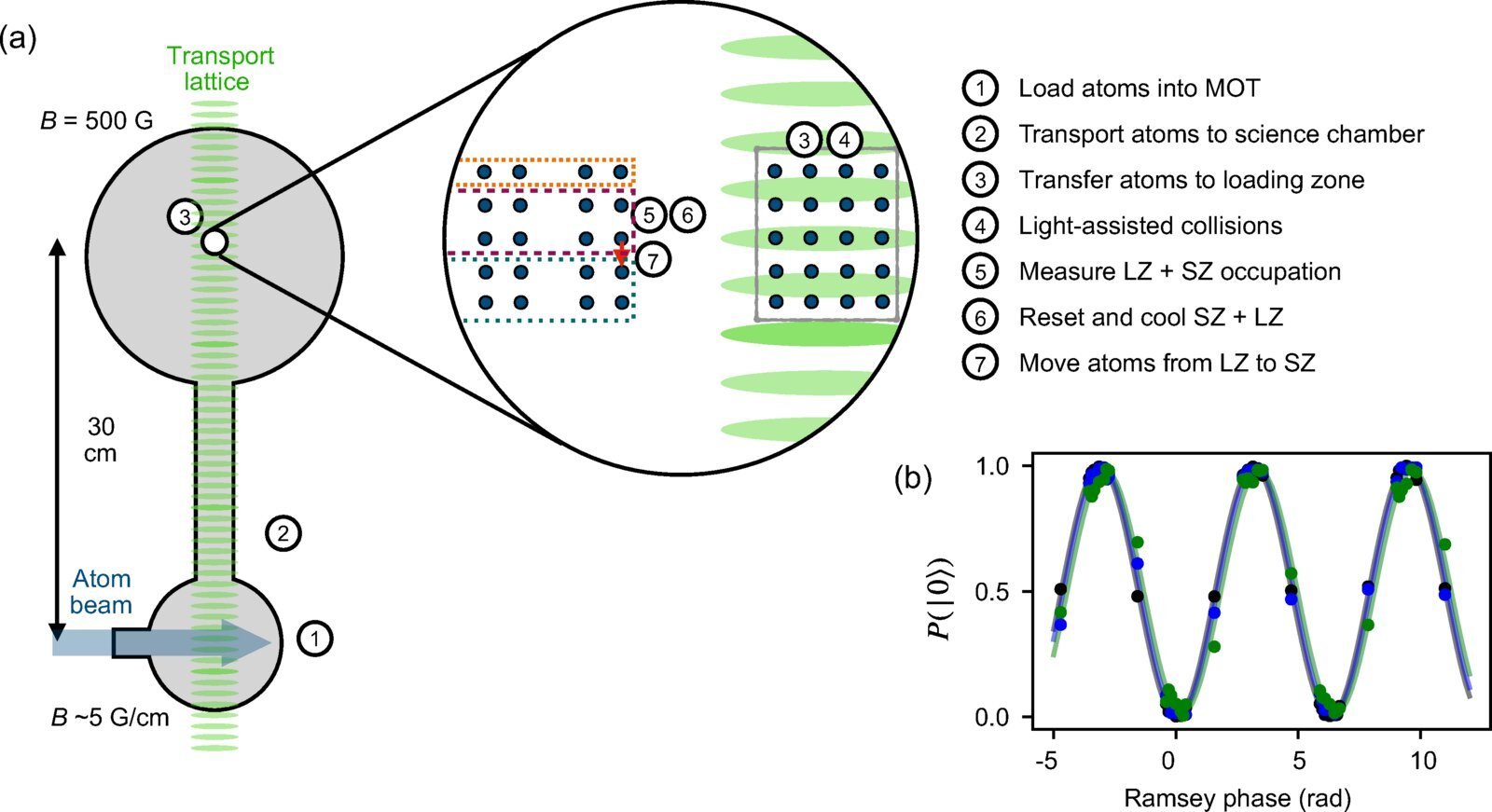
为解决这一问题,研究团队想出了"分区管理"的办法。他们把原子分成5个不同的功能区:寄存区用于存放量子比特,交互区进行计算,测量区用于利用辅 助原子检查误差,储备区则放着备用原子,加载区负责从外部补充新原子。 这样一来,就好比把工厂的生产线分成几个独立车间,即便某个车间出现故障,其他车间仍能照常运转,不会让整个生产停摆。当"工厂"发现某个原子"跑 掉"时,会立即从储备区调出备用原子,放到空缺位置,并将其重置为最低能量状态,使其马上投入运算。同时,完成检查任务的辅助原子也可以被回收, 经过重置后重复使用,实现"边运行边修复"。 为了验证这一机制,研究团队让量子计算机运行了一个重复代码,并连续进行了41轮自检。每轮中,系统都能像替换损坏零件一样,及时补上丢失的原子, 而数据运行不受影响。研究人员表示,如果没有自我修复功能,系统在几轮运算后就会"耗光原子",无法继续工作。 这项研究表明,中性原子量子处理器在电路运行中可像"回收零件"一样,重新初始化并重复使用辅助原子,这样在量子比特寿命有限的条件下,量子电路也 能连续运转。 来源:科技日报 科技日报记者 张佳欣 就像传统计算机一样,量子计算机也会"出故障"。在运行过程 ...
克服运行中原子损耗限制 能自行修复的量子计算机问世
Ke Ji Ri Bao· 2025-12-23 00:56
这样一来,就好比把工厂的生产线分成几个独立车间,即便某个车间出现故障,其他车间仍能照常运 转,不会让整个生产停摆。当"工厂"发现某个原子"跑掉"时,会立即从储备区调出备用原子,放到空缺 位置,并将其重置为最低能量状态,使其马上投入运算。同时,完成检查任务的辅助原子也可以被回 收,经过重置后重复使用,实现"边运行边修复"。 为了验证这一机制,研究团队让量子计算机运行了一个重复代码,并连续进行了41轮自检。每轮中,系 统都能像替换损坏零件一样,及时补上丢失的原子,而数据运行不受影响。研究人员表示,如果没有自 我修复功能,系统在几轮运算后就会"耗光原子",无法继续工作。 这项研究表明,中性原子量子处理器在电路运行中可像"回收零件"一样,重新初始化并重复使用辅助原 子,这样在量子比特寿命有限的条件下,量子电路也能连续运转。 就像传统计算机一样,量子计算机也会"出故障"。在运行过程中,它们有时会丢失用于计算的原子,这 可能会让计算直接中断。不过,据最新一期《物理评论X》杂志报道,美国量子计算机制造商"原子计 算"展示了一种在运行中能自行修复的中性原子量子计算机,克服了原子损耗的关键难题,为开发可持 续运行的量子计算机奠 ...
【早报】李强发声!谋划一批带动全局的重大工程、重大项目、重大载体;国际金银续创新高
财联社· 2025-12-22 23:10
Macro News - The State Council, led by Premier Li Qiang, is planning major projects and initiatives to drive overall development, emphasizing the need for detailed and practical measures in the 14th Five-Year Plan [3] - The National Audit Office reported that 98% of the 2,186 issues identified in the 2024 budget audit have been rectified, with a total of 1.04 trillion yuan involved in the corrections [3] Industry News - The Ministry of Commerce announced temporary anti-subsidy measures on dairy products imported from the EU, effective December 23, 2025, due to identified subsidies causing substantial harm to the domestic dairy industry [4] - The National Development and Reform Commission announced a reduction in domestic gasoline and diesel prices by 170 yuan and 165 yuan per ton, respectively, marking the last price adjustment of the year [7] - The National Medical Insurance Administration released a procurement document for high-value medical consumables, aiming to reduce costs for public medical institutions [7] - Nvidia's GB300 AI server cabinet shipments are expected to reach 55,000 units in the coming year, a 129% increase driven by major companies like Microsoft and Meta [7] - The Chinese stock market is experiencing a strong rebound, with Goldman Sachs predicting continued growth into 2026 due to investor re-evaluation of the tech sector [8] Company News - BYD confirmed reports of salary increases for its R&D personnel [9] - China Communications Construction Company and Xiangyuan Cultural Tourism announced that their actual controller has been taken into criminal custody [10] - Tongyu Communication plans to increase capital and introduce investors to enhance its financial strength for satellite communication product development [10] - Huaxia Happiness rejected five temporary proposals from China Ping An Life for the upcoming shareholders' meeting [10] - Zhaoran Co. signed a contract for a 4.033 billion yuan project for producing biodegradable polyester, representing 142% of its audited revenue for 2024 [10]


我国量子纠错研究取得新进展
财联社· 2025-12-22 16:06
Core Viewpoint - The research team at the University of Science and Technology of China has made significant progress in quantum error correction using the superconducting quantum processor "Zuchongzhi 3.2," establishing a foundation for practical quantum computing [1][2]. Group 1: Quantum Processor Development - The "Zuchongzhi 3.2" quantum processor, based on 107 qubits, has achieved a new "full microwave quantum state leakage suppression architecture" [1]. - Performance improvements in single-qubit and two-qubit gate manipulation accuracy and readout fidelity have been observed compared to previous generations [1]. - The research team successfully demonstrated a surface code logical qubit with a code distance of 7, where the logical error rate significantly decreases as the code distance increases, proving operation below the error correction threshold [1]. Group 2: Importance of Quantum Error Correction - Achieving "below threshold" quantum error correction is a long-sought core goal in the global quantum computing field and a key milestone for transitioning quantum computing systems from prototypes to practical applications [2]. - This new technological approach provides a more advantageous solution for constructing million-qubit quantum computers in the future [2].