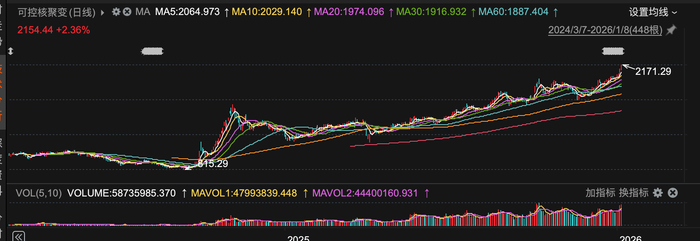
可控核聚变

Search documents
弱势盘整,旗手券商带头跳水
Ge Long Hui· 2026-01-08 20:15
昨天强势的证券板块大回撤,截止午盘下跌1.73%,其中华林证券触及跌停,华泰证券大跌4.04%,兴业证券、国泰海通、东方证券等多股跌幅 在3%上方。能源金属、保险、退税商店等行业板块紧随其后,且跌幅均在1%上方。 小幅低开后震荡反转,截止午盘三大指数涨跌互现,其中沪指微涨0.09%,深成指下跌0.2%,创业板指下跌0.52%。两市合计近3700只个股上 涨,合计成交额1.77万亿。 商业航天概念反复活跃,其中鲁信创投10天8板,银河电子4连板,通宇通讯2连板。AI应用概念爆发,包括久其软件、宝信软件等在内的多股 涨停。脑机接口概念走强,其中创新医疗、普利特、南京熊猫等股4连板。可控核聚变概念表现活跃,其中中国一重、国机重装、中国核建2连 板。 欢迎您在评论中分享自己的看法,大家一起学习和讨论。 ...


逾3700股飘红 科技前沿赛道领涨结构性行情
Shang Hai Zheng Quan Bao· 2026-01-08 16:49
Market Overview - The A-share market experienced significant differentiation after a strong rally, with the Shanghai Composite Index slightly retreating by 0.07% to 4082.98 points, while the Sci-Tech Innovation Index rose by 1.14% to 1766.57 points, driven by sectors like brain-computer interfaces and controllable nuclear fusion [2] Brain-Computer Interface Sector - The brain-computer interface sector saw strong performance, with stocks like Aipeng Medical hitting a 20% limit-up, and companies such as Nanjing Panda and Prit reported consecutive gains [3] - Nanjing Panda clarified that it currently has no mature products related to brain-computer interfaces and that the concept will not materially impact its operations [3] - Prit disclosed that its LCP film products are suitable for use as flexible electrode materials in brain-computer interfaces, and it is the only domestic company to achieve a significant technological breakthrough in this area [3] Controllable Nuclear Fusion Sector - The controllable nuclear fusion concept experienced a surge, with over ten stocks, including China Nuclear Engineering and Snowman Group, hitting the limit-up [4] - The sector has seen a cumulative increase of nearly 10% since the beginning of 2026, indicating strong market interest [4] Technological Breakthroughs in Nuclear Fusion - Recent breakthroughs in controllable nuclear fusion technology were reported by the Hefei Institute of Physical Science, which confirmed significant experimental results related to the "artificial sun" superconducting tokamak [5] - The International Energy Agency predicts that the global nuclear fusion market could approach 3.5 trillion yuan by 2030, highlighting the sector's potential [5] - The past five years have shown explosive growth in the global fusion industry, with total investments rising from $1.9 billion in 2021 to $9.7 billion, and an additional $2.6 billion expected in 2024 [5] Investment Outlook - UBS's China president stated that Chinese assets are not in a "heated" state, with expected earnings growth of 14% for the MSCI China Index in 2026, driven by sectors like internet platforms and high-end manufacturing [6] - UBS's internal data indicates that foreign investment in Chinese assets is expected to rebound significantly, although there remains considerable room for growth compared to historical averages [6] - The valuation advantages and structural growth potential of Chinese assets make them an attractive option for global investors seeking to hedge against single-market risks [6]





技术突破与资本赋能助力核聚变产业化提速-聚焦中上游投资机会-可控核聚变深度报告
2026-01-08 16:02
Summary of Key Points from the Conference Call on Controlled Nuclear Fusion Industry Overview - The conference focuses on the **controlled nuclear fusion industry**, highlighting significant advancements in both the US and China, particularly with the **Energy Singularity Company** achieving a 120-second steady-state long-pulse plasma operation with its **Honghuang 170** device, exceeding market expectations [1][2]. Core Insights and Arguments - **Rapid Development**: The controlled nuclear fusion sector has seen substantial changes since 2025, driven by energy demand, US-China technological competition, advancements in high-temperature superconductors and AI, and a competitive investment landscape [1][4]. - **Investment Opportunities**: Current investment opportunities are primarily concentrated in the **midstream and upstream segments**, including high-temperature superconductors, plasma-facing materials, superconducting magnets, vacuum chambers, and auxiliary systems like cooling and heating systems [1][5][18]. - **Market Dynamics**: The controlled nuclear fusion sector experienced three phases of growth in 2025: driven by technological breakthroughs, downstream engineering installations, and significant tenders following the completion of the BEPCII device [6]. Important Developments and Catalysts - **2026 Catalysts**: Key factors expected to catalyze the controlled nuclear fusion sector in 2026 include national funding support, major device tenders, and project launches such as **Best Craft** and **Jiangxi Xinghuo No. 1** [3][7]. - **Global Progress**: The announcement of a potential merger between **Trump Media Group** and **TAE** to build the world's largest commercial fusion power plant by 2026 signifies rapid advancements in the US commercial fusion sector [2][19]. Challenges and Considerations - **Technical Challenges**: The industry faces significant challenges, including the need for extremely high temperatures and collision probabilities, as well as the efficient confinement and utilization of high-temperature plasma [12][16]. - **Investment Focus**: Investors are advised to focus on upstream raw material suppliers and midstream equipment manufacturers, particularly those producing superconducting materials and key components for fusion devices [20]. Additional Insights - **Government Support**: Governments worldwide are prioritizing controlled nuclear fusion as a strategic energy solution due to its potential to address energy shortages with clean, high-density energy sources [8][9]. - **Research Resurgence**: Renewed interest in controlled nuclear fusion research is attributed to breakthroughs in high-temperature superconductors and AI technologies, which enhance the feasibility and efficiency of fusion experiments [16][17]. Conclusion - The controlled nuclear fusion industry is poised for significant growth, driven by technological advancements, government support, and increasing investment opportunities, particularly in the midstream and upstream segments. Investors should remain vigilant for emerging trends and key players in this rapidly evolving sector [1][20].
核聚变核心逻辑再梳理
2026-01-08 16:02
Summary of Key Points from the Conference Call Industry Overview - The conference call discusses the global controlled nuclear fusion industry, highlighting a competitive landscape between the US and China, with the US relying on tech giants for capital expenditure and policy guidance, while China focuses on state-led initiatives [1][3]. Core Insights and Arguments - Controlled nuclear fusion is included in China's "14th Five-Year Plan," indicating strong governmental support and potential for increased capital expenditure in the sector [1][3]. - Current investments in China's nuclear fusion projects are approximately 150 billion yuan, with expectations for continued growth in the coming years [4][5]. - The industry is currently in the experimental phase, with significant future capital expenditure potential as projects transition to engineering and demonstration phases, which may require investments in the hundreds of billions [7][8]. Important Developments - The Hefei BEST project is a key observation point, with significant bidding activity expected in 2026, including a notable increase in bidding amounts in November, reaching nearly 4 billion yuan [9]. - The Tokamak device's magnet component represents a high value segment (30%-40% of total value), with companies like Western Superconducting and Yongding Co. being noteworthy in the low and high-temperature superconducting routes [10]. Potential Investment Opportunities - Key companies in the supply chain, such as Hefei's Hezhong Intelligent, Nanchang's Lianchuang Optoelectronics, and Chengdu's Guoguang, are identified as having significant growth potential due to their critical positions in the industry [2][10]. - The nuclear fusion sector is expected to see substantial capital inflows, particularly as projects like Hefei BEST begin to materialize, which will drive technological advancements and commercialization [5][11]. Additional Considerations - Future catalysts for the nuclear fusion sector include policy support, progress in bidding and contract awards, and the successful launch of new experimental projects, which could positively impact market sentiment and stock prices of related companies [11].
AI基建-电力需求缺口
2026-01-08 16:02
Summary of Key Points from Conference Call Records Industry Overview - The records primarily focus on the **gas turbine industry**, highlighting the surge in demand driven by **AI data center construction** and **energy transition**. The demand for gas turbines is projected to reach approximately **56 GW in 2024**, with further growth expected in 2025 [1][2]. Core Insights and Arguments - **Demand Drivers**: The global gas turbine market is primarily driven by two factors: the increasing demand for AI and the upgrade of energy structures. These trends are expected to accelerate starting in 2024 [2]. - **Regional Demand**: The North American and Middle Eastern markets are experiencing significant growth in gas turbine orders, with major manufacturers like **Mitsubishi Heavy Industries** and **GE** reporting substantial increases in orders, particularly for heavy gas turbines [3][4]. - **Middle East Energy Transition**: Saudi Arabia aims for **50% of its electricity to come from natural gas by 2030**, contributing to a significant rise in gas demand in the region. Since June 2024, major gas turbine manufacturers in the Middle East have secured around **20 GW** in gas orders, which will be crucial for the demand increase in 2025 [5]. - **Supply Constraints**: Global gas turbine manufacturers are facing supply shortages and are actively expanding production capacities. GE plans to increase its capacity to **90 units by 2028**, while Siemens Energy anticipates reaching over **30 GW** in capacity by 2030 [6]. Additional Important Insights - **Opportunities for Chinese Component Suppliers**: Chinese companies are gaining opportunities to deepen collaborations with international manufacturers. Companies like **Longda** and **Yingliu** have signed long-term agreements with firms such as **GE** and **Siemens Energy** [7]. - **Growth in Storage Solutions**: The demand for energy storage solutions is expected to grow significantly, with North American large-scale storage capacity projected to reach **70 GWh by 2025**. The annual growth rate for AI data center-related storage is anticipated to be between **20%-30%** [19]. - **HRSG Market Impact**: The demand for Heat Recovery Steam Generators (HRSG) is expected to rise as **60-70%** of North American gas power projects will adopt combined cycle power generation, enhancing power generation efficiency by **40-50%** [13]. - **Economic Viability of Solar and Storage Solutions**: The cost of solar energy combined with storage is becoming increasingly competitive, especially with policy support that can reduce overall investment costs by about **30%** [18]. Conclusion The gas turbine industry is poised for significant growth driven by AI and energy transition trends, with substantial opportunities for both established manufacturers and emerging suppliers, particularly in the context of North American and Middle Eastern markets. The integration of renewable energy solutions, such as solar and storage, is also becoming a critical component of the energy landscape.
晚间公告|1月8日这些公告有看头
Di Yi Cai Jing· 2026-01-08 15:07
Major Announcements - Tongcheng New Materials is planning to issue H-shares and apply for listing on the Hong Kong Stock Exchange to enhance its international strategy and financing channels [2] - Huaxia Happiness's controlling shareholder and actual controller are involved in arbitration with a claim amount of approximately 6.4 billion yuan [5] - Industrial Fulian announced a cash dividend distribution of 6.55 billion yuan for the first half of 2025, with a record date of January 15, 2026 [6] Stock Trading Risks - Fenglong Co. reported significant stock price volatility, with a cumulative increase of over 20% in two consecutive trading days, indicating high speculation risk [3] - Guojiji Heavy Industry stated that its revenue from controllable nuclear fusion products is currently very low, despite being classified as a related stock [4] - China Nuclear Construction highlighted that its controllable nuclear fusion business has not generated any revenue yet [11][15] Financial Performance - Puni Testing expects a loss of 200 million to 250 million yuan for the fiscal year 2025, following a 100% increase in stock price over ten trading days [18] - Meike Home anticipates a negative net profit for 2025, indicating financial challenges [19] - Jinli Permanent Magnet forecasts a net profit increase of 127% to 161% for 2025, driven by strong sales in various sectors [20] New Business Developments - Aibisen received a drug registration certificate for its exclusive injectable botulinum toxin product, marking a significant milestone in its strategic layout [14] - Changhong Technology's subsidiary secured over half of the procurement share for semiconductor materials from a major domestic wafer factory, enhancing its market position [30] Share Buybacks and Reductions - Xingchen Technology plans to repurchase shares worth 60 million to 120 million yuan for employee stock ownership plans [22] - *ST Jianyi's shareholder plans to reduce holdings by up to 1.23% of total shares [23] - Lai Yifen's controlling shareholder intends to reduce holdings by up to 3% of the company's shares [25]
晚报 | 1月9日主题前瞻
Xuan Gu Bao· 2026-01-08 14:46
Group 1: Sodium Battery - The China Chemical and Physical Power Industry Association has approved the release of the group standard for sodium-ion batteries for energy storage, marking a new phase of standardization in this field [1] - Sodium-ion batteries are expected to accelerate from laboratory testing to large-scale applications due to their abundant resources, low cost, and high safety [1] - The global shipment of sodium-ion batteries is projected to exceed 347 GWh by 2030, with a compound annual growth rate of 58.1% [1] Group 2: Commercial Aerospace - Arrow Yuan Technology has begun construction on China's first offshore reusable rocket production base with a total investment of 5.2 billion yuan [2] - The reusable rocket market is anticipated to experience explosive growth, with 2026 expected to be the "Year of Rocket Reusability," significantly reducing launch costs [2] - If recovery technology breakthroughs occur by 2026, China could establish a satellite constellation by 2030, unlocking trillion-dollar markets in space internet and remote sensing [2] Group 3: Medical Research - A team from Peking University has developed a protein-targeted degradation technology that can expose tumor cells that evade the immune system, transforming them from "invisible enemies" to "intelligence messengers" [3] Group 4: Water Resources - The Chinese government is accelerating the construction of the national water network, with significant investment opportunities in the water resources engineering sector [3] - The water resources engineering construction industry is expected to maintain a compound annual growth rate of 8.5% from 2025 to 2030, reaching a market size of over 2.2 trillion yuan by 2030 [3] Group 5: Controlled Nuclear Fusion - The new Atomic Energy Law of the People's Republic of China will take effect on January 15, 2026, encouraging and supporting controlled nuclear fusion research [4] - The global fusion market is expected to exceed 100 billion USD by 2030, driven by significant domestic and international developments in the sector [4]
301357,重大资产重组!机构龙虎榜抢筹6股
Zheng Quan Shi Bao· 2026-01-08 14:04
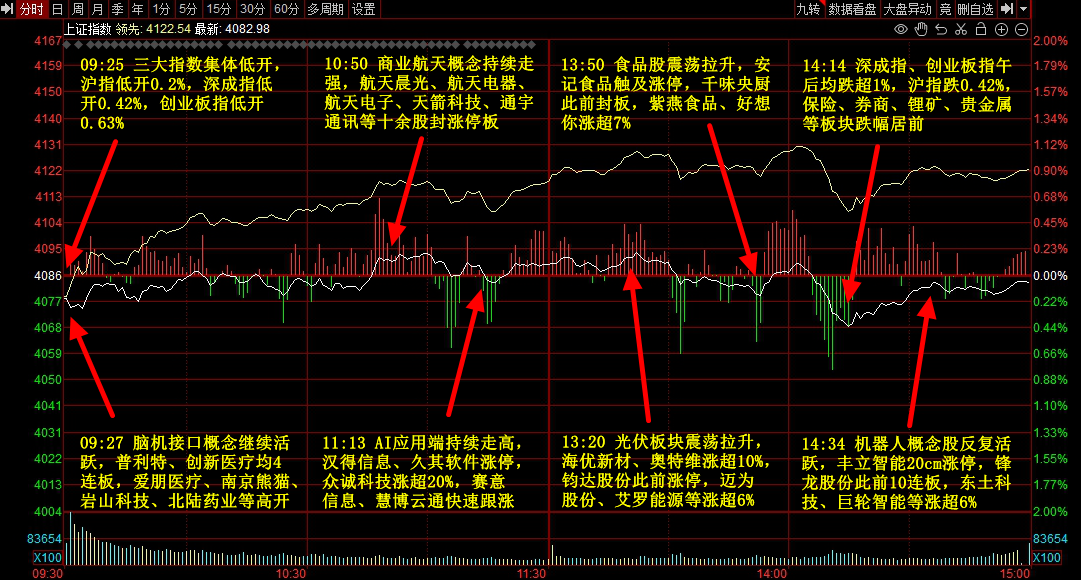
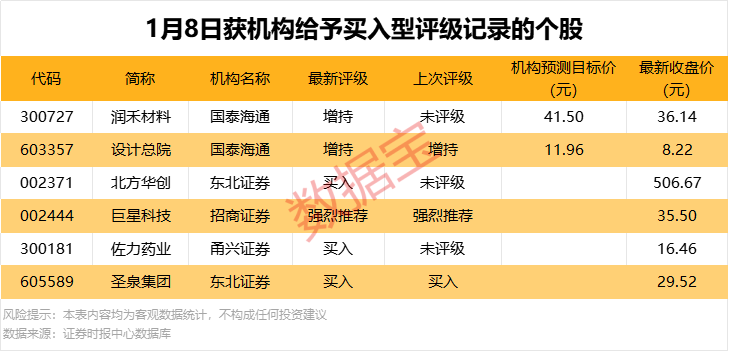
Market Overview - The three major A-share indices showed mixed performance on January 8, with the Shanghai Composite Index experiencing fluctuations. The total trading volume in the Shanghai and Shenzhen markets reached 2.83 trillion yuan, an increase of over 55 billion yuan compared to the previous day. More than 3,700 stocks closed higher [1] Sector Performance - Leading sectors included domestic aircraft carriers, military information technology, and terahertz technology, while sectors such as cobalt, nickel, and rare earth permanent magnets saw significant declines [1] Institutional Ratings - Six stocks received buy ratings from institutions today. However, the average performance of these stocks was a decline of 0.73%, underperforming the Shanghai Composite Index. Notable decliners included Northern Huachuang, Giant Star Technology, and Shengquan Group [1] Institutional Trading - In the institutional trading rankings, 17 stocks saw net buying, with Aerospace Electric and Zhenlei Technology each receiving over 200 million yuan in net purchases. Conversely, Jin Feng Technology faced a net sell-off exceeding 600 million yuan, leading the sell-off list [4][6] Notable Stock Movements - The top net buying stocks included Aerospace Electric (27.62 million yuan), Zhenlei Technology (25.90 million yuan), and Hailanxin (13.54 million yuan). On the other hand, Jin Feng Technology led the net selling stocks with a net sell amount of 600 million yuan, followed by Qiangyi Co. and Zhongkuang Resources, each with over 300 million yuan in net sales [5][6] Company Announcements - Northern Changlong plans to acquire a 51% stake in Shunyi Technology, which is expected to constitute a major asset restructuring. Shunyi Technology specializes in intelligent control technology and high-end manufacturing [8] - Tian Sheng New Materials' largest shareholder is planning a change in company control, leading to a stock suspension starting January 9 [8] - Huaxia Happiness is involved in arbitration with a case amounting to approximately 6.4 billion yuan [8] - Quanxin Co. intends to issue convertible bonds to raise no more than 312 million yuan for projects related to commercial aviation transmission and integrated communication [8] - Vanke A announced the resignation of its executive vice president, Yu Liang, due to retirement [8]

1月8日重要资讯一览
Zheng Quan Shi Bao Wang· 2026-01-08 13:36
Group 1 - China Petroleum & Chemical Corporation and China Aviation Oil Group have received approval from the State Council for a restructuring [2] - The Guangzhou Municipal Government has issued a plan to accelerate the construction of an advanced manufacturing city from 2024 to 2035, focusing on reusable rocket technology and establishing testing bases for large liquid rockets [2] - On January 8, polysilicon futures hit the limit down with a decline of 9%, following a meeting where the State Administration for Market Regulation discussed monopoly risks with major solar companies [2] Group 2 - Nestlé has initiated a precautionary recall of specific batches of infant formula in several European countries, with the Chinese subsidiary complying with the recall to protect consumer rights [3] - Fenglong Co. may apply for a trading suspension if its stock price continues to rise abnormally [5] - Pritchard Co. does not expect large-scale orders for its LCP film products in the brain-computer interface sector in the short term [6] - Vanke A has announced the resignation of its retiring executive vice president, Yu Liang [7] - Jiangshun Technology is planning to jointly invest in the establishment of an investment fund [8] - Kuanse Co. clarified that it is not involved in commercial aerospace or satellite navigation businesses, countering media reports [9]




全球商业化核聚变装置首次实现百秒运行
Xin Lang Cai Jing· 2026-01-08 13:10
Core Insights - The latest development in the nuclear fusion sector is marked by the successful operation of the world's first fully high-temperature superconducting tokamak, Honghuang 70, which achieved a stable long-pulse plasma operation for 120 seconds during its 5319th experiment [1][2][3]. Company Developments - Energy Singularity, the company behind Honghuang 70, claims that this experiment demonstrates the device's reliability and stability for long-pulse operation, validating the engineering feasibility of high-temperature superconducting tokamaks [1][2]. - The Honghuang 70 device is noted for being the first commercial nuclear fusion device developed by a private company, with a domestic production rate exceeding 96% [5]. - Future plans include the development of a compact high-temperature superconducting tokamak prototype, Honghuang 170, aimed at achieving the lowest cost for net energy gain from deuterium-tritium fusion [4][5]. Industry Trends - The nuclear fusion sector is experiencing a surge in interest, as evidenced by a 2.36% increase in the controllable nuclear fusion index as of January 8, with a cumulative increase of 52.5% for the year [7]. - Over 70% of stocks in the controllable nuclear fusion sector saw gains, with several companies reaching their daily limit up [8][9]. - The successful experiment is expected to prompt a reevaluation of the maturity and commercialization timeline of fusion technology by international capital and industry [14]. Technological Context - Nuclear fusion is considered the "ultimate energy" source due to its abundant raw materials and lack of pollution emissions [15]. - The high-temperature superconducting tokamak is highlighted as the only fusion energy solution that meets the criteria of scientific robustness, engineering feasibility, and commercial cost-effectiveness [15]. - Current fusion technology routes include magnetic confinement fusion, with tokamaks being a prominent design, often referred to as "artificial suns" [15][16].