
新发展理念

Search documents
行进中国·创新发展这5年 一条产业链背后的创新发展之路
Ren Min Wang· 2025-10-09 06:36
Core Viewpoint - The article emphasizes the importance of innovation, coordination, green development, openness, and sharing in driving high-quality economic growth in China over the past decade, highlighting the role of "chain master" enterprises in building and strengthening industrial chains [1] Group 1: Building Chains - The construction of new industrial chains begins with integrating AI technology to enhance manufacturing processes, moving from traditional methods to AI-driven solutions that can detect minute differences in production [2] - The development of the first industrial multimodal model, Industry GPT, by a technology company showcases the potential of AI in automating and improving manufacturing efficiency [3] Group 2: Supplementing Chains - A company in Shandong has successfully developed high-conductivity aluminum alloy cables, addressing global challenges in the industry and achieving breakthroughs in material properties through interdisciplinary collaboration [4] - This innovation not only enables domestic production but also enhances the safety, efficiency, and energy-saving capabilities of critical infrastructure projects in China [5] - The shift from reliance on imports to domestic production has led to reduced costs and shorter delivery times, significantly benefiting major engineering projects [6] Group 3: Extending Chains - In Hainan, advancements in agricultural technology have transformed traditional farming into a comprehensive value chain, allowing farmers to increase their income through high-quality produce [8] - The integration of advanced technologies in breeding and cultivation processes has created a new competitive landscape in agriculture, benefiting both producers and consumers [8] Group 4: Strengthening Chains - The medical device industry is experiencing innovation through enhanced supply chain efficiency and resilience, exemplified by a company producing biodegradable vascular stents using advanced 3D printing technology [9] - The focus on collaborative partnerships across the supply chain aims to reduce costs and improve access to innovative medical products for the public, reflecting the modernization of the industry [9]
钟才文:深入了解中国就会坚定相信中国
Ren Min Ri Bao· 2025-10-09 03:25
Group 1 - China's new development philosophy, characterized by "innovation, coordination, green, openness, and sharing," addresses both domestic economic challenges and global issues, providing a reliable solution for long-term human development [1] - The "Belt and Road Initiative" proposed by China has become a significant global public good, enhancing international cooperation and showcasing China's commitment to maintaining international order [2] - China's economic growth has positioned it as a stabilizing force in the global economy, offering vast investment opportunities and a broad export market, while promoting institutional openness [3] Group 2 - Allegations from Western entities regarding China's export of excess capacity and state-owned enterprise subsidies are unfounded; China's industrial competitiveness stems from its institutional advantages and market dynamics [4] - The increase in foreign visitors to China, with 38.05 million entries in the first half of the year, reflects a growing global interest in experiencing the authentic China, countering biases and fostering positive perceptions [5]
四中全会前,人民日报连发八篇钟才文,传递什么信号
21世纪经济报道· 2025-10-07 23:56
Group 1 - The core viewpoint of the article emphasizes the long-term stability and resilience of China's economy under the guidance of Xi Jinping's economic thought, highlighting the significant achievements and transformations since the 18th National Congress of the Communist Party of China [3][4][8] - China's GDP is projected to grow from 54 trillion yuan in 2012 to nearly 135 trillion yuan by 2024, with an average annual growth rate of 6%, nearly double the global average of 3.1% [3][4] - The shift from traditional factor-driven growth to innovation-driven growth is evident, with the contribution of consumption to economic growth expected to reach around 63% during the 14th Five-Year Plan period [4][5] Group 2 - The article discusses the deep transformation of development dynamics, with innovation becoming the primary driving force, as evidenced by China's rise in the global innovation index from 34th in 2012 to 10th by 2025 [4][5] - The rural income growth rate has consistently outpaced urban income growth, with nearly 100 million rural poor lifted out of poverty, marking a significant achievement in poverty alleviation [5][6] - China's commitment to green transformation is highlighted, with a focus on ecological protection and sustainable development, as reflected in the significant improvements in environmental quality [6][31] Group 3 - The article outlines the importance of coordinated regional development strategies, such as the integration of the Beijing-Tianjin-Hebei region and the Yangtze River Delta, which have led to notable economic improvements [5][6] - China's foreign trade has remained robust, with the total volume of goods trade consistently ranking first globally, and the country has become a major trading partner for over 150 countries [6][32] - The article emphasizes the enhancement of people's well-being, with improvements in public services and social security systems contributing to increased life satisfaction and security among citizens [7][30] Group 4 - The article highlights the significant investment opportunities arising from China's economic transformation, particularly in traditional industries transitioning to high-end, intelligent, and green production [19][20] - The rapid growth of the consumer market is noted, with expectations for retail sales to exceed 50 trillion yuan by 2025, solidifying China's position as the world's second-largest consumer market [21][22] - The ongoing urbanization and infrastructure development present substantial investment opportunities, especially in less developed regions [22][23] Group 5 - The article discusses the certainty of China's development strategy, which ensures a stable direction for economic growth, contrasting with the policy fluctuations seen in some Western countries [23][24] - China's macroeconomic policies are characterized by stability and adaptability, allowing for effective responses to both domestic and international challenges [24][25] - The article emphasizes the resilience of China's economy, which has demonstrated the ability to withstand external pressures and maintain growth despite global uncertainties [25][26] Group 6 - The article underscores China's commitment to high-level openness and its role as a contributor to global economic stability, with a focus on multilateralism and cooperation [32][33] - The Belt and Road Initiative is highlighted as a significant platform for international cooperation, enhancing connectivity and economic collaboration with numerous countries [35][36] - China's market offers vast opportunities for foreign investment, with a focus on creating a favorable business environment and expanding market access [36][40]

四中全会前,人民日报连发八篇“钟才文”
Zhong Guo Ji Jin Bao· 2025-10-07 22:42
Group 1 - The 20th Central Committee's Fourth Plenary Session will be held in Beijing from October 20 to 23, signaling strong confidence in China's economic development under Xi Jinping's economic thought [1] - Since the 18th National Congress, China's economy has maintained strategic stability and high-quality development, achieving a GDP growth from 54 trillion yuan to nearly 135 trillion yuan from 2012 to 2024, with an average annual growth rate of 6% [2][3] - The transformation of development concepts has led to higher quality economic growth, with the International Monetary Fund (IMF) indicating a shift towards a more balanced and sustainable growth model [2] Group 2 - The supply and demand sides of China's economy have undergone profound changes, with innovation becoming the primary driving force, and domestic consumption expected to contribute approximately 63% to economic growth during the 14th Five-Year Plan period [3][4] - China's global innovation index ranking has improved significantly, moving from 34th in 2012 to 10th in 2025, with a notable increase in patent applications [3][4] - The rural population's income growth has outpaced that of urban residents, with nearly 100 million rural poor lifted out of poverty, showcasing effective regional development strategies [4][5] Group 3 - China's openness has increased, with the country becoming a major trading partner for over 150 countries, maintaining the world's largest goods trade volume [5][6] - The economic structure has shifted, with the proportion of GDP from the service sector rising, indicating a transition towards a more service-oriented economy [6][7] - The contribution of consumption to economic growth is expected to rise, while investment's contribution is projected to decrease to below 28% [3][4] Group 4 - The Chinese economy is expected to provide new opportunities for many countries, enhancing global economic stability and cooperation [6][7] - The focus on improving people's livelihoods has led to increased public safety and overall living standards, with life expectancy projected to reach 79 years by 2024 [6][7] - The government continues to prioritize social welfare, with significant investments in education, healthcare, and social security systems [6][7] Group 5 - China's economic transformation presents significant investment opportunities, particularly in traditional industries transitioning to high-end, intelligent, and green production [16][17] - The country is fostering innovation and talent, with substantial investments in research and development, positioning itself as a leader in global technology [17][18] - The expansion of consumer markets and infrastructure development is expected to create vast opportunities for both domestic and foreign investors [18][19]
深入了解中国就会坚定相信中国(习近平经济思想指引下的中国经济专论)
Ren Min Ri Bao· 2025-10-06 22:01
Group 1 - The core viewpoint emphasizes that engaging with China represents an opportunity for global investment and cooperation, highlighting the importance of understanding China's development logic and governance philosophy [1] - China's new development philosophy, characterized by "innovation, coordination, green development, openness, and sharing," is presented as a scientific response to global development challenges, offering effective solutions to issues like economic stagnation and environmental crises [1] - The article asserts that China's economic growth has significantly contributed to global prosperity, positioning the country as a stabilizing force in the world economy, and promoting a model of open and tailored cooperation with various nations [3] Group 2 - The narrative counters Western criticisms of China's economic practices, arguing that China's competitive edge stems from institutional advantages and market dynamics rather than excess capacity or unfair practices [4] - The article highlights the increasing number of foreign visitors to China, with a reported 30.2% year-on-year increase in foreign entry and exit numbers, indicating a growing global interest in experiencing China firsthand [5] - It underscores the cultural appeal of China, suggesting that its long-standing civilization and values resonate with universal human values, enhancing China's global image [4]
事关中国经济 人民日报连续6天刊发“钟才文”署名文章 信息量很大
Hua Xia Shi Bao· 2025-10-05 01:14
Group 1 - The core argument emphasizes that China's economy has maintained strategic stability and high-quality development despite global uncertainties, showcasing resilience and vitality [3][4][6] - From 2012 to 2024, China's GDP is projected to grow from 54 trillion yuan to nearly 135 trillion yuan, with an average annual growth rate of 6%, nearly double the global average of 3.1% [3] - The contribution of consumption to economic growth is expected to reach around 63% during the 14th Five-Year Plan period, indicating a shift towards a consumption-driven economy [4] Group 2 - China's innovation index has significantly improved, rising from 34th in 2012 to 10th in 2025, with a notable increase in patent applications [4] - The country has become the world's largest market for industrial robots and is rapidly advancing in artificial intelligence and biotechnology [20][21] - The integration of technology and industry is accelerating, with high-tech manufacturing growth outpacing overall industrial growth [15] Group 3 - The rural population's income growth has consistently outpaced that of urban residents, reflecting successful poverty alleviation efforts [5] - Nearly 100 million rural poor have been lifted out of poverty, marking a significant achievement in social development [5] - The construction of new infrastructure and urban renewal projects is expected to create substantial investment opportunities [22][23] Group 4 - China's foreign trade has remained robust, with the total goods trade volume ranking first globally for several years [6] - The Belt and Road Initiative has positioned China as a key player in international cooperation and trade [6] - The country has established itself as a major trading partner for over 150 countries and regions [6] Group 5 - The focus on green development has led to significant improvements in environmental quality, with China ranking first in renewable energy capacity [36] - The country aims to achieve carbon neutrality and has implemented various ecological protection measures [36] - The energy transition index shows a substantial rise in China's ranking, reflecting progress in sustainable development [5]
经济发展取得新成就(新时代画卷·决战决胜“十四五”)
Ren Min Ri Bao· 2025-10-01 22:30
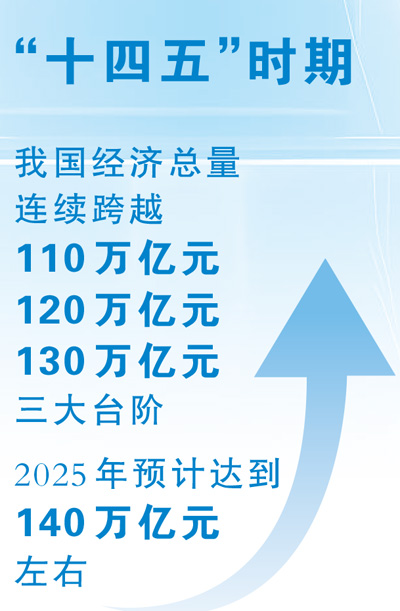
Economic Growth and Development - China's economy has crossed significant milestones, reaching over 110 trillion yuan, 120 trillion yuan, and 130 trillion yuan during the "14th Five-Year Plan" period, with an expected growth to around 140 trillion yuan by 2025 [19] - The innovation capability is continuously improving, with R&D investment intensity projected to reach 2.68% in 2024, surpassing the average level of EU countries [19] - The three major economic regions—Beijing-Tianjin-Hebei, Yangtze River Delta, and Guangdong-Hong Kong-Macau Greater Bay Area—account for over 40% of the national economy in 2024 [19] Green Development - National forest coverage has reached 25.09%, an increase of approximately 2 percentage points since 2020 [19] - By 2024, the energy consumption per unit of GDP is expected to decrease by 11.6% compared to the end of the "13th Five-Year Plan," making China one of the fastest countries in energy intensity reduction globally [19] - The installed capacity of renewable energy generation has historically surpassed that of coal power, establishing the world's largest clean power system [19] Trade and Openness - The number of free trade pilot zones in China has reached 22, covering all regions [19] - China has become one of the top three trading partners for 157 countries and regions [19] - In 2024, the total import and export volume with countries involved in the Belt and Road Initiative is projected to reach 22.07 trillion yuan, accounting for over 50% of China's total trade [19] Social Development - Resident income growth is in sync with economic growth, and the income gap between urban and rural areas has further narrowed [19] - By the end of 2024, the urbanization rate of the permanent population is expected to reach 67%, an increase of 3.11 percentage points since the end of 2020 [19] - The scale of employed population from poverty alleviation efforts has remained stable at over 30 million for four consecutive years [19]
新发展理念引领高质量发展
Ren Min Ri Bao· 2025-10-01 22:03
Economic Growth and Development - China's economy has crossed significant milestones, reaching over 110 trillion, 120 trillion, and 130 trillion yuan during the "14th Five-Year Plan" period, with an expected GDP of around 140 trillion yuan by 2025, indicating substantial economic strength [1] - The country has achieved historic accomplishments in social and economic development under the new development philosophy of innovation, coordination, green, openness, and sharing, marking a solid step towards high-quality development [1] Innovation and R&D - Research and development (R&D) investment intensity is projected to increase to 2.68% in 2024, surpassing the average level of EU countries, with the total number of R&D personnel being the highest in the world [1] - China has made significant advancements in fields such as artificial intelligence, quantum technology, manned spaceflight, and deep space exploration, achieving multiple global "firsts" [1] Regional Development - By 2024, the economic output of the Beijing-Tianjin-Hebei, Yangtze River Delta, and Guangdong-Hong Kong-Macau Greater Bay Area regions is expected to account for over 40% of the national economy [1] - The integration of eastern region advantages in industry, technology, and capital with western region resource endowments is emphasized, with the "West-East Power Transmission" capacity exceeding 300 million kilowatts and the "East Data West Computing" hubs accounting for over 70% of national computing power [1] Green Development - National forest coverage has reached 25.09%, an increase of approximately 2 percentage points since 2020 [1] - By 2024, energy consumption per unit of GDP is expected to decrease by 11.6% compared to the end of the "13th Five-Year Plan," making China one of the fastest countries in terms of energy intensity reduction globally [1] - The installed capacity of renewable energy generation has historically surpassed that of coal power, establishing the world's largest clean power generation system [1] Openness and Trade - The number of free trade pilot zones in China has reached 22, covering all regions of the country [2] - China has become one of the top three trading partners for 157 countries and regions, with imports and exports to Belt and Road Initiative countries totaling 22.07 trillion yuan in 2024, accounting for over 50% of China's total trade [2] Social Development and Income Growth - Resident income growth has kept pace with economic growth, and the income gap between urban and rural areas has further narrowed [2] - By the end of 2024, the urbanization rate of the permanent population is expected to reach 67%, an increase of 3.11 percentage points since the end of 2020 [2] - The number of employed individuals from poverty alleviation efforts has remained stable at over 30 million for four consecutive years [2]
140万亿!中国经济的“大逻辑”
Sou Hu Cai Jing· 2025-10-01 04:52
Core Viewpoint - China's GDP is expected to exceed 140 trillion yuan, reflecting a consistent and strategic economic growth rather than mere luck [1] Group 1: Strategic Determinants - The development strategy in China is characterized by long-term planning, including five-year plans and counter-cyclical adjustments, which contribute to stable economic acceleration [1] - The focus on theoretical innovation has evolved from "development is the hard truth" to "new development concepts" and "new quality productivity," impacting various sectors such as robotics and digital agriculture [1] Group 2: Societal Contributions - The significant reduction in poverty, with 100 million people lifted out, and the emergence of 400 million middle-income individuals, highlight the alignment between national goals and individual aspirations [1] - The establishment of the world's largest social security system enhances the overall productivity driven by the people's creativity [1] Group 3: Institutional Advantages - The dual-driven model of proactive government and effective market mechanisms fosters continuous vitality in the economy [1] - With a population of 1.4 billion, China's vast market facilitates rapid iteration of emerging industries, providing a broad stage for economic activities [1] Group 4: Future Outlook - The achievement of 140 trillion yuan is viewed not as a peak but as a new starting point for further economic development, emphasizing clarity in direction, innovation in theory, precision in regulation, strength in the populace, and expansiveness in the market [1]

人民日报钟才文:中国GDP今年预计可达140万亿元
Ren Min Ri Bao· 2025-10-01 02:28
Economic Growth and Achievements - Since the establishment of New China and especially after the reform and opening up, China's economic development has been remarkable, with GDP growing from 367.9 billion yuan in 1978 to an expected 134.9 trillion yuan in 2024, averaging an annual growth rate of 8.8%, significantly higher than the global average of about 3% during the same period [1] - During the 14th Five-Year Plan period, China's GDP surpassed 100 trillion yuan in 2020 and has since crossed the thresholds of 110 trillion, 120 trillion, and 130 trillion yuan, with an expectation to reach 140 trillion yuan this year [1] Leadership and Governance - The leadership of the Communist Party of China (CPC) provides fundamental guarantees for economic and social development through top-level design, overall layout, coordination, and implementation [1] - The CPC's long-term governance avoids policy shortsightedness and instability seen in Western multi-party systems, serving as a "stability anchor" for China's economic development [1] Theoretical Framework and Innovation - The CPC continuously innovates its theoretical framework to provide scientific guidance for economic and social development, adhering to the principles of "liberating thoughts, seeking truth from facts, and maintaining integrity while innovating" [2] - Xi Jinping's economic thought introduces new concepts such as "new development concepts" and "new development patterns," which build upon traditional socialist models while adapting to contemporary needs [2] Strategic Planning and Macro Control - The combination of strategic planning and effective macroeconomic control is a unique advantage for long-term economic stability, guiding resource allocation and ensuring orderly implementation of development goals [2] - China emphasizes the importance of macroeconomic control systems to manage economic fluctuations and maintain operations within a reasonable range [2] People-Centric Development - A people-centered development approach is crucial for long-term economic stability, focusing on improving living standards and ensuring that development benefits are equitably shared among the population [3] - The successful poverty alleviation of nearly 100 million people and the establishment of the world's largest social security system reflect the commitment to shared development [3] Market Economy and Production Relations - The integration of socialism with a market economy has injected continuous vitality into China's economic development, with a focus on balancing government and market roles [4] - Recent efforts have been made to optimize production relations to align with new productive forces, enhancing resource allocation efficiency and promoting high-quality economic development [4] Innovation and Market Potential - China's vast domestic market, with over 1.4 billion people and more than 400 million middle-income individuals, creates significant potential for innovation and economic growth [5] - The interaction between supply and demand fosters a conducive environment for innovation, reducing costs and accelerating technological advancements to meet the evolving needs of the population [5] Conclusion - The long-term stable development of China's economy is a result of strong leadership from the CPC and the synergistic effects of various factors, indicating a robust trend and logic behind the rapid economic growth and social stability [5]