
服务业等

Search documents
美国增长通胀平衡有所恶化
HTSC· 2026-03-30 05:27
Economic Growth - The U.S. economic growth momentum weakened slightly in March, with the composite PMI at 51.4, below the expected 51.9[2] - The GDPNow indicator shows a decline in Q1 GDP growth to 2.0%, down by 0.3 percentage points[2] - Consumer confidence dropped significantly in March, with the Redbook retail index showing a year-on-year decline of 6.5%[2] Financial Conditions - Financial conditions tightened significantly in March, with Goldman Sachs' financial conditions index tightening by 75 basis points[3] - The S&P 500 index fell by 7.4% to 6368.9, while the credit spread widened by 4 basis points to 1.15%[3] - The 2-year and 10-year U.S. Treasury yields increased by 54 basis points and 49 basis points, reaching 3.91% and 4.43% respectively[3] Inflation - February's CPI showed a mild increase of 0.3%, while core CPI decreased to 0.2%[4] - High oil prices are expected to elevate short-term inflation expectations, with 2-year and 10-year inflation expectations rising by 50 basis points and 3 basis points to 3.28% and 2.32% respectively[4] Labor Market - February's non-farm payrolls showed a decline of 92,000 jobs, significantly below the expected increase of 55,000[5] - The unemployment rate rose by 0.1 percentage points to 4.4%, with the labor force participation rate decreasing to 62.0%[5] - Job vacancies indicated a slowdown in labor demand, as evidenced by a decrease in the Indeed job postings index[5] Risks - Geopolitical risks in the Middle East are rising, which could further impact economic conditions and the labor market[6]
2026年1-2月宏观经济数据
Guan Tong Qi Huo· 2026-03-16 11:11
Report Summary 1. Report Industry Investment Rating No information provided. 2. Core Viewpoint In January - February 2026, major economic indicators showed a significant rebound, and the national economy got off to a good start. However, the impact of changes in the external environment has deepened, geopolitical risks have continued to rise, and there are still many old problems and new challenges in domestic economic development and transformation, with some enterprises facing operational difficulties [3]. 3. Summary by Relevant Catalogs Industrial Production - From January - February, the added value of industrial enterprises above designated size increased by 6.3% year - on - year, 1.1 percentage points faster than in December of the previous year. Equipment manufacturing and high - tech manufacturing had good growth momentum, with their added values increasing by 9.3% and 13.1% respectively, 3.0 and 6.8 percentage points faster than the overall industrial added value. The output of products such as 3D printing equipment, lithium - ion batteries, and industrial robots increased significantly [3]. - In February, the manufacturing PMI was 49.0%, and the enterprise production and operation activity expectation index was 53.2%, up 0.6 percentage points from the previous month [3]. Service Industry - From January - February, the national service industry production index increased by 5.2% year - on - year, 0.2 percentage points faster than in December of the previous year. Industries such as information transmission, software and information technology services, leasing and business services, and finance had relatively fast growth [4]. - In February, the service industry business activity index was 49.7%, up 0.2 percentage points from the previous month; the service industry business activity expectation index was 55.8%. Industries such as accommodation, catering, and culture, sports and entertainment were in a high - level boom range [4]. Market Sales - From January - February, the total retail sales of consumer goods reached 8607.9 billion yuan, a year - on - year increase of 2.8%, 1.9 percentage points faster than in December of the previous year. Service retail sales increased by 5.6% year - on - year, 0.1 percentage points faster than the whole of the previous year. Online retail sales of goods and services reached 3254.6 billion yuan, a year - on - year increase of 9.2% [5]. Fixed - Asset Investment - From January - February, national fixed - asset investment (excluding rural households) was 5272.1 billion yuan, a year - on - year increase of 1.8%, compared with a decline of 3.8% for the whole of the previous year. Infrastructure investment increased by 11.4% year - on - year, while real estate development investment decreased by 11.1% [6]. Goods Import and Export - From January - February, the total volume of goods import and export was 7732.1 billion yuan, a year - on - year increase of 18.3%, 13.4 percentage points faster than in December of the previous year. Exports were 4617.8 billion yuan, an increase of 19.2%; imports were 3114.3 billion yuan, an increase of 17.1% [7]. Employment - From January - February, the average urban surveyed unemployment rate was 5.3%, the same as the same period of the previous year. In February, the urban surveyed unemployment rate was 5.3%, up 0.1 percentage points from the previous month [8]. Price - From January - February, the national consumer price index (CPI) increased by 0.8% year - on - year. The industrial producer price index (PPI) decreased by 1.2% year - on - year, with the decline narrowing [9].
全景扫描:美国经济、政策与战略动态
GOLDEN SUN SECURITIES· 2026-03-11 14:05
Economic Insights - The U.S. economy is showing resilience, but internal momentum is weakening, with GDP growth expected to slow to 2.2% in 2025, primarily due to government shutdown impacts[2] - AI-related investments are becoming a significant growth pillar, contributing over 1 percentage point to GDP growth in Q1, Q2, and Q4 of 2025, with contributions of 1.29%, 1.17%, 0.55%, and 1.16% respectively[2] - The labor market is experiencing a fragile stabilization, with non-farm payrolls showing volatility and overall conditions still trending downward[5] Inflation Dynamics - Inflation remains sticky, with core inflation driven by non-housing services being a key variable; the super core CPI remains strong[5] - Energy inflation, influenced by geopolitical factors, could see a 10% rise in oil prices pushing energy CPI up by approximately 2.4%, contributing about 0.15 percentage points to overall CPI[6] Monetary and Fiscal Policy - The Federal Reserve is adopting a cautious stance, with potential policy shifts expected post-chairman transition in May; current effective federal funds rate may be below the nominal neutral rate[7] - Fiscal policy is expected to provide strong support to GDP growth in Q1 2026, contributing approximately 2 percentage points, but this support is projected to decline in subsequent quarters[8] Government Strategy - The Trump administration is refocusing its strategy, emphasizing domestic political mobilization and a "New Monroe Doctrine" in foreign policy, prioritizing the Western Hemisphere[9] - The administration's military strategy aims to avoid prolonged conflicts, favoring limited military actions to achieve strategic objectives[10] - Trade policy remains uncertain, with recent court rulings affecting tariff implementations, yet the administration continues to explore new tariff measures as negotiation tools[11]
日本企业盈利回流国内乏力,超4成留在海外
日经中文网· 2026-02-14 03:31
Core Viewpoint - Japanese companies achieved a record profit of 26 trillion yen from overseas operations in 2025, but over 40% of this profit did not return to Japan, indicating a slow trend of repatriation despite yen depreciation [2]. Group 1: Profit and Investment Trends - In 2025, Japan's current account surplus reached 31.8799 trillion yen, an increase of 11.1% compared to 2024 [4]. - The surplus from "primary income" sources, including dividends from overseas subsidiaries and overseas securities transactions, reached a historical high of 41.5903 trillion yen [6]. - Direct investment income contributed significantly to this surplus, with a surplus of 26.0585 trillion yen, surpassing securities investment income [6]. Group 2: Corporate Behavior and Government Response - Japanese companies are maintaining a strong inclination towards overseas investments despite rising costs, with net foreign direct investment amounting to 32.785 trillion yen, a 6.7% increase from the previous year [8]. - A survey indicated that 63.2% of Japanese companies plan to strengthen and expand their overseas operations, reflecting a persistent desire for international growth [8]. - The Japanese government has acknowledged the low expected returns from domestic investments as a fundamental reason for the sluggish domestic investment [8][10]. Group 3: Challenges and Strategic Needs - The ongoing labor shortage and high logistics costs are impacting corporate site selection, suggesting that mere yen depreciation will not suffice to encourage investment repatriation [10]. - There is a need for the Japanese government to develop strategies to enhance the country's supply capacity to attract investments back to Japan [10].


一揽子政策加码支持民间投资和居民消费 财政金融协同促内需
Jing Ji Ri Bao· 2026-01-29 23:22
Core Viewpoint - The recent series of policies issued by the Ministry of Finance and other departments aims to promote domestic demand through financial and fiscal collaboration, focusing on stimulating private investment and enhancing consumer spending, which will provide tangible benefits to businesses and individuals [1][2]. Group 1: Stimulating Private Investment - The new policies significantly enhance support for private investment, utilizing tools such as loan interest subsidies and guarantee compensation to lower financing costs and barriers for private enterprises [2]. - A new loan interest subsidy for small and micro enterprises will provide a 1.5% annual subsidy on the principal for up to two years, with a maximum loan amount of 50 million yuan per entity, covering 14 key industries including new energy vehicles and medical equipment [2]. - The newly established special guarantee plan for private investment aims to provide guarantees for loans to small and micro private enterprises, with a total planned amount of 500 billion yuan over two years, supporting various production and operational activities [2][3]. Group 2: Enhancing Consumer Spending - The policies also focus on boosting consumer spending, which is crucial for improving livelihoods and sustaining economic growth, with updates to personal consumption loan interest subsidies and service industry loan interest subsidies [4]. - The updated personal consumption loan interest subsidy allows for a maximum subsidy of 3,000 yuan per transaction, significantly increasing the potential support for large purchases and enhancing consumer purchasing power [5]. - The service industry loan interest subsidy has been optimized, increasing the maximum loan amount from 1 million yuan to 10 million yuan, with a 1% interest subsidy for one year, benefiting a wider range of consumption sectors [5]. Group 3: Implementation and Effectiveness - The comprehensive policies aim to enhance support for private investment and consumer spending, aligning fiscal policy with bank credit activities to release policy dividends more effectively [6]. - The Ministry of Finance emphasizes the need for efficient implementation, simplifying processes to ensure that benefits are accessible without cumbersome applications, and ensuring that fiscal expenditures are adequately budgeted for 2026 [6].
本报评论员:乘势而上 以高水平保护推动高质量发展|贯彻落实全国生态环境保护工作会议精神③
Zhong Guo Huan Jing Bao· 2026-01-21 01:10
Group 1 - The core viewpoint emphasizes the importance of high-level ecological protection as a support for high-quality development, with a focus on the construction of a beautiful China and the planning of ecological protection work for the 15th Five-Year Plan [1][2] - Since the 14th Five-Year Plan, the total emissions of major pollutants in China have continuously decreased, indicating an improving ecological environment and a clear trend towards high-quality development [1] - The establishment of the world's largest clean power supply system, clean steel production system, and carbon emission trading market demonstrates that high-level protection is essential for high-quality development [1] Group 2 - The future direction includes strengthening confidence and actively pursuing high-quality development while ensuring ecological protection [2] - Achieving high-level ecological protection requires ongoing efforts in pollution prevention and ecosystem optimization, with a focus on precise, scientific, and legal governance [2] - The main line of improving ecological environment quality will be integrated with promoting a comprehensive green transformation of economic and social development [2] Group 3 - High-quality development is an inherent requirement for building a beautiful China, necessitating the promotion of green productivity and addressing climate change [3] - The transition of traditional industries towards greener practices and the growth of strategic emerging industries will provide a solid foundation for low-carbon transformation [3] - The 15th Five-Year Plan aims to achieve carbon peak, presenting new opportunities for structural emission reduction and ecological quality improvement [3] Group 4 - The relationship between protection and development is not a single-choice question, and the integration of ecological beauty with high-quality development is essential for achieving the goals of a beautiful China [4] - High-level protection should drive high-quality development while accelerating the pace of green and low-carbon transformation [4] - The goal is to reduce pollutant emissions while enhancing economic development levels, turning the grand blueprint of building a beautiful China into a reality [4]
国家统计局局长就2025年全年国民经济运行情况答记者问
Guo Jia Tong Ji Ju· 2026-01-19 07:45
Economic Overview - In 2025, China's GDP reached 140 trillion yuan, marking a 5.0% increase from the previous year, with a stable urban unemployment rate of 5.2% and foreign exchange reserves exceeding 3.3 trillion USD [5][6][9] - The contribution of final consumption expenditure to economic growth was over 52%, indicating a strong consumer market [18][27] High-Quality Development - The proportion of high-tech manufacturing value added in total industrial value added rose to 17.1%, with a notable increase in the contribution of final consumption to economic growth [6][12] - The R&D expenditure intensity reached 2.8%, surpassing the OECD average for the first time, and China's innovation index entered the global top ten [7][22] Industrial Production - The industrial added value reached 41.7 trillion yuan, growing by 5.8%, with manufacturing value added at 34.7 trillion yuan, reflecting a stable industrial base [39] - The growth rates for high-tech and equipment manufacturing industries were 9.4% and 9.2%, respectively, indicating a shift towards higher value-added production [39][40] Consumer Market Dynamics - The total retail sales of consumer goods exceeded 50 trillion yuan, growing by 3.7%, with service retail sales increasing by 5.5%, highlighting a shift towards service consumption [27][28] - Online retail sales grew by 8.6%, with e-commerce and new retail models contributing significantly to consumer spending [28][29] Policy Impact - The implementation of proactive macroeconomic policies, including the promotion of consumption and investment, effectively supported economic stability and growth [55][56] - The "Two New" policies and the promotion of high-quality development have led to significant improvements in service consumption and industrial output [55][56] Future Outlook - Despite challenges, the long-term positive trend of China's economy remains intact, supported by strong fundamentals and ongoing reforms [32][35] - The focus on innovation and the integration of new technologies are expected to drive future economic growth and enhance productivity [22][56]
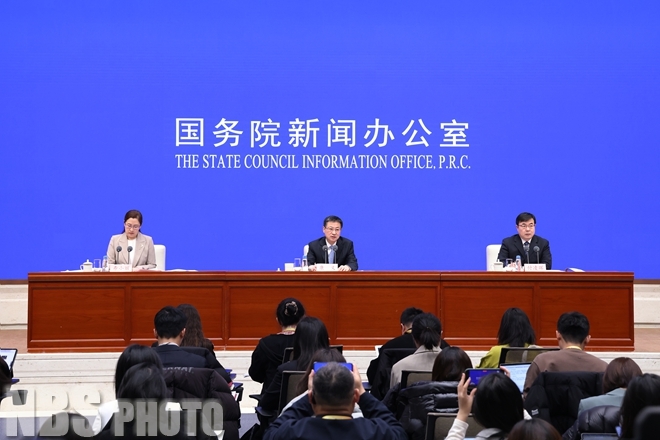
山西省委经济工作会议在太原举行 唐登杰卢东亮讲话 张春林出席
Xin Lang Cai Jing· 2025-12-26 02:29
Core Viewpoint - The meeting emphasized the importance of adhering to Xi Jinping's thoughts and the directives from the 20th National Congress, focusing on high-quality development and the comprehensive transformation of the economy in Shanxi Province as it prepares for the "15th Five-Year Plan" [1][4]. Economic Performance and Development - Shanxi's economy has shown resilience, maintaining stability and progress despite challenges, with significant advancements in industrial transformation and energy revolution [2][3]. - The province has effectively responded to various difficulties over the past five years, achieving new progress and accomplishments in various sectors [2]. Strategic Goals and Tasks for 2026 - The overall economic work requirement for 2026 includes implementing Xi Jinping's thoughts, focusing on high-quality development, and enhancing the province's role in national resource-based economic transformation [4][5]. - Key tasks for the upcoming year include expanding domestic demand, promoting energy transition, upgrading industries, and enhancing rural-urban integration [6][5]. Specific Focus Areas - The meeting outlined ten priority tasks for economic work, including: 1. Implementing strategies to expand domestic demand and stimulate consumption [5][6]. 2. Promoting energy transition and developing clean energy [6]. 3. Upgrading traditional industries and fostering new industries [6]. 4. Encouraging diverse development tailored to local conditions [6]. 5. Leading new productive forces through technological innovation [6]. 6. Deepening reforms and expanding openness [6]. 7. Promoting urban-rural integration and regional development [6]. 8. Enhancing ecological construction and sustainability [6]. 9. Improving and safeguarding people's livelihoods [6]. 10. Maintaining safety and stability across various sectors [6]. Implementation and Coordination - The meeting stressed the need for unified action and detailed measures to achieve set goals, emphasizing the importance of collaboration among various departments and local governments [7][8]. - It called for a focus on practical results, enhancing project planning, and ensuring effective investment to support economic growth [7][8].
国泰海通:美国经济的韧性与三重“K”型分化
Xin Lang Cai Jing· 2025-12-24 10:59
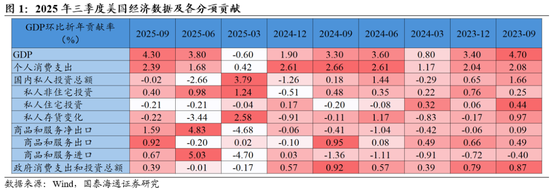
Core Viewpoint - The U.S. economy showed resilience in Q3 2025, driven by strong personal consumption, increased public spending, and enhanced export contributions, despite exhibiting a "K"-shaped divergence in income, business performance, and economic sectors [1][2][3][4]. Economic Performance - The U.S. GDP annualized growth rate for Q3 2025 was 4.3%, exceeding expectations of 3.3% and the previous value of 3.8%, indicating overall economic resilience [5][26]. - Key contributors to this economic resilience included personal consumption, public spending growth, and increased exports [2][23][27]. Personal Consumption - Capital market wealth effects significantly supported high growth in personal consumption, with a contribution rate of 2.39% to GDP in Q3 2025. Year-on-year, personal consumption grew by 2.8%, with goods consumption up 3.3% and services consumption up 2.5% [6][27]. - The performance of the capital markets, with major indices reaching historical highs, was closely linked to consumer spending [6][27]. Public Spending - Government consumption and investment saw a rebound, with a 0.55% increase in Q3 2025 compared to previous quarters' contractions. Notably, defense spending rose by 1.43% [6][27][28]. - The U.S. Treasury significantly raised its borrowing plan for Q3 2025 from an estimated $554 billion to $1.01 trillion, providing additional funding for government spending [6][27]. Export Growth - U.S. exports increased by 2.13% in Q3 2025, a significant rise compared to previous quarters, supported by a recovery in global economic activity and new trade agreements that reduced tariffs [7][28][29]. "K"-Shaped Divergence - The economy displayed a "K"-shaped divergence characterized by: - **Individual Level**: Income disparity led to consumption differences, with higher unemployment rates among minority groups and wealth concentration in the top 10% of households [3][11][32]. - **Business Level**: Large enterprises maintained a positive outlook, reflected in the S&P Global Composite PMI, while small businesses showed weaker performance as indicated by the NFIB optimism index [3][13][34]. - **Sector Level**: Investment and growth disparities were evident, with strong performance in private non-residential investments, particularly in equipment and intellectual property, while construction investment declined [3][15][35]. Future Outlook - The U.S. economy is expected to face short-term impacts from the government shutdown in Q4 2025, but overall resilience is anticipated to remain strong into 2026, with a likely recovery in Q1 2026 [4][18][25][37]. - The Federal Reserve is projected to implement 2-3 rate cuts in 2026, despite the economy's strength, due to structural weaknesses in the labor market and potential influences from leadership changes at the Fed [4][19][38].

日本核心CPI连续51个月同比上升
Xin Hua Cai Jing· 2025-12-19 02:44
Core Insights - Japan's core Consumer Price Index (CPI), excluding fresh food, rose by 3.0% year-on-year to 112.5 in November, marking the 51st consecutive month of year-on-year increases [1] - The year-on-year increase in November's core CPI remained stable compared to the previous month, while the month-on-month increase was 0.3%, slightly lower than the 0.4% recorded in the prior month [1] Price Drivers - The primary driver of the price increase in November was food, with significant price hikes observed in grains, snacks, prepared foods, dining out, beverages, meat, and dairy products [1] - Coffee bean prices surged by 51.6% year-on-year, while the price of ordinary japonica rice saw a year-on-year increase of 37.0%, although this was a decrease from last year's high levels [1] - Other categories such as housing repairs, electricity, automotive-related expenses, communication fees, and hotel accommodations also experienced year-on-year price increases [1] Economic Policy Impact - Concerns have been raised by media and experts regarding Prime Minister Suga Yoshihide's commitment to an active fiscal policy, which is exacerbating the depreciation of the yen and potentially leading to further inflation in Japan [1]