
量化投资

Search documents
最新百强私募榜出炉!量化巨头明汯、幻方登榜!京盈智投夺得“小而美”百强亚军!
私募排排网· 2025-11-20 03:31
Market Overview - In October, the A-share market is characterized by a "slow bull market" with indices fluctuating upwards, rapid sector rotation, and increasing trading volume [2] - The number of private equity firms with assets exceeding 10 billion reached 18 in October, setting a new monthly record for the year [2] Performance of Private Equity Firms - The average return of private equity products from January to October has shown significant changes in rankings among different investment modes [2] - Among private equity firms managing over 500 million, a list of the top 100 subjective and quantitative private equity firms based on returns has been compiled [2] Quantitative Private Equity Rankings - In the top 100 quantitative private equity firms, 36 firms have over 10 billion in assets, with 22 of them ranking in the top 50 [3] - The average return threshold for firms to be included in the top 100 was set at ***% [3][11] Subjective Private Equity Rankings - In the top 100 subjective private equity firms, the average return also surpassed that of the top quantitative firms [11] - The majority of subjective private equity firms are in the 500 million to 1 billion range, with Shenzhen having the highest number of firms [12] Small and Beautiful Private Equity Rankings - Among the "small and beautiful" private equity firms with assets between 0-2 billion, there are 457 firms that meet the ranking criteria [20] - The majority of these firms are subjective private equity, with significant representation from Shanghai and Shenzhen [20] Notable Firms and Strategies - Huacheng Private Equity achieved the highest average return among quantitative firms, focusing on derivatives trading [6] - Yongshu Investment, ranked 9th among subjective firms, emphasizes a balanced approach to risk and return, focusing on sectors like semiconductors and new energy [19][24]


打卡一家收益Top2的私募!聚焦宏观多资产策略的差异化打法
私募排排网· 2025-11-20 00:00
Core Viewpoint - The article highlights the significance of small to medium-sized private fund managers in the industry, particularly focusing on Wuliang Capital, which has shown strong performance in quantitative investment strategies [3][6]. Part 1: Company Overview - Wuliang Capital, established in 2015, specializes in quantitative investment and is based in Shenzhen, with a current management scale of approximately 2 billion RMB [6]. - The company has expanded its focus from A-share quantitative investment to include macro quantitative and CTA quantitative strategies, aiming to develop a multi-asset, multi-strategy approach [6]. Part 2: Core Team - Wuliang Capital employs a team of 20, primarily consisting of research personnel with backgrounds in statistics, finance, mathematics, and computer science from prestigious universities [10]. - The team has accumulated extensive experience in quantitative and portfolio management across various asset classes, including stocks and futures [10]. Part 3: Core Strategies and Representative Products - The company has evolved its strategies from a focus on quantitative stock selection to a diversified macro quantitative multi-asset strategy since 2022 [20]. - The macro quantitative multi-strategy product aims to achieve stable long-term growth by diversifying investments across various asset classes while managing risks effectively [20]. - The product's design is inspired by Bridgewater's all-weather strategy, emphasizing risk parity and low correlation among assets [20]. Part 4: Core Advantages - Wuliang Capital's approach is data-driven, focusing on asset allocation and enhancement rather than relying on subjective predictions [22]. - The product's performance has been diversified, with returns coming from a broader range of assets compared to other macro products that may rely heavily on a few asset types [22]. - The company has achieved positive returns for three consecutive years, demonstrating strong risk-adjusted returns [22]. Part 5: Continuous Evolution Capability - The company plans to expand its strategy lines and enhance its quantitative trading and research systems to support steady growth in management scale [23]. - Wuliang Capital aims to strengthen its position in quantitative investment by investing in talent and optimizing its data-driven research model [23].

不同地区私募十强!幻方上榜杭州、禧悦夺冠北京、恒穗领衔上海!
私募排排网· 2025-11-18 07:00
Core Viewpoint - The article provides an overview of the performance and distribution of private equity firms in China, highlighting the concentration of firms in major cities and their respective performance metrics for the year 2025 up to October [2][3]. Group 1: Private Equity Firm Distribution - As of October 2025, there are 7,586 private equity firms in China, with 5,479 located in first-tier cities (Beijing, Shanghai, Guangzhou, Shenzhen, Hangzhou), accounting for 72.22% of the total [2]. - Shanghai has the highest number of top-tier private equity firms (108), followed by Beijing (57) and Shenzhen (26) [2]. Group 2: Performance Metrics by Region - In Beijing, 745 products showed an average return of 29.54% from January to October 2025 [3]. - Shanghai's 1,519 products had an average return of 28.36% during the same period [3]. - Guangzhou's 288 products achieved an average return of 34.05% [3]. - Shenzhen's 884 products reported an average return of 31.67% [3]. - Hangzhou's 330 products had the highest average return at 36.48% [3]. Group 3: Top Performing Private Equity Firms - In Beijing, the top three performing firms are Beijing Xiyue Private Equity, Beiheng Fund, and Huacheng Private Equity [5]. - Shanghai's top three firms are Hengsui Asset, Haiseng Fund, and Jiugao Investment [9]. - Guangzhou's leading firms include Jingyan Private Equity, Hainan Xiangyuan Private Equity, and Zeyuan Investment [13]. - Shenzhen's top performers are Qiantou Investment, Fuyuan Capital, and Shenzhen Zeyuan [18]. - Hangzhou's leading firms are Nongfu Private Equity, Haokun Shengfa Asset, and Berkshire Investment [23]. Group 4: Notable Characteristics of Top Firms - Beijing Xiyue Private Equity has a management scale of approximately 416 million and a standout product with a high return [7][8]. - Hengsui Asset in Shanghai has a management scale of about 88 million and is noted for its strong performance [12]. - Jingyan Private Equity in Guangzhou focuses on technology innovation and advanced manufacturing [16]. - Qiantou Investment in Shenzhen emphasizes value growth and market dynamics [21]. - Nongfu Private Equity in Hangzhou has a management scale of approximately 553 million and maintains a focus on technology [25]. Group 5: Other Regions - Outside the major cities, there are 2,107 private equity firms, with an average return of 25.93% for 1,294 products [26]. - The top firms in these regions include Luyuan Private Equity, Mingze Investment, and Yidian Najin (Quanzhou) Private Equity [31].

这一幕昨夜再现:美股、黄金、加密货币齐跌
Sou Hu Cai Jing· 2025-11-18 04:04
来源:智通财经 周一,金融市场面临又一轮猛烈的抛售,席卷了从黄金到加密货币再到此前高飞的科技股在内的诸多资 产,并将道指拖入了自今年四月特朗普关税风波以来最糟糕的三日连跌。 智通财经周一早间就曾介绍过,过往当其他资产走弱时,投资者往往会转向黄金寻求更安全的资金"避 风港"。然而,本月的情况却并非如此——近期,黄金与美股常常出现同步下跌的情况,一些业内人士 已开始担心,这可能暗示市场正面临更为严峻的局面,尤其当这意味着投资者无处可寻避风港时…… 本月以来,美股市场的震荡已持续加剧,因科技巨头们宣布巨额资本支出计划,而这些计划日益依赖于 发行大量债务。交易员的忧虑情绪已将华尔街的"恐慌指数"——芝商所波动率指数VIX,推升至了四月 特朗普"解放日"关税公告以来的最高水平之一。 高盛资产管理公司全球量化投资策略联席主管Osman Ali表示,"尽管(AI领域的)赢家应该会多于输家。 但同时很明显,有些企业将无法在这个新世界中竞争。" 行情数据显示,截至周一收盘,科技股占比较高的纳斯达克指数周一下跌0.8%,标普500指数下跌 0.9%。道琼斯工业平均指数下跌1.2%,跌幅达557点。 即便是股神巴菲特"破天荒"对谷 ...
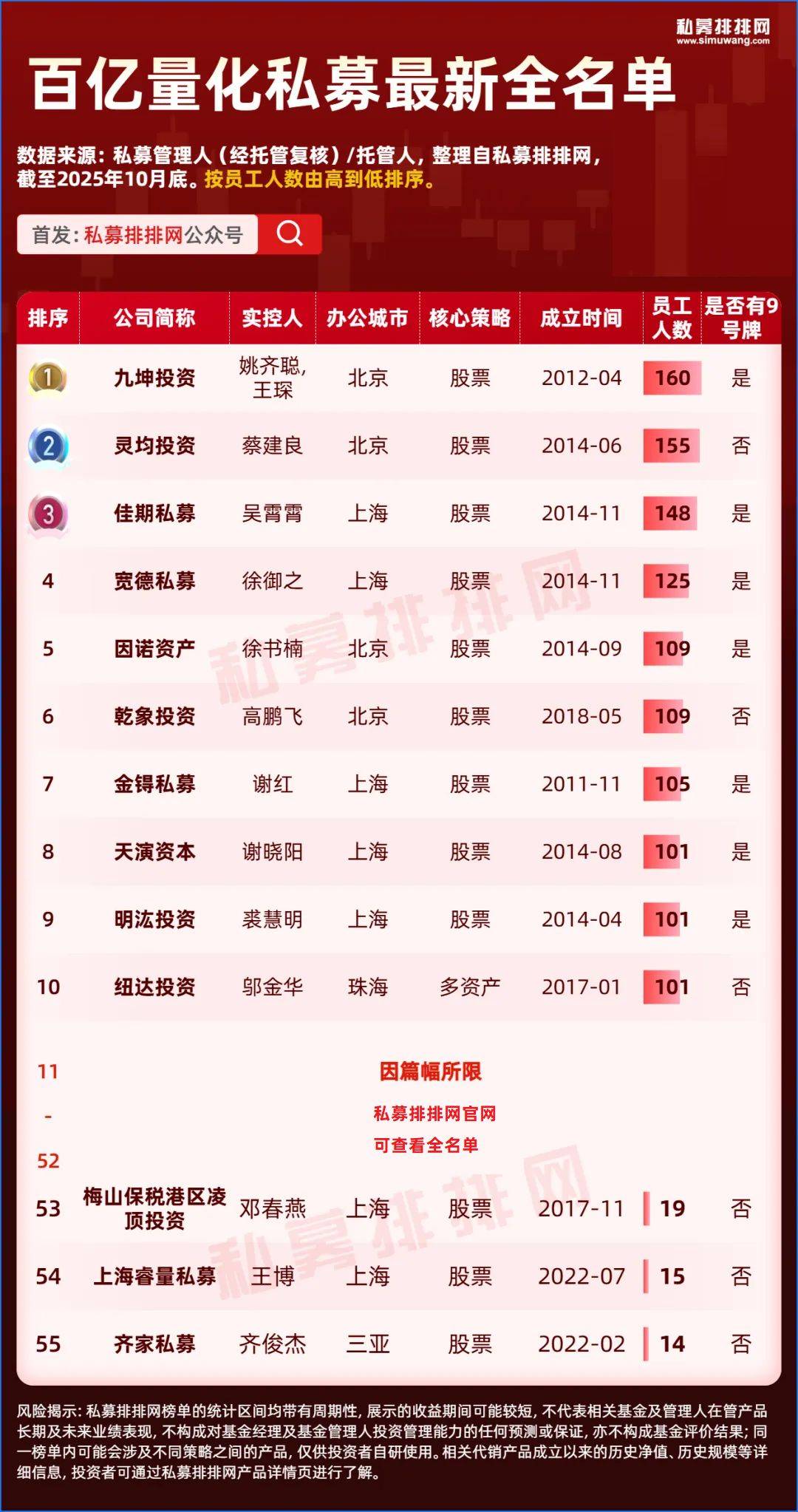
百亿量化私募再增10家!幻方年内业绩再夺亚军!超量子位列前10
Sou Hu Cai Jing· 2025-11-17 12:14
| 百亿量化私募最新全名单 | | | | | | | | | --- | --- | --- | --- | --- | --- | --- | --- | | 数据来源:私募管理人(经托管复核)/托管人,整理自私募排排网, | | | | | | | | | 截至2025年10月底。按员工人数由高到低排序。 | | | | | | | | | 自发:私募排排网公众号 | | Q | | | | | | | 办公城市 核心策略 排序 | 公司简称 | 实控人 | | | 成立时间 | 员工 | 是否有9 | | | | | | | | 人数 | 号牌 | | C | 九坤投资 | 姚齐聪, 壬琛 | 北京 | 股票 | 2012-04 | 160 | 是 | | 2) | 灵均投资 | 蔡建良 | 北京 | 股票 | 2014-06 | 155 | 合 | | 3 | 佳期秋景 | 吴霄霄 | 上海 | 股票 | 2014-11 | 148 | 를 | | 4 | 员德私募 | 徐御之 | 上海 | 股票 | 2014-11 | 1 245 | 是 | | 5 | 因语资产 | 徐书楠 | 北京 | 股票 ...
1484只个股获融资买入!但真正能赚钱的只有…
Sou Hu Cai Jing· 2025-11-17 06:38
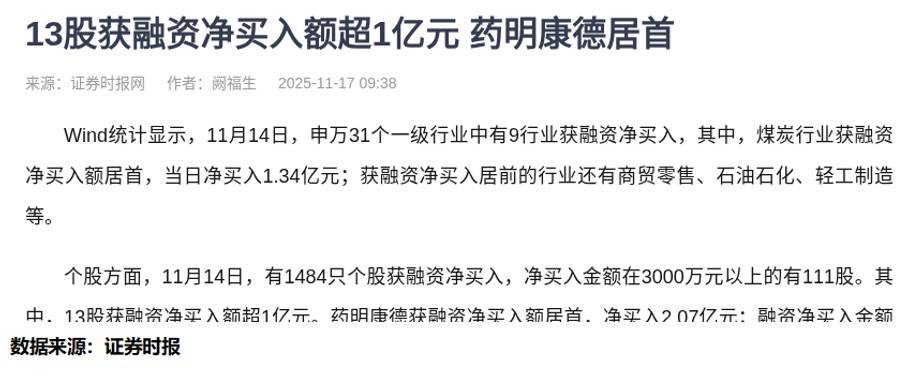
Group 1 - The core phenomenon in the market is the contrasting behavior of institutional investors and retail investors, where significant capital inflows into cyclical stocks and leading companies like WuXi AppTec are observed, while retail investors complain about their losses [1][3] - On November 14, financing data showed that the coal industry led with a net buying amount of 134 million yuan, while WuXi AppTec received a substantial 207 million yuan in investments, indicating market recognition of cyclical sectors and leading stocks [3][5] - The complexity of institutional trading strategies is highlighted, as they often use public positive news as a cover for reverse operations, which retail investors may not understand [3][4] Group 2 - High-quality stocks face inherent contradictions: increasing speculative buying and profit-taking, leading to volatility in their prices [4][6] - A "slow bull, fast adjustment" pattern is identified, where stocks may double in value over four months but experience significant corrections, causing panic among retail investors [6][9] - Quantitative analysis reveals that price fluctuations often mask underlying institutional behaviors, such as "institutional shaking," which is a tactic used to create panic and facilitate profit-taking [9][10] Group 3 - The coal sector's financing data illustrates why retail investors may find themselves trapped after following positive news without understanding the true intentions of institutional investors [9][10] - Recommendations for ordinary investors include avoiding being misled by surface data, understanding the implications of large capital inflows, and recognizing the combination of price movements and institutional inventory as signs of potential manipulation [10][12] - Emphasizing the importance of viewing market behavior through a quantitative lens, the focus should be on the underlying logic reflected by the data rather than the numbers themselves [12]
老船长新航线!九坤投资登榜百亿私募A500指增前三!
私募排排网· 2025-11-17 03:45
Core Viewpoint - The article discusses the performance and potential of the CSI A500 Index in the context of the A-share market, highlighting its superior elasticity compared to the CSI 300 Index and its role as a new investment option for investors [2][5]. Group 1: Market Performance - The CSI A500 Index has shown significant growth this year, outperforming the CSI 300 Index, with historical instances of doubling in value during major market rallies in 2009, 2015, and 2020 [2]. - As of October, the CSI A500 Index has been a focal point for investment products, with notable performance from quantitative strategies, particularly from Jiukun Investment's CSI A500 Index Enhanced Product [2][3]. Group 2: Index Characteristics - The CSI A500 Index, launched in September 2024, includes 500 stocks with large market capitalization and good liquidity, representing a balanced distribution across various industries [5][24]. - It covers 71.2% of total A-share market revenue, 56.1% of market capitalization, and 62.5% of net profit attributable to shareholders, indicating a broad market representation despite comprising less than 10% of the total stock count [5][25]. Group 3: Investment Strategy - The combination of the CSI A500 Index with quantitative strategies offers advantages such as risk diversification, capturing new alpha opportunities in emerging industries, and enhancing liquidity [6][7][8]. - Jiukun Investment's approach emphasizes long-term stability and adaptability in various market conditions, leveraging its extensive experience in quantitative investment [11][15]. Group 4: Future Outlook - The CSI A500 Index is positioned as a key area for quantitative investment strategies, with expectations for continued growth and innovation in investment approaches [15][30]. - The index's active trading and diverse industry representation align well with the principles of quantitative investment, making it a favorable choice for investors seeking to capitalize on market trends [15][31].

重量组第8名钱成:全天候策略广受机构青睐
Qi Huo Ri Bao Wang· 2025-11-17 00:59
Core Insights - The article highlights the insights shared by Qian Cheng, chairman of Shanghai Kuan Investment Asset Management Co., during an investment forum, focusing on his experience in quantitative trading and market analysis [1] Group 1: Investment Strategy - Qian Cheng emphasizes the importance of an all-weather strategy, originally developed by Bridgewater Associates, which involves diversifying investments across low-correlation assets such as stocks, bonds, gold, and commodities to achieve stable long-term returns [1] - The strategy is increasingly adopted by major asset management institutions both domestically and internationally [1] Group 2: Market Analysis - Qian notes the inverse volatility relationship between the CSI 300 Index and treasury futures, suggesting that incorporating commodities and gold can enhance the risk-adjusted performance of investment portfolios [1] - He believes that the commodity market is poised for cyclical opportunities in the near future [1] Group 3: Trading Philosophy - The trading philosophy advocated by Qian includes focusing on key sectors during bull markets and decisively taking profits at market peaks to avoid over-reliance on quantitative logic [1] - Asset management firms should prioritize absolute returns and invest in research and strategy optimization to create long-term value for clients [1] - Qian stresses the necessity of maintaining risk control and trend judgment to sustain a competitive edge in the industry amid market fluctuations [1]
当量化基金瞄准“基金平均成绩”,权益底仓又有新选择
聪明投资者· 2025-11-17 00:05
Core Viewpoint - The article discusses the recent reforms in the public fund industry, particularly the establishment of performance benchmarks, which are expected to enhance the quality of public funds and provide clearer investment goals for investors [2][24]. Group 1: Performance Benchmarks - The public fund industry has introduced a performance benchmark system, which includes a classification of benchmark elements, aimed at improving fund performance evaluation [2]. - Investors are encouraged to align their investment goals with these benchmarks, particularly in actively managed equity products, where the goal should be to outperform the average market performance [3]. Group 2: Market Average and Active Equity Funds - Defining the market average is crucial; for those aiming to outperform indices like the CSI 300 or the CSI 500, selecting corresponding enhanced index products is likely to meet their objectives [4]. - The Wind偏股混合基金指数 (885001) has shown a consistent ability to outperform mainstream broad-based indices over the past decade, reflecting the alpha generation of actively managed equity funds [4][5]. Group 3: Historical Performance Data - Historical data shows that the偏股混合型基金指数 has had varied performance from 2016 to 2025, with notable years such as 2019 and 2020 where it achieved returns of 45.02% and 55.91% respectively [5]. - The percentage of actively managed equity funds that consistently outperform the偏股混合基金指数 over five years is below 5%, indicating the rarity of such funds [8]. Group 4: Quantitative Investment Strategies - Quantitative investment strategies are highlighted as a more reliable method for investors to achieve returns above the market average, as they leverage disciplined models to identify outperforming products [10][11]. - The 华安事件驱动量化混合 fund, managed by Zhang Xu, has consistently outperformed its benchmarks since its management began in 2020, showcasing the effectiveness of quantitative strategies [12][13]. Group 5: Fund Management and Strategy - Zhang Xu employs a comprehensive quantitative investment system that integrates various analytical models to enhance fund performance, focusing on industry rotation and stock selection strategies [15][20]. - The fund's strategy aims for excess returns while maintaining a secondary focus on tracking error, utilizing a combination of micro, macro, and event-driven analyses [20][21].

银河基金罗博:深挖量化学习潜力 提升投资适应能力
Zhong Guo Zheng Quan Bao· 2025-11-17 00:04
Core Insights - The article discusses the advancements made by Galaxy Fund's quantitative team in deep quantitative stock selection research, emphasizing the shift from traditional linear analysis to nonlinear analysis for better market insights and investment opportunities [1][2] Group 1: Quantitative Research Strategies - The quantitative research approach combines linear and nonlinear strategies, utilizing multi-factor models alongside nonlinear machine learning models to achieve stable excess returns and reduce tracking errors [1][2] - The team has developed strategies that include both linear methods, primarily multi-factor models, and nonlinear methods such as XGBoost and LightGBM, which enhance the model's adaptability to market changes [2][3] Group 2: Neural Network Development - The development of complex neural network learning is highlighted, where the approach integrates long-term rules with short-term information to improve the training of supervised learning models [3] - The focus is on extracting features from raw data while addressing the noise present in the data, which aids in the model's ability to adapt quickly to market fluctuations [3] Group 3: Satellite Strategies - To further enhance market adaptability, satellite strategies are employed, including dividend selection and large-cap growth selection, which target specific market characteristics [4] - The dividend selection strategy focuses on high dividend yield stocks, while the large-cap growth strategy emphasizes stocks with large market capitalization and high growth potential [4] Group 4: Risk Management and Product Development - A financial risk management strategy has been developed to mitigate unexpected impacts from risk events, forming a comprehensive quantitative strategy system [5] - The Galaxy Fund has launched two index enhancement products: the Galaxy CSI 300 Index Enhanced Fund and the Galaxy CSI A500 Index Enhanced Fund, with plans to issue the Galaxy CSI 800 Index Enhanced Fund, which offers a balanced representation of both large-cap and mid-cap growth styles [5]