创新

Search documents
深耕者 终绽放——解码三家粤企的“冠军之道”
Shang Hai Zheng Quan Bao· 2025-09-12 19:13
Group 1 - The core viewpoint of the article emphasizes the innovative and sustainable growth strategy of Jinfa Technology, focusing on its commitment to R&D and market needs [2][4][5] - Jinfa Technology has achieved significant milestones, including a revenue increase from over 1 billion yuan in 2000 to an expected 60 billion yuan in 2024, positioning itself as a global brand [2][3] - The company has developed a lightweight battery pack solution for electric vehicles that reduces weight by 30% and improves range by 10%, showcasing its innovative capabilities in modified plastics [3][4] Group 2 - Jinfa Technology has invested over 20 billion yuan in R&D over the past 30 years, holding more than 6,800 patents across various technology chains [4][5] - The company adheres to a direct sales model to closely understand customer needs, which drives its innovation process [4][5] - Jinfa Technology has expanded its product offerings to include special engineering plastics, biodegradable plastics, carbon fibers, and composite materials, aligning with strategic emerging industries [3][4] Group 3 - The company focuses on deepening its core business in modified plastics while expanding upstream to raw materials and downstream to high-value sectors like carbon fiber and healthcare [5][6] - Jinfa Technology has established a global manufacturing and service network, with production bases in multiple countries, enhancing its local service capabilities [7][8] - The overseas sales volume of finished products reached 233,500 tons in 2024, marking a year-on-year growth of 29.51% [8]

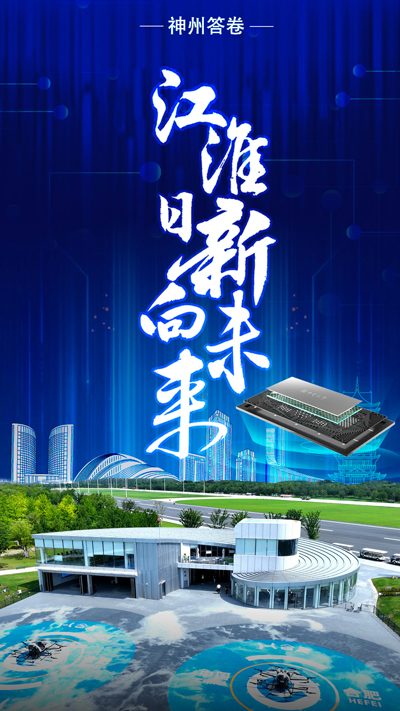
神州答卷|江淮日新向未来
Xin Hua Wang· 2025-09-12 11:46
Group 1: Innovation and Development - The core theme of the articles revolves around the importance of innovation in driving economic growth and addressing challenges in Anhui province [2][10][24] - Anhui has proposed 47 major questions related to innovation to tackle current and future development issues, aiming to establish itself as a significant hub for technological innovation and new industries [2][10] - The province's industrial revenue has increased from 3.8 trillion yuan in 2020 to 5.49 trillion yuan in 2024, with a rise in the contribution of high-tech industries to industrial value added [5][9] Group 2: Automotive Industry - Anhui's automotive production reached 1.7557 million units in the first seven months of this year, with 855,300 units being new energy vehicles, showing significant growth compared to previous years [3][5] - The Jianghuai Automobile's Zun Jie super factory in Hefei is a key player in the smart manufacturing sector, utilizing over 1,800 robots for automated production [3][5] Group 3: Challenges and Opportunities - Despite the growth, there are challenges such as a decline in fixed asset investment and profits for industrial enterprises, indicating a need for stronger internal demand [9][10] - The province is focusing on stabilizing and enhancing its automotive industry competitiveness while addressing difficulties in other sectors like photovoltaics and foreign trade [10][22] Group 4: Future Industry Development - Anhui is implementing a "7+N" future industry cultivation plan targeting fields like quantum technology, space information, and advanced materials, aiming for a future industry scale of 500 billion yuan by 2030 [18][20] - The province is also exploring innovative methods for industry cultivation, including establishing investment platforms and promoting collaboration between scientists and engineers [20][25] Group 5: Innovation Ecosystem - A comprehensive innovation ecosystem is being developed, with a focus on integrating government, industry, academia, finance, and application to enhance innovation capabilities [25][31] - The province aims to cultivate over 2 million talents for emerging industries by 2027, with a significant increase in R&D investment and output [25][28]

服贸会,原来如此!105秒读懂↓
Yang Shi Wang· 2025-09-12 07:31
Core Insights - The China International Fair for Trade in Services (CIFTIS) has evolved from the Beijing International Trade in Services Fair, which started in 2012, and was renamed in 2020 to reflect its focus on service trade development [1][3][5] Theme Evolution - The annual themes of CIFTIS reflect global trends in service trade, emphasizing digitalization, cooperation, and sustainability [1][7] - In 2020, the theme was "Global Services, Mutual Benefits and Sharing," highlighting the openness and shared value of service trade in a global context [3] - The 2021 theme, "Digital Opens the Future, Services Promote Development," focused on digital development and included a dedicated digital services exhibition area [5] - The 2022 theme, "Service Cooperation Promotes Development, Green Innovation Welcomes the Future," introduced an environmental services exhibition area to support green transformation [7] - The 2023 theme, "Openness Leads Development, Cooperation Wins the Future," emphasizes the dual win concept of openness and cooperation [7] - The 2024 theme will establish "Global Services, Mutual Benefits and Sharing" as a permanent theme, reinforcing China's commitment to service trade openness [8] - In 2025, the fair will continue with the permanent theme while introducing "Digital Leadership, Service Trade Renewal" as the annual theme, focusing on new scenarios and vitality generated by digitalization and intelligence in service trade [8]

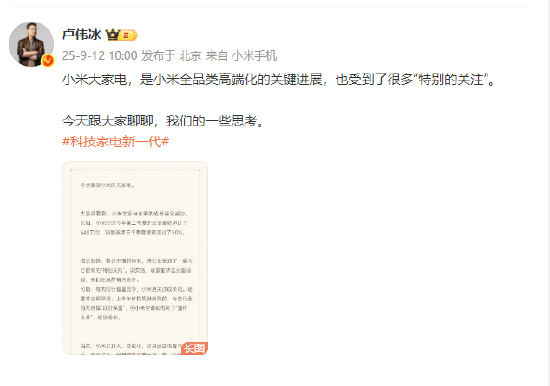
卢伟冰谈小米大家电业务:上半年价格战激烈,受到一些前辈“特别关照”
Feng Huang Wang· 2025-09-12 04:25
Core Insights - Xiaomi's air conditioning shipments exceeded 5.4 million units in Q2, with sales growth surpassing 50% for three consecutive quarters [1] - The company emphasizes that continuous innovation is essential to transform a "red ocean" market into a "blue ocean" [1] - In Q2, Xiaomi's revenue from smart home appliances grew by 66%, with air conditioning revenue increasing by 60% [1]

卢伟冰:小米大家电坚决走高端化之路
Xin Lang Ke Ji· 2025-09-12 02:24
Core Insights - Xiaomi's home appliance business is experiencing rapid growth, with air conditioner shipments exceeding 5.4 million units in Q2, marking over 50% growth for three consecutive quarters [1] - The company emphasizes a focus on growth rather than competition, contrasting its strategy with that of industry peers who are engaged in price wars [1] - Xiaomi is committed to high-end product development in the home appliance sector, viewing it as a critical step in its overall strategy for premiumization across all product categories [1] Group 1 - Xiaomi's air conditioner sales have shown significant growth, with a shipment of over 5.4 million units in the second quarter [1] - The company has achieved a balance of volume and price increase, contrary to competitors who are opting for price reductions to boost sales [1] - Xiaomi's approach to innovation is seen as a way to transform the competitive landscape of the home appliance industry, which is characterized as a "red ocean" [1] Group 2 - The home appliance sector is described as a long-term market with potential for continuous innovation, indicating Xiaomi's belief in the absence of a fixed industry structure [1] - The company aims to collaborate with industry veterans to explore new opportunities within the home appliance market [1] - Xiaomi's strategy reflects a broader trend of premiumization that has already been established in its mobile and automotive segments [1]
小米卢伟冰谈空调价格战:同行看重竞争,小米更关注成长
Xin Lang Ke Ji· 2025-09-12 02:20
Core Insights - Xiaomi's air conditioning business has shown significant growth, with over 5.4 million units shipped in Q2 of this year, marking a continuous growth rate exceeding 50% for three consecutive quarters [1][6][7] - The company emphasizes a focus on growth rather than competition, contrasting its strategy with some industry peers who prioritize price competition [1][7] - Xiaomi aims to transform the home appliance sector through innovation, believing that continuous innovation can turn a "red ocean" into a "blue ocean" [2][7] Business Strategy - Xiaomi is committed to high-end product development across its appliance range, viewing this as a critical advancement following its mobile and automotive sectors [2][7][8] - The company has introduced innovative technologies in various appliances, such as the "super electrolysis" technology in washing machines, "micro-fresh" preservation technology in refrigerators, and a new "master picture engine" for televisions [2][8] Market Position - Despite being a newcomer in the home appliance industry, Xiaomi acknowledges the presence of established competitors and aims to learn from them while carving out its own niche [2][7] - The company is actively engaging in the market with initiatives like the "Xiaomi Technology Life Exhibition" to showcase its innovative products and smart home ecosystem [2][3]
日媒:创新缺失是日本经济停滞的“病根”
Huan Qiu Shi Bao· 2025-09-11 23:14
Core Viewpoint - The lack of technological innovation is a primary reason for Japan's prolonged economic stagnation, as evidenced by recent electoral outcomes reflecting public dissatisfaction with the economic situation [1][2]. Group 1: Economic Performance - Japan's economy has been in decline since the bursting of its bubble in the 1990s, with its global ranking in per capita nominal GDP dropping from second place in 2000 to 38th by 2024 [2]. - The government has long promoted policies aimed at escaping deflation, with the Bank of Japan implementing unconventional monetary easing since 2013 [2]. Group 2: Inflation and Deflation - Deflation is not the true cause of Japan's economic stagnation; rather, it has experienced benign deflation, which does not pose a significant threat to the economy [3]. - Historical examples show that economies can thrive even during periods of deflation, primarily due to strong innovation [3]. Group 3: Innovation and Corporate Behavior - The absence of innovation is a critical factor in Japan's economic stagnation, as many companies have avoided risk and neglected innovation over the past 30 years [4]. - Despite low levels of innovation, Japanese companies have managed to increase productivity, but they have prioritized shareholder dividends and cash accumulation over capital investment and R&D [4]. - The lack of wage growth has been a significant issue, with recent electoral promises to increase real wages resonating with voters, yet merely focusing on wages does not address the broader economic challenges [4].
3M Company (MMM) Presents At Morgan Stanley's 13th Annual Laguna Conference Transcript
Seeking Alpha· 2025-09-11 22:50
Core Insights - The company has focused on returning to basics, emphasizing accountability, agility, and innovation to improve business performance [1] - Progress has been made in three key priorities: top line growth through innovation and commercial excellence, operational performance, and effective capital deployment [2] Product Innovation - In the first half of the year, the company launched 126 products, which is nearly equivalent to the total of 128 products launched in all of 2023 [2]


3M (NYSE:MMM) FY Conference Transcript
2025-09-11 20:22
Summary of 3M FY Conference Call - September 11, 2025 Company Overview - **Company**: 3M (NYSE: MMM) - **Industry**: Multi-Industry, including Safety and Industrial, Consumer, Electronics, Automotive, and more Key Points and Arguments Leadership and Strategic Focus - The CEO, Bill Brown, emphasized a return to basics, focusing on business fundamentals, culture, accountability, agility, and innovation [3][4] - Three main priorities were outlined: top-line growth through innovation and commercial excellence, operational performance, and effective capital deployment [3][4] Product Launches and Innovation - 3M launched 126 products in the first half of 2025, a significant increase from 128 in all of 2023, representing a 70% year-over-year growth [4][5] - The company is on track for over 215 product launches in 2025, aiming for 1,000 launches over the next three years [4][5] Financial Performance and Growth Metrics - The Safety and Industrial Business Group (SIBG) showed improvement with organic growth of 2.5% in the first half of 2025, up from negative growth in the previous year [5][6] - Margins improved by 250 basis points year-over-year, with a target of 25% margins by 2027 [6][7] - The company aims for a billion dollars of growth above macroeconomic trends over the next three years, with half from commercial excellence and half from new product introductions [18][24] Operational Excellence - The CEO highlighted the importance of operational excellence, including metrics like on-time and in-full (OTIF) delivery, which improved from 80% to 89.6% year-over-year [11][12] - The focus on asset utilization is critical, with current utilization at 59%, aiming to improve surge capacity and reduce excess assets [13][14] Market Conditions and Expectations - The macroeconomic environment remains sluggish, with expectations of low single-digit growth in various sectors, including automotive and consumer markets [31][32] - China remains a strong market for 3M, contributing over 10% of the company's revenue, although growth is expected to soften in the back half of the year [36][38] Portfolio Management and Divestitures - The company is reviewing its portfolio to focus on higher growth and margin potential businesses, with about 10% of the portfolio identified for potential divestiture [25][26] - Priority verticals for investment include semiconductors, data centers, aerospace, and automotive [25][26] Litigation and Financial Management - Ongoing litigation includes public water supplier issues and personal injury cases, with settlements structured to manage cash flow over time [40][41] - The company maintains a strong balance sheet to handle litigation costs and is focused on cash management strategies [44][45] Future Outlook - The CEO expressed confidence in achieving growth targets, with expectations of accelerating growth in the back half of 2025 [23][31] - The company is committed to innovation and improving operational metrics to drive sustainable growth [10][18] Additional Important Insights - The company is phasing out PFAS production by the end of 2025, focusing on alternative materials and innovation [46][47] - The impact of tariffs is being managed, with expectations of offsetting costs through pricing and operational efficiencies [51][52]
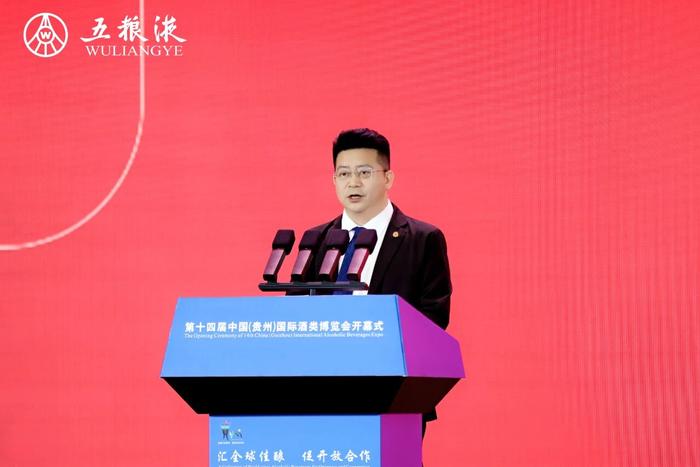
五粮液亮相第十四届贵州酒博会
Zheng Quan Ri Bao Zhi Sheng· 2025-09-11 09:08
Core Viewpoint - The 14th China (Guizhou) International Wine Expo emphasizes global cooperation and cultural exchange in the wine industry, showcasing over 20,000 wine products from more than 1,000 exhibitors across 40 countries and regions, with Wuliangye as a prominent representative of Chinese liquor [1][3]. Group 1 - The theme of the expo is "Gather Global Fine Wines, Promote Open Cooperation," highlighting the importance of cultural exchange and collaboration in the wine industry [3]. - Wuliangye's participation showcases its commitment to enhancing brand recognition and emotional connection through innovative interactions, aiming to promote the global appreciation of fine wines [3][4]. - Wuliangye's General Manager, Hua Tao, emphasized the need for innovation in the industry, advocating for breaking boundaries through marketing, product development, and experiential engagement to connect with younger consumers [3][4]. Group 2 - The Wuliangye brand exhibition hall features a design that reflects its historical heritage and international achievements, showcasing various product lines that attract diverse audiences [4]. - New product launches, such as the 29° Wuliangye "First Love," have gained significant attention due to their appealing design and targeted market positioning, indicating a successful strategy to engage younger demographics [4]. - Interactive experiences at the expo, such as the "Youth Message Collection Station," aim to immerse visitors in Wuliangye's youthful branding initiatives, further demonstrating the company's innovative approach to new consumer trends [4].