
中性利率

Search documents
高利率环境下美国劳动力市场保持韧性的原因及后续展望
Sou Hu Cai Jing· 2025-06-03 02:59
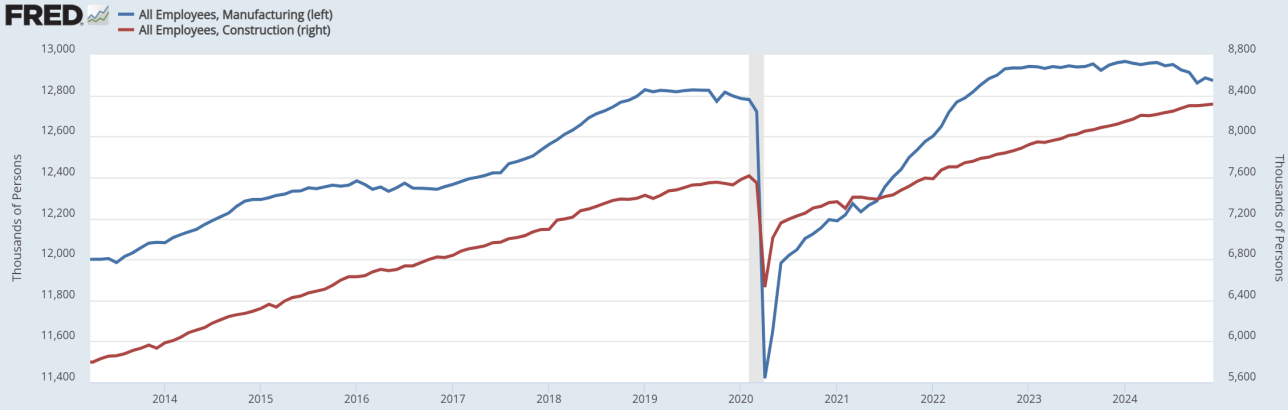
Group 1 - The core viewpoint of the articles highlights the resilience of the U.S. labor market despite aggressive interest rate hikes by the Federal Reserve post-pandemic, characterized by a steepening of the Phillips and Beveridge curves [1][2][4][5]. - The U.S. labor market has shown robust growth with unemployment rates remaining historically low, even as the Federal Reserve raised interest rates from 0-0.25% to 5.25%-5.5% over a span of 11 hikes [3][4]. - The average monthly non-farm employment from March 2022 to March 2025 is 230,400, significantly higher than the pre-pandemic average of 178,000 [3]. Group 2 - The Phillips curve has become more vertical, indicating that despite a drop in inflation from 7.0% to 2.1%, the unemployment rate only increased from 3.6% to 4.1%, demonstrating the labor market's resilience [4]. - The Beveridge curve has steepened, showing that even with a decrease in job vacancy rates from 7.4% to 4.4%, the unemployment rate only rose slightly, further indicating labor market strength [5]. - The labor market is characterized by a significant "demand exceeding supply" situation, with a labor shortage exacerbated by slow recovery in labor supply post-pandemic [6]. Group 3 - Strong public and private investments, driven by the Biden administration's "Invest in America" agenda, have significantly boosted labor demand, with total spending around $1.2 trillion since late 2021 [7]. - Private sector investments have exceeded $1 trillion, particularly in manufacturing and non-residential construction, contributing to job growth despite high interest rates [7][8]. - The accumulation of "excess savings" and rising asset prices have supported consumer spending, which in turn has driven labor demand, creating a positive feedback loop in the economy [12][13]. Group 4 - The influx of low-cost immigrant labor has made the labor market both "scarce and relatively cheap," which has stimulated demand and mitigated the impact of high interest rates on business costs [14][15]. - The labor market's dynamics can explain the verticalization of the Phillips curve and the steepening of the Beveridge curve, as high demand persists even with rising interest rates [16]. - The neutral interest rate has risen post-pandemic, leading to an underestimation of the restrictive nature of the Federal Reserve's policy rates, which has contributed to the labor market's resilience [17][18]. Group 5 - In the short term, the labor market is expected to remain stable, with a gradual decrease in hiring rates but low levels of layoffs, indicating a balanced supply-demand situation [20][21]. - In the medium to long term, uncertainties stemming from potential policy changes under the Trump administration could impact the labor market, particularly regarding tariffs and federal spending cuts [22].

鲍威尔的抉择:是否重蹈伯恩斯的覆辙?
Sou Hu Cai Jing· 2025-05-22 07:30
Group 1: Inflation and Monetary Policy - Federal Reserve Chairman Powell indicated that future supply shocks may lead to more volatile inflation, prompting a reassessment of the monetary policy framework, particularly the "average inflation targeting" strategy introduced in 2020 [1] - The current federal funds rate is between 4.5% and 4.75%, with Powell emphasizing the need to ensure inflation is truly under control before considering rate cuts [2] - The market is uncertain about the Fed's next steps, as inflation has decreased but remains above the target, leading to fluctuating expectations regarding interest rate cuts [5] Group 2: Government Debt and Fiscal Pressure - The U.S. government debt has reached $36.19 trillion, exceeding the debt ceiling of $33.1 trillion, creating significant interest payment pressures [3] - Calls for the Fed to lower interest rates are increasing, as lower rates could alleviate the government's borrowing burden, but this could also lead to a depreciation of the dollar and increased inflation risks [3] Group 3: Employment Market Dynamics - The unemployment rate is currently at 4.1%, but the Fed believes the labor market is still too "hot," indicating a desire to cool it down without causing significant job losses [4] - Powell's approach aims to balance high interest rates to control inflation while maintaining employment levels [4] Group 4: Historical Context and Lessons - The comparison to the 1970s under Chairman Burns highlights the risks of aggressive rate cuts leading to uncontrollable inflation, with historical data showing inflation rates averaging 9% during that period [7][11] - Current inflation rates are at 2.9% with a core CPI of 3.4%, indicating that inflation is still above the Fed's target [12] Group 5: Political and Market Pressures - Former President Trump has publicly called for immediate rate cuts, contrasting with Powell's cautious stance, as companies like Ford and Mattel lower earnings forecasts amid economic uncertainty [6] - Wall Street analysts are warning of potential recession risks, with Goldman Sachs predicting a 35% chance of recession within a year, increasing the pressure for the Fed to act [6]
欧洲央行管委森特诺:为防止通胀率跌破2%,利率可能不得不降到1.5%-2%的中性利率以下。
news flash· 2025-05-21 12:09
Group 1 - The European Central Bank (ECB) may need to lower interest rates below the neutral rate of 1.5%-2% to prevent inflation from falling below 2% [1]
【财经分析】澳大利亚央行年内或再降息两次
Xin Hua Cai Jing· 2025-05-21 00:56
Group 1 - The Reserve Bank of Australia (RBA) announced its second interest rate cut of the year, aligning with market expectations, and analysts predict two more cuts may follow [1][2] - The RBA's decision to cut rates is driven by concerns over weak economic growth and inflation data indicating a moderation in inflationary pressures, with the first quarter's trimmed mean inflation rate at 2.9%, entering the RBA's target range for the first time since 2021 [2][3] - Recent economic indicators show resilience in the Australian economy, with the unemployment rate stable at 4.1%, a quarterly wage price index increase of 0.9%, and a slight rise in consumer confidence to 92.1 points [2] Group 2 - The RBA expressed a cautious stance regarding future rate cuts, highlighting uncertainties related to global trade and geopolitical factors that could negatively impact economic growth, employment, and inflation [3][4] - The RBA has revised its inflation forecasts downward, with the overall inflation rate expected to be 2.1% compared to a previous estimate of 2.4%, indicating a shift in focus from anti-inflation measures to supporting economic growth [4][5] - Analysts anticipate multiple rate cuts in the future, with predictions of cuts in August and November, potentially lowering the benchmark rate to 3.35% by year-end [5][6]
瑞典央行行长特登:目前我们处于接近中性利率的水平,但尚不完全明确。
news flash· 2025-05-16 07:07
Core Viewpoint - The Governor of the Swedish Central Bank, Stefan Ingves, stated that the current interest rates are close to neutral levels, but there is still uncertainty regarding this assessment [1] Group 1 - The Swedish Central Bank is currently evaluating its position on interest rates, indicating a cautious approach to monetary policy [1] - There is an acknowledgment of the ambiguity surrounding the exact neutral interest rate level, suggesting potential future adjustments [1]
5月16日电,瑞典央行行长特登表示,目前处于接近中性利率的水平,但尚不完全明确。
news flash· 2025-05-16 07:07
智通财经5月16日电,瑞典央行行长特登表示,目前处于接近中性利率的水平,但尚不完全明确。 ...
【海外观潮】 日本央行仍有加息可能
Zheng Quan Shi Bao· 2025-05-12 17:49
Group 1 - The core viewpoint of the articles indicates that Japan's inflation is persistently above the Bank of Japan's target, with the CPI rising 3.6% year-on-year in March, marking 36 consecutive months above the 2% target [1] - The core CPI in March also increased by 3.2%, remaining elevated for 43 months, suggesting a sustained inflationary environment that supports the possibility of further interest rate hikes by the central bank [1] - The latest data shows that the core CPI in Tokyo rose by 3.4% in April, indicating ongoing inflationary pressures, particularly driven by rising wages [2] Group 2 - Japan's GDP has shown resilience, growing by 2.9% annually, with exports increasing for six consecutive months, reflecting strong economic activity supported by both domestic and external demand [3] - The services sector PMI has remained robust, providing a counterbalance to the manufacturing sector, which is still below the growth threshold [3] - The Bank of Japan has adjusted its economic outlook, lowering GDP growth forecasts for fiscal years 2025 and 2026, while also revising down its core CPI expectations, indicating a cautious approach to monetary policy [5] Group 3 - The yen has become the best-performing currency among G10 currencies this year, attracting international investment, despite the ongoing depreciation against the dollar due to significant interest rate differentials [4] - The potential for further interest rate hikes by the Bank of Japan remains, although the pace may be influenced by external factors such as U.S. tariff policies, which introduce uncertainty into Japan's economic outlook [4][5] - The Bank of Japan has not indicated a halt to interest rate increases, with the governor emphasizing that further hikes could occur if economic growth and inflation align with expectations [5]
英国央行委员泰勒:需要了解中性利率才能对“限制性”政策有自己的看法。
news flash· 2025-05-12 16:53
Core Viewpoint - The need to understand the neutral interest rate is emphasized for forming opinions on "restrictive" monetary policies [1] Group 1 - The statement highlights the importance of comprehending the neutral interest rate to evaluate the implications of current monetary policies [1]
英国央行货币政策委员会(MPC)成员Taylor:距离(降息至)中性利率还有很远的距离。
news flash· 2025-05-12 16:37
英国央行货币政策委员会(MPC)成员Taylor:距离(降息至)中性利率还有很远的距离。 ...