碳中和

Search documents
市场洞察:从概念蓝图到油箱现实,航空可持续燃料即将进入爆发性增长元年
Tou Bao Yan Jiu Yuan· 2026-01-15 12:32
Investment Rating - The report does not explicitly state an investment rating for the sustainable aviation fuel (SAF) industry Core Insights - Sustainable aviation fuel (SAF) is crucial for the aviation industry's green transition, with a potential to reduce carbon emissions by nearly 80% over its lifecycle compared to traditional jet fuel [4] - The HEFA (Hydroprocessed Esters and Fatty Acids) route currently dominates the SAF market, accounting for 95% of the market share [4] - The global SAF market is expected to see significant growth, with demand projected to reach 18.35 million tons by 2030 and 72.62 million tons by 2035 [8][11] Summary by Sections Q1: Definition and Technology Pathways of Aviation Sustainable Fuel - SAF is derived from various sustainable resources, including waste oils, agricultural residues, and municipal solid waste [4] - The main production processes for SAF include FT (Fischer-Tropsch), HEFA, and ATJ (Alcohol-to-Jet) [4][5] Q2: Global Market Landscape and Growth Trends for Aviation Sustainable Fuel - The demand for SAF is primarily concentrated in Europe and North America, driven by regulatory policies [8] - The EU mandates a minimum of 2% SAF blending in aviation fuel by 2025, significantly increasing demand [9] - Global SAF production is expected to double in 2024, with a projected demand of over 2 million tons [8] Q3: Market Potential and Advantages of Aviation Sustainable Fuel in China - China has abundant resources for SAF production, including 235 million tons of municipal solid waste and 210 million tons of agricultural waste annually [19] - The Chinese SAF market is in its early stages, with pilot projects initiated by major airlines [20] Q4: Domestic Aviation Sustainable Fuel Enterprises and Project Tracking - The SAF industry in China includes a diverse range of participants, with state-owned enterprises leading the market [24] - Most SAF projects are in the early stages of development, focusing on various technological pathways [25] Q5: Competitive and Collaborative Relationships between Aviation Sustainable Fuel and Other Emerging Aviation Energies - SAF is compatible with existing aircraft and infrastructure, making it a more immediate solution compared to hydrogen and electric energy [27] - Hydrogen energy is limited to short-haul flights and requires specialized aircraft, while electric energy is constrained by battery density [28]
行业聚焦:全球激光焊接头行业头部生产商市场份额及排名调查
QYResearch· 2026-01-15 10:26
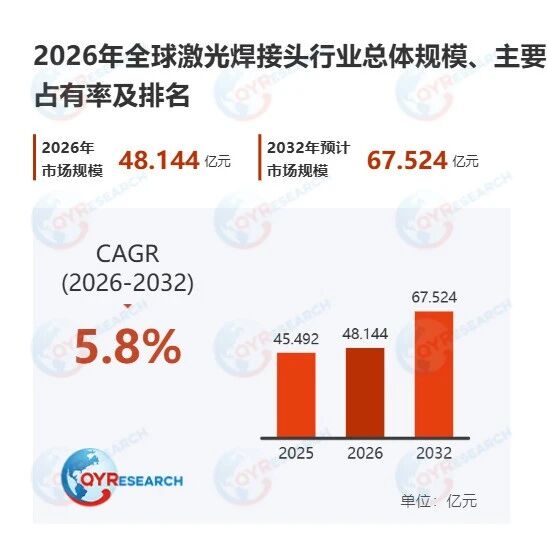
Core Insights - The global laser welding head market is experiencing rapid growth driven by the demand for precision welding in sectors such as electric vehicles, power batteries, and consumer electronics [4][7] - The market is characterized by an oligopolistic structure, with major players like Trumpf, IPG, Coherent, and Precitec holding approximately 70% of the high-end market share [4][9] - The market is projected to reach USD 993 million by 2032, with a compound annual growth rate (CAGR) of 5.8% over the coming years [5] Global Trends and Drivers - The primary drivers of the laser welding head market include the rigid demand for high-precision and high-efficiency welding processes in industries such as electric vehicles and energy storage [7] - The integration of welding heads with automation technologies, including robotics and vision systems, is being accelerated by industrial automation upgrades [4][7] - The trend towards lightweight materials, such as aluminum alloys and composites, is increasing the demand for advanced laser welding heads capable of swing welding and remote scanning [7] Competitive Landscape - The laser welding head market exhibits a concentrated competitive landscape, with leading companies leveraging technological advantages and comprehensive supply chain strategies [4] - Major companies dominate the high-end market, while Chinese manufacturers are gaining ground in the mid-to-low-end market through cost-effectiveness and rapid response [4][9] - Future competition is expected to focus on advanced applications such as composite welding and ultrafast laser technologies, with leading firms enhancing their ecosystem control through mergers and acquisitions [4] Opportunities and Challenges - Structural opportunities arise from global "carbon neutrality" policies promoting the expansion of green industries, particularly in battery and lightweight material processing [5] - Regulatory challenges, including export restrictions on high-end optical components and compliance costs associated with data security laws, pose risks to market expansion [5][8] - The high initial investment and maintenance costs of laser welding heads limit adoption among small and medium enterprises, while reliance on imported core optical components creates supply chain vulnerabilities [8] Industry Development Opportunities - The demand for precision welding in green energy sectors, such as power batteries and hydrogen energy, is creating new market opportunities for high-performance welding heads [10] - The trend towards domestic substitution is allowing local companies to penetrate the mid-market and specific applications, such as 3C electronics and hardware processing [10] - The push for smart and digital solutions is driving the development of integrated welding heads with capabilities for visual monitoring and adaptive control [10]

电投水电跌2.00%,成交额1.40亿元,主力资金净流出1598.12万元
Xin Lang Cai Jing· 2026-01-15 06:50
Core Viewpoint - The stock of State Power Investment Corporation Water Power Co., Ltd. has experienced fluctuations, with a current price of 13.22 CNY per share and a market capitalization of 57.906 billion CNY, reflecting a 1.30% increase year-to-date but a slight decline over the past five trading days [1]. Financial Performance - For the period from January to September 2025, the company reported a revenue of 2.936 billion CNY, representing a year-on-year decrease of 5.16%. The net profit attributable to shareholders was 56.0255 million CNY, down 36.60% compared to the previous year [2]. - Cumulative cash dividends since the company's A-share listing amount to 849 million CNY, with 21.8629 million CNY distributed over the past three years [3]. Shareholder Information - As of December 19, 2025, the number of shareholders is 48,200, a decrease of 3.37% from the previous period. The average number of circulating shares per person has increased by 3.49% to 16,213 shares [2]. - Among the top ten circulating shareholders, Hong Kong Central Clearing Limited holds 5.956 million shares, an increase of 2.6329 million shares from the previous period [3]. Business Overview - The company, established on June 30, 1994, and listed on November 1, 2000, operates in the energy ecological integration sector, focusing on air pollution control, industrial and municipal water treatment, hazardous waste treatment, and integrated development and operation of hydropower and watershed hydropower stations [1]. - The main revenue sources include desulfurization and denitrification (57.93%), environmental engineering (18.66%), catalyst sales (11.67%), water treatment operations (10.50%), and other supplementary services [1].

中再资环涨2.15%,成交额9660.68万元,主力资金净流入1019.66万元
Xin Lang Cai Jing· 2026-01-15 06:40
Core Viewpoint - Zhongzai Zihuan's stock price has shown a slight increase this year, with a notable rise in recent trading days, despite a decline over the past two months. The company is primarily engaged in waste electrical equipment recycling and solid waste disposal, facing a significant drop in revenue and net profit year-on-year [2][3]. Group 1: Stock Performance - As of January 15, Zhongzai Zihuan's stock price increased by 2.15%, reaching 4.27 CNY per share, with a trading volume of 96.61 million CNY and a turnover rate of 1.39% [1]. - The stock has risen by 4.66% since the beginning of the year, with a 2.15% increase over the last five trading days and a 2.40% increase over the last 20 days, while it has decreased by 0.47% over the last 60 days [2]. Group 2: Company Overview - Zhongzai Zihuan, established on November 6, 1996, and listed on December 16, 1999, is located in Beijing and specializes in the recycling and dismantling of waste electrical equipment and integrated disposal of solid waste in industrial parks [2]. - The company's revenue composition includes 70.60% from waste electrical dismantling, 29.30% from industrial waste and deep processing, and 0.10% from leasing income [2]. Group 3: Financial Performance - For the period from January to September 2025, Zhongzai Zihuan reported an operating income of 2.449 billion CNY, a year-on-year decrease of 15.56%, and a net profit attributable to shareholders of -373 million CNY, representing a year-on-year decrease of 689.07% [2]. - The company has distributed a total of 154 million CNY in dividends since its A-share listing, with 51.39 million CNY distributed over the past three years [3]. Group 4: Shareholder Information - As of September 30, 2025, Zhongzai Zihuan had 45,800 shareholders, a decrease of 4.10% from the previous period, with an average of 36,190 circulating shares per person, an increase of 4.27% [2]. - Notably, the Southern CSI 1000 ETF has exited the list of the top ten circulating shareholders [3].

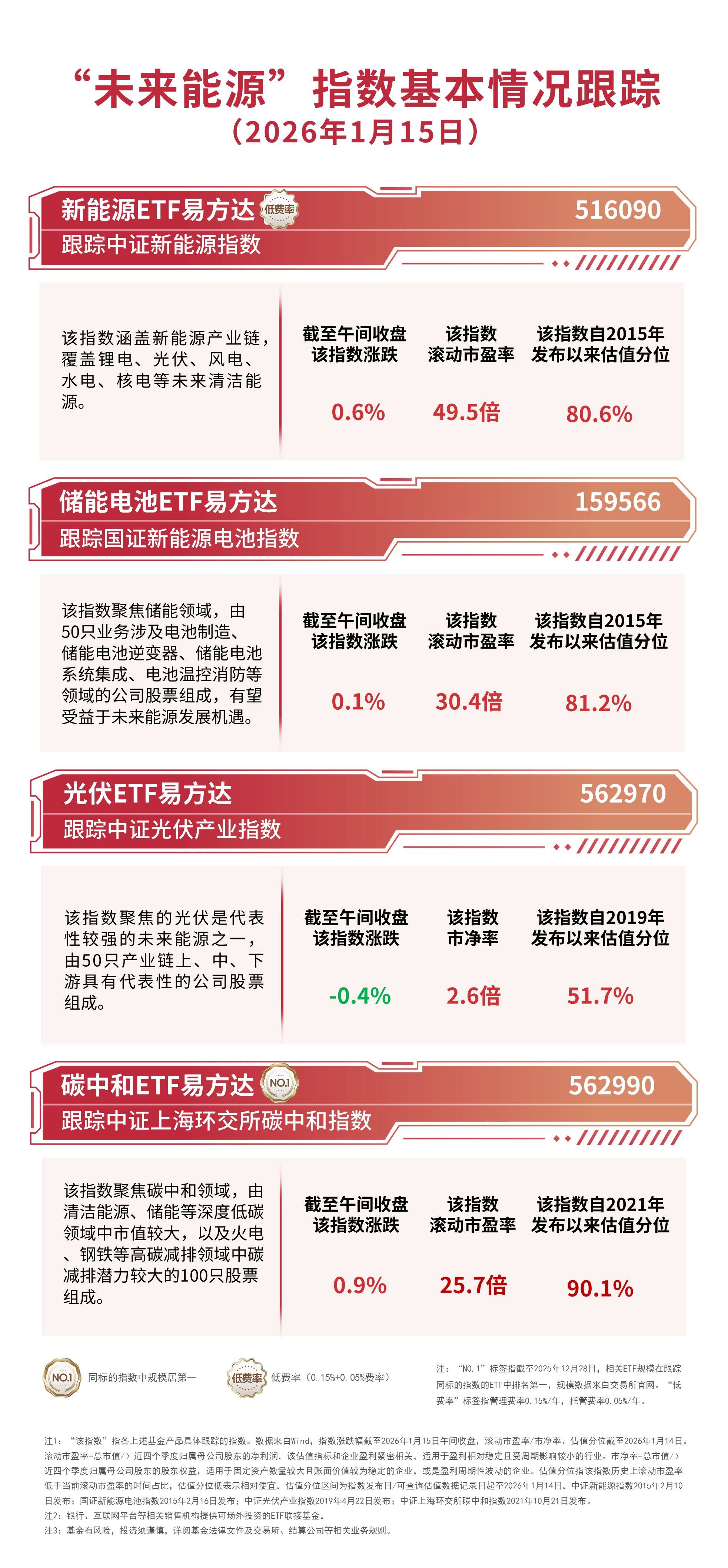
新能源板块局部活跃,关注新能源ETF易方达(516090)、储能电池ETF易方达(159566)等投资机会
Sou Hu Cai Jing· 2026-01-15 04:57
Group 1 - The new energy sector is showing localized activity, with lithium battery electrolyte and power battery concepts leading in gains [1] - As of the midday close, the China Securities Shanghai Carbon Neutrality Index increased by 0.9%, the China Securities New Energy Index rose by 0.6%, the National Securities New Energy Battery Index went up by 0.1%, while the China Securities Photovoltaic Industry Index decreased by 0.4% [1][5] Group 2 - The index focuses on the energy storage sector, consisting of 50 companies involved in battery manufacturing, energy storage battery inverters, energy storage battery system integration, and battery temperature control and fire protection, which are expected to benefit from future energy development opportunities [3] - The photovoltaic ETF managed by E Fund tracks the China Securities Photovoltaic Industry Index, which represents a strong future energy source and includes 50 representative companies across the upstream, midstream, and downstream of the industry chain [5][6]
新中港跌2.26%,成交额8525.44万元,主力资金净流出1601.63万元
Xin Lang Zheng Quan· 2026-01-15 03:05
Group 1 - The core viewpoint of the news is that New Zhonggang's stock price has shown fluctuations, with a recent decline of 2.26% and a total market value of 3.806 billion yuan [1] - As of January 15, the stock price is reported at 9.50 yuan per share, with a trading volume of 85.2544 million yuan and a turnover rate of 2.21% [1] - The net outflow of main funds is 16.0163 million yuan, with significant selling activity observed [1] Group 2 - New Zhonggang's stock price has increased by 11.24% since the beginning of the year, with a 7.22% rise in the last five trading days and a 12.56% increase over the past 20 days [2] - The company, Zhejiang New Zhonggang Thermal Power Co., Ltd., was established on October 17, 1997, and listed on July 7, 2021, focusing on the production and supply of thermal and electric power through cogeneration [2] - The main business revenue composition is 95.17% from cogeneration, 4.73% from energy storage, and 0.10% from other sources [2] Group 3 - As of September 30, the number of shareholders for New Zhonggang is 22,900, an increase of 12.16% from the previous period, with an average of 17,497 circulating shares per person, a decrease of 10.83% [2] - For the period from January to September 2025, New Zhonggang achieved an operating income of 529 million yuan, a year-on-year decrease of 18.48%, while the net profit attributable to shareholders increased by 2.51% to 91.8345 million yuan [2] - Since its A-share listing, New Zhonggang has distributed a total of 344 million yuan in dividends, with 204 million yuan distributed over the past three years [2]

万丰奥威涨2.25%,成交额3.90亿元,主力资金净流出610.31万元
Xin Lang Cai Jing· 2026-01-15 02:22
Core Viewpoint - Wan Feng Ao Wei's stock price has shown a significant increase in recent trading sessions, reflecting positive market sentiment and financial performance [1][2]. Group 1: Stock Performance - As of January 15, Wan Feng Ao Wei's stock price rose by 2.25% to 17.71 CNY per share, with a trading volume of 3.90 billion CNY and a turnover rate of 1.06%, resulting in a total market capitalization of 376.04 billion CNY [1]. - Year-to-date, the stock price has increased by 10.62%, with a rise of 8.45% over the last five trading days, 18.78% over the last twenty days, and 5.54% over the last sixty days [1]. Group 2: Financial Performance - For the period from January to September 2025, Wan Feng Ao Wei reported a revenue of 11.416 billion CNY, representing a year-on-year growth of 0.40%, while the net profit attributable to shareholders increased by 29.38% to 729 million CNY [2]. - The company has distributed a total of 4.016 billion CNY in dividends since its A-share listing, with 950 million CNY distributed over the past three years [3]. Group 3: Shareholder Structure - As of September 30, 2025, the number of shareholders decreased by 8.64% to 223,300, while the average number of circulating shares per person increased by 9.46% to 9,509 shares [2]. - Among the top ten circulating shareholders, the Southern CSI 500 ETF holds 21.6166 million shares, a decrease of 441,900 shares from the previous period, while Hong Kong Central Clearing Limited holds 20.6760 million shares, down by 286,290 shares [3].

中油资本跌2.50%,成交额2.26亿元,主力资金净流出5314.61万元
Xin Lang Cai Jing· 2026-01-15 02:10
Core Viewpoint - 中油资本's stock price has shown fluctuations with a recent decline of 2.50%, while the company has experienced a year-to-date increase of 2.36% in stock price [1] Group 1: Financial Performance - As of September 30, 中油资本 reported a revenue of 6.82 billion yuan, reflecting a year-on-year growth of 13.94% [2] - The net profit attributable to shareholders for the same period was 39.97 billion yuan, which represents a year-on-year decrease of 7.95% [2] - The company has cumulatively distributed dividends of 158.10 billion yuan since its A-share listing, with 51.33 billion yuan distributed over the past three years [3] Group 2: Shareholder and Market Activity - The number of 中油资本 shareholders increased to 241,700, up by 15.66% from the previous period, while the average circulating shares per person decreased by 13.54% to 52,296 shares [2] - Major shareholders include Hong Kong Central Clearing Limited, which holds 89.78 million shares, a decrease of 5.82 million shares from the previous period [3] - New entrants among the top ten circulating shareholders include 华夏沪深300ETF and 嘉实沪深300ETF, holding 23.22 million shares and 20.02 million shares respectively [3] Group 3: Business Overview - 中油资本, established on October 11, 1996, operates in various financial sectors including finance companies, banks, financial leasing, trusts, insurance, and securities [1] - The company's main revenue sources are interest income (88.54%), earned premiums (4.48%), commission income (4.47%), and other business activities (2.51%) [1] - 中油资本 is classified under the non-bank financial sector, specifically in diversified finance and financial holding [1]

宏观金融类:文字早评2026/01/15星期四-20260115
Wu Kuang Qi Huo· 2026-01-15 00:58
Group 1: Report Industry Investment Rating - Not provided in the content Group 2: Report's Core View - For the stock index, at the beginning of the year, incremental funds entered the market, the margin trading scale increased significantly, and the market trading volume quickly expanded. In the long - term, policies support the capital market. In the short - term, focus on the market rhythm and adopt the strategy of buying on dips [4]. - For treasury bonds, the market's improved economic expectations may put pressure on the bond market, but the sustainability of economic recovery needs to be observed. In the first quarter, the bond market is expected to fluctuate weakly due to factors such as the stock market's spring rally, government bond supply, and interest rate cut expectations [7]. - For precious metals, the current international gold price is rising steadily, and the silver price is rising rapidly with significant volatility. It is recommended to hold existing long positions, and there are significant risks in opening new long or short positions [8]. - For non - ferrous metals, most metal prices are expected to fluctuate widely. For example, copper prices are supported by tight supply at the mine end, aluminum prices are affected by overseas low inventory and domestic downstream demand, and nickel prices are constrained by oversupply pressure but supported by macro - factors [12][14][18]. - For black building materials, steel prices are expected to continue to oscillate at the bottom, iron ore prices are expected to oscillate at a relatively high level, and the prices of coking coal and coke are expected to oscillate in the current range [32][34][38]. - For energy and chemicals, rubber can be considered with a neutral strategy, oil prices can be traded with a low - buying and high - selling strategy, and the strategies for other chemicals vary according to their fundamentals [54][56]. - For agricultural products, the short - term trend of hog prices is expected to be stable with partial fluctuations, egg prices may have different trends in the near and far months, and the prices of other agricultural products are also affected by supply and demand and other factors [78][79][81]. Group 3: Summary by Related Catalogs Macro - financial Stock Index - **Market Information**: Three departments held a symposium on new energy vehicle enterprises, Shanghai issued an action plan for high - level autonomous driving, the central bank carried out a 900 - billion - yuan repurchase operation, and tax rebates were offered for housing purchases [2]. - **Strategy**: Buy on dips in the short - term [4]. Treasury Bonds - **Market Information**: The prices of main contracts showed different changes. The central bank carried out a 900 - billion - yuan repurchase operation, and China's export and import data in December 2025 were positive. The central bank's net investment was 212.2 billion yuan [5]. - **Strategy**: The bond market is expected to fluctuate weakly in the first quarter [7]. Precious Metals - **Market Information**: Gold and silver prices rose, and there were differences in the statements of Fed officials. US PPI and retail sales data were released [8]. - **Strategy**: Hold existing long positions, and avoid opening new long or short positions [8]. Non - ferrous Metals Copper - **Market Information**: The domestic equity market fluctuated, copper prices rose, LME copper inventory increased, and the import loss of Shanghai copper expanded [10]. - **Strategy**: Copper prices are expected to oscillate at a high level in the short - term [12]. Aluminum - **Market Information**: The domestic spot market weakened, aluminum prices fluctuated, and inventory increased [13]. - **Strategy**: Aluminum prices are expected to oscillate at a high level in the short - term [14]. Zinc - **Market Information**: Zinc prices rose, and inventory and other data were released [15]. - **Strategy**: Zinc prices are expected to oscillate widely following the non - ferrous sector [15]. Lead - **Market Information**: Lead prices rose, and inventory and other data were released [16]. - **Strategy**: Lead prices are expected to oscillate widely following the non - ferrous sector [16]. Nickel - **Market Information**: Nickel prices fluctuated, and the prices of raw materials such as nickel ore and nickel iron were stable [17]. - **Strategy**: Nickel prices are expected to oscillate widely in the short - term, and it is recommended to wait and see [18]. Tin - **Market Information**: Tin prices rose to the daily limit, supply and demand and inventory data changed [19][20]. - **Strategy**: Tin prices are expected to fluctuate following market sentiment, and it is recommended to wait and see [21]. Carbonate Lithium - **Market Information**: The price of carbonate lithium decreased, and the trading volume and open interest changed [22]. - **Strategy**: Be cautious due to the risk of a significant correction, and it is recommended to wait and see or take a light position [23]. Alumina - **Market Information**: The price of alumina rose, and inventory and other data changed [24]. - **Strategy**: It is recommended to wait and see, and it is not cost - effective to chase long positions. Consider shorting near - month contracts on rallies [25]. Stainless Steel - **Market Information**: Stainless steel prices rose, and inventory decreased [26]. - **Strategy**: Stainless steel prices are expected to oscillate at a high level in the short - term [27]. Cast Aluminum Alloy - **Market Information**: Cast aluminum alloy prices fluctuated, and inventory decreased [28]. - **Strategy**: Cast aluminum alloy prices are supported by cost and supply factors, and may strengthen further [29]. Black Building Materials Steel - **Market Information**: Steel prices fluctuated, and inventory and other data changed [31]. - **Strategy**: Steel prices are expected to continue to oscillate at the bottom, and attention should be paid to market rumors and policy impacts [32]. Iron Ore - **Market Information**: Iron ore prices rose, and supply, demand, and inventory data changed [33]. - **Strategy**: Iron ore prices are expected to oscillate at a relatively high level in the short - term, and attention should be paid to steel mills' restocking and iron - making production rhythms [34]. Coking Coal and Coke - **Market Information**: Coking coal prices rose, and coke prices fell. Spot prices and inventory data changed [35]. - **Strategy**: Coking coal and coke prices are expected to oscillate in the current range, and attention should be paid to market sentiment and policy impacts [38]. Glass and Soda Ash - **Market Information**: Glass prices were stable, and inventory decreased. Soda ash prices rose, and inventory increased [39][41]. - **Strategy**: For glass, it is recommended to wait and see due to high inventory. For soda ash, the market is weak and lacks substantial positive support [40][41]. Manganese Silicon and Ferrosilicon - **Market Information**: Manganese silicon and ferrosilicon prices rose slightly [42]. - **Strategy**: The market is affected by market sentiment and cost factors. Pay attention to manganese ore supply and "dual - carbon" policy impacts [44]. Industrial Silicon and Polysilicon - **Market Information**: Industrial silicon prices rose, and polysilicon prices fell. Supply, demand, and inventory data changed [45][47]. - **Strategy**: Industrial silicon prices are expected to be under pressure, and polysilicon prices are expected to be weak in the short - term. Pay attention to production plans and policy impacts [46][49]. Energy and Chemicals Rubber - **Market Information**: Rubber prices fluctuated, and supply and demand data changed [51][52]. - **Strategy**: Adopt a neutral strategy. If the RU2605 contract falls below 16,000, switch to a short - term short strategy [54]. Crude Oil - **Market Information**: Crude oil and refined oil prices rose, and inventory data showed accumulation [55]. - **Strategy**: Do not be overly bearish on oil prices in the short - term. Adopt a low - buying and high - selling strategy and wait and see for now [56]. Methanol - **Market Information**: Methanol prices changed, and regional spot prices and MTO profits changed [57]. - **Strategy**: Methanol has limited downward space and is suitable for buying on dips [58]. Urea - **Market Information**: Urea prices rose, and regional spot prices and basis data changed [59][60]. - **Strategy**: Take profits on rallies due to expected fundamental bearish factors [61]. Pure Benzene and Styrene - **Market Information**: Pure benzene prices were stable, and styrene prices changed. Supply, demand, and inventory data changed [62]. - **Strategy**: It is possible to go long on non - integrated styrene profits before the first quarter [63]. PVC - **Market Information**: PVC prices fell, and supply, demand, and inventory data changed [64]. - **Strategy**: Adopt a short - selling strategy on rallies in the medium - term due to strong supply and weak demand [65]. Ethylene Glycol - **Market Information**: Ethylene glycol prices rose, and supply, demand, and inventory data changed [66]. - **Strategy**: The supply - demand pattern needs to be improved by increasing production cuts. Be cautious of rebound risks in the short - term [67]. PTA - **Market Information**: PTA prices fell, and supply, demand, and inventory data changed [68]. - **Strategy**: PTA is expected to enter the Spring Festival inventory accumulation stage after short - term inventory reduction. Pay attention to mid - term long - buying opportunities [69]. p - Xylene - **Market Information**: PX prices fell, and supply, demand, and inventory data changed [70][71]. - **Strategy**: PX is expected to maintain a small inventory accumulation pattern before the maintenance season and follow crude oil for mid - term long - buying opportunities [72]. Polyethylene (PE) - **Market Information**: PE prices rose, and supply, demand, and inventory data changed [73]. - **Strategy**: Go long on the LL5 - 9 spread on dips as the long - term contradiction shifts to production mismatch [74]. Polypropylene (PP) - **Market Information**: PP prices rose, and supply, demand, and inventory data changed [75]. - **Strategy**: The PP price may bottom out in the first quarter of next year as the supply - surplus pattern changes [76]. Agricultural Products Hogs - **Market Information**: Hog prices were stable with partial fluctuations [78]. - **Strategy**: The short - term spot price has limited downward momentum, and the mid - term supply is large. Consider short - selling on rallies and long - buying on dips in the long - term [79]. Eggs - **Market Information**: Egg prices were stable with some increases [80]. - **Strategy**: Short - sell near - month contracts on rallies and be cautious of over - valued far - month contracts [81]. Soybean and Rapeseed Meal - **Market Information**: Protein meal prices fell, and supply, demand, and inventory data changed [82]. - **Strategy**: Maintain a wait - and - see attitude in the short - term [83]. Oils and Fats - **Market Information**: Oil prices fluctuated, and supply, demand, and inventory data changed [84][85]. - **Strategy**: The current fundamentals are weak, but the long - term outlook is optimistic, and oil prices may be near the bottom [86]. Sugar - **Market Information**: Sugar prices rebounded, and supply, demand, and inventory data changed [87][88]. - **Strategy**: Wait for the international sugar price to rebound after the northern hemisphere's harvest in February. Temporarily wait and see in the domestic market [89]. Cotton - **Market Information**: Cotton prices rose, and supply, demand, and inventory data changed [90][91]. - **Strategy**: The 1 - month USDA report is neutral. Wait for a pullback to go long on Zhengzhou cotton [92].
特朗普话音刚落,中方发布5号公告:对美国商品加税,实施期限5年
Sou Hu Cai Jing· 2026-01-14 15:51
Core Viewpoint - The recent announcement by the U.S. to impose a 25% additional tariff on countries trading with Iran is seen as a strategic move targeting China, leveraging sanctions against Iran to pressure China on trade and geopolitical issues [1][3]. Group 1: U.S. Tariff Announcement - The U.S. intends to impose a 25% additional tariff on all countries engaging in business with Iran, effective immediately and unchangeable [1]. - This move is perceived as a tactic to indirectly target China, which has been Iran's largest trading partner for a decade, with trade volumes approaching $60 billion [3]. Group 2: China's Response - In response to the U.S. tariff threat, China's Ministry of Commerce issued Announcement No. 5, continuing anti-dumping duties on solar-grade polysilicon from the U.S. and South Korea for an extended period of five years starting January 14, 2026 [5][6]. - The anti-dumping tax rates for U.S. companies range from 53.3% to 57%, while South Korean companies face rates between 4.4% and 113.8% [7]. Group 3: Historical Context of China's Measures - China's anti-dumping measures are not a reaction to the recent U.S. threats but are based on over a decade of compliance and regulatory monitoring, with the first announcement made in January 2014 [11]. - The decision to extend these measures was based on a thorough investigation that concluded the termination of anti-dumping duties would likely lead to renewed low-price dumping by U.S. and South Korean companies, harming China's domestic polysilicon industry [13]. Group 4: Importance of Polysilicon in the Solar Industry - Polysilicon is crucial for the photovoltaic industry, serving as the primary material for manufacturing silicon wafers and solar cells [17]. - China dominates the global photovoltaic supply chain, holding 98% of silicon wafer production, 85% of solar cell production, and 80% of module production, making it a key player in the transition to carbon neutrality [19]. Group 5: Impact of U.S. and South Korean Practices - Historically, U.S. and South Korean companies have used their technological advantages to engage in price dumping, significantly impacting China's polysilicon market, which saw a reduction from 43 domestic companies to just 8 due to competitive pressures [23]. - The U.S. has also imposed additional tariffs on Chinese products under the guise of national security, creating a multi-layered blockade against China [26]. Group 6: Current Market Dynamics - In 2024, China's polysilicon exports surged by 300%, while imports fell significantly, indicating a shift in market dynamics where U.S. and South Korean products now hold a negligible market share in China [32]. - The continuation of anti-dumping duties serves to mitigate risks and protect China's domestic industry from potential future dumping practices [33]. Group 7: Broader Implications - The contrasting approaches of the U.S. and China highlight a significant difference in trade strategies, with the U.S. relying on unilateral tariffs and China adhering to established legal frameworks [35][39]. - The U.S. has shown signs of softening its stance post-announcement, recognizing the interdependence of markets, particularly in sectors like semiconductors and agriculture [41][43]. Group 8: Future Outlook - The continuation of anti-dumping duties by China not only safeguards its polysilicon industry but also reshapes the global photovoltaic supply chain, potentially forcing U.S. and South Korean companies to redirect their exports to regions less affected by these tariffs [47]. - The competition in the photovoltaic sector is expected to shift from price wars to technology battles, with both U.S. and Chinese companies needing to innovate to maintain their market positions [54][56].