通用人工智能(AGI)

Search documents
Scaling时代终结了,Ilya Sutskever刚刚宣布
机器之心· 2025-11-26 01:36
Group 1 - The core assertion from Ilya Sutskever is that the "Age of Scaling" has ended, signaling a shift towards a "Research Age" in AI development [1][8][9] - Current AI models exhibit "model jaggedness," performing well on complex evaluations but struggling with simpler tasks, indicating a lack of true understanding and generalization [11][20][21] - Sutskever emphasizes the importance of emotions as analogous to value functions in AI, suggesting that human emotions play a crucial role in decision-making and learning efficiency [28][32][34] Group 2 - The transition from the "Age of Scaling" (2020-2025) to the "Research Age" is characterized by diminishing returns from merely increasing data and computational power, necessitating new methodologies [8][39] - Safe Superintelligence Inc. (SSI) focuses on fundamental technical challenges rather than incremental improvements, aiming to develop safe superintelligent AI before commercial release [9][11][59] - The strategic goal of SSI is to "care for sentient life," which is viewed as a more robust alignment objective than simply obeying human commands [10][11][59] Group 3 - The discussion highlights the disparity in learning efficiency between humans and AI, with humans demonstrating superior sample efficiency and the ability to learn continuously [43][44][48] - Sutskever argues that the current models are akin to students who excel in exams but lack the broader understanding necessary for real-world applications, drawing a parallel to the difference between a "test-taker" and a "gifted student" [11][25][26] - The future of AI may involve multiple large-scale AI clusters, with the potential for a positive trajectory if the leading AIs are aligned with the goal of caring for sentient life [10][11]


AGI奇点临近 蚂蚁集团“灵光”能否乍现?
Mei Ri Jing Ji Xin Wen· 2025-11-25 15:57
Core Insights - The launch of Ant Group's AI assistant, Lingguang App, has generated significant user interest, with over 500,000 downloads within three days, indicating a strong market entry for consumer-facing AI applications [2][5] - Lingguang App allows users to create small applications using natural language, significantly lowering the technical barriers and time costs associated with app development, thus enabling ordinary users to participate in application creation [1][4] - Ant Group's strategic focus on practical application scenarios in AI, as demonstrated by Lingguang App, positions it competitively against other major players in the AI market [5][6] User Engagement and Features - Users have praised the app for its aesthetic design and ease of information retrieval, highlighting its ability to summarize content effectively [2] - The app can generate personalized learning plans and interactive applications based on user commands, showcasing its versatility and user-friendly interface [3][4] - Lingguang App's "flash application" feature allows for quick generation of tools like fitness planners and travel organizers, emphasizing its practical utility [4] Competitive Landscape - The AI application market is becoming increasingly competitive, with major players like DeepSeek and ByteDance's "Doubao" leading in monthly active users [5][6] - Ant Group's entry into the AI space with Lingguang App and other products reflects a strategic shift from financial technology to general AI, aiming to capture a share of the growing AI market [6][9] - The competition is expected to intensify as other companies integrate generative capabilities into their existing platforms, potentially leading to a surge in "generative mini-programs" by 2026 [7][9] Strategic Development - Ant Group is investing heavily in AI and data technology, with projected research expenditures exceeding 65 billion yuan from 2022 to 2024, indicating a long-term commitment to AI development [8] - The establishment of an AGI department within Ant Group signifies a focused effort on advancing general AI algorithms and applications, with a goal of creating a flagship product in the consumer AI space [9][10] - The integration of Lingguang App with existing services like Alipay suggests a strategic move to create a seamless user experience and capitalize on the growing demand for AI-driven applications [7][10]
AGI奇点临近,蚂蚁集团“灵光”能否乍现?
Mei Ri Jing Ji Xin Wen· 2025-11-25 14:28
Core Insights - The launch of Ant Group's AI assistant, Lingguang App, has generated significant user interest, with over 500,000 downloads within three days, indicating a strong market entry for consumer-facing AI applications [2][5][9] - Lingguang App allows users to create small applications using natural language, significantly lowering the technical barriers and time costs associated with app development, thus enabling ordinary users to participate in application creation [1][4][6] - Ant Group's strategic focus on practical application scenarios and its commitment to advancing general artificial intelligence (AGI) are evident through its various AI initiatives, including Lingguang, which showcases its full-chain capabilities from technological breakthroughs to real-world applications [1][6][8] User Engagement and Features - Users have praised the app for its aesthetic design and ease of information retrieval, with feedback highlighting the app's ability to summarize content effectively [2][3] - The app's functionality includes generating personalized learning plans and interactive games, demonstrating its versatility in catering to diverse user needs [3][4] - The introduction of "flash applications" allows users to create tools for various purposes, such as fitness planning and travel organization, with minimal input [4][6] Competitive Landscape - The AI application market is becoming increasingly competitive, with major players like DeepSeek and ByteDance's "Doubao" leading in monthly active users, while Ant Group's Lingguang App is positioned to disrupt the existing market dynamics [5][6] - Ant Group's emphasis on real-world applications and its strategic foresight in AGI development are seen as key differentiators in the crowded AI landscape [5][6][9] - The ongoing competition in AI applications is expected to evolve into a "super app + ecosystem" phase, with Ant Group's Lingguang seamlessly integrating with its existing services like Alipay [6][7] Investment and Development Strategy - Ant Group has committed substantial resources to AI research, with projected investments exceeding 65 billion yuan from 2022 to 2024, reflecting its dedication to advancing AI and data technologies [7][8] - The establishment of an AGI department within Ant Group signifies a focused approach to developing general AI algorithms and applications, with a goal of creating a flagship product that resonates with consumers [9][10] - The company aims to leverage its existing resources and capabilities to enhance user experiences through AI, positioning itself for future growth in the AGI market [10][11]
马斯克称“Grok 5有10%概率实现AGI”
Ju Chao Zi Xun· 2025-11-25 12:31
Core Viewpoint - Tesla CEO Elon Musk stated that the upcoming Grok 5 model from his AI company xAI has a 10% chance of achieving Artificial General Intelligence (AGI) [1] Group 1: Product Development - Grok 5 is expected to be released in the first quarter of 2026, a delay from previous expectations of a late 2025 launch [1] - The delay in Grok 5's release is attributed to resource limitations and stringent testing requirements encountered during development [1] Group 2: Competitive Landscape - Musk expressed confidence that Grok 5 will outperform competitors, specifically mentioning that it will "crush" the performance of GPT-5 [1] - The key to achieving human-level reasoning capabilities lies in the use of real-time data rather than static training datasets, according to Musk [1]
马斯克约战 Faker?Grok5 要带着大的来了
3 6 Ke· 2025-11-25 12:15
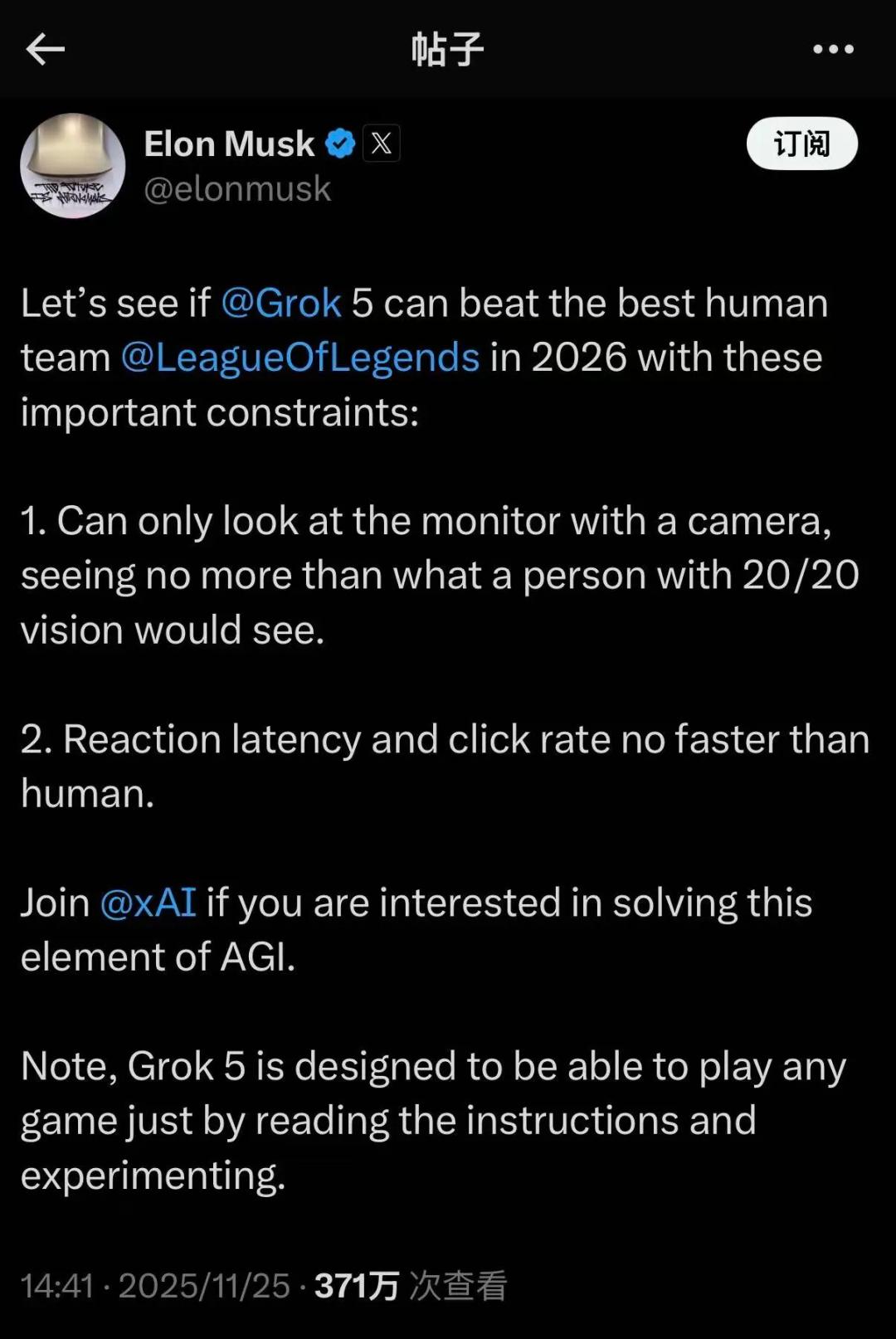
Core Points - Elon Musk has issued a challenge for Grok5 to compete against top human teams in League of Legends, marking a potential first for AI in a 5v5 format [1] - The challenge is seen as a promotional strategy for the upcoming release of Grok5 in January 2026 [3][10] Group 1: Challenge Details - Grok5 will face two significant limitations: it can only view the game through a camera with a vision equivalent to 20/20, and its reaction time and clicking speed cannot exceed that of humans [3] - These restrictions aim to push Grok5 to evolve in cognitive and reasoning capabilities rather than relying on speed and direct data reading [3] Group 2: Required Capabilities for Grok5 - Grok5 must possess advanced end-to-end visual perception, enabling it to recognize over 160 game elements amidst complex visuals [5] - It needs to demonstrate strong interference resistance, managing various visual noise factors such as resolution changes and screen reflections [5] - The AI must exhibit multimodal learning and generalization, allowing it to adapt strategies based on game updates without extensive retraining [7] - Strategic prediction and game theory capabilities are essential for Grok5 to compete effectively against seasoned human players [7] Group 3: Implications and Future Outlook - The challenge is viewed as a significant test for Grok5's potential in achieving general artificial intelligence (AGI) [10] - Musk's comments suggest a competitive spirit in the AI landscape, hinting at Grok's ambition to rank first among large models by January [10]
六小龙的乌镇信号:AI创业从拼模型进入拼场景时代
3 6 Ke· 2025-11-25 09:54
Core Insights - The "Six Little Dragons" of Hangzhou, representing six innovative companies, showcased their collective vision at the World Internet Conference, emphasizing the shift from data accumulation to cognitive construction in the AI era [1][11][12] - The AI core industry in Zhejiang Province achieved a revenue of 494.4 billion yuan, marking a 22% year-on-year growth, with R&D expenses reaching 39 billion yuan, up 14% [1][11] Company Highlights - Yushutech exemplifies the rise of embodied intelligence, growing from 3 to over 1,000 employees since its inception in 2016, with a 29.5% year-on-year revenue increase in the robotics sector [2][3] - Qiangnao Technology focuses on brain-computer interface technology, aiding individuals with disabilities, and plans to expand into sleep products [3][4] - Qunkua Technology sees spatial intelligence as a crucial area for future development, essential for managing robots in physical environments [4][8] - Yundongchu Technology has transitioned from creating robotic dogs to developing humanoid robots for hazardous environments [5][8] - Game Science, led by CEO Feng Ji, highlights China's dominance in the gaming market, with four of the top ten highest-grossing games globally developed by Chinese teams [5][6] Industry Trends - The AI investment landscape is shifting, with embodied intelligence surpassing large models in attracting funding, indicating a preference for companies with revenue and production capabilities [7][8] - The focus is moving from isolated technological advancements to collaborative ecosystem building, as seen in the strategies of various companies [7][8] - The concept of "world models" is emerging, emphasizing the need for AI to understand and interact with the physical world rather than just processing text [11][12][13] Future Outlook - The AI industry is transitioning from a focus on model size to a deeper understanding of the world, with the next decade expected to prioritize spatial intelligence and real-world interactions [11][12][13] - The collective efforts of the "Six Little Dragons" signify a natural evolution in the AI sector, driven by Hangzhou's robust manufacturing capabilities and engineering culture [12][13]

大摩闭门会:全球震荡,何去何从_纪要
2025-11-25 01:19
Summary of Key Points from Conference Call Industry Overview - The conference discusses the global investment landscape, particularly focusing on AI investments in the US and China, as well as the implications for various sectors including technology, banking, real estate, and insurance. Core Insights and Arguments 1. **AI Investment Strategies** - The US adopts a heavy asset gamble strategy aiming for AGI, while China takes a lightweight approach focusing on ecosystem development, leveraging infrastructure, talent, and data cost advantages to lower AI investment costs and mitigate bubble risks [1][7][20]. 2. **Technology Stock Valuations** - Current technology stock valuations are near 23 times earnings, indicating structural fragility reliant on a few large-cap stocks. Long-term optimism remains due to widespread industry applications, with many S&P 500 companies expecting AI to drive profit growth despite short-term volatility risks [1][8]. 3. **Federal Reserve Interest Rate Predictions** - The Federal Reserve is expected to lower interest rates in January, April, and June 2026, with the December rate cut expectation canceled. This adjustment has led to recent volatility in US stocks, but the long-term outlook remains optimistic, driven by broader market participation rather than solely AI-related companies [1][4][5][6]. 4. **Chinese Banking Sector Outlook** - Chinese banks are anticipated to gradually increase loan rates to cover long-term risks and manage non-performing assets, with regulatory support for reasonable pricing. This trend is expected to aid in the financial sector's recovery [1][17]. 5. **Real Estate Market Stabilization** - High-tier city real estate markets may not stabilize until 2027 due to the complex process of digesting excess inventory. The transmission mechanisms in the real estate market are intricate, and policy interventions often yield less than expected results [1][21][22]. 6. **Consumer and Investment Trends** - Consumer spending is expected to slow down in 2026, with investment improving slightly compared to 2025. Key drivers for consumption include the continuation of trade-in policies and expanded funding uses in fast-moving consumer goods and services [1][25]. 7. **Export Resilience Amidst Challenges** - Exports are projected to slightly slow but remain resilient, with the fading of the "rush to export" effect and a stable real exchange rate for the yuan. The diversification of export destinations and industrial upgrades in China are seen as foundational strengths [2][26]. 8. **Insurance Industry Growth Potential** - The insurance sector in China is viewed as having significant growth potential, with premium growth expected between 10% and 15%. The current low penetration of financial wealth compared to the US presents opportunities for expansion [1][19]. Other Important Insights 1. **Market Volatility and Investment Strategy** - Short-term market volatility driven by fear and algorithmic trading may not necessitate drastic investment strategy changes, particularly in the Chinese market, which is expected to maintain stability in 2026 [1][9][10]. 2. **Financial Sector Risk Management** - The financial sector, particularly banks, is seen as managing risks effectively, with non-performing loan rates stabilizing and a focus on sustainable growth [1][15][16]. 3. **AI Bubble Concerns** - While there are concerns about a bubble in US AI investments, China's AI infrastructure investment is significantly lower, reducing the risk of a similar bubble. Companies like Tencent and Alibaba are highlighted as having promising prospects in the AI space [1][20][27][28]. 4. **Real Estate Policy Effectiveness** - The effectiveness of real estate policies is questioned, with a need for comprehensive strategies rather than piecemeal approaches to address the ongoing challenges in the sector [1][22][24][23]. This summary encapsulates the key points discussed in the conference call, providing insights into the current state and future outlook of various industries and economic factors.
大涨超5%!再创新高!将成为全球第3家市值超4万亿美元公司!谷歌为什么能成为全球AI新的风向标?2年、50位高管亲述谷歌的翻盘!
美股IPO· 2025-11-24 16:19
Core Insights - Google's stock price reached an all-time high, with a market capitalization approaching $4 trillion, positioning it to become the third company globally to surpass this milestone [1] - The company has emerged as a new leader in AI, particularly with the launch of its Gemini model, which has been recognized for its competitive capabilities against OpenAI's offerings [5][31] Group 1: Historical Context and Challenges - At the end of 2022, Google faced significant challenges, losing nearly 40% of its stock value as it struggled to compete with OpenAI's ChatGPT, which had successfully captured public interest [2][12] - Internal conflicts and cultural shifts were evident as Google rushed to catch up, leading to a series of missteps and a redefinition of acceptable error standards within the company [8][9] Group 2: Strategic Decisions and Developments - The merger of DeepMind and Google Brain into Google DeepMind aimed to consolidate AI research efforts and enhance the company's competitive edge [25][27] - The development of Bard, Google's response to ChatGPT, involved significant resource allocation and a rapid timeline, resulting in a high-pressure environment for employees [17][19] Group 3: Product Launches and Market Reactions - Bard's initial launch was marred by a factual error that led to a significant drop in Alphabet's stock price, highlighting the risks associated with rapid product deployment [21][22] - Despite early setbacks, the Gemini model was eventually launched, outperforming ChatGPT in various benchmarks and restoring investor confidence [31][34] Group 4: Ongoing Challenges and Future Directions - The company continues to face scrutiny over its AI products, with incidents of bias and misinformation prompting internal discussions about safety and responsibility [37][38] - As Google pushes forward with AI innovations, it must balance the need for rapid development with the potential risks and ethical considerations associated with its technologies [48]


美国AI算力新基建是“泡沫”吗?
腾讯研究院· 2025-11-24 09:03
Group 1 - The current investment in computing power in the U.S. is a proactive infrastructure layout in the context of approaching general artificial intelligence, showing signs of a bubble but not yet out of control, supported by rapid iterations of large model technology and high revenue growth of large model companies [3][5][28] - The total installed capacity of large data center projects currently planned in the U.S. has exceeded 45 GW, with an expected investment of over $2.5 trillion, raising concerns about a potential "crash mechanism" if these investments fail to yield expected returns [3][8][7] - Companies like OpenAI and Anthropic are experiencing significant revenue growth, with OpenAI projected to exceed $20 billion in annual revenue by the end of this year, a fivefold increase from last year [3][13][14] Group 2 - In Q3, cloud computing revenues for Amazon, Microsoft, and Google reached $33 billion, $30.9 billion, and $15.2 billion respectively, driven by AI, with year-on-year growth rates of 20%, 28%, and 34% [4][16] - The demand for computing power is expected to continue rising, with a significant increase in the number of AI users, indicating a strong market need to support the construction of large-scale data centers [12][11] - The investment landscape includes substantial debt financing, with AI companies' bond issuance exceeding $200 billion this year, raising concerns about potential risks associated with high leverage [24][23][22] Group 3 - Historical context suggests that not all long-term investments are bubbles; the nature of the investment (productive vs. non-productive) and the source of funding (self-investment vs. debt) are critical factors [5][26][27] - The current AI computing power investment wave faces potential risks such as technological iteration slowdown and high leverage, but this does not imply a wrong direction; historical trends show that technological advancements often involve cycles of overheating and correction [30][28][31] - The construction of data centers is a key component of the U.S. re-industrialization strategy, with significant investments expected to drive local supply chains and industrial growth [20][24]





通用人工智能元年,新品竞争白热化,谁能成用户首选?
Sou Hu Cai Jing· 2025-11-24 08:13
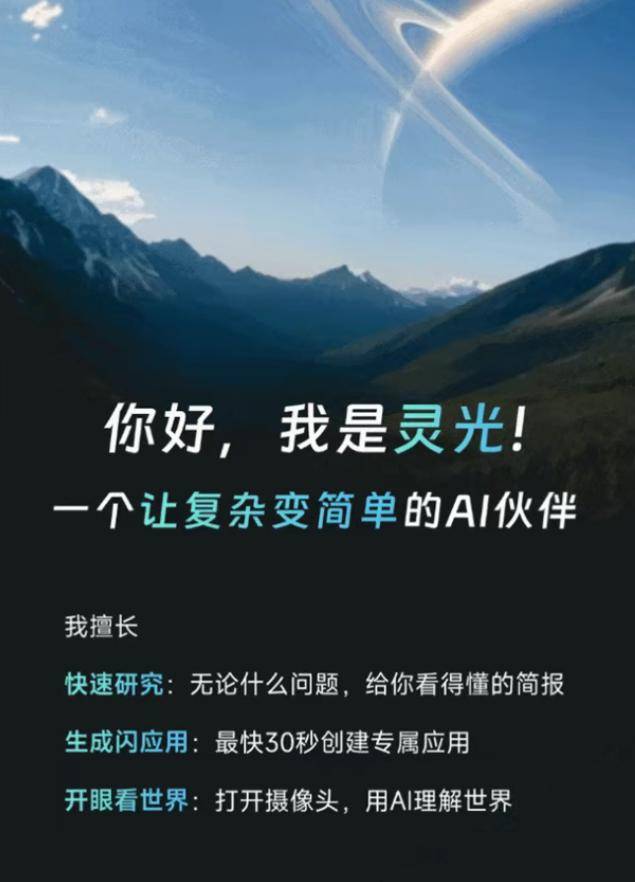
Core Insights - Ant Group recently launched its multimodal AI assistant "Lingguang," which achieved over 100,000 downloads within four days, aiming to break the homogeneity in the AI to C market focused on conversational interactions [1][6] - Alibaba also released the "Qwen" app, which integrates life services and adopts a free strategy, indicating a comprehensive user-level coverage in the AI to C market [3][8] - The competition in the industry is shifting from individual product comparisons to a contest of group resource integration capabilities, with major players like ByteDance, Tencent, and Alibaba vying for dominance in the AI to C space [5][12] Ant Group's "Lingguang" - "Lingguang" features capabilities such as "Lingguang Dialogue," "Lingguang Flash Applications," and "Lingguang Open Eye," supporting various forms of information output including 3D, audio, video, and charts [7][9] - The core philosophy of "Lingguang" is to simplify complex tasks, allowing users to create applications through natural language input in about one minute [6][7] - Ant Group's CTO emphasized the goal of making advanced AI technology accessible to ordinary users, aiming to enhance productivity [8][9] Competitive Landscape - The launch of "Lingguang" and "Qwen" signifies a strategic move by Alibaba to create a complementary competitive relationship rather than direct competition [9][12] - The AI to C market is evolving, with a focus on the ability of AI to perform tasks rather than just engage in conversation, indicating a shift towards more functional AI applications [12][14] - The integration of AI capabilities into everyday life is becoming a key objective for internet giants, with the potential for significant market growth [10][14] Industry Challenges and Future Directions - The industry faces challenges such as high user learning costs, insufficient ecological collaboration, and the need for deeper integration of tools, payments, and services [9][14] - Experts suggest that the next competitive focus may be on providing personalized and intelligent services while ensuring data security and user experience consistency [15][16] - The ongoing competition in the AI to C market is expected to intensify, with the ultimate success hinging on the ability to integrate ecosystems and mature technological products [14][16]