全球经济增长

Search documents
IMF上调2026年全球增长预期至3.3%,AI投资与政策发力抵消贸易风险
Sou Hu Cai Jing· 2026-01-19 09:49
(本文来自第一财经) 这份题为《全球经济:在分歧的力量中保持平稳》的报告指出,尽管面临贸易政策剧烈波动、地缘政治 紧张以及财政压力等多重逆风,全球经济依然展现出适应能力与韧性。 报告显示,全球经济在看似平稳的增长预测下,正经历着深刻的内部结构分化:贸易政策转向带来 的"阻力"正被人工智能(AI)驱动的投资热潮、各国财政与货币政策的支持以及私营部门的灵活性所产 生的"助力"所抵消。(第一财经记者 葛唯尔) 当地时间2026年1月19日,国际货币基金组织(IMF)发布了2026年首份《世界经济展望》(WEO)更 新报告。根据最新预测,全球经济增长在2026年预计将保持在3.3%,较2015年10月的预测值上调0.2个 百分点;预计2027年增速略微放缓至3.2%,与预测前值持平。 ...
“中国仍是全球经济增长的最大贡献者”——访世界经济论坛总裁博尔格·布伦德
Xin Lang Cai Jing· 2026-01-18 12:18
专访|"中国仍是全球经济增长的最大贡献者"——访世界经济论坛总裁博尔格·布伦德 新华社记者焦倩 陈俊侠 世界经济论坛总裁博尔格·布伦德日前在瑞士日内瓦接受新华社记者专访时说,中国仍是全球经济增长 的最大贡献者。 布伦德说,中国在传统优势领域持续发力,同时积极进军新兴技术领域。世界经济论坛预计,中国今年 的经济增速将在5%以上。 布伦德说,中国正见证前沿技术领域加速增长,并且正加倍投入新技术研发与创新。"这些新技术有望 在未来数年带来巨大的生产力提升与增长机遇。"布伦德说,中国正是这一进程的重要推动者。 布伦德说:"当前最令人担忧的是,地缘紧张局势升级可能扼杀全球经济增长。"他认为,世界若能避免 地缘紧张局势升级,2026年全球经济增速有望保持在3%以上。 世界经济论坛近日发布的"全球合作晴雨表"报告指出,当前多边主义持续面临强劲逆风,全球合作的结 构和形势正在发生变化。 布伦德肯定中国在维护多边主义方面发挥的作用。他强调,未来仍需依靠联合国等多边机制来应对诸如 疫情、网络犯罪等全球性挑战。 布伦德认为,维护并发展现有的多边主义机制非常重要,二战结束以来,正是这种机制为世界带来了巨 大繁荣。 世界经济论坛202 ...
博尔格·布伦德:“中国仍是全球经济增长的最大贡献者”
Xin Lang Cai Jing· 2026-01-18 08:10
世界经济论坛总裁博尔格·布伦德日前在瑞士日内瓦接受新华社记者专访时说,中国仍是全球经济增长 的最大贡献者。 作者: 陈俊侠 世界经济论坛近日发布的"全球合作晴雨表"报告指出,当前多边主义持续面临强劲逆风,全球合作的结 构和形势正在发生变化。 布伦德肯定中国在维护多边主义方面发挥的作用。他强调,未来仍需依靠联合国等多边机制来应对诸如 疫情、网络犯罪等全球性挑战。 布伦德认为,维护并发展现有的多边主义机制非常重要,二战结束以来,正是这种机制为世界带来了巨 大繁荣。 世界经济论坛2026年年会即将于19日至23日在瑞士达沃斯举办,主题为"对话的精神"。来自全球130多 个国家和地区近3000名不同领域的代表将围绕如何加强合作、释放新增长动力、投资于人等主题展开讨 论。 布伦德说,在分裂和竞争加剧的世界,确保对话至关重要,因为对话是良性进程的开端,有助于推动世 界进步。"在世界经济论坛看来,对话不是奢侈品,而是必需品。" 来源:新华社 布伦德说,中国在传统优势领域持续发力,同时积极进军新兴技术领域。世界经济论坛预计,中国今年 的经济增速将在5%以上。 布伦德说,中国正见证前沿技术领域加速增长,并且正加倍投入新技术研发 ...
世行上调全球经济增长预期至2.6%,但不同国家间增长差异显著
Shang Wu Bu Wang Zhan· 2026-01-16 14:01
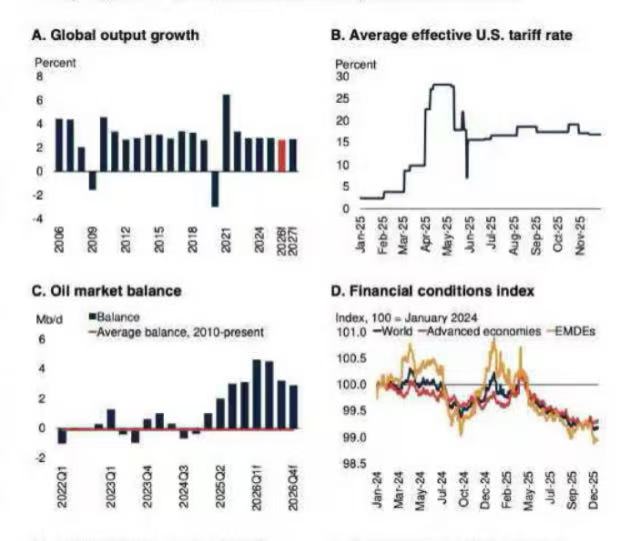
报告指出,尽管面临贸易紧张局势加剧及政治不确定性上升等挑战,全球经济仍展现出超出预期的韧 性。2025年全球经济增长率预估为2.7%,这意味着当前年度仅会出现轻微的经济活动放缓。过去一 年,库存增长、投资者强烈的风险偏好以及对人工智能投资的加速,共同支撑了经济增长,同时供应链 也逐步适应了更高的贸易壁垒。这一快于预期的增长,为2020年衰退后持续五年的全球复苏画上句号。 此次复苏被评价为六十多年来最强劲的一次,但同时也掩盖了不同国家间的显著差异。 波黑《独立报》1月14日报道。世行在最新发布的《全球经济展望》报告中,将2026年全球经济增长预 期从原先的2.3%上调至2.6%。 世界银行副首席经济学家阿伊汗.高斯警告称,近年经济增长已呈放缓趋势。2023年至今,全球经济增 长率介于2.6%至2.8%之间,明显低于疫情前十年3.2%的平均水平。他指出,在增长势头减弱、债务高 企及贸易碎片化的背景下,许多发展中国家将面临持续的发展挑战。(驻波黑使馆经商处) 发达经济体普遍实现了强劲复苏,近90%的经济体人均收入已超过疫情前水平。然而,超过四分之一的 发展中国家和新兴市场仍未恢复至2019年的水平,最贫困国家及面临 ...
世界银行预测2026年全球经济增长将放缓至2.6%
Shang Wu Bu Wang Zhan· 2026-01-15 16:54
报告呼吁国际社会加强合作,共同改善全球贸易环境、缓解融资约束并应对气候相关风险。报告建 议,为激发投资活力、促进长期增长,新兴市场和发展中经济体的政策制定者应着力深化国内改革,推 动贸易结构多元化,完善宏观经济政策框架,消除关键领域结构性瓶颈。若不能有效提升经济内生动 力,许多经济体将难以应对劳动年龄人口增长带来的就业压力。 报告认为,当前全球经济增长面临的短期风险总体偏向下行。若贸易紧张局势进一步升级、贸易壁 垒继续提高,或因资产价格下跌、财政压力或通胀超预期引发金融市场情绪恶化,经济增长可能受到明 显制约。另一方面,若人工智能相关活动加速普及,或企业对新贸易环境的适应能力增强,则可能为经 济带来上行支撑。 报告同时指出,全球经济在应对贸易摩擦升级与政策不确定性方面已展现出显著韧性。2025年,贸 易商品储备增加、市场风险偏好强劲以及人工智能领域支出大幅上升,共同支撑了全球经济活跃度,供 应链体系也对日益增长的贸易壁垒作出了适应性调整。近五年,全球经济从2020年衰退中的复苏速度超 过预期,为六十多年来罕见,但不同经济体之间复苏态势分化严重。 数据显示,发达经济体复苏较为稳固,近90%的发达经济体人均收入已 ...
世界银行:预计2026年全球经济增速2.6%,较去年6月的预测有所上调|宏观经济
清华金融评论· 2026-01-15 10:44
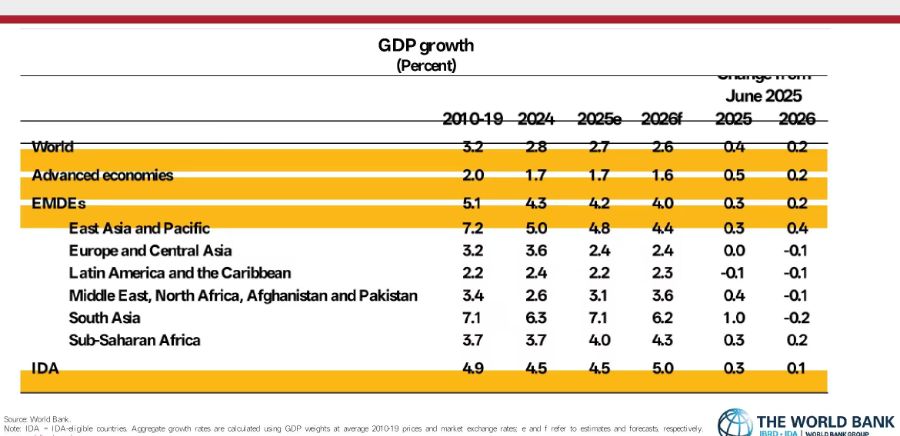
当 地 时 间 1 3 日 , 世 界 银 行 ( 下 称 " 世 行 " ) 发 布 最 新 一 期 《 全 球 经 济 展 望》报告,显示尽管贸易紧张局势与政策不确定性持续存在,全球经济的 韧性仍超出预期。 世行预计未来两年全球增速大体保持平稳,2026年为2.6%,2027年回升至2.7%,较去年6月的预测有 所上调。 不过,世行也表示,即便当前预测正确无误,2020年至2030年可能是20世纪60年代以来全球经济增长 最疲软的十年。 世行认为,增长乏力正导致全球生活水平差距拉大:到2025年底,几乎所有发达经济体的人均收入均 已超越2019年水平,但约四分之一发展中经济体的人均收入仍低于2019年。 仍展现出韧性 报告显示,尽管面临贸易紧张局势和政策不确定性加剧,过去一年全球经济在人工智能(AI)投资大 增等因素影响下仍展现出韧性。 世行表示,2025年,政策变动前的贸易激增与全球供应链的迅速调整支撑了经济增长。然而随着贸易 与内需走弱,这些提振效应预计将在2026年消退。 不过报告认为,全球金融条件趋于宽松及多个大型经济体的财政扩张应有助于缓冲经济下行。受劳动 力市场趋软及能源价格下降影响,预计20 ...

世界银行:全球经济韧性超出预期,穷国和富国收入差距拉大
2 1 Shi Ji Jing Ji Bao Dao· 2026-01-15 05:41
Group 1 - The World Bank projects that the GDP growth for developing economies will slow from 4.2% in 2025 to 4% in 2026, with a slight recovery to 4.1% in 2027 due to easing trade tensions and improved financial conditions [4] - By 2026, the per capita income growth for developing economies is expected to be 3%, which is approximately 1 percentage point lower than the average growth rate from 2000 to 2019, resulting in per capita income reaching only 12% of that of developed economies [4][3] - The report indicates that by the end of 2025, nearly all developed economies will have surpassed their per capita income levels from 2019, while about one-quarter of developing economies will still be below that level [3] Group 2 - The World Bank's latest Global Economic Outlook report highlights that global economic resilience has exceeded expectations despite ongoing trade tensions and policy uncertainties, with a forecasted global growth rate of 2.6% in 2026 [3] - The chief economist of the World Bank emphasizes the need for governments in both emerging and developed economies to actively promote private investment and trade, while managing public spending and increasing investment in new technologies and education to avoid stagnation and unemployment [4] - The report suggests that the upcoming decade will see 1.2 billion young people entering the labor force in developing economies, which may exacerbate employment pressures, necessitating comprehensive policy actions to enhance productivity and employment capacity [5]
经济韧性凸显!世界银行上调2026年全球经济增长预期
Xin Lang Cai Jing· 2026-01-14 11:23
Global Economic Outlook - The World Bank's latest Global Economic Prospects report indicates that despite ongoing trade tensions and policy uncertainties, global economic resilience has exceeded expectations [1] - The report forecasts stable global growth rates over the next two years, with a decline to 2.6% in 2026 and a rebound to 2.7% in 2027, an upward revision from previous predictions [1] Economic Growth Factors - The report attributes the past year's economic resilience to increased investments in artificial intelligence, despite the challenges posed by trade tensions and policy uncertainties [1] - It is expected that the effects of trade surges and rapid adjustments in global supply chains will support economic growth until 2025, but these effects are likely to fade by 2026 as trade and domestic demand weaken [1] Inflation and Financial Conditions - Global inflation is projected to slightly decrease to 2.6% in 2026, influenced by a softening labor market and declining energy prices [1] - The report suggests that easing global financial conditions and fiscal expansions in major economies will help buffer against economic downturns [1] Regional Economic Projections - The East Asia and Pacific region is expected to see growth rates of 4.4% in 2026 and 4.3% in 2027, while Europe and Central Asia are projected to stabilize at 2.4% in 2026 and rise to 2.7% in 2027 [2] - South Asia's growth is anticipated to decline to 6.2% in 2026 before recovering to 6.5% in 2027 [2] China’s Economic Outlook - China's economic growth rate is projected to be 4.4% in 2026, consistent with previous forecasts, supported by recent fiscal measures and a degree of stability in global trade policies [2] Developing Economies - Growth in developing economies is expected to slow from 4.2% in 2025 to 4% in 2026, with a slight recovery to 4.1% in 2027, driven by easing trade tensions and improved financial conditions [3] - Low-income countries are projected to grow faster, with an average growth rate of 5.6% in 2026-2027, supported by solid domestic demand and recovering exports [3] Income Disparity - The report emphasizes that the growth in developing economies will not be sufficient to close the income gap with developed economies, with per capita income growth expected to be 3% in 2026, about 1 percentage point lower than the average from 2000-2019 [3]
世行上调全球增长预期,却警告最疲软十年?
Sou Hu Cai Jing· 2026-01-14 05:50
Group 1 - The World Bank has raised the global growth forecast to 2.6%, but warns that the next decade could be the weakest since the 1960s, highlighting a contradiction that is not necessarily at odds [4][5] - The increase in growth is primarily driven by a surge in AI investments, which temporarily supports the global economy, akin to adding a turbocharger to an aging engine without addressing underlying structural issues [4][5] - Structural divergence is accelerating, with wealthy economies benefiting from technological dividends while low-income economies struggle to catch up [5][6] Group 2 - There is a growing disparity in living standards, where average improvements do not reflect the worsening conditions experienced by many, indicating a widening gap in capabilities rather than a cyclical issue [6][7] - Real pressures are emerging from trade, with the delayed effects of U.S. tariff policies likely leading to a slowdown in global trade growth by 2026 [7][8] - The world still requires trade, but the rules are becoming more fragmented, costs are rising, and uncertainty is increasing, posing a significant stress test for economies heavily reliant on external demand [8] Group 3 - The World Bank suggests that attention should not solely focus on growth figures; investments should be directed towards technology and education to enhance capabilities and resilience [8] - The current growth phase is viewed not as a reversal but as a bifurcation point, emphasizing that structural integrity and long-term strategies are more critical than mere speed [8]

世行:预计2026年全球经济增速为2.6%
Di Yi Cai Jing· 2026-01-14 00:31
世行称,尽管贸易紧张局势与政策不确定性持续存在,全球经济的韧性仍超出预期。 当地时间13日,世界银行(下称"世行")发布最新一期《全球经济展望》报告,显示尽管贸易紧张局势 与政策不确定性持续存在,全球经济的韧性仍超出预期。 世行预计未来两年全球增速大体保持平稳,2026年为2.6%,2027年回升至2.7 %,较去年6月的预测有所 上调。 不过,世行也表示,即便当前预测正确无误,2020年至2030年可能是20世纪60年代以来全球经济增长最 疲软的十年。 世行认为,增长乏力正导致全球生活水平差距拉大:到2025年底,几乎所有发达经济体的人均收入均已 超越2019年水平,但约四分之一发展中经济体的人均收入仍低于2019年。 仍展现出韧性 报告显示,尽管面临贸易紧张局势和政策不确定性加剧,过去一年全球经济在人工智能(AI)投资大 增等因素影响下仍展现出韧性。 世行表示,2025年,政策变动前的贸易激增与全球供应链的迅速调整支撑了经济增长。然而随着贸易与 内需走弱,这些提振效应预计将在2026年消退。 不过报告认为,全球金融条件趋于宽松及多个大型经济体的财政扩张应有助于缓冲经济下行。受劳动力 市场趋软及能源价格下降 ...