区域协同

Search documents
锐财经|经济大省展现强劲发展动能
Ren Min Ri Bao Hai Wai Ban· 2025-12-10 02:04
Core Viewpoint - Economic provinces in China are playing a crucial role in stabilizing the national economy while driving growth, with clear future plans outlined in the "14th Five-Year" proposals [1][2]. Group 1: Economic Performance - The top ten economic provinces contribute nearly 20% of the national area and over 60% of the GDP, acting as a stabilizing force for the national economy [2]. - In the first three quarters of this year, all nine provinces in the top ten recorded GDP growth rates above or on par with the national average, showcasing strong development momentum [2]. - Jiangsu's GDP surpassed 10 trillion yuan for the first time, while Shanghai and Hunan both exceeded 4 trillion yuan, marking a new threshold for the "four trillion club" [2]. Group 2: Future Planning - Five of the ten economic provinces have set ambitious goals to lead in various aspects, such as Guangdong aiming for economic doubling by 2035 and Jiangsu focusing on high-quality development and technological innovation [3]. - Zhejiang plans to achieve significant progress in high-quality development and common prosperity within five years [3]. Group 3: Structural Optimization and New Momentum - Economic provinces are at the forefront of structural optimization and new momentum, with policies promoting the growth of emerging industries like digital economy and artificial intelligence [4]. - Guangdong has released a detailed plan for digital economy development, targeting a core AI industry scale exceeding 440 billion yuan by 2027 [4]. Group 4: Domestic Demand and Investment - Economic provinces are enhancing domestic demand and stabilizing investment through consumption activities and major engineering projects [6]. - Guangdong has allocated an additional 3.5 billion yuan for fiscal policies, while Jiangsu plans to distribute over 400 million yuan in consumption vouchers [7]. Group 5: Reform and Innovation - To further stimulate growth potential, economic provinces are encouraged to focus on breaking regional collaboration barriers and innovating in areas like low-altitude economy [8].
经济大省展现强劲发展动能(锐财经)
Ren Min Ri Bao Hai Wai Ban· 2025-12-09 22:32
Core Insights - Economic provinces in China play a crucial role in stabilizing the national economy and driving high-quality development, with a clear roadmap emerging from recent "14th Five-Year" planning proposals [1][2] Group 1: Economic Performance - The top ten economic provinces contribute nearly 20% of the country's area and over 60% of GDP, acting as stabilizers and leaders in high-quality development [2] - In the first three quarters of this year, all nine provinces in the top ten exceeded or matched the national average GDP growth rate, showcasing strong development momentum [2] - Jiangsu's GDP surpassed 10 trillion yuan for the first time, while Shanghai and Hunan both exceeded 4 trillion yuan, raising the entry threshold for the "four trillion club" [2] Group 2: Future Planning - Five of the ten economic provinces have set ambitious goals to lead in various aspects, such as Guangdong aiming to double its economic total by 2035 and achieve per capita GDP at the level of developed countries [3] - Jiangsu emphasizes leading in high-quality development, technological innovation, and promoting common prosperity [3] - Zhejiang aims for significant progress in high-quality development and common prosperity demonstration within five years [3] Group 3: Structural Optimization and New Momentum - Economic provinces are pioneers in optimizing development structures and fostering new growth drivers, with policies promoting digital economy and AI [4][5] - Guangdong has released a detailed plan for digital economy development, including initiatives for data circulation and AI core industries, targeting over 440 billion yuan in scale by 2027 [5] - The focus on emerging industries is evident, with provinces like Zhejiang and Shandong prioritizing AI, new materials, and biotechnology in their planning [5] Group 4: Domestic Demand and Investment - Economic provinces are enhancing domestic demand and stabilizing investment through various initiatives, including significant financial allocations for consumer incentives [6] - Guangdong has allocated 3.5 billion yuan for six major consumer policies, while Jiangsu plans to distribute over 400 million yuan in consumption vouchers [6] - Major infrastructure projects are progressing, such as the completion of key bridges and water resource projects, which are expected to benefit millions [6] Group 5: Reform and High-Level Opening - Economic provinces are actively working on deep reforms and high-level openness, with measures to improve the business environment and integrate into the national market [7] - Sichuan has introduced 25 measures to address business environment challenges, while Henan has developed a plan to support the national market integration [7] - Future focus areas include breaking regional collaboration barriers and testing new mechanisms in emerging sectors like low-altitude economy [7]

非凡五年,广东把“逆风局”打成“高端局”
21世纪经济报道· 2025-12-09 00:34
Core Viewpoint - The article discusses how Guangdong province has managed to maintain economic growth and resilience despite facing significant challenges over the past five years, including the pandemic and global trade tensions. The province's GDP has consistently surpassed key milestones, demonstrating its ability to adapt and innovate in a changing economic landscape [3][4]. Economic Performance - Guangdong's total economic output has crossed the thresholds of 12 trillion, 13 trillion, and 14 trillion yuan, maintaining its position as the largest economy in China for 36 consecutive years [3]. - The average annual GDP growth rate for Guangdong during the first four years of the 14th Five-Year Plan is 4.7%, which, while seemingly modest, represents a significant marginal increase compared to previous decades [6]. Industrial Transformation - The province is focusing on transforming traditional industries and fostering emerging sectors, having initiated digital transformation for over 44,000 industrial enterprises [7]. - Guangdong produces a quarter of the country's new energy vehicles and over a third of industrial robots, with its core AI industry accounting for one-third of the national total [9]. Technological Innovation - More than one-third of provincial funding for technological innovation has been directed towards basic research, leading to Guangdong's top ranking in regional innovation capabilities [10]. - Key technological breakthroughs include advancements in high-end chips and surgical robots, showcasing the province's commitment to innovation [10]. Reform and Openness - Guangdong leads in several indicators of private sector development and has been recognized for its favorable business environment for four consecutive years [10]. - The province's total import and export volume has exceeded 9 trillion yuan, with a diverse range of international trade partnerships [10]. Regional Development and Sustainability - Guangdong is implementing a "full map development" strategy to promote balanced regional growth, transferring over 300 manufacturing projects to less developed areas [12]. - The province has achieved significant improvements in environmental quality, with record levels of air quality and water quality [12]. Social Welfare - Over 6 million new urban jobs have been created in Guangdong during the 14th Five-Year Plan, with a 4.9% average annual increase in per capita disposable income [12]. - The province has achieved near-complete coverage of pension insurance and has facilitated educational access for children of migrant workers [12].
青企联动 共创未来 “沪渝皖”三省四地青年企业家联建交流活动在沪举行
Xin Lang Cai Jing· 2025-12-08 12:25
为推进长三角与成渝地区青年企业家的跨区域交流合作,12月5日,上海市黄浦区青年企业家商会、松江区青年创业商会,重庆市万州区青年商会,安徽 省六安市青年企业家协会在上海国际仲裁中心共同举办"青企联动·共创未来"——"沪渝皖"三省四地青年企业家联建交流活动。 上海市工商联党组成员、副主席汪剑明出席并致辞。黄浦区委统战部副部长、区工商联党组书记顾辰晓,安徽省六安市委统战部副部长、市工商联党组书 记张强,重庆市万州区工商联党组成员、副主席陈忠,松江区工商联党组成员、副主席兼秘书长袁建峰参加活动。 汪剑明指出,新一轮科技革命和产业变革的浪潮奔涌而来,高质量发展成为时代最强音。在这样的历史方位中,加强区域协同、促进青年企业家的交流互 鉴,具有重要而深远的意义。 他希望四地青年企业家以此次联建交流为契机,一是能够成为红色基因的"传承者",从红色基因中汲取力量,将个人理想融入国家发展大局,在诚信经 营、合规发展等方面做表率;二是能够成为创新路上的"追光者",在人工智能、生物科技、新能源重塑世界的时代,勇闯"无人区",敢啃"硬骨头";三是 能够成为区域合作的"联络者",通过沪渝皖三省四地的活动增进友谊,促进信息沟通,促成产业合 ...

仓干配一体化数智转型 成都冷链物流实现连锁餐饮降本提效
Jin Tou Wang· 2025-12-06 05:21
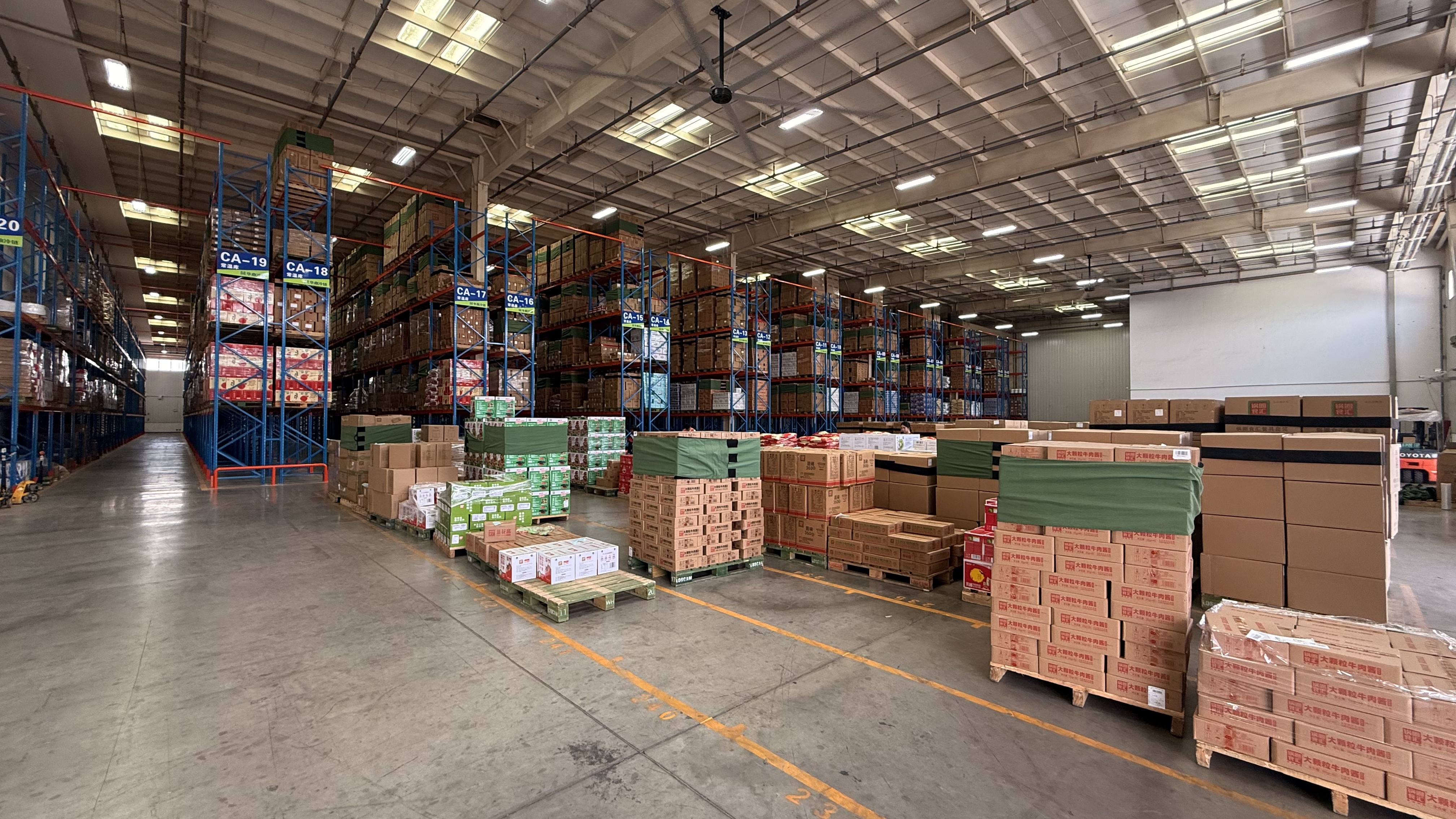
Core Insights - The Sichuan cold chain logistics industry is undergoing a profound transformation driven by innovation, transitioning from traditional transportation to digital, refined, and collaborative models, supported by consumer upgrades and policy incentives [1][16] - The industry integrates cold chain logistics deeply into the entire supply chain of catering and frozen food, providing efficient, safe, and stable supply chain support for chain catering enterprises [1] Digital Transformation - The chain catering industry's expansion demands high standards for ingredient freshness, delivery timeliness, and quality standardization, which Sichuan cold chain companies address through digital transformation and technological innovation [4] - Huading Cold Chain's "cloud warehouse + transportation network + information network" model exemplifies this transformation, significantly shortening the average delivery radius by over 30% [6] Warehouse and Delivery Efficiency - Huading Cold Chain has established a grid-based warehousing system centered in Chengdu, with provincial centers and front warehouses, optimizing delivery processes [6] - The company utilizes a digital management platform to ensure real-time order response, vehicle scheduling, and route planning, achieving a food loss rate of just 0.3% and a customer satisfaction rate of 98% [7][9] Supply Chain Integration - The digital management platform synchronizes data across warehousing, transportation, and delivery, allowing chain catering enterprises to monitor ingredient status and optimize inventory management, thus reducing operational costs [9][10] - Sichuan cold chain companies are innovating service models to provide comprehensive solutions from storage to delivery, exemplified by Yuhu Cold Chain's centralized kitchen and regional warehouse model, which reduces costs by 15% [10] Transportation Optimization - Sichuan cold chain enterprises are integrating their own vehicles with social transport resources, employing intelligent scheduling systems to enhance delivery efficiency [12] - Huading Cold Chain collaborates with Chengdu Haibawang Market to provide precise procurement suggestions and rapid delivery to 80% of chain catering outlets in the Sichuan-Chongqing region, achieving a daily transaction volume exceeding 5,000 tons [12] Regional Collaboration - The Sichuan cold chain logistics industry is forming a cluster development effect, with Chengdu as a core hub, enhancing service coverage and circulation efficiency for chain catering enterprises [13][15] - This regional collaboration model supports the expansion of chain catering brands into lower-tier cities, ensuring consistent supply and reducing logistics costs, thus fostering industry growth [15] Future Outlook - The Sichuan cold chain logistics market is projected to exceed 100 billion yuan by 2026, establishing a nationwide and global cold chain logistics network [16] - Continued focus on digital transformation, innovative models, and regional collaboration will enhance service quality and operational efficiency, driving high-quality development in the chain catering industry [16]
“十五五” 要来了!你的工作、钱包,都藏在这3个新方向里
商业洞察· 2025-12-04 09:23
中国经济发展的"十五五"规划前瞻研究 2025年,中国即将迈入"十五五" 规划新阶段。这五年,不仅是衔接2035年基 本实现现代化目标的关键过渡期,更是中国经济从"规模扩张"向"质量跃升"转 型的攻坚期。 未来五年,国家的发展浪潮将涌向何方? 哪些行业会崛起,哪些技能会升值? 我们每个人的工作、生活、投资又将迎来怎样的新机遇? "十五五"规划,正是解开这些疑问的"时代蓝图"和"财富密码"。 它远不止是宏大的国家目标,更是与每个人都息息相关。 《中国经济发展的"十五五"规划前瞻研究》由中国人民大学应用经济学院郑超愚 学 者 团 队 撰 写 , 紧 扣 " 十 五 五 " 规 划 编 制 实 施 的 政 策 热 度 , 聚 焦 经 济 高 质 量 发 展 、 新 质 生 产 力 培 育 、 区 域 协 调 等 核 心 议 题 , 进 行 趋 势 预 测 与 政 策 路 径 探 索 。 是各界把握"十五五"政策方向的权威参考。 读懂 "十五五": 不是增速竞赛,而是系统升级 提到五年规划,很多人会先问 "经济增速目标是多少?" 但在 "十五五" 的语境里,增速只是结果,真正的核心是 如何实现有质量的增长。 回顾 " ...
【西安】强化“菜篮子”工程稳产保供
Shan Xi Ri Bao· 2025-12-03 22:37
11月27日至29日,西安国家中心城市"菜篮子"工程稳产保供全程可追溯联盟农产品保供基地发布暨 产销对接活动举办。 活动还设置了城市对话、企业路演、生产端推介、流通端采购需求发布等环节,邀请重点城市代 表、区域合作研究专家及市场流通龙头企业,共同探讨绿色产业链与生态经济协同发展路径。通过精准 对接,活动现场销售额超500万元,达成意向合作金额超10亿元,促成5个跨区域合作项目签约,有效拓 展了关中平原城市群及周边城市农业创新合作空间。 西安市农业农村局相关负责人表示:"西安市将持续完善'菜篮子'工程稳产保供体系,强化区域协 同联动,保障特大城市'菜篮子'安全,推动区域农业高质量发展。"(记者:陈志涛) 本次活动以"产销互联·区域协同"为主题,通过展览展示、产销对接、市场参观考察、洽谈合作以 及行业交流等形式,拓展农业创新合作,构建特大城市初级农产品稳产保障体系,携手加快农产品标准 化生产和质量全程可追溯进程。 活动现场发布首批60家联盟农产品保供基地名单。据悉,该联盟旨在构建"从田间到餐桌"全链条跨 区域稳产保供体系,实现农产品生产标准化、质量全程可追溯,保障市民"菜篮子"安全,推动关中平原 城市群农业产业升 ...
以进一步深化改革融通江苏发展新动能
Xin Hua Ri Bao· 2025-12-02 05:48
Group 1 - The core viewpoint emphasizes that Jiangsu must leverage reform as a key driver for high-quality development, focusing on "integration" to break down institutional barriers and enhance the flow of critical elements such as talent, technology, capital, and data [1] - The "14th Five-Year Plan" period requires Jiangsu to address existing barriers between technology, education, and talent through reform practices, enhancing their interaction to support industrial upgrades and future development [2] - Establishing a dual-channel mechanism for industry professors and technology vice presidents aims to integrate academic and industry expertise, enhancing the practical application of research in enterprises [3] Group 2 - The emphasis on regional collaboration highlights the need for Jiangsu to create a complementary and high-quality regional economic layout, leveraging its strategic position in the Yangtze River Delta [5] - The "1+3" functional area reform is identified as a key strategy to address development imbalances and enhance overall competitiveness within Jiangsu [5] - The proposal to optimize the "flying economy" and establish a shared benefits mechanism aims to stimulate cooperation between regions and enhance innovation [6] Group 3 - The focus on market system construction aims to eliminate obstacles to the establishment of a unified national market, enhancing supply and demand dynamics through institutional reforms [8] - Jiangsu's strong supply capacity for intermediate products necessitates reforms to elevate its position in the value chain, promoting high-value-added segments [8] - The introduction of a public demand-driven technology iteration mechanism aims to address challenges in urban governance, healthcare, and environmental protection [9] Group 4 - Jiangsu's large population of 85 million presents an opportunity to convert its market potential into effective demand, driving high-quality supply [10] - The exploration of new consumption incentives linked to sustainable behaviors aims to create a circular consumption market [10] - The establishment of a skills-based compensation guideline is intended to ensure that skill enhancements directly reflect in income growth [10] Group 5 - The need for a platform-driven approach to enhance the market-oriented allocation of factors is emphasized, promoting the integration of technology, data, and governance [11] - The establishment of a data aggregation hub aims to clarify rights and responsibilities in data development and usage, ensuring equitable benefit sharing [11] - The introduction of a collaborative and efficient system for assessment will shift focus from GDP to indicators of factor integration, linking results to resource allocation [12]
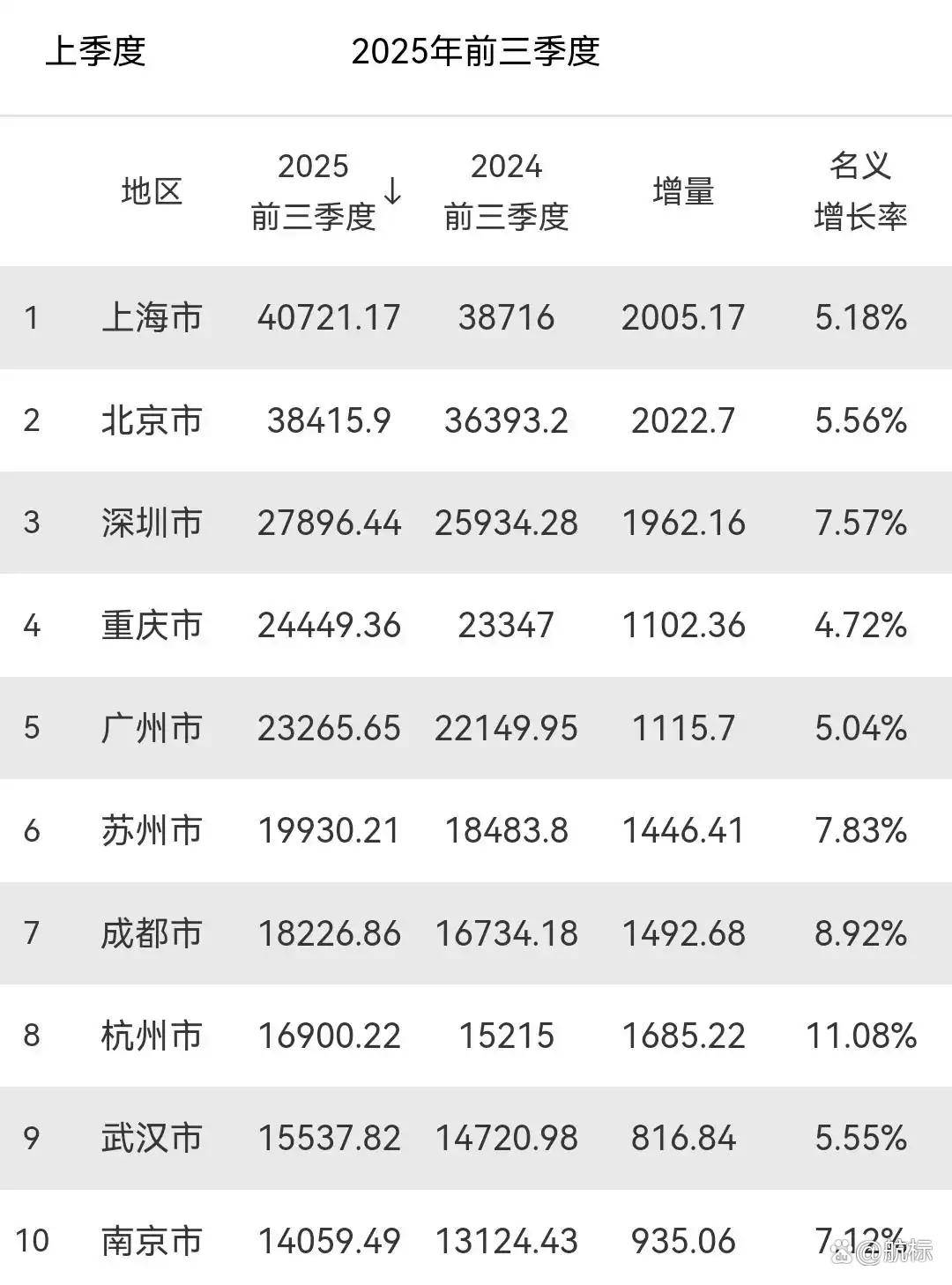
我国GDP10强城市更新:上海稳居第1,广州逼近重庆,杭州增速第1!
Sou Hu Cai Jing· 2025-11-22 08:52
Core Insights - The economic performance of China's top ten cities in the first three quarters of 2025 shows a competitive landscape, with Shanghai maintaining its lead, while Guangzhou and Chongqing are in close competition, and Hangzhou emerging as a standout with significant growth [1][5][11] Group 1: Economic Performance of Top Cities - Shanghai ranks first with a GDP of 40,721.17 billion, showing a year-on-year increase of 2,005.17 billion and a growth rate of 5.18% [4][5] - Beijing follows with a GDP of 38,415.9 billion, reflecting a growth of 2,022.7 billion and a rate of 5.56% [4] - Shenzhen's GDP stands at 27,896.44 billion, with a growth of 1,962.16 billion and a rate of 7.57% [4] - Chongqing's GDP is 24,449.36 billion, with a growth of 1,102.36 billion and a rate of 4.72% [4][6] - Guangzhou's GDP is 23,265.65 billion, showing a growth of 1,115.7 billion and a rate of 5.04% [4][6] - Hangzhou achieves a GDP of 16,900.22 billion with an impressive growth rate of 11.08% [4][8] Group 2: Competitive Dynamics - The competition between Guangzhou and Chongqing is highlighted, with a narrow gap of 1,183.71 billion in GDP, and Guangzhou's growth rate surpassing Chongqing's [6][7] - Chongqing benefits from the Chengdu-Chongqing economic circle, but faces challenges in its automotive sector, impacting overall growth [6] - Guangzhou leverages its position in the Guangdong-Hong Kong-Macau Greater Bay Area, with significant growth in foreign trade and the automotive sector [6] Group 3: Sectoral Insights - Hangzhou's growth is driven by the digital economy, with a 23% increase in cross-border e-commerce and significant advancements in AI applications [8][9] - The city's digital economy is transitioning from scale expansion to practical applications, enhancing its growth sustainability [8][9]
朋友圈”更大合作成果更多,运河城市产业引才联盟成立一年交出亮眼“成绩单
Yang Zi Wan Bao Wang· 2025-11-20 08:18
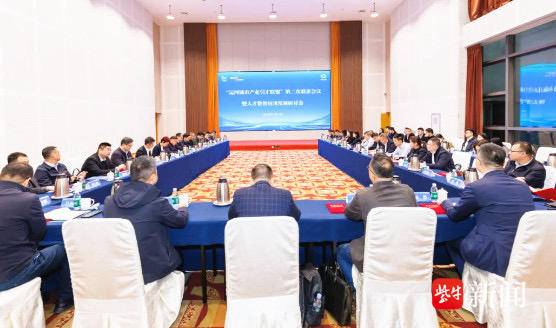
扬子晚报/紫牛新闻记者11月20日从扬州获悉,2025年第三届"绿扬金凤"人才周子活动——运河城市产 业引才联盟第二次联席会议本周成功举行。联盟成员以"开放合作、优势互补、共促发展"为宗旨,携手 做大人才工作"朋友圈"。 活动现场 据介绍,去年11月17日,扬州人才集团牵头组建的运河城市产业引才联盟在扬州成立,搭建起跨区域人 才交流合作的重要平台。一年来,在人才信息共享、校企合作对接、引才渠道拓展等方面取得丰硕成 果。本次联席会议上,联盟"朋友圈"进一步扩大——南京人才集团、盐城市人才集团、连云港市人才发 展集团等正式加入。目前联盟已汇聚13所院校、13家人才集团及5家头部猎聘机构,形成覆盖政、企、 校、猎的多元协作网络。苏州大学招生就业处处长靳葛表示,将聚焦运河沿线产业发展需求,优化人才 培养结构,提升人才培养质量,努力成为联盟人才供给的"蓄水池"。同时主动对接城市发展和企业需 求,搭建更高效的人才供需对接平台,努力成为联盟协同发展的"粘合剂"。 "作为联盟参与者,我们和扬州13个重点产业开展深度对接,累计选派400余名骨干教师赴企业担任科技 特派员,同时聚焦各城市主导产业,分层分类开展招聘活动,并以跨省组 ...