地方政府隐性债务

Search documents
前8个月地方政府借钱约7.7万亿,六成用于偿还旧债
第一财经· 2025-09-04 15:25
Core Viewpoint - Local governments are accelerating borrowing to invest in major projects and repay old debts to boost the economy and mitigate risks [2][3]. Group 1: Borrowing Scale and Purpose - In the first eight months of this year, local governments issued approximately 7.7 trillion yuan in bonds, a year-on-year increase of 42%, marking a historical high for the same period [2]. - Of the 7.7 trillion yuan in bonds, about 3.8 trillion yuan were refinancing bonds, which increased by 64% year-on-year, while 3.9 trillion yuan were new bonds, up 26% year-on-year [3]. - Approximately 4.77 trillion yuan, or 62% of the total borrowing, was used for repaying old debts, while nearly 3 trillion yuan was allocated for major project construction [8]. Group 2: Special New Bonds - Special new bonds, which are primarily used for major public projects, have also been utilized for refinancing hidden debts and repaying overdue corporate payments, referred to as "special new special bonds" [6]. - The issuance of special new bonds exceeded market expectations, with nearly 1 trillion yuan issued for refinancing hidden debts, surpassing the previously stated 800 billion yuan target [6][7]. - It is estimated that around 2 trillion yuan of new special bonds will be allocated to resolve overdue corporate payments this year [7]. Group 3: Investment Allocation - Among the nearly 2.3 trillion yuan allocated for project construction, approximately 28% was directed towards municipal and industrial park infrastructure, 18% towards transportation infrastructure, and 14% towards land reserves [9]. - The implementation of a "negative list" management approach has significantly broadened the investment scope for special bonds, allowing for land reserve investments, which totaled about 324 billion yuan in the first eight months [9]. Group 4: Debt Risk Management - As of July 2025, the total local government debt is projected to be approximately 52.76 trillion yuan, remaining within the limit of about 57.99 trillion yuan, indicating that local debt risks are generally manageable [10].

前7月地方借钱6.7万亿 钱怎么花 | 财税益侃
Di Yi Cai Jing· 2025-08-07 14:23
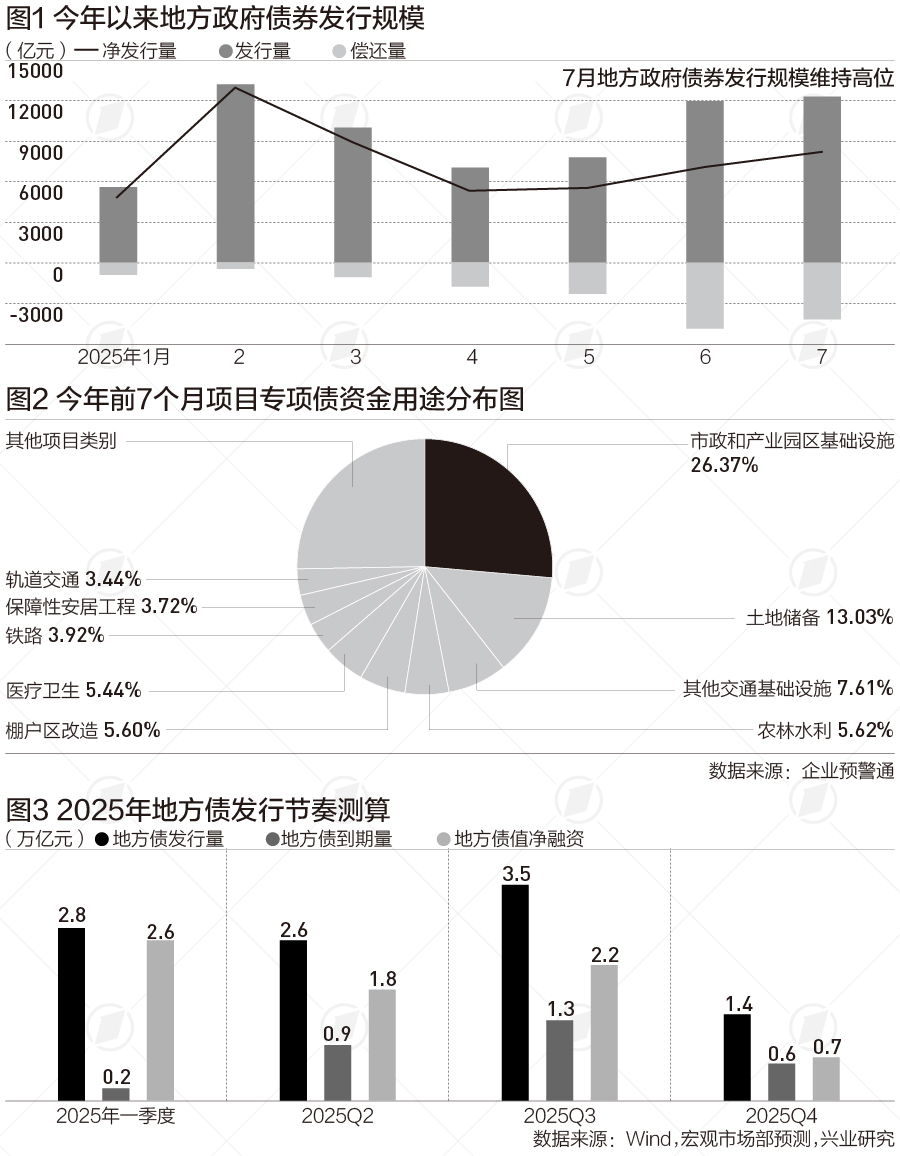
Core Viewpoint - Local governments in China have significantly increased their borrowing this year to stabilize the economy and mitigate risks, with a record issuance of local government bonds [1][2]. Group 1: Bond Issuance and Utilization - In the first seven months of this year, approximately 67,037 billion yuan of local government bonds were issued, marking a year-on-year increase of about 60% [1]. - More than half of the bond proceeds are allocated to repay old debts, while nearly half is invested in major project construction [1]. - Of the 67,037 billion yuan issued, about 34,000 billion yuan were refinancing bonds, up 65% year-on-year, and approximately 33,000 billion yuan were new bonds, increasing by about 55% [1][2]. Group 2: Refinancing and Debt Management - Refinancing bonds are primarily used for "borrowing new to repay old" debts, addressing the significant fiscal imbalance faced by local governments [2]. - The central government initiated a plan to replace hidden debts with local government bonds, with a total of 10 trillion yuan allocated for this purpose, of which 6 trillion yuan is through refinancing bonds [2]. Group 3: Project Funding and Special Bonds - New bonds are mainly directed towards major public welfare projects to stabilize investment and address shortfalls [3]. - In the first seven months, approximately 28,000 billion yuan of new special bonds were issued, accounting for over 60% of the total annual issuance target of 44,000 billion yuan [3]. - A significant portion of the new special bonds, around 8,000 billion yuan, is earmarked for resolving hidden debt issues and settling overdue payments to enterprises [3][4]. Group 4: Infrastructure Investment - About 26.37% of the new special bond funds are allocated to municipal and industrial park infrastructure, while 17.63% is directed towards transportation infrastructure [10]. - The issuance of land reserve special bonds has surged, with over 2,600 billion yuan issued in the first seven months, aimed at recovering idle land and stabilizing the real estate market [10]. Group 5: Future Expectations and Debt Management - The central government has emphasized accelerating the issuance and utilization of government bonds to enhance funding efficiency [11]. - Experts predict that local governments will complete the issuance of 44,000 billion yuan in new special bonds by the end of October, with a focus on increasing project initiation rates [11]. - As of June 2025, the total local government debt is projected to be 51.95 trillion yuan, remaining below the debt ceiling of approximately 57.99 trillion yuan [12].
热点思考 | “隐债问责” ,有何新变化?(申万宏观·赵伟团队)
赵伟宏观探索· 2025-08-06 16:04
Core Viewpoint - The article discusses the recent developments in the management of local government hidden debts in China, highlighting the increased accountability measures and the focus on grassroots government actions and project-related hidden debts [1][2][6]. Summary by Sections Hidden Debt Accountability Cases - Since the initiation of the new round of hidden debt resolution work in 2022, the Ministry of Finance has reported 44 typical cases of "hidden debt accountability," indicating a strengthened regulatory approach towards local hidden debts [2][12]. - The accountability cases are primarily concentrated in low-tier cities in central and western regions, with significant occurrences in provinces like Jiangxi, Henan, and Anhui [3][15]. Changes in 2025 Accountability Cases - The 2025 accountability cases show a shift towards focusing on grassroots government behavior and project-related hidden debts, reflecting a "penetrating" regulatory approach [4][17]. - The accountability cases in 2025 emphasize the actions of city, district, and county-level governments, with specific instances of accountability involving local industrial development committees [4][20]. New Directions for Hidden Debt - New hidden debt allocations in 2025 include funds for paying off loans for shantytown renovations and high-standard farmland improvement projects, indicating a trend of local governments resorting to hidden debts for project financing [5][23]. - The accountability measures reveal that local governments are increasingly using hidden debts to cover construction costs and repay existing debts, reflecting financial pressures on local budgets [7][23]. Reform Signals Behind Hidden Debt Accountability - The changes in hidden debt accountability cases signal a heightened emphasis on high-quality construction and strict regulation of new hidden debts, as highlighted in recent central government meetings [6][31]. - The accountability measures also point to the need for reform in the fiscal relationship between central and local governments, as local governments face pressures in maintaining basic financial obligations [7][38]. Fiscal System Reform - The article suggests that fiscal system reform is crucial for preventing hidden debts and addressing the competitive pressures faced by local governments, which have increasingly relied on high-tax industries and central subsidies [7][38].

土地溢价率继续回升——每周经济观察第31期
一瑜中的· 2025-08-04 13:27
Economic Outlook - The Huachuang Macro WEI index has slightly increased to 6.35% as of July 27, up from 5.84% on July 20, indicating a recovery in infrastructure and durable goods consumption [2][8] - The land premium rate has risen for three consecutive weeks, reaching 9% as of July 27, with a four-week average of 6.9%, compared to 5.47% in June [2][12] Consumption Trends - Service consumption has shown a decline, with subway ridership remaining stable at an average of 81.53 million daily in 27 cities, and domestic flight numbers increasing by only 0.8% year-on-year [3][12] - Retail sales of passenger vehicles have decreased, with a year-on-year growth of 5% as of July 27, down from 17% previously [3][12] - The sales of commercial residential properties have seen a significant drop, with a 22% year-on-year decrease in July compared to 17.6% in June [3][12] Production Insights - Infrastructure activity is performing better than last year, with asphalt plant operating rates at 33% as of July 30, up 6.7% year-on-year [3][16] - Coal throughput at Qinhuangdao port has shown a year-on-year growth of 11.8% in July, down from 24.4% in June [3][19] Trade Developments - Port container throughput has experienced a seasonal decline, with a week-on-week decrease of 6.5% as of July 27, while the four-week cumulative year-on-year growth is 5.6% [3][21] - The U.S. import figures have shown a significant drop, with a year-on-year decrease of 20.5% in July [3][22] Price Movements - A decline in commodity prices has been observed, with the South China index down 2.5% and the RJ/CRB commodity price index down 2.3% [3][37] - Prices for upstream solar and lithium carbonate have significantly decreased, with polysilicon futures down 3.1% and lithium carbonate futures down 13.7% [3][38] Debt and Interest Rates - The issuance of special bonds has exceeded the pace of the previous year, with a total of 2.82 trillion yuan issued, representing 64% of the annual target [4][43] - Interest rates have decreased, with the one-year, five-year, and ten-year government bond yields reported at 1.3734%, 1.5686%, and 1.7059%, respectively [4][51]

财政部通报六起隐性债问责案例,有地方新增隐性债超六百亿元
Nan Fang Du Shi Bao· 2025-08-04 12:03
Core Viewpoint - The Ministry of Finance has publicly reported six typical cases of local government hidden debt accountability, revealing a total increase of over 140 billion yuan in hidden debts, with Xiamen, Fujian, accounting for the largest share at 68.396 billion yuan [1][2]. Group 1: Hidden Debt Overview - Hidden debt refers to debts incurred by local governments outside the legal debt budget, which may involve direct or indirect repayment using fiscal funds and illegal guarantees [1]. - The scale and growth rate of hidden debt often exceed that of explicit debt, typically associated with violations such as illegal guarantees and disguised borrowing [1][3]. Group 2: Case Details - In Xiamen, from July 2020 to June 2023, the Xiamen Urban Construction Development Investment Co. funded seven urban renewal projects, resulting in hidden debt of 57.897 billion yuan [2]. - Additionally, the Xiamen Torch Tongxiang High-tech City Construction Investment Co. incurred 440 million yuan in hidden debt for a project initiated in November 2020 [2]. - The Xiamen Urban Construction Development Investment Co. and Xiamen Tong'an Guotou Real Estate Development Co. also created 10.059 billion yuan in hidden debt for 32 resettlement housing projects since October 2019 [2]. Group 3: Accountability and Measures - The reported cases highlight deviations in the performance outlook of local leaders and a lack of strict discipline in implementing central government policies, which severely impacts the effectiveness of hidden debt risk prevention [3]. - The Ministry of Finance emphasizes the need for local governments to learn from these cases, implement central government directives, and treat the prevention of hidden debt risks as a critical political task [3]. - A commitment to strengthen accountability measures and enhance the supervision of hidden debt issues has been reiterated, with a focus on discovering and addressing violations promptly [3].
涉及1400余亿元!财政部通报,多位地方官员被问责!
Jin Rong Shi Bao· 2025-08-04 09:16
Core Viewpoint - The central government emphasizes the importance of preventing and resolving hidden local government debt risks, mandating lifelong accountability and responsibility tracing for such issues [1][2]. Group 1: Accountability and Cases - The Ministry of Finance has reported six typical cases of accountability related to hidden debt, involving provinces such as Liaoning, Fujian, Shandong, Hubei, Chongqing, and Sichuan, with new hidden debts exceeding 140 billion yuan [1][2]. - Specific cases include Shenyang and Dezhou, which incurred hidden debts of 5.2 million yuan and 1.45 million yuan respectively through state-owned enterprise financing for agricultural projects [1]. - Xiamen, Wuhan, and Chengdu also reported significant hidden debts, with Xiamen's debt reaching 683.96 million yuan, Wuhan's at 103.85 million yuan, and Chengdu's at 614.08 million yuan, all through state-owned enterprise funding [1][2]. Group 2: Policy Implementation and Effects - The replacement policy for local government debt is showing gradual effects, significantly reducing the scale of hidden debts that local governments need to resolve independently [3]. - The issuance of low-interest local government bonds to replace high-interest, short-term, and risky hidden debts has alleviated debt interest expenses and repayment pressures [3]. - The central government has reiterated the need to strictly prevent the addition of new hidden debts, establishing it as a fundamental discipline to avoid a cycle of old debts being replaced by new ones [3].
每周经济观察第31期:土地溢价率继续回升-20250804
Huachuang Securities· 2025-08-04 07:44
Economic Indicators - The Huachuang Macro WEI index rose to 6.35% as of July 27, up from 5.84% on July 20, marking an increase of 0.52 percentage points[2] - The land premium rate increased to 9% for the week ending July 27, with a four-week average of 6.9%, compared to 5.47% in June[11] Consumer Trends - Subway ridership in 27 cities averaged 81.53 million daily in July, roughly unchanged from last year, while domestic flight numbers increased by 0.8% year-on-year to 14,700 flights in early August[9] - Retail sales of passenger vehicles grew by 5% year-on-year as of July 27, down from 17% previously, indicating a slowdown in durable goods consumption[9] Trade and Shipping - Port container throughput fell by 6.5% week-on-week as of July 27, with a four-week cumulative year-on-year growth of 5.6%[24] - U.S. imports showed a decline, with a year-on-year drop of 20.5% in late July, and imports from China decreased by 25.6%[25] Commodity Prices - Prices for upstream photovoltaic materials and lithium carbonate have significantly dropped, with rebar prices down by 2.9% and lithium carbonate futures down by 13.7%[3] - The South China Glass Index fell by 19.1%, indicating a broader decline in commodity prices amid reduced "involution" sentiment[41] Debt and Financing - New special bond issuance reached 2.82 trillion yuan, achieving 64% of the annual target, faster than the previous year[5] - The Ministry of Finance reported six cases of local government hidden debt, emphasizing the need to manage and mitigate hidden debt risks[53]
财政部曝光6起违法违规新增隐性债务典型案例
Ren Min Ri Bao· 2025-08-03 21:50
Core Viewpoint - The Ministry of Finance is intensifying efforts to manage local government debt and curb the emergence of hidden debts through a series of accountability measures and public disclosures of typical cases of hidden debt violations [1][3]. Summary by Relevant Sections Hidden Debt Cases - Shenyang City, Liaoning Province: New hidden debt of 520 million yuan due to high-standard farmland renovation project, with accountability for local officials [2] - Xiamen City, Fujian Province: New hidden debt of 68.396 billion yuan from land development and housing projects, with accountability for senior city officials [2] - Dezhou City, Shandong Province: New hidden debt of 14.5 million yuan from high-standard farmland construction, with accountability for local leaders [2] - Wuhan City, Hubei Province: New hidden debt of 10.385 billion yuan from public infrastructure projects, with accountability for local officials [2] - Wulong District, Chongqing: New hidden debt of 16 million yuan for infrastructure projects, with accountability for district officials [2] - Chengdu City, Sichuan Province: New hidden debt of 61.408 billion yuan from urban renewal and public projects, with accountability for the deputy mayor [2] Measures and Accountability - The Ministry of Finance emphasizes strict implementation of accountability mechanisms for local government violations related to debt, urging effective measures to prevent the increase of hidden debts and to manage existing hidden debt stock [3].
财政部通报六起地方政府隐性债务,多名干部被问责!
证券时报· 2025-08-02 14:19
Core Viewpoint - The article emphasizes the Chinese government's commitment to preventing and resolving hidden local government debt risks, highlighting the importance of accountability and strict enforcement of financial discipline [1]. Summary by Sections Hidden Debt Cases - Shenyang City, Liaoning Province incurred hidden debt of 520 million yuan through state-owned enterprises for high-standard farmland renovation projects [2]. - Xiamen City, Fujian Province reported hidden debt of 68.396 billion yuan through state-owned enterprises for land development and housing projects [2]. - Dezhou City, Shandong Province added hidden debt of 14.5 million yuan via state-owned enterprises for high-standard farmland construction [2]. - Wuhan East Lake New Technology Development Zone, Hubei Province accumulated hidden debt of 10.385 billion yuan through state-owned enterprises for public infrastructure projects [2]. - Wulong District, Chongqing City borrowed 16 million yuan from state-owned enterprises for infrastructure development, resulting in hidden debt [2]. - Chengdu City, Sichuan Province reported hidden debt of 61.408 billion yuan through state-owned enterprises for urban renewal and public projects [2]. Accountability Measures - In Chengdu, approximately 47 government and state-owned enterprise officials were held accountable for the hidden debt issues, with significant financial mismanagement identified [3]. - From June 2020 to June 2023, Chengdu's state-owned enterprises provided funding totaling 37.164 billion yuan for urban renewal projects, contributing to the hidden debt [3]. - Chengdu's transportation investment group and other state-owned enterprises contributed 16.07 billion yuan for municipal projects, further increasing hidden debt [3]. - The Chengdu government was involved in paying 8.174 billion yuan for rail transit development funds, which also added to the hidden debt [3]. Disciplinary Actions - The Sichuan Provincial Discipline Inspection Commission and the Provincial Supervision Commission took disciplinary actions against several officials, including the Deputy Mayor of Chengdu and other key figures [4][5]. - Notable disciplinary actions included criticism, inspections, and investigations into serious violations of discipline and law, leading to expulsion from the party and public office for some individuals [5][7].

【财经早报】000408,拟每10股派10元
Zhong Guo Zheng Quan Bao - Zhong Zheng Wang· 2025-08-02 00:30
Monetary Policy and Economic Support - The People's Bank of China continues to implement a moderately loose monetary policy, focusing on preventing excessive exchange rate fluctuations and increasing financing support for key areas such as "two new" and "two heavy" [2] - The National Development and Reform Commission (NDRC) announced the release of the fourth batch of 69 billion yuan in funding to support the consumption of old goods, completing the annual plan of 300 billion yuan [2] Company Performance - Ninebot reported a revenue of 11.742 billion yuan for the first half of 2025, a year-on-year increase of 76.14%, with a net profit of 1.242 billion yuan, up 108.45% [5] - Hikvision achieved a revenue of 41.818 billion yuan, a 1.48% increase year-on-year, with a net profit of 5.657 billion yuan, up 11.71% [5] - Cangge Mining reported a revenue of 1.678 billion yuan, a decrease of 4.74%, but a net profit of 1.8 billion yuan, an increase of 38.80% [5] - Chipone expects a revenue of approximately 584 million yuan for Q2 2025, a quarter-on-quarter increase of 49.90% [5] Corporate Developments - Zhongyou Engineering received a project award letter for a seawater pipeline project in Iraq worth 2.524 billion USD (approximately 18.032 billion yuan), which could positively impact future revenue and profits [7] - BYD reported July car sales of 344,296 units, a year-on-year increase of 0.27%, with cumulative sales from January to July reaching 2.49 million units, up 27% [6] - China Shenhua announced plans to issue shares and pay cash to acquire coal-related assets from its controlling shareholder, the National Energy Group [8] Industry Trends - The report from CITIC Securities suggests focusing on high-growth sectors such as overseas computing chains, innovative pharmaceuticals, wind power, and military industry, while also monitoring the progress of domestic computing and AI applications [8]