少子化

Search documents
日本今年上半年出生人口为33.9万人 创同期新低
Zhong Guo Xin Wen Wang· 2025-08-29 16:23
Core Insights - Japan's birth rate continues to decline, with the first half of 2023 recording the lowest number of births since 1969, totaling 339,000, a decrease of 3.1% year-on-year [1] - The death toll in Japan for the same period reached 837,000, an increase of 25,000 from the previous year, marking a 3.1% rise [1] - The natural population decrease, calculated as the difference between deaths and births, stands at 498,000 [1] Birth and Death Statistics - Births in Japan for the first half of 2023 were 339,000, down by 11,000 compared to the same period last year [1] - Deaths increased to 837,000, reflecting a growing trend in mortality [1] - The natural population decrease of 498,000 highlights the ongoing demographic challenges [1] Marriage Trends - The number of marriage registrations in Japan for the first half of 2023 was approximately 239,000 pairs, a decrease of 9,952 pairs or 4.0% year-on-year [1] - This decline in marriages is indicative of broader societal trends affecting birth rates [1] Government Response - The Ministry of Health, Labour and Welfare acknowledges the accelerating trend of declining birth rates and plans to enhance measures to address this demographic crisis [1]
你有没有发现,现在讨论结婚、生娃、买房这些话题的时候,大家的眼神里都带着一种无力感
Sou Hu Cai Jing· 2025-08-26 16:31
Group 1 - The core issue highlighted is the significant decline in birth rates in China, with 2023's newborn population at approximately 902 million, down from 956 million in 2022, indicating a drop of over 50 million [3] - The number of college graduates in 2024 is projected to be 11.79 million, an increase of 210,000 from the previous year, while the newborn population continues to decrease, creating a disparity between the supply of graduates and the declining number of children [3][4] - The marriage registration numbers have halved from 1.346 million in 2013 to 683 million in 2023, indicating a direct impact of declining birth rates on marriage and housing demand, particularly for school district properties [4] Group 2 - The trend of declining birth rates is leading to a shrinking educational demand, which could result in a future shortage of students in schools, affecting the education sector's resource allocation [3][4] - The rapid decline in birth rates in China is compared to other countries like South Korea, which has a total fertility rate of 0.72 in 2023, suggesting that China's larger population base may face more severe disruptions in various industries linked to infant numbers, such as baby products and household goods [6][8] - The youth unemployment rate for ages 16 to 24 reached 21.3% in 2023, indicating that despite a large population, the market's capacity to absorb labor is insufficient, raising concerns about future labor supply and demand dynamics [8]


宏观专题分析报告:人口灰犀牛:现状、影响和应对
SINOLINK SECURITIES· 2025-08-25 05:57
Demographic Trends - By 2024, the global population aged 65 and above will account for 10.2%, indicating a shift to a mildly aging society, with projections of 13.1% by 2035[2][15]. - China will officially enter a moderately aging society by 2024, with 15.6% of its population aged 65 and above, and is expected to reach 22.8% by 2035[3][25]. Challenges Faced by China - China is experiencing accelerated aging, with the proportion of the population aged 65 and above projected to reach 15.6% in 2024, nearing Japan's 1997 aging level[3][32]. - The total fertility rate in China has dropped to 1.0 in 2023, one of the lowest among major economies, indicating a severe challenge of low birth rates[3][28]. Economic Implications - The aging population will lead to a decline in the labor force, exerting downward pressure on potential growth rates, which are expected to drop to around 5.0% by 2026-2030 and further to 4.5% by 2031-2035[4][61]. - Japan's experience shows that after crossing two demographic turning points, the economy faced persistent negative output gaps, with 69% of the quarters from 1993 to 2024 recording negative growth gaps[4][68]. Inflation Dynamics - Aging populations typically exert inflationary pressures; however, many developed economies have experienced deflationary trends due to mismatched supply and demand shocks[5][74]. - In China, the short-term impact of aging may suppress inflation, but long-term effects could lead to upward inflationary pressures as labor supply contracts[5][80]. Policy Recommendations - To address the challenges of an aging population, increasing labor productivity is crucial, which can be achieved through technological advancements, raising labor participation rates, and attracting foreign labor[6][81]. - China should focus on enhancing its social security system to manage the economic impacts of an aging population effectively[6][32].
主题研究|育儿补贴对少子化及宏观经济的影响——基于日本的历史经验
野村东方国际证券· 2025-08-14 10:54
Core Viewpoint - China's childcare subsidy policy is more comprehensive and generous compared to Japan's historical subsidies, reflecting a strong commitment to addressing declining birth rates [2][10][11]. Group 1: China's Childcare Subsidy Policy - The recently released "Implementation Plan for Childcare Subsidies" will provide annual subsidies of 3,600 yuan per child for families with children under three years old starting January 1, 2025, with an estimated budget of around 90 billion yuan for the first year [6][10]. - The subsidy amount represents approximately 4.4% of the average disposable income for Chinese families, slightly higher than Japan's 4.1% in 1992 [10][11]. - The absence of income restrictions in China's subsidy policy allows for broader coverage, facilitating quicker implementation across the country [10][11]. Group 2: Comparison with Japan's Childcare Subsidy Policy - Japan's childcare subsidy policy has evolved from targeting low-income families to providing subsidies to all families, with the income threshold gradually removed by 2024 [7][9]. - Historical data shows that Japan's subsidies initially had strict income limits, while China's current policy aims to support all newborns without such restrictions [9][10]. - Japan's subsidy amounts have increased over the years, but the initial coverage was limited compared to China's current approach [7][9]. Group 3: Challenges of Declining Birth Rates - China faces significant challenges with declining birth rates, with the total fertility rate dropping below Japan's levels and birth numbers falling below 10 million for the first time since the 1940s [11][13]. - Japan's experience with declining birth rates highlights the importance of comprehensive policies that address not only childcare but also marriage and economic pressures [15][40]. - The need for a supportive environment for families, including improved workplace conditions and childcare facilities, is critical in both countries to combat declining birth rates [3][25].

人口16连降,日本绷不住了
虎嗅APP· 2025-08-14 00:18
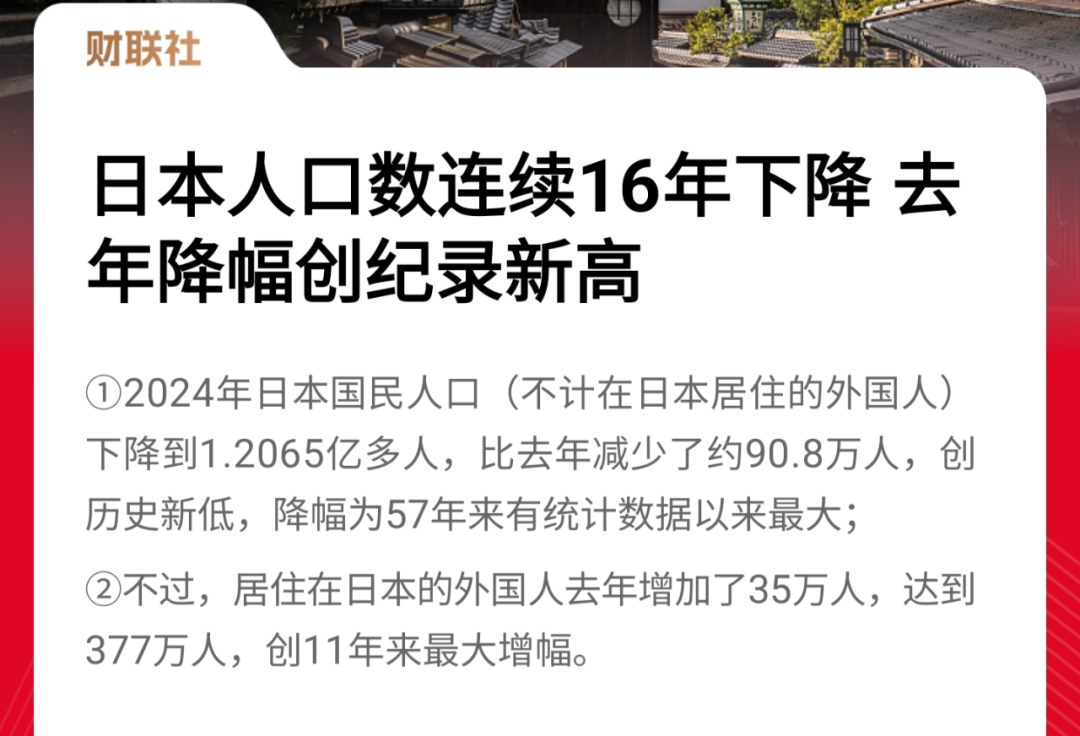
Core Viewpoint - Japan is experiencing a continuous population decline for 16 years, with the latest statistics showing a decrease of 908,000 people, marking the largest drop since records began. The total population is now 120.65 million [4][6]. Group 1: Population Decline - Japan's population has decreased by nearly 7 million since 2008, equivalent to the disappearance of two Osaka cities [6]. - The birth rate in Japan reached a historic low of 686,000 in 2024, while the death toll rose to nearly 1.6 million, indicating a significant demographic crisis [8][10]. - The median age in Japan is 49.4 years, with approximately 29.6% of the population aged 65 and older, highlighting the severe aging issue [12][14]. Group 2: Government Response - Japan has invested approximately 66 trillion yen (around 3.2 trillion yuan) over the past 20 years to combat the declining birth rate, but the effectiveness of these measures is questioned [6][20]. - The total fertility rate in Japan is now at 1.15, significantly below the replacement level of 2.1, although it is not the lowest in East Asia [20][22]. - The government has implemented extensive financial support for families, including a total average subsidy of 3.52 million yen (about 164,000 yuan) for children aged 0-18 [26][29]. Group 3: Comparison with Other Regions - The European Union's population reached 450.4 million in 2024, marking a continuous increase, with 19 out of 27 member states experiencing population growth [33][34]. - The EU's natural population decline is offset by immigration, with over 2.3 million net immigrants in 2024, contrasting with Japan's reluctance to accept immigrants [38][40]. - Japan's immigration policy may need to shift in response to its declining population, as the number of foreign residents has increased by 350,000 in the past year, reaching a total of 3.77 million [44][45].
人口16连降,日本绷不住了
Hu Xiu· 2025-08-13 06:33
Core Points - Japan's population has decreased to 120.65 million as of January 1, 2025, marking a record decline of 908,000 people from the previous year, the largest drop since records began [1] - The country has experienced a continuous population decline for 16 years, totaling a reduction of nearly 7 million people since 2008, equivalent to the disappearance of two Osaka cities [3][5] - Japan has invested approximately 66 trillion yen (about 3.2 trillion yuan) over the past 20 years to address the declining birth rate, viewing it as a national crisis [4] Population Trends - In 2024, Japan recorded its lowest birth rate of 686,000, while the death toll reached nearly 1.6 million, the highest on record [6] - The dual pressures of declining birth rates and an aging population are contributing to the ongoing population decrease [8] - Japan's median age is 49.4 years, with approximately 29.6% of the population aged 65 and older, making it the oldest country globally [11][13] Regional Disparities - Population decline is widespread across Japan, with only Tokyo experiencing growth among the 47 prefectures; other regions are seeing declines [14][15] - Some areas, like Tottori Prefecture, have populations dropping below 100,000, facing a "disappearance crisis" [16] Education and Infrastructure Impact - The population decrease has led to the closure of over 400 schools annually, with more than half of private universities failing to meet enrollment targets [17] - Some schools have been repurposed for other uses, such as agricultural parks or aquariums [18] Government Response and Policies - Japan's total fertility rate fell to 1.15 in 2024, the lowest since records began in 1947, significantly below the 2.1 replacement level [21] - The government has implemented extensive financial support measures, including a comprehensive subsidy system for families with children, averaging 3.52 million yen (approximately 164,000 yuan) per child from birth to age 18 [31] - New policies include full tuition waivers for national universities for families with three or more children, alongside various other financial incentives [32][34] Comparison with Other Regions - Despite Japan's low birth rate, it is not the lowest in East Asia, with South Korea's rate at 0.75 [24] - The European Union has seen population growth, with 19 out of 27 member states increasing their populations, largely due to immigration, which Japan has been historically resistant to [37][42][43] - Japan's recent increase in foreign residents, reaching 3.77 million, indicates a potential shift in immigration policy as domestic population decline continues [48][49]
幼儿园招生,进入白热化
创业邦· 2025-08-11 10:19
Core Viewpoint - The article discusses the ongoing crisis in the private kindergarten sector in China, highlighting the increasing number of closures and the challenges faced by educators and institutions amid changing policies and declining birth rates [5][20]. Group 1: Industry Trends - A significant number of private kindergartens are closing down, with various regions reporting multiple closures within a short timeframe, indicating a growing trend of "kindergarten closures" across the country [8]. - The article notes that the closures predominantly affect private kindergartens, which thrived during a previous boom but are now struggling to adapt to new regulations and market conditions [8][12]. Group 2: Challenges Faced by Educators - Educators are experiencing heightened pressure to meet enrollment targets, with some facing penalties for failing to attract enough students, leading to a stressful work environment [7][24]. - The competitive landscape has shifted, with parents becoming more discerning and demanding, often leading to conflicts between parents and educators over fees and services [26][27]. Group 3: Policy Changes - Recent government directives have mandated that community kindergartens must operate as public or non-profit institutions, significantly impacting the operational model of many private kindergartens [15]. - The government aims to increase the proportion of public kindergartens to 50% and non-profit private kindergartens to 30%, which poses a challenge for profit-driven private institutions [15]. Group 4: Market Dynamics - The article highlights a shift in the market where public kindergartens are rapidly expanding, offering lower fees and better facilities, which has led to a decline in enrollment for private institutions [16][20]. - The decline in birth rates has exacerbated the situation, with fewer children enrolling in kindergartens, leading to a significant reduction in student numbers for many private institutions [20][22].
幼儿园招生,进入白热化
虎嗅APP· 2025-08-09 13:38
Core Viewpoint - The article discusses the challenges and transformations faced by the early childhood education industry in China, particularly focusing on the increasing number of private kindergartens shutting down amid changing policies and demographic trends. Group 1: Industry Trends - The early childhood education sector is experiencing a "closure wave," with numerous private kindergartens shutting down across various regions, indicating a significant industry contraction [9][10]. - The government has introduced policies to increase the proportion of public kindergartens to 50% and to promote non-profit private kindergartens to 30%, aiming to limit excessive profit-seeking behavior in the sector [21]. - The demographic trend of declining birth rates is leading to a decrease in enrollment numbers in kindergartens, exacerbating the financial pressures on private institutions [26][29]. Group 2: Market Dynamics - The competition for student enrollment has intensified, with kindergartens resorting to aggressive marketing strategies, including discounts and promotional offers, to attract parents [25][26]. - Parents are becoming more discerning, comparing multiple options and demanding higher quality services, which has led to increased pressure on kindergartens to meet these expectations [25][30]. - The shift from a focus on educational quality to marketing tactics has transformed the operational landscape of kindergartens, with many educators feeling the strain of these changes [25][30]. Group 3: Personal Experiences of Educators - Educators are facing heightened stress and anxiety due to the pressures of enrollment and the demands from parents, leading to a challenging work environment [33][34]. - Many experienced teachers are being pushed out of the industry as public kindergartens set higher entry requirements, leaving them unable to compete [37]. - The emotional toll on educators is significant, with many expressing feelings of loss and regret as they witness the decline of the industry they have dedicated their careers to [38].
幼儿园招生,进入白热化
3 6 Ke· 2025-08-09 06:02
Core Viewpoint - The early childhood education industry in China is facing significant challenges, including a wave of kindergarten closures and increased competition from public kindergartens, leading to a decline in enrollment and financial pressures on private institutions [4][18][25]. Group 1: Industry Trends - A series of government initiatives aimed at boosting birth rates, such as the annual subsidy of 3,600 yuan for children under three, have been introduced, but the impact on the industry remains uncertain [1][4]. - The number of kindergarten closures is rising sharply, with private kindergartens being the most affected, as they struggle to adapt to changing regulations and market conditions [4][18]. - The shift towards public and non-profit kindergartens is evident, with mandates requiring new community kindergartens to operate as public or non-profit institutions, further squeezing private operators [12][13]. Group 2: Enrollment Challenges - Enrollment pressures have intensified, with many kindergartens resorting to aggressive marketing tactics to attract students, including offering free classes and discounts [16][19]. - The competition from newly established public kindergartens has led to a significant drop in student numbers for many private institutions, with some reporting a 75% reduction in enrollment [24][25]. - Parents are increasingly selective, comparing multiple options and prioritizing affordability and quality, which has forced many kindergartens to lower fees and offer incentives [16][19]. Group 3: Financial Strain - The financial burden on private kindergartens is escalating, with rising operational costs and declining revenues leading to unsustainable business models [17][19]. - Many educators are facing job insecurity as kindergartens close or reduce staff in response to dwindling enrollment [25][28]. - The industry's rapid expansion in previous years has resulted in a significant oversupply of private kindergartens, which are now struggling to survive in a more competitive environment [9][13].

“生育国补”,救不了天价私立幼儿园
Hu Xiu· 2025-08-09 03:58
Group 1 - The article highlights a significant decline in the private kindergarten sector, with many institutions shutting down due to various pressures, including increased competition from public kindergartens and changing regulations [9][54][58] - Recent government initiatives aimed at boosting birth rates, such as waiving fees for larger classes, have not yet translated into improved enrollment for private kindergartens, indicating a disconnect between policy and market realities [2][8] - The article discusses the historical context of the kindergarten industry, noting a previous boom driven by high demand and a growing middle class, which has now shifted to a more challenging environment with declining birth rates and increased scrutiny on educational quality [12][19][42] Group 2 - The article details the struggles of educators in the current environment, where they face pressure to meet enrollment targets while dealing with demanding parents and administrative challenges [5][51][60] - It emphasizes the shift in parental expectations, with families now more selective and price-sensitive, leading to aggressive marketing tactics from kindergartens, including discounts and promotional offers [39][41][56] - The narrative illustrates the emotional toll on educators as they navigate a landscape where their roles have transformed from teaching to marketing, reflecting broader industry changes [36][44][60]