投资于物

Search documents
学习规划建议每日问答|怎样理解投资于物和投资于人紧密结合
Sou Hu Cai Jing· 2025-12-08 03:58
Group 1 - The core viewpoint emphasizes the integration of investment in physical assets and human capital as a means to enhance development momentum, expand domestic demand, and promote comprehensive human development [1] - Investment in physical assets has played a crucial role in China's rapid economic growth, contributing to the accumulation of physical capital, enhancement of production capacity, and improvement of public service levels [1][2] - There is significant potential for further investment in physical assets, particularly in key industries and technological advancements, as China's per capita capital stock remains low compared to developed countries [2] Group 2 - The importance and urgency of investing in human capital are increasingly recognized, as the economy shifts from capital-intensive to talent-intensive growth, necessitating greater investment in education, healthcare, and skills training [3] - Enhancing the income distribution system and promoting equal access to basic public services are essential for improving human capital investment and ensuring a high-quality life for all citizens [4] - Establishing a long-term mechanism for human capital investment, including optimizing fiscal responsibilities and encouraging various stakeholders to invest in human development, is critical for sustainable economic growth [4]
求是专访 | 为什么提出“投资于人”
Sou Hu Cai Jing· 2025-12-01 03:45
Core Viewpoint - "Investment in people" is a specific embodiment of the people-centered development philosophy, reflecting a necessary requirement for China's economic and social development at a certain stage, and is an active choice for long-term planning [2][3] Group 1: Definition and Relationship - "Investment in people" refers to allocating more fiscal funds and public resources to areas such as education, employment, healthcare, and social security, focusing on enhancing human capabilities and driving high-quality economic development through human capital [2][3] - It contrasts with "investment in material," emphasizing a new development direction that corrects past investment models and capacity expansion approaches [2][3] Group 2: Economic Context - Economic growth has traditionally focused on capacity expansion, with "investment in material" being the preferred strategy due to its quicker returns and easier cost-benefit analysis [3] - From 2008 to 2023, China's incremental capital-output ratio increased from 2.84 to 9.44, indicating that more capital is required to generate the same GDP growth, highlighting the diminishing returns of material investment [3][6] Group 3: Social Needs and Development - The pursuit of a better life by the people encompasses not only diverse and high-quality consumption needs but also broader social development goals [4][6] - "Investment in people" aims to meet these needs and is not a rejection of "investment in material," but rather seeks a close integration and positive interaction between the two [4][6] Group 4: Policy Implications - The emphasis on "investment in people" is a necessary requirement for China's economic and social development, particularly in the context of the 14th Five-Year Plan, which aims to guide investment direction and optimize investment structure [6][7] - The current domestic demand issue is partly due to insufficient consumer demand and the need for a better interaction between consumption and investment [7] Group 5: Areas of Focus - Key areas for "investment in people" include education, training, employment, and the development of human resources, which are essential for enhancing human capital and professional skills [10][11] - Investment should also extend to creating a favorable ecological environment and meeting the spiritual and cultural needs of the population [10][11] Group 6: Long-term Vision - "Investment in people" is fundamentally about enhancing the quality of life and civilization, which is closely linked to the development of social productivity [15][16] - The approach should be integrated into the broader context of Chinese-style modernization, focusing on human development as a primary goal [16][17]


读懂“十五五”规划建议 感知政策里的民生“温度”
Sou Hu Cai Jing· 2025-12-01 01:36
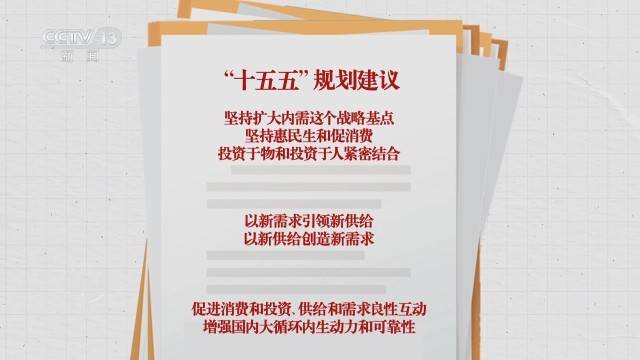
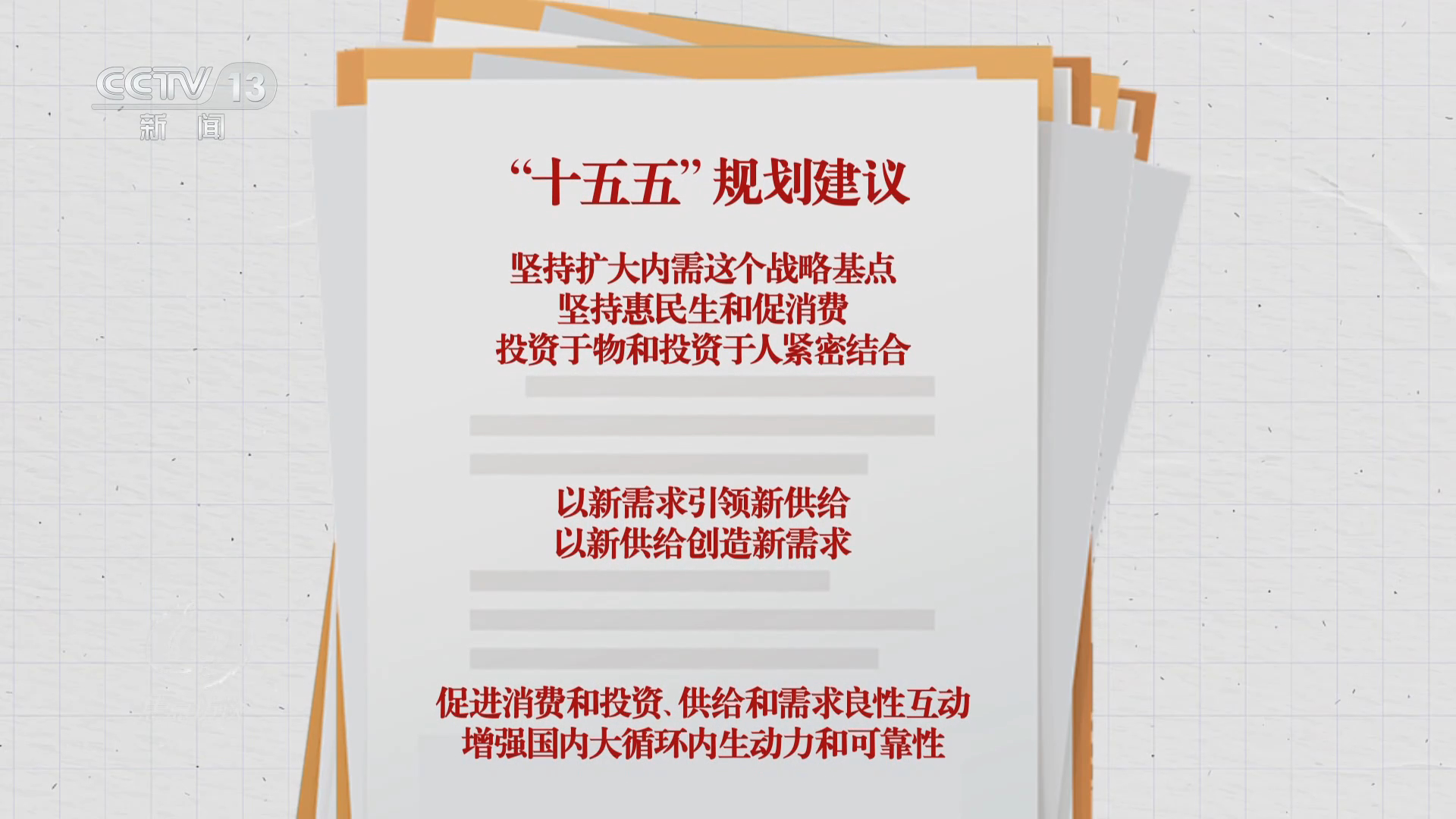
央视网消息(焦点访谈):今天(11月30日),我们继续"向着新目标前进"系列。从柴米油盐到衣食住 行,从孩子的书包到老人的康养,每个人对美好生活的向往都是国家发展的方向。"十五五"规划建议 中,关于扩大内需、优化投资有哪些全新部署?这些部署背后又藏着怎样的发展新逻辑?今天,我们就 带着这些疑问,一起层层拆解,读懂政策里的民生温度与发展密码。我们先来看关于内需和投资,"十 五五"规划建议里的"新提法""新目标"是什么。 "十五五"规划建议指出,坚持扩大内需这个战略基点,坚持惠民生和促消费、投资于物和投资于人紧密 结合,以新需求引领新供给,以新供给创造新需求,促进消费和投资、供给和需求良性互动,增强国内 大循环内生动力和可靠性。其中,"坚持惠民生和促消费、投资于物和投资于人紧密结合"是"十五五"规 划建议中关于内需和投资的一个全新提法和目标。 清华大学中国发展规划研究院常务副院长董煜:"投资于物与投资于人,是这次"十五五"规划当中的一 大亮点,实现了发展目的与发展路径的更好结合,实现了投资目标和投资结构之间的有机协同。" 中国国际经济交流中心资深专家委员朱民:"这个政策在未来十年、二十年以至于三十年,给整个中国 ...
焦点访谈|读懂“十五五”规划建议 感知政策里的民生“温度”
Yang Shi Wang· 2025-11-30 14:07
Group 1 - The core viewpoint of the article emphasizes the importance of expanding domestic demand and optimizing investment as outlined in the "14th Five-Year Plan" [3][5] - The new proposal highlights the integration of "investment in material" and "investment in people," aiming to enhance the quality of life and stimulate consumption [3][11] - The article discusses the shift in investment focus from physical infrastructure to human capital, indicating a strategic decision to prioritize investments that directly benefit people's lives [5][15] Group 2 - The "14th Five-Year Plan" suggests that investment in people includes funding for education, healthcare, and elderly care, which are crucial for improving living standards [5][19] - The article provides examples of successful integration of investments in both material and human resources, such as the Shenzhen Guangming Cloud Valley project, which has attracted high-tech enterprises and created job opportunities [11][13] - It highlights the need for a long-term vision in investments, focusing on talent development and innovation as key areas for future growth [25][27] Group 3 - The article notes that the total fixed asset investment in China is projected to reach 52 trillion yuan, emphasizing the scale of investment compared to global standards [9] - It discusses the necessity of increasing residents' income to boost consumption, with specific goals set in the "14th Five-Year Plan" to align income growth with economic growth [19][21] - The article mentions that the government aims to direct more resources towards social welfare, with over 70% of fiscal spending in various regions allocated to the livelihood sector [21][23]
【学习贯彻党的二十届四中全会精神】】党的二十届四中全会名词卡片:投资于物、投资于人
Sou Hu Cai Jing· 2025-11-19 04:43
Group 1 - Investment in physical assets has played a crucial role in China's sustained economic growth, enhancing production capacity and social productivity, while also supporting new industrialization, information technology, urbanization, and agricultural modernization [1] - Investment in physical assets is a significant component of total demand, driving economic growth, creating jobs, and improving public services, which in turn boosts residents' wealth accumulation and consumption capacity [1] - Recent investments in food reserves, energy bases, emergency supplies, and industrial backups have strengthened China's economic resilience and risk management capabilities [1] Group 2 - There remains substantial potential for investment in physical assets in China, as per capita capital stock is relatively low compared to developed countries, and there is a need to optimize the capital structure and enhance investment quality in key industries [2] - The importance and urgency of investing in human capital have become increasingly prominent, as the return on investment in physical assets has declined, necessitating a shift towards innovation-driven and demand-driven economic growth [2] - Increasing investments in education, healthcare, and elderly care is essential for improving living standards and achieving high-quality development, as well as promoting comprehensive human development [2] Group 3 - Key directions for investment in human capital include improving income distribution systems, promoting equal access to basic public services, and increasing government investment in areas such as childcare, education, healthcare, and vocational training [3] - Strengthening human resource development and investing in various talents, especially in technology and innovation, is critical for providing foundational support for high-quality development [3] - Establishing a long-term mechanism for investing in human capital, optimizing fiscal responsibilities, and enhancing local government assessment and incentive mechanisms are necessary to stimulate investment in human capital across society [3]
把握“投资于人”的丰富意蕴(连线评论员)
Ren Min Ri Bao· 2025-11-17 22:01
Core Viewpoint - The integration of "investment in material" and "investment in people" is essential for promoting high-quality development and improving the quality of life for the population [1][4]. Investment in People vs. Investment in Material - Investment in people focuses on human capital development, including education, health, social security, and employment support, while investment in material emphasizes physical assets [1][2]. - The shift from material to human investment reflects a change in growth drivers from factor-driven to innovation-driven, enhancing the quality of human resources and innovation capabilities [1][2]. - Investment in people has a longer return cycle but offers stable and lasting benefits, contributing to social effects and economic quality [1][2]. Deep Adjustments in Economic Governance - The adjustment in economic governance is evident in three areas: shifting growth drivers, optimizing economic structure, and focusing on sustainable long-term development [1][2]. - The emphasis on balancing short-term growth with long-term development indicates a refined approach to macroeconomic management [1][2]. Synergy Between Investments - The relationship between investment in material and investment in people is reciprocal; material investment can enhance human development, while human investment can stimulate material investment [2][3]. - A systematic approach is needed to align investments in technology infrastructure and talent development, ensuring a cohesive strategy that connects education, talent, and industry [2][3]. Supply and Demand Dynamics - On the supply side, the combination of investments can significantly enhance labor quality and innovation capacity, leading to a new level of productivity [3]. - On the demand side, investing in people improves social security and overall welfare, which can elevate demand levels and create a dynamic balance between supply and demand [3]. Broader Economic Implications - The focus on human development is crucial for transitioning from middle-income to high-income status, emphasizing the importance of talent cultivation and human-centered economic strategies [4]. - The approach aims to maximize human creativity and drive economic growth through the comprehensive development of the population [4].
【图解】权威解读|一图秒懂“十五五”规划建议核心热词
Zhong Guo Jing Ji Wang· 2025-11-14 03:26
Core Viewpoint - The article emphasizes the importance of achieving a moderate level of development for China by 2035, with a focus on enhancing GDP and fostering emerging industries to adapt to global economic changes [2][5][14]. Group 1: Economic Development Goals - The target is to exceed the threshold of $20,000 in per capita GDP by 2020 standards and to double the per capita GDP by 2035 compared to 2020 levels [2]. - Achieving a moderate level of development is seen as crucial for China's economic strategy moving forward [2]. Group 2: Emerging Industries - The "14th Five-Year Plan" aims to develop new pillar industries such as renewable energy, new materials, aerospace, and low-altitude economy [5]. - There is a call for a focus on key areas like quantum technology, biomanufacturing, hydrogen energy, and sixth-generation mobile communication to drive future industrial growth [6]. Group 3: Regional Innovation Systems - The establishment of regional innovation systems is essential, involving collaboration among government, enterprises, universities, and research institutions to enhance innovation capabilities [9]. - A tailored approach based on local resources and industrial foundations is recommended to prevent market bubbles and ensure sustainable development [6]. Group 4: Investment Strategies - Investment in physical assets (infrastructure, buildings, machinery) is crucial for solidifying the material and technical foundation for economic development [10]. - Investment in human capital (education, healthcare, skills training) is equally important for enhancing the capabilities and potential of the population [10]. Group 5: Digital Trade - Digital trade, characterized by data as a key production factor and digital services, is rapidly growing and is identified as a new trend in international trade and economic growth [12]. Group 6: Energy Strategy - Building an energy powerhouse is highlighted as a significant goal, with energy security being critical for national stability and development [13][14]. - The transition to green and low-carbon energy sources is emphasized as a timely and necessary step in the current global context [14].

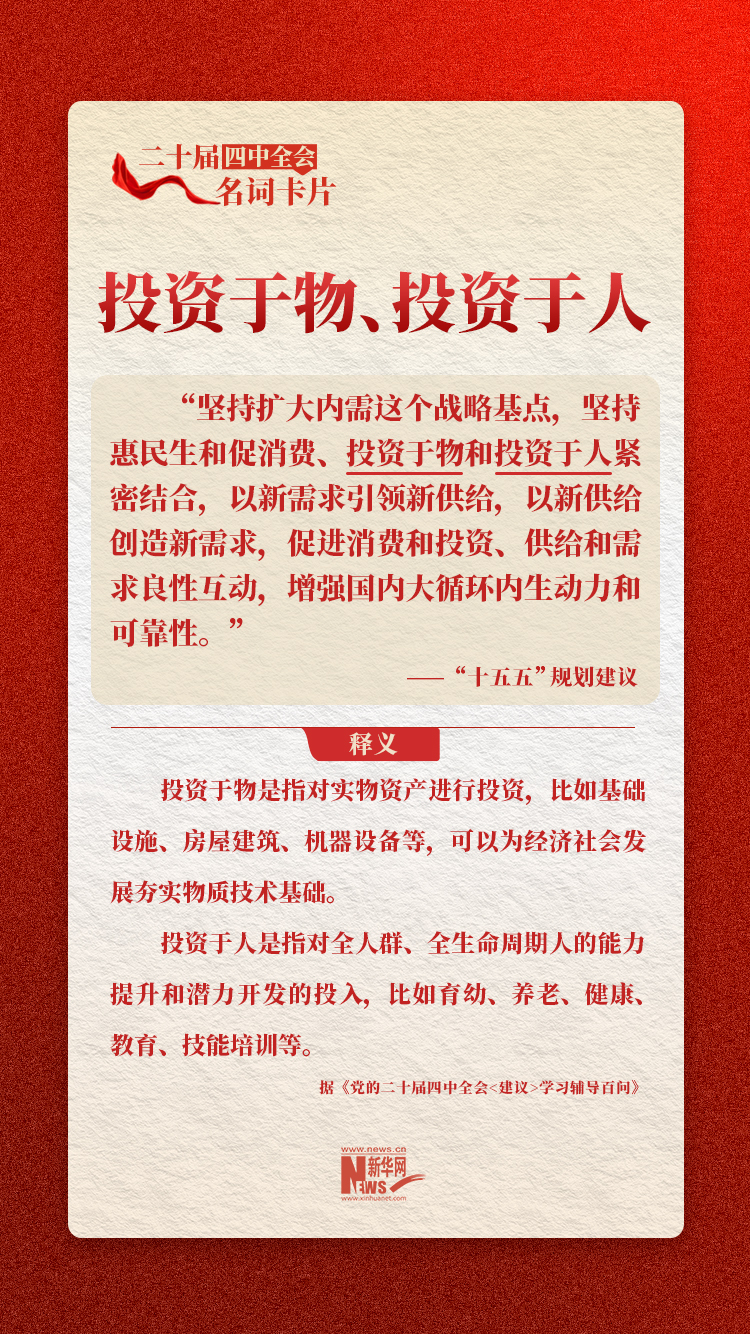
二十届四中全会名词卡片:投资于物、投资于人
Xin Hua Wang· 2025-11-13 13:19
Core Viewpoint - The article emphasizes the importance of balancing investments in physical assets and human capital to drive economic growth and improve living standards in China, highlighting the need for a strategic focus on both areas to enhance domestic demand and supply dynamics [2][8]. Group 1: Investment in Physical Assets - Investment in physical assets has played a crucial role in China's rapid economic development, leading to effective accumulation of physical capital, enhanced production capacity, and improved social productivity [6]. - Such investments are a significant component of total demand, driving economic growth, creating jobs, and increasing residents' wealth and consumption capacity [6]. - Recent investments in food reserves, energy bases, emergency supplies, and industrial backups have strengthened China's economic resilience and risk management capabilities [6]. Group 2: Potential for Further Investment in Physical Assets - There remains substantial potential for further investment in physical assets in China, as per capita capital stock is still relatively low compared to developed countries [7]. - The capital stock structure requires optimization, with some key industries facing insufficient investment and quality issues, necessitating upgrades to outdated machinery, infrastructure, and urban areas [7]. Group 3: Importance of Investment in Human Capital - The urgency of investing in human capital has become increasingly apparent, as the return on investment in physical assets has declined in recent years [8]. - To transition from a capital-intensive to a talent-intensive economy, it is essential to enhance investments in human capital, fostering human capital accumulation and creating a "human capital dividend" [8]. - Increased investment in education, healthcare, and elderly care is vital for improving living standards and achieving high-quality development for the population [8]. Group 4: Key Directions for Investment in Human Capital - Improving income distribution systems and ensuring fair compensation based on contributions is essential for promoting productivity [9]. - Advancing equal access to basic public services and reducing disparities between regions and demographics is a priority [9]. - Increasing government investment in areas such as childcare, education, healthcare, vocational training, and cultural sports is necessary to cover the entire population and lifecycle [9]. - Strengthening human resource development and investing in high-skilled talent, particularly in technology and innovation, is crucial for supporting high-quality development [9]. Group 5: Establishing Long-term Mechanisms for Human Capital Investment - Establishing a long-term mechanism for human capital investment involves optimizing fiscal responsibilities and resource allocation, enhancing local government assessment and incentive systems [10]. - It is important to stimulate the active participation of various stakeholders in investing in human capital and to include such investments in statistical accounting [10].
解题“十五五”投资,首编“全口径政府投资计划”怎么做
2 1 Shi Ji Jing Ji Bao Dao· 2025-11-08 12:02
Group 1 - The core viewpoint emphasizes the importance of expanding domestic demand as a strategic foundation during the 14th Five-Year Plan period, focusing on enhancing consumer spending and investment efficiency [1][2][6] - The government aims to optimize the investment structure by stimulating private investment and increasing government investment in consumption-related sectors to promote a virtuous cycle of investment and consumption [2][12] - There is a recognition of the need to invest in both physical assets (infrastructure, machinery) and human capital (education, healthcare) to support sustainable economic growth and improve living standards [6][9][11] Group 2 - The government plans to implement significant landmark projects in urban renewal, new energy systems, and major water conservancy projects, while ensuring that infrastructure investment continues to grow appropriately [8][14] - The strategy includes enhancing the quality of public services and addressing the needs of an aging population, thereby increasing demand for services in healthcare, elderly care, and cultural tourism [7][8] - The government will focus on improving the investment environment for private enterprises, ensuring fair competition, and providing financing support to stimulate private sector investment [15][16]
解题“十五五”投资,首编“全口径政府投资计划”怎么做
21世纪经济报道· 2025-11-08 11:54
Core Viewpoint - The article emphasizes the importance of expanding domestic demand as a strategic foundation during the "15th Five-Year Plan" period, focusing on enhancing consumer spending and effective investment to drive economic growth [1][5]. Group 1: Consumer Spending - The government aims to boost resident consumption by optimizing the environment, innovating consumption scenarios, and removing unreasonable restrictions in the consumption sector [1][2]. - Measures will be taken to enhance residents' income share in national income distribution, with a focus on increasing government funding for social welfare [1][6]. - The article highlights the need to address the challenges of paid leave and improve mechanisms to ensure its implementation [1]. Group 2: Effective Investment - The government plans to optimize investment structure by stimulating private investment and enhancing the role of government investment in driving consumption-related sectors [2][10]. - There is a focus on improving investment efficiency, particularly in transportation and energy sectors, to address issues of "heavy investment, light returns" [2][10]. - The article discusses the importance of deepening investment and financing system reforms, utilizing new policy financial tools, and enhancing public-private partnerships [2][10]. Group 3: Investment in People - The article stresses the significance of investing in human capital alongside physical assets, highlighting the need for investments in education, healthcare, and skills training [5][6]. - It points out that the return on investment in physical assets has been declining, necessitating a shift towards enhancing human capital to foster new productivity [6][8]. - The government is encouraged to prioritize public funding for comprehensive development across all demographics and life stages [8][12]. Group 4: Infrastructure and Major Projects - The "15th Five-Year Plan" will see the implementation of significant landmark projects in urban renewal, strategic transportation, and new energy systems [7][10]. - The government aims to maintain appropriate growth in infrastructure investment while ensuring it does not exceed necessary levels [7][10]. - Key projects will also focus on service consumption areas such as elderly care, healthcare, and cultural tourism to meet the evolving needs of the population [7][10]. Group 5: Policy Recommendations - The article suggests that local governments should shift from traditional competition models to optimizing human capital and creating a conducive environment for investment [8][14]. - It emphasizes the need for clear delineation between government and private investment roles to stimulate private sector participation [12][14]. - The article advocates for enhancing the investment environment for private enterprises, ensuring fair competition, and providing necessary support for risk management [14][15].