权益投资

Search documents
理财新势力亮相科创板打新入场者为何仅为少数派
Zhong Guo Zheng Quan Bao· 2025-12-01 20:25
Core Viewpoint - The article discusses the increasing participation of bank wealth management companies in IPO offline subscription, particularly highlighting the successful allocation of shares in the domestic GPU company, Moore Threads, marking a significant step in equity investment for these firms [1][2]. Group 1: Bank Wealth Management Participation - Bank wealth management companies, such as Ningyin Wealth Management and Xingyin Wealth Management, have successfully participated in the offline subscription of Moore Threads, indicating a growing trend in equity investments [1][2]. - The participation of these companies in IPO offline subscriptions is seen as a strategy to enhance the returns of their wealth management products, although only a few firms have actively engaged in this practice [1][3]. Group 2: Investment Strategy and Market Response - The AI chip industry is experiencing rapid growth, and bank wealth management companies are aligning their investment strategies with national policies to support the real economy and technological innovation [2][3]. - The implementation of policies granting bank wealth management companies equal status as Class A investors in offline subscriptions has led to a swift market response, with several firms beginning to participate in IPOs [2][3]. Group 3: Research and Capability Challenges - Many bank wealth management companies face challenges in participating in IPO offline subscriptions due to limitations in research capabilities and personnel allocation [3][4]. - Establishing a robust research mechanism and investment decision-making process is essential for these companies to effectively engage in new stock subscriptions [3][4]. Group 4: Future Directions and Recommendations - To enhance their participation in IPO offline subscriptions, bank wealth management companies are advised to strengthen their industry research and valuation modeling capabilities, design differentiated product structures, and improve investor engagement [4]. - The high premium characteristics of A-share new stocks provide an opportunity for bank wealth management products to achieve excess returns, making participation in IPOs a valuable strategy [3][4].
“中国版英伟达”上市,银行理财也在抢筹!试水IPO打新,难点在哪?
券商中国· 2025-11-30 04:24
Core Viewpoint - The article discusses the successful IPO of Moer Technology, referred to as the "Chinese version of Nvidia," which has set a record for the highest issuance price in the A-share market this year [1] Group 1: IPO and Market Participation - Moer Technology's IPO was priced at 114.28 yuan per share, making it the most expensive new stock this year [3] - The participation of bank wealth management companies, such as Ningyin Wealth Management and Xingyin Wealth Management, in the IPO's offline allocation marks a significant development in the market [2][3] - The new IPO underwriting regulations implemented this year have allowed bank wealth management companies and insurance asset management firms to participate in new stock subscriptions, providing substantial policy benefits [2][4] Group 2: Wealth Management Companies' Involvement - Ningyin Wealth Management successfully allocated approximately 3.18 million shares worth about 3.93 million yuan, with its highest allocation product receiving 1.52 million yuan [3] - Xingyin Wealth Management's three products collectively received about 1.79 million shares, amounting to approximately 2.04 million yuan, with one product achieving an allocation of 988,300 yuan [4] - The participation of these wealth management companies in IPOs is still limited, with only three out of 32 companies actively engaging in A-share IPOs [6] Group 3: Investment Strategies and Challenges - The article highlights the challenges faced by wealth management companies in enhancing their equity investment capabilities, including research and team building [2][9] - The low interest rate environment is pushing wealth management firms to strengthen their equity investment capabilities to build competitive advantages [2][9] - The current market conditions and regulatory support are driving wealth management companies to seek enhanced returns through equity investments, despite facing challenges in research capabilities and client risk preferences [9][10]


新基火热发售,老基濒临清盘,资深老将加盟后“首秀”,惠升权益业务能否踏上新征程?
Hua Xia Shi Bao· 2025-11-20 10:13
Core Viewpoint - The A-share market is gradually recovering, leading to increased activity in new fund issuance, highlighted by the launch of the Huisheng Balanced Return Mixed Fund, marking a significant step for Huisheng Fund Management in equity investment and a test of fund manager Qian Ruinan's investment capabilities [2][4]. Fund Launch and Performance - Huisheng Fund's new product, the Huisheng Balanced Return Mixed Fund, officially started fundraising on November 17, 2023, with a target fundraising cap of 2 billion yuan and a fundraising period from November 17 to December 5, 2023 [4]. - The fund aims to invest 60%-95% of its assets in stocks and depositary receipts, with up to 50% allocated to Hong Kong Stock Connect stocks, under the management of Qian Ruinan [4]. Existing Fund Challenges - Concurrently, Huisheng Fund faces potential liquidation risks for another mixed fund, the Huisheng Huiyi Mixed Fund, due to its net asset value falling below 50 million yuan for 40 consecutive working days, with a warning that liquidation procedures may be initiated if this continues for 50 days [3][4]. Management Background - Qian Ruinan, with 16 years of experience, has previously held significant positions in well-known fund companies and managed various funds, although his past performance includes negative returns for several actively managed equity funds [5][7]. - His management of the Huisheng Huiwei Flexible Allocation Mixed Fund has shown promising results, achieving returns of 27.34% and 27.06% for A and C shares, respectively, within 138 days of his involvement [7]. Company Structure and Strategy - Huisheng Fund, established in 2018, has seen its total management scale exceed 55 billion yuan, but it heavily relies on bond funds, which account for over 90% of its assets, with mixed funds totaling less than 4.3 billion yuan [7][8]. - The company has been actively recruiting equity investment talent, hiring at least six new active equity fund managers in 2024, indicating a strategic shift towards diversifying its product offerings and reducing reliance on bond funds [8].

从“有没有”到“好不好” 普惠金融关注权益市场投资
Zhong Guo Jing Ying Bao· 2025-11-19 23:24
Group 1 - The core viewpoint of the news is that the new "National Nine Articles" emphasizes the need for a capital market that is highly adaptable, competitive, and inclusive by 2035, marking a new phase in the development of inclusive finance [1] - The white paper titled "Embracing Financial Health: Wealth Management Supporting the High-Quality Development Path and Practice of Inclusive Finance" was jointly released by China International Capital Corporation Wealth Management and the China Inclusive Finance Research Institute [1][2] - The white paper indicates that inclusive finance is transitioning from focusing on penetration rates to enhancing financial quality, with financial health becoming a new driving force for this transformation [1][2] Group 2 - There is a positive correlation between equity investment and financial health, with survey data showing that residents participating in equity market investments tend to have better financial health, particularly in financial resilience and emergency borrowing capacity [3] - The research highlights that good financial health is a foundation for participating in risk markets, and ongoing investment practices can enhance residents' understanding of financial markets and improve their risk prevention capabilities [3][4] - The white paper specifically studies small business owners, noting that their financial health and wealth management capabilities are crucial for the long-term survival and development of their enterprises [3][4] Group 3 - The report from the National Financial Supervision Administration indicates that by the end of Q3 2025, the balance of inclusive loans to small and micro enterprises reached 36.5 trillion yuan, a year-on-year increase of 12.1% [6] - Experts emphasize the need to shift from merely pursuing the quantity of inclusive finance to focusing on quality, enhancing the adaptability of economic finance [6][7] - The company is enhancing its service offerings in wealth management for residents and empowering small businesses by providing passive investment products and intelligent investment advisory tools [7]
迈向一流投资机构!这份倡议书勾勒北京公募基金高质量发展新蓝图
Zhong Guo Zheng Quan Bao· 2025-11-19 08:49
Core Viewpoint - The Beijing Securities Association has issued a "High-Quality Development Initiative" for the public fund industry, calling for comprehensive implementation of national strategies and regulatory requirements to enhance the sector's performance in the new era [1][3]. Group 1: Industry Development Requirements - The initiative emphasizes the importance of aligning with national development goals, focusing on areas such as technology finance, green finance, inclusive finance, pension finance, and digital finance to achieve high-quality growth [1]. - It advocates for a shift from prioritizing scale to emphasizing returns, promoting a multi-strategy investment research system, and enhancing investor engagement to improve their experience [1]. - The initiative encourages long-term and value investment principles, increasing the range and innovation of equity fund products, particularly those aligned with national strategic directions [1]. Group 2: Compliance and Risk Management - The initiative stresses the need for a compliance-driven approach to create value, enhancing corporate governance and internal controls to balance business growth with risk management [2]. - It calls for the establishment of robust risk monitoring and emergency response mechanisms to strengthen the industry's resilience against potential risks [2]. Group 3: Financial Culture and Talent Development - The initiative promotes the cultivation of a strong financial culture, emphasizing ethical standards and professional capabilities in talent development [2]. - It encourages fund managers to take a leading role in the industry, fostering strategic collaboration among institutions to create a synergistic development environment [2]. Group 4: Series of Activities - Since its launch on September 8, the "High-Quality Development Series Activities" has engaged over forty industry institutions and mainstream media, creating a comprehensive communication framework [3]. - The conclusion of the series marks a significant consensus on high-quality development within the Beijing public fund industry, reflecting a proactive response to policy initiatives and industry transformations [3].
北京公募基金行业高质量发展 倡议书
Zhong Guo Zheng Quan Bao· 2025-11-19 08:09
Core Viewpoint - The Central Financial Work Conference has outlined the direction for financial development in the new era, emphasizing the acceleration of building a strong financial nation. The "Action Plan for Promoting High-Quality Development of Public Funds" serves as a guide for deepening reforms and enhancing efficiency in the industry [1] Group 1: Mission and Responsibility - Financial institutions are urged to integrate into the national development framework, prioritizing service to the real economy and focusing on five key areas: technology finance, green finance, inclusive finance, pension finance, and digital finance [1] - A collaborative market structure is encouraged to achieve high-quality development while serving national strategies [1] Group 2: Service Quality and Investor Focus - The industry is called to shift from a focus on scale to a focus on returns, enhancing the investment experience for investors [2] - A comprehensive investment research system is to be established, ensuring alignment with investor interests through fee reforms and long-term assessment mechanisms [2] Group 3: Investment Strategy - There is a push to enhance equity investment capabilities and develop a robust asset allocation system, focusing on long-term and value investment principles [3] - The industry is encouraged to innovate equity fund products that align with national strategic directions, such as thematic and index funds [3] Group 4: Compliance and Risk Management - Emphasis is placed on compliance as a value creator, with a focus on governance and internal control to balance business growth and risk prevention [4] - A robust risk monitoring and emergency response mechanism is to be established to ensure the industry's stable development [4] Group 5: Financial Culture and Industry Ecology - The promotion of a distinctive financial culture is essential for sustainable industry development, with a focus on talent development and ethical standards [5] - Social responsibility and a positive industry image are highlighted as key components for enhancing public trust and recognition [5] Group 6: Institutional Development and Competitiveness - The goal is to build modern, first-class investment institutions with improved governance and decision-making processes [6] - Digital transformation and differentiated development strategies are emphasized to enhance operational efficiency and market competitiveness [6] Group 7: Industry Collaboration and Development - Fund managers are encouraged to lead the industry towards a cooperative and win-win development model, while sales and custodial institutions must adhere to investor suitability and asset safety [7] - A long-term evaluation system is to be established to promote a culture of long-term investment [7] - Media institutions are tasked with positive promotion and market confidence building [8]
长期趋势?险资“购买”策略生变:权益、固收占比“一升一降”
Huan Qiu Wang· 2025-11-19 01:54
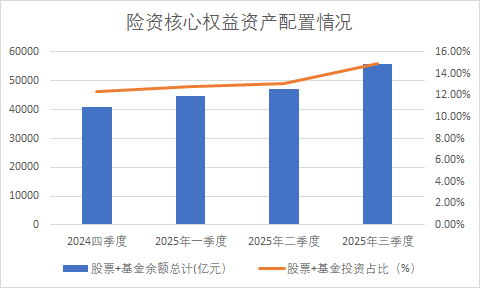
Core Insights - The investment trend of insurance capital is showing a significant increase, with total investment balance reaching 37.46 trillion yuan by the end of Q3 2025, up 3.39% from 36.23 trillion yuan at the end of Q2 2025 [1] - The proportion of equity investments in the overall asset allocation has risen, with the total balance of investments in stocks and securities investment funds reaching 5.593 trillion yuan, accounting for 14.93% of the total investment balance, an increase of 1.88 percentage points from 13.05% at the end of Q2 2025 [3] - The number of equity stakes taken by insurance capital has reached a new high, with 31 instances recorded this year, surpassing the previous peak in 2020 and marking the highest since records began in 2015 [6] Investment Allocation - By the end of Q3 2025, life insurance companies held 33.73 trillion yuan of the total investment, while property insurance companies contributed 2.39 trillion yuan [4] - Life insurance companies' investments in stocks and securities investment funds amounted to approximately 5.19 trillion yuan, representing 15.38% of their total investment balance, an increase of 2.04 percentage points from 13.34% at the end of Q2 2025 [4] - Property insurance companies invested 405 billion yuan in stocks and securities investment funds, accounting for 16.97% of their total investment balance, an increase of 0.81 percentage points from Q2 2025 [6] Market Dynamics - The decline in bond investment proportion is notable, with bonds accounting for 48.52% of total investments, down from 49.31% at the end of Q2 2025 [3] - The proportion of bank deposits in property insurance companies decreased from 17.24% at the end of Q2 2025 to 15.67% at the end of Q3 2025, while life insurance companies' bank deposit proportion fell from 8.02% to 7.37% in the same period [8] - The shift towards equity investments is driven by regulatory encouragement to increase allocations in high-dividend, low-volatility equity assets, as well as changes in accounting rules that facilitate equity investment [8]

险资万亿布局,稳守银行股
Huan Qiu Wang· 2025-11-17 07:37
Core Viewpoint - Insurance funds have shown strong market entry momentum in the first three quarters of 2025, with a significant increase in stock holdings and a proactive asset allocation strategy in the current market environment [1][2]. Group 1: Insurance Fund Performance - By the end of Q3, the book balance of stocks held by insurance funds surged by 1.19 trillion yuan compared to the end of last year, marking an increase of nearly 50%, reaching 3.62 trillion yuan [1]. - When including securities investment funds, the core equity asset scale has approached 5.6 trillion yuan, reflecting a growth of approximately 1.5 trillion yuan since the beginning of the year [1]. - In Q3 alone, the core equity asset scale increased by 864 billion yuan, with stocks contributing 552.4 billion yuan to this growth [1]. Group 2: Factors Driving Increased Holdings - Multiple factors are driving the recent significant increase in insurance fund holdings, including favorable policy guidance, the need for stable returns in a low-interest-rate environment, and the positive trend in the capital market, particularly the "slow bull" market in A-shares [2]. Group 3: Investment Preferences - Insurance funds have a clear investment path, with bank stocks being a major focus, accounting for 51.92% of the total market value of nearly 640 billion yuan in heavy holdings [4]. - In addition to traditional defensive sectors, insurance funds have also increased holdings in cyclical and consumer sectors such as steel, telecommunications, agriculture, and food and beverage [4]. - The investment strategy reflects a "dividend stocks + growth stocks" approach, with a broad coverage in sectors like electronics, pharmaceuticals, power equipment, machinery, and automobiles [4]. Group 4: Stock Selection Strategy - Insurance funds prioritize high-dividend stocks with stable earnings as a "ballast" in their portfolios to fill the net investment income gap in a low-interest-rate environment, while also selecting quality growth companies in emerging industries for excess returns [5]. - There are differences in stock selection preferences between life insurance and property insurance companies, with life insurers favoring low price-to-book ratio, high-dividend large-cap stocks, while property insurers tend to prefer higher price-to-earnings ratios and lower dividend yields [5]. - Equity investment has become a decisive factor in the profitability of insurance companies, with expectations for improved A-share market conditions to enhance the investment ecosystem for insurance funds [5].
加仓!险资前三季度股票余额增万亿 重仓了这些行业
Di Yi Cai Jing· 2025-11-16 21:26
今年前三季度,险资投资的一大重点就是加仓股票。 第一财经记者根据金融监管总局最新发布的2025年三季度保险公司资金运用情况表(下称"资金运用情 况表")梳理,三季度末,保险资金运用余额达到37.46万亿元,其中股票的账面余额为3.62万亿元。这 一数字较去年末增加了1.19万亿元,增幅近五成;其中第三季度增加5524亿元。 如果加上证券投资基金,则截至三季度末险资配置的核心权益资产近5.6万亿元,较去年末增加近1.5万 亿元,其中第三季度单季增加值为8640亿元。 从Choice显示的险资三季度重仓股来看,银行股依然是险资的"心头好",不仅三季度末持仓市值占比超 一半,且第三季度险资增持股数也在所有重仓股中排名首位。在银行股外,据业内分析师统计,钢铁、 通信、食品饮料等行业在三季度获险资重点增持,而电力设备、有色金属、交通运输等则环比减持。 从去年末到今年三季度末,险资配置的股票余额一路上涨。资金运用情况表数据显示,今年三季度末险 资(指产险、寿险公司,下同)持有股票的账面余额为3.62万亿元,较去年末的2.43万亿元大幅增加了 1.19万亿元,涨幅高达49.14%,在资金运用余额中的占比也从去年末的7.30 ...
37万亿险资下半年投向哪
Bei Jing Shang Bao· 2025-11-16 15:40
Core Insights - Insurance capital is reshaping its investment strategy, with a notable shift from traditional fixed-income assets to equities as companies seek higher returns in a low-interest-rate environment [1][4]. Group 1: Investment Trends - As of the end of Q3, the total investment balance of insurance companies reached 37.46 trillion yuan, marking a 12.6% increase from the beginning of the year [3]. - The proportion of bond investments has slightly decreased, with life insurance companies reducing their bond investment ratio from 51.9% in Q2 to 51.02% in Q3 [3][5]. - Bank deposits have also seen a decline, with property insurance companies' bank deposit ratio dropping from 17.24% in Q2 to 15.67% in Q3, and life insurance companies' from 8.02% to 7.37% [3]. Group 2: Equity Investments - Life insurance companies' stock investment ratio reached 10.12% by the end of Q3, an increase of 1.31 percentage points from Q2, while property insurance companies' stock investment balance grew to 8.74%, up by 0.41 percentage points [5][6]. - The total stock investment by both types of companies amounted to 3.6 trillion yuan, reflecting a strategic shift towards equities to address asset scarcity and mitigate interest rate risks [5][6]. Group 3: Regulatory Environment - Recent regulatory changes have encouraged insurance companies to increase their equity investments, including a 5% increase in the equity asset ratio for certain solvency levels and a 10% reduction in risk factors for stock investments [6]. - The overall asset allocation is expected to maintain a "fixed income as the mainstay, equity as a supplement" structure, but the gradual increase in equity proportion is seen as a long-term trend [7].