
消费者知情权

Search documents
为罗永浩鼓掌,但也给他提个醒
第一财经· 2025-09-14 03:42
Core Viewpoint - The article discusses the public debate initiated by internet influencer Luo Yonghao regarding the sale of pre-prepared dishes by the restaurant brand Xibei, emphasizing the need for consumer awareness and transparency in the food industry [3][4]. Group 1: Consumer Rights and Industry Standards - The public's core demands are twofold: ensuring consumer rights to know about pre-prepared dishes and establishing clear national standards for such products [3][4]. - The discussion around food quality, pricing, and consumer rights has gained traction, indicating a positive outcome from the debate [3]. Group 2: Industry Response and Public Sentiment - There is a clear divide in public opinion, with consumers largely supporting Luo Yonghao while restaurant owners tend to defend Xibei, highlighting a conflict between industry standards and consumer demands [4][5]. - The backlash against Xibei suggests that supporting the restaurant may be seen as opposing consumer interests, which poses risks for restaurant owners [4]. Group 3: Luo Yonghao's Influence and Controversy - Luo Yonghao's history of public disputes with major brands has contributed to his rising popularity, but it raises questions about his motivations and the timing of his statements [5][6]. - Initial comments made by Luo regarding Xibei's dishes were criticized for being overly negative and potentially misleading, leading to a shift in his narrative towards advocating for transparency rather than outright condemnation of pre-prepared dishes [6][7]. Group 4: Legal and Ethical Considerations - Legal experts suggest that Luo's initial statements could be seen as defamatory, indicating potential legal repercussions for his comments [7]. - The impact of Luo's statements has led to significant revenue declines for Xibei and other businesses in the pre-prepared food supply chain, raising concerns about the responsibility of public figures in their communications [7][8]. Group 5: Responsibility of Public Figures - The article emphasizes the importance of public figures being cautious with their influence, as their words can have significant societal impacts [8][9]. - The need for accountability in public discourse is highlighted, suggesting that influential individuals should be mindful of their statements to avoid negative consequences for businesses and consumers alike [9].


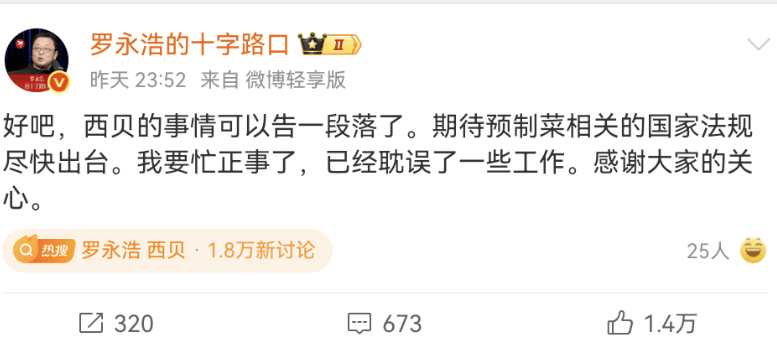
罗永浩:西贝预制菜事件告一段落
Sou Hu Cai Jing· 2025-09-14 03:10
Core Viewpoint - The incident involving pre-made dishes at Xibei has reached a temporary conclusion, with expectations for national regulations on pre-made dishes to be established soon [1][4]. Group 1: Company Actions and Reactions - Luo Yonghao has publicly criticized Xibei for using pre-made dishes, which has sparked significant public discussion [4]. - Xibei's founder, Jia Guolong, announced intentions to sue Luo Yonghao and introduced a "Luo Yonghao Menu" to emphasize that Xibei does not use pre-made dishes, while also allowing kitchen inspections [4]. - Despite Xibei's claims, media investigations revealed that many ingredients used are frozen or refrigerated, with some items, like broccoli in children's meals, having a shelf life of up to 24 months, leading to dissatisfaction among parents [4]. Group 2: Consumer Rights and Regulatory Developments - An article by Xinhua News Agency highlighted consumer concerns regarding the right to know, criticizing businesses that misrepresent pre-made dishes as freshly prepared while charging premium prices [4]. - The article called for the establishment of a disclosure system for pre-made dishes to protect consumer rights, with legal experts suggesting that restaurants should label the use of pre-made dishes in dining areas and provide complaint channels for consumers [4]. - Following the Xinhua article's stance and the impending announcement of national standards for pre-made dishes, Luo Yonghao declared a unilateral ceasefire, while Jia Guolong remained silent [4].
预制菜,又摊上事了
Sou Hu Cai Jing· 2025-09-13 11:00
Core Viewpoint - The ongoing dispute between Luo Yonghao and Xibei over the definition and use of prepared dishes has escalated, drawing significant public attention and impacting Xibei's business [1][3][4]. Group 1: Company Responses - Luo Yonghao initiated the controversy with a social media post, leading to Xibei's founder, Jia Guolong, announcing plans to sue him for defamation [1][3]. - Jia Guolong emphasized that Xibei does not use prepared dishes but rather "pre-processed ingredients," aiming to clarify the company's position [2][4]. - Following the backlash, Xibei opened its kitchen for media visits and shared its cooking processes to demonstrate transparency [4][7]. Group 2: Financial Impact - The controversy has reportedly led to a significant decline in Xibei's revenue, with a loss of over 2 million yuan in a single day [3]. - Jia Guolong acknowledged that the pricing strategy of Xibei has faced criticism, admitting past mistakes that contributed to the perception of Xibei as expensive [12][16]. Group 3: Industry Context - The debate centers around the definition of "prepared dishes," with many consumers equating any non-cooked meal as prepared, despite regulatory definitions differing [4][10]. - The prevalence of prepared dishes in the restaurant industry is increasing, with many chains reportedly using them to streamline operations and maintain consistency [24]. - Luo Yonghao's comments highlighted the need for transparency in the prepared dish industry, advocating for consumer awareness regarding food sourcing and preparation methods [27][30]. Group 4: Consumer Sentiment - Consumer trust is a critical issue, with many willing to accept higher prices if they believe the quality justifies the cost [13][16]. - The public's perception of Xibei's pricing and quality has been a longstanding topic of discussion, with many consumers expressing dissatisfaction with the value offered [10][12]. - The relationship between consumers and restaurants is complex, with transparency and quality being key factors in maintaining trust [20][34].
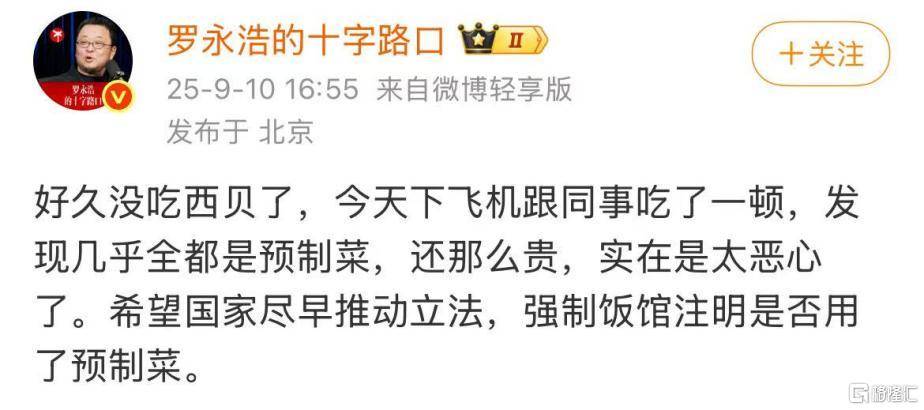
西贝营业额大降,于东来力挺西贝视频已不可见
Zheng Quan Shi Bao· 2025-09-13 10:28
Core Viewpoint - The ongoing dispute between Luo Yonghao and the restaurant chain Xibei regarding the use of "pre-prepared dishes" has led to significant financial repercussions for Xibei, with reported daily revenue losses of 1 million yuan on September 10 and 11, and an expected decrease of 2 to 3 million yuan starting September 12 [1][2]. Group 1: Financial Impact - Xibei's revenue has been adversely affected, with a direct loss of 1 million yuan per day on September 10 and 11, and an anticipated loss of 2 to 3 million yuan per day from September 12 onwards [1]. - The controversy has resulted in a noticeable decline in customer traffic for Xibei, indicating a broader impact on the brand's reputation and financial health [1]. Group 2: Industry Reactions - Several prominent figures in the restaurant industry have publicly supported Xibei, emphasizing the challenges faced by businesses and the importance of constructive criticism rather than damaging accusations [2]. - Luo Yonghao has expressed concerns about the potential harm to Xibei and the restaurant industry as a whole, advocating for legislative measures to ensure transparency in the use of pre-prepared dishes [2]. Group 3: Legal and Regulatory Aspects - Legal opinions suggest that Xibei's use of certain ingredients may classify them as pre-prepared dishes under current regulations, raising questions about the company's marketing claims [3]. - A draft national standard for food safety regarding pre-prepared dishes is set to be publicly reviewed, which could lead to clearer definitions and regulations for the industry [3][4]. Group 4: Consumer Awareness - Luo Yonghao has emphasized the need for transparency in the restaurant industry, asserting that consumers have the right to know whether pre-prepared dishes are used [4]. - The discussion highlights a growing demand for clarity and honesty in food sourcing and preparation, as consumers increasingly seek fresh and authentic dining experiences [5].
刷屏!罗永浩:太好了,万众期待!!西贝营业额大降,于东来力挺西贝视频已不可见,抖音账号已私密!
证券时报· 2025-09-13 10:01
Core Viewpoint - The ongoing debate between Luo Yonghao and the restaurant chain Xibei regarding "pre-made dishes" has highlighted significant issues in the restaurant industry, particularly concerning transparency and consumer rights [1][10]. Group 1: Impact on Xibei - Luo Yonghao's claim about Xibei serving pre-made dishes has led to a noticeable decline in Xibei's business, with daily revenue dropping by 1 million yuan on September 10 and 11, and an expected decrease of 2 to 3 million yuan starting September 12 [2]. - Xibei's CEO, Jia Guolong, emphasized that the restaurant does not serve any pre-made dishes and expressed the urgency of addressing the situation to mitigate further damage [2][6]. Group 2: Industry Reactions - Many prominent figures in the restaurant industry have publicly supported Xibei, indicating a divide between public opinion and industry sentiment [7]. - Yu Donglai, the owner of a well-known restaurant, expressed gratitude for Xibei and similar brands, highlighting the challenges faced by entrepreneurs and the importance of constructive criticism rather than condemnation [7]. Group 3: Legal and Regulatory Developments - A draft national standard for pre-made dishes, led by the National Health Commission, has passed expert review and will soon seek public opinion, marking a significant step towards regulatory clarity in the industry [8][9]. - The new standards will require restaurants to disclose their use of pre-made dishes, transitioning the industry from unregulated growth to a more compliant framework [10]. Group 4: Luo Yonghao's Position - Luo Yonghao clarified his stance on pre-made dishes, stating he does not oppose them but advocates for transparency regarding their use in restaurants [10]. - During a live broadcast, he criticized Xibei's claims of not using pre-made dishes, arguing that the lack of national standards does not justify misleading consumers about the freshness of ingredients [10][11].

壹快评丨消费者不仅需要吃得放心,而且需要吃得明白
Di Yi Cai Jing· 2025-09-13 05:40
西贝事件折射保障消费者对菜品的知情权十分重要。 你愿意让自己的孩子去餐厅吃保质期24个月的有机速冻西蓝花吗? 近日,网红企业家罗永浩指责餐饮品牌西贝部分菜是预制菜且贵,希望国家尽早推动立法,强制饭馆注 明是否用了预制菜,保障消费者知情权。而西贝创始人贾国龙则回应称西贝没有一道菜是预制菜。 中国预制菜行业的发展已超20年,且体量还在不断扩大。消费者对预制菜风味、营养和安全存在诸多质 疑,目前国标缺失也加剧了这一质疑,此前一些小学生食堂采用预制菜引起家长强烈反弹,而此次人均 消费100元左右的西贝餐食事件,无疑也折射了公众这一方面的担忧。 此次西贝事件中,西贝采用了预制工艺的原料菜品,或用了预制菜,本身并没有问题,问题出在消费者 对此并不知情。因此此次西贝开放后厨是值得称赞的,让消费者能去了解相关菜品的具体原料、制作工 艺等。在获知这些信息之后,消费者会作出自己的选择,比如是否要带孩子吃保质期24个月的有机速冻 西蓝花,即使它是符合食品安全标准的。 无论西贝事件最终结局如何,这无疑是消费者对保障自身舌尖上知情权的一次大觉醒,既能推动预制菜 标准体系建设,并鼓励越来越多的餐饮企业使用预制菜明示,同时,相信也会有越来 ...
一分钟在线人数破10万,罗永浩开直播“爆了”
Mei Ri Jing Ji Xin Wen· 2025-09-12 23:36
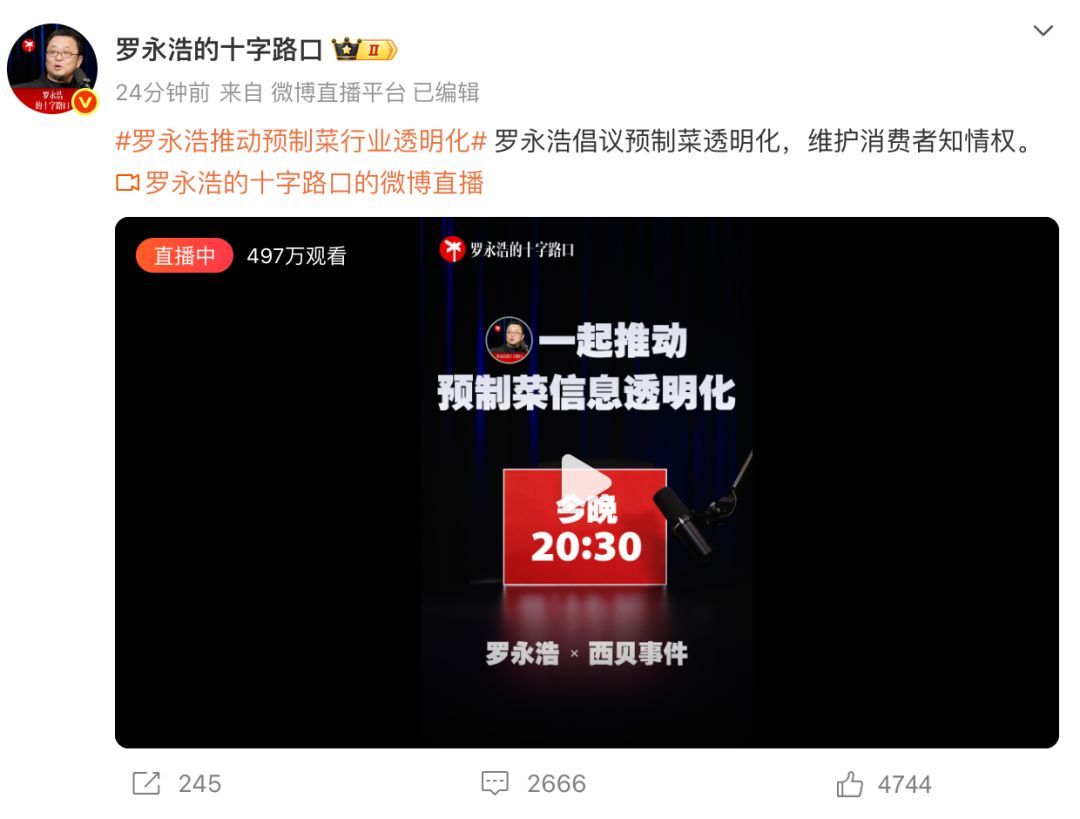
Core Viewpoint - The controversy surrounding the pre-prepared dishes of the restaurant chain "Xibei" has gained significant attention, particularly following a live broadcast by Luo Yonghao, who criticized Xibei's marketing and public relations efforts while advocating for transparency in the pre-prepared food industry [1][4][6]. Group 1: Luo Yonghao's Live Broadcast - Luo Yonghao's live broadcast attracted over 100,000 viewers within the first 10 minutes and nearly 5 million views on Weibo by the end of the session [1]. - He criticized Xibei's public relations team for their lack of professionalism and highlighted the importance of consumer awareness regarding pre-prepared dishes [4]. - Luo emphasized that while he supports the concept of pre-prepared dishes, he opposes selling them at prices equivalent to freshly made meals [4][6]. Group 2: Xibei's Response - In response to Luo's accusations, Xibei issued an open letter claiming that his statements were untrue and provided detailed production processes for 13 dishes to clarify their preparation methods [8]. - Xibei announced plans to allow customers to tour their kitchens and production facilities to enhance transparency and consumer trust [8]. Group 3: Definition and Regulation of Pre-prepared Dishes - The definition of pre-prepared dishes has been clarified by regulatory authorities, stating that they must not contain preservatives and should be pre-processed for safe consumption [11][12]. - The distinction between pre-prepared dishes and pre-processing was emphasized, with the latter referring to the preparation of raw ingredients rather than finished products [12].
罗永浩与西贝的预制菜争议引爆行业,消费者为何“谈虎色变”
Di Yi Cai Jing· 2025-09-12 14:53
Core Viewpoint - The ongoing dispute between entrepreneur Luo Yonghao and the restaurant brand Xibei highlights differing perceptions of "pre-made dishes" and raises questions about consumer rights and industry standards in the pre-made food sector [1][2][5] Group 1: Dispute Overview - Luo Yonghao publicly criticized Xibei for serving pre-made dishes at high prices, emphasizing the importance of consumer awareness regarding the use of pre-made ingredients [2][5] - Xibei's response included a commitment to legal action against Luo and a public disclosure of their food preparation processes, asserting that their dishes are not pre-made but rather pre-processed [2][3] Group 2: Industry Context - The pre-made food industry in China has been developing for over 20 years, primarily known to B-end operators until recent years when consumer awareness increased due to market changes and the pandemic [4][5] - The industry is projected to grow significantly, with estimates suggesting a market size of 5 trillion yuan for B-end and 7 trillion yuan for C-end by 2030, assuming a penetration rate of 15%-20% [4] Group 3: Regulatory Environment - There is currently no national standard for pre-made dishes in China, leading to inconsistencies across regions, although there is a push for clearer labeling to protect consumer rights [4][6][7] - Recent government initiatives aim to promote transparency in the use of pre-made dishes in restaurants, aligning with consumer rights to know the nature of the food they purchase [6][7] Group 4: Consumer Perception and Safety - Consumers often conflate pre-prepared ingredients with pre-made dishes, leading to misunderstandings about what constitutes pre-made food [8][9] - The central kitchen model is increasingly adopted in the restaurant industry, enhancing food safety through standardized production and centralized sourcing, which helps mitigate risks associated with traditional kitchen operations [9]
西贝否认删博,罗永浩最新发声
Sou Hu Cai Jing· 2025-09-12 14:23
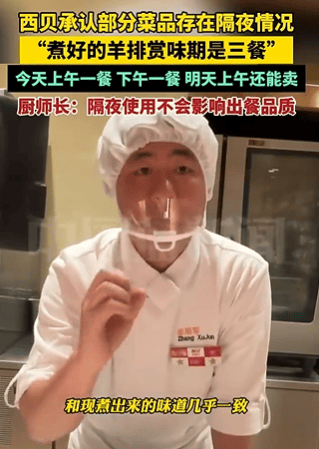
Core Viewpoint - The controversy surrounding the restaurant chain Xibei and its use of overnight dishes has sparked significant public debate, particularly following comments made by public figure Luo Yonghao regarding the quality and preparation of the food served [2][5][8]. Group 1: Company Response - Xibei acknowledged that some dishes may be prepared in advance and served the next day, asserting that this practice does not compromise food quality [2][5]. - Following Luo Yonghao's criticisms, Xibei released a detailed letter to customers, defending its practices and providing a 42-page document outlining the preparation processes for the dishes in question [5][8]. - Xibei's founder, Jia Guolong, stated that none of the dishes served in their restaurants are classified as pre-prepared meals, and the company plans to open its kitchens to the public for transparency [10][27]. Group 2: Public and Legal Reactions - Luo Yonghao's comments led to a backlash, with legal experts suggesting that if he can substantiate his claims about Xibei's use of pre-prepared meals, it may not constitute defamation [9][10]. - The public has expressed confusion over the definition of pre-prepared meals, with some consumers concerned about the quality and pricing of such dishes [11][13]. - The controversy has highlighted a broader issue regarding consumer rights and the need for transparency in the food industry, particularly concerning the use of pre-prepared ingredients [28][29]. Group 3: Industry Context - The definition of pre-prepared meals was officially established in March 2024 by six government departments, clarifying what constitutes such meals and emphasizing the importance of food safety [16][17]. - The industry is facing challenges related to public perception of pre-prepared meals, with many consumers associating them with lower quality despite their potential benefits in terms of efficiency and safety [15][28]. - The ongoing debate reflects a growing demand for transparency in the food service industry, as consumers increasingly seek to understand the origins and preparation methods of their meals [29].
罗永浩承认直播间卖过预制菜:预制菜就是另一种罐头,但不透明消费者受不了
Xin Lang Ke Ji· 2025-09-12 13:17
Core Viewpoint - The discussion centers around the transparency issues related to pre-prepared meals in China, with a focus on consumer rights and the recent controversy involving Luo Yonghao and Xibei [1]. Group 1 - Luo Yonghao conducted a live stream discussing pre-prepared meals, emphasizing that his platform has been transparent about selling them [1]. - He stated that pre-prepared meals are a legitimate product, comparing them to canned food, and highlighted the ongoing consumer frustration regarding the lack of transparency in the industry [1]. - Luo expressed a desire to protect consumer rights, particularly the right to be informed about the products they purchase [1].