
税制改革

Search documents
哈政府向议会提交国家预算草案和发展预测
Shang Wu Bu Wang Zhan· 2025-09-11 15:46
Core Viewpoint - The government of Kazakhstan has approved and submitted a three-year socio-economic development forecast and national budget draft to the parliament, projecting an average annual real GDP growth rate of 5.3% over the next three years [1] Economic Projections - Nominal GDP is expected to increase from 183.8 trillion tenge in 2026 to 229.8 trillion tenge in 2028, equivalent to 42.56 billion USD [1] - The budget deficit is projected to be 2.5% of GDP in 2026, decreasing to 1.7% in 2027 and 0.9% in 2028 [1] Tax and Spending Reforms - Tax reform is anticipated to boost the proportion of spending that stimulates economic growth from 10.9% to 16.1%, providing essential infrastructure and financial support for business development [1] - The government emphasizes maintaining a socially-oriented budget in accordance with presidential directives to ensure the fulfillment of social obligations [1]
特朗普关税战,印度股市成了最大输家?
Hua Er Jie Jian Wen· 2025-08-21 07:47
Core Viewpoint - The article highlights the significant impact of escalating trade tensions, particularly the threat of a 50% tariff from the U.S., on India's economic growth and corporate profitability, marking India as one of the most affected players in the ongoing trade disputes [1]. Group 1: Economic Impact - Analysts have downgraded earnings forecasts for Indian companies, with a 1.2% reduction in projected earnings over the next 12 months, the largest decline in Asia [1]. - If the U.S. continues to impose a 50% tariff on Indian goods, it could lead to a 1 percentage point decrease in India's GDP growth rate, particularly affecting labor-intensive sectors like textiles [2]. - The Indian stock market's status has dramatically shifted from being the most favored in Asia to the least favored within just two months [1]. Group 2: Corporate Profitability - Indian corporate earnings growth has remained in single digits for five consecutive quarters, significantly below the expected growth range of 15%-25% from 2020-21 to 2023-24 [3]. - The latest earnings forecast downgrades are a direct response to disappointing financial results for the April to June quarter [3]. - Key sectors such as automotive, capital goods, food and beverages, and durable consumer goods have seen net profit forecasts reduced by 1% or more [4]. Group 3: Government Response - In response to trade pressures, the Indian government is considering a major tax reform aimed at stimulating domestic demand by simplifying the Goods and Services Tax (GST) structure [4]. - The proposed tax reform could contribute an estimated 0.35-0.45 percentage points to GDP growth by the fiscal year 2027 [5]. - Despite a projected average GDP growth of 8.8% for the fiscal years 2022-2024, the ongoing trade tensions pose significant challenges to this growth outlook [5].
盛松成等:通过税制改革提高地方政府促消费的积极性 | 宏观经济
清华金融评论· 2025-08-19 09:06
Core Viewpoint - The article emphasizes the importance of boosting consumption as a primary task for expanding domestic demand, highlighting the need for reform in the current tax system to incentivize local governments to promote consumption effectively [2][3][4]. Group 1: Current Challenges - Local governments face significant financial constraints due to accumulated debt and a downturn in the real estate market, which hampers their enthusiasm for promoting consumption [3][4]. - The existing value-added tax (VAT) and consumption tax systems primarily based on the production location create a misalignment between tax revenue and consumption potential, limiting the release of consumption capacity [2][7]. Group 2: Tax Revenue Structure - In 2024, China's total tax revenue is projected to be 17.5 trillion yuan, with VAT contributing 6.67 trillion yuan (38%) and consumption tax contributing 1.65 trillion yuan (9%) [4]. - VAT is the largest contributor to local tax revenue, shared equally between central and local governments, while the consumption tax is expected to become a new source of incremental revenue for local governments as reforms progress [4][5]. Group 3: Recommendations for Reform - The article suggests reforming the VAT distribution mechanism to focus more on the consumption location, enhancing the precision of transfer payments to local governments [5][12]. - It advocates for accelerating the shift of consumption tax collection to the retail stage, promoting the development of emerging consumption sectors such as green, smart, and health-related industries [5][12]. Group 4: International Experience - The article draws lessons from international practices, particularly the EU's shift from a production-based to a consumption-based VAT system, which was driven by the need for a unified market and the evolution of cross-border trade [10][11]. - The U.S. sales tax system, which relies on state-level taxation and does not have a unified VAT, provides insights into how differentiated tax rates can guide consumer behavior and link tax revenues to public services [13][14]. Group 5: Enhancing Local Government Incentives - To improve local government incentives for promoting consumption, the article recommends optimizing the VAT distribution mechanism to ensure more accurate compensation for consumption areas [16][17]. - It also suggests adjusting consumption tax rates to encourage healthy and environmentally friendly consumption, while considering transitional measures to balance local interests during the reform process [17][18].

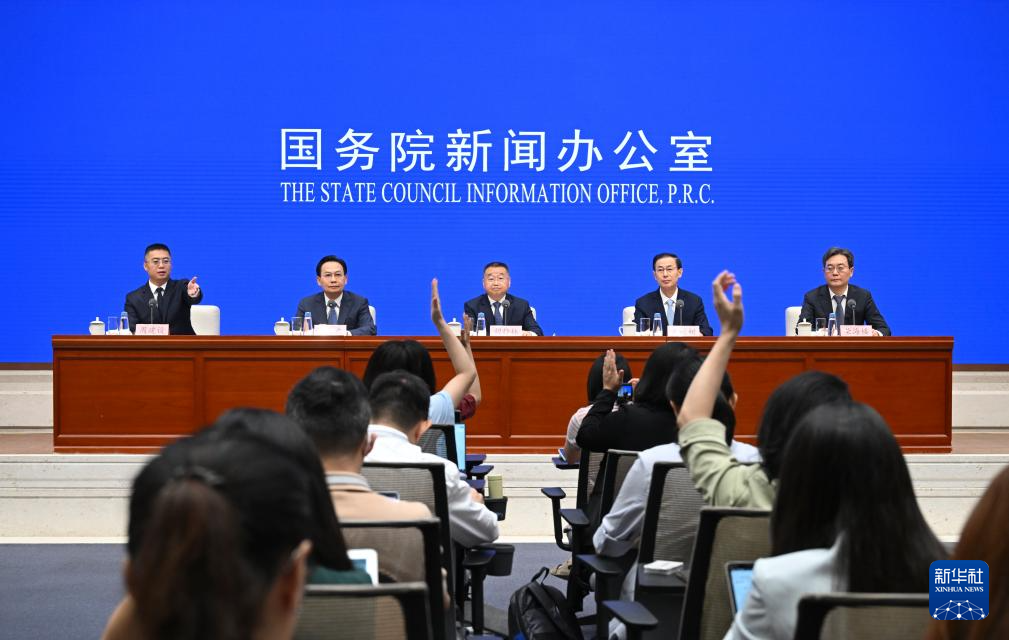
高质量完成“十四五”规划丨“十四五”期间经济增长带动税费征收累计将超155万亿元
Xin Hua Wang· 2025-08-12 06:10
Core Insights - The National Taxation Administration revealed that during the "14th Five-Year Plan" period, tax revenue is expected to exceed 155 trillion yuan, accounting for approximately 80% of total fiscal revenue [2] - A series of tax reduction and fee reduction policies have been implemented, with an estimated total of 10.5 trillion yuan in new tax reductions and fee reductions, and export tax rebates expected to exceed 9 trillion yuan [4] - The tax system reform and tax reductions have significantly supported the improvement of people's livelihoods, with personal income tax reductions increasing from 116 billion yuan in 2020 to nearly 300 billion yuan this year [4] Tax Revenue and Economic Growth - Tax revenue during the "14th Five-Year Plan" is projected to exceed 85 trillion yuan, with social insurance fees and land transfer fees expected to exceed 70 trillion yuan [2] - As of June 2023, the number of tax-related business entities has surpassed 100 million, reflecting strong market vitality and resilience [4] Tax Compliance and Enforcement - A new tax enforcement system has been established, focusing on risk management and accountability, with 62,100 tax law violations investigated, recovering 571 billion yuan in tax losses [5] - The awareness of tax law and the importance of maintaining legal fairness have significantly increased across society [5]
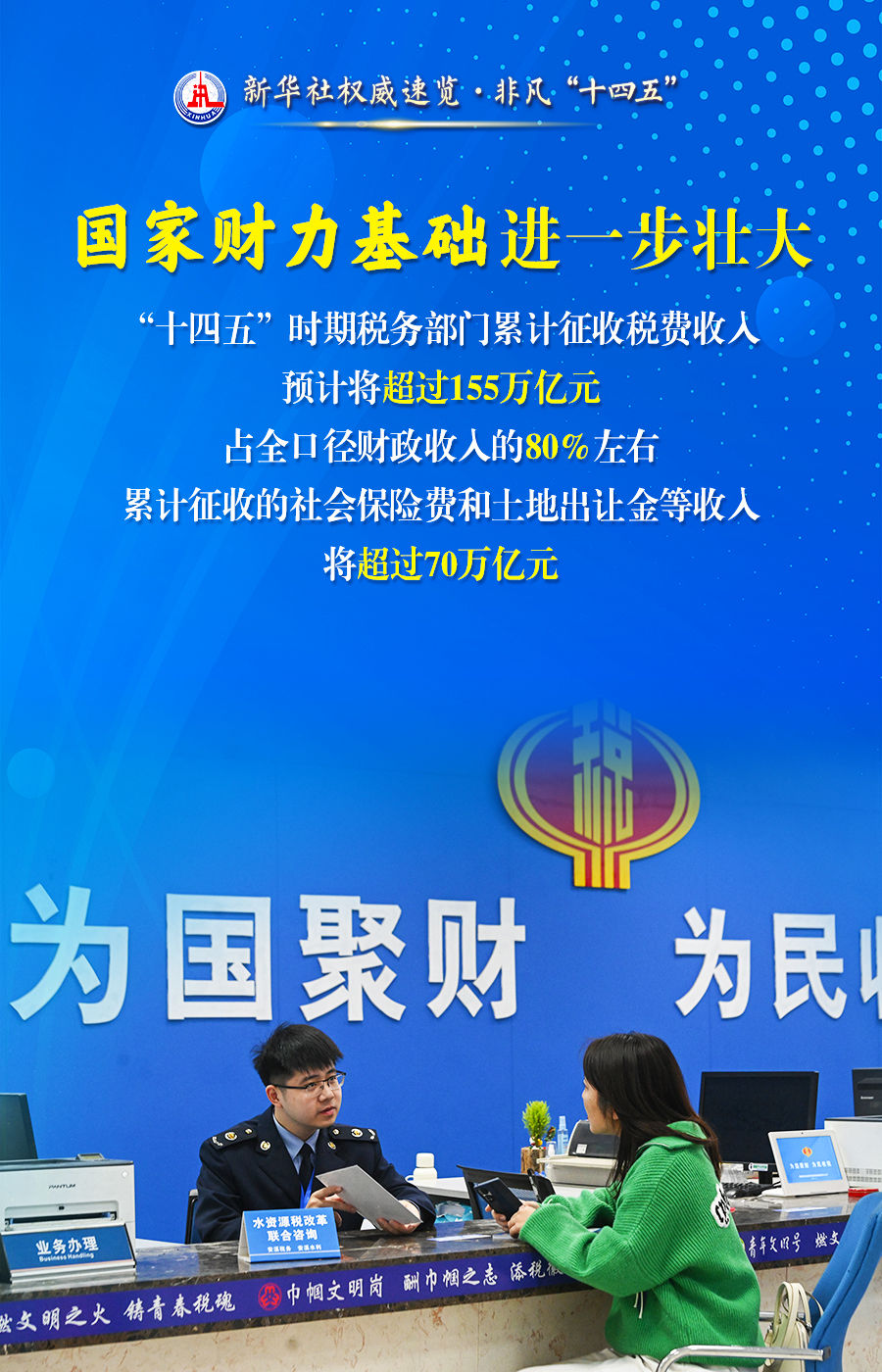
新华社权威速览·非凡“十四五”丨这些数据,读懂税收改革发展成果
Xin Hua Wang· 2025-08-12 06:10
Group 1 - The core viewpoint is that during the "14th Five-Year Plan" period, China's tax reform and development have achieved positive results, enhancing financial strength, economic vitality, and optimizing the business environment [1][5][9] - A cumulative reduction in taxes and fees is expected to reach 10.5 trillion yuan, significantly promoting economic and social improvement [5] - The number of tax-related business entities has surpassed 100 million, with a net increase of 30 million since 2020, indicating strong market vitality and resilience [5] Group 2 - The manufacturing sector's sales revenue accounts for 29% of total sales revenue, while high-tech industries have seen an annual growth rate of 13.9% in sales revenue [7] - The private economy's sales revenue represented 71.7% of total sales revenue in the first half of this year, an increase of 2.8 percentage points compared to 2020 [7] - The number of individuals benefiting from special additional deductions for personal income tax has reached 119 million, with tax reductions increasing from 116 billion yuan in 2020 to nearly 300 billion yuan this year [9] Group 3 - The tax system reform has provided strong support for improving people's livelihoods, with significant reductions in tax filing materials and the ability to handle 97% of tax matters online [11] - The Value-Added Tax Law has been officially issued, and the tax collection and management law is undergoing a comprehensive revision after 24 years [13] - Tax authorities have investigated 62,100 cases of tax violations, recovering 571 billion yuan in various tax losses [13]
固收专题:如何定量测算票息增值税政策对债市的影响
Minsheng Securities· 2025-08-04 12:09
Group 1 - The report highlights the adjustment of the value-added tax policy on interest income from government bonds, which will be reinstated for new issues starting from August 8, 2025, while existing bonds will remain exempt until maturity [1][8][10] - The adjustment aims to enhance the pricing mechanism of the bond market and better establish the benchmark role of government bond rates, reflecting the government's commitment to tax reform and market development [1][10][12] - The current bond market size is reported at 189.76 trillion yuan, with government bonds accounting for 38.02 trillion yuan, local government bonds for 52.51 trillion yuan, and financial bonds for 42.34 trillion yuan [10][12] Group 2 - Public funds will maintain a tax advantage post-policy adjustment, which is expected to increase demand for self-operated and outsourced investments by banks, particularly in government and local bonds [2][12][14] - The effective tax rates post-adjustment are calculated at 3.26% for public funds and 6.34% for bank self-operated investments, necessitating a yield compensation of 4-8 basis points for public funds and 8-15 basis points for banks on newly issued bonds [2][14][24] - The report anticipates that the market will experience short-term fluctuations as investors adjust to the new tax implications, with potential downward pressure on existing bond yields and upward adjustments on new bond coupon rates [3][17][26] Group 3 - The adjustment is expected to influence the pricing of government bond futures, with new issues potentially requiring higher yields to become the cheapest-to-deliver (CTD) bonds [4][26] - The report indicates that the difficulty of new bonds becoming CTD will vary across different futures contracts, with certain contracts being more affected than others [4][26][27] - The analysis includes detailed calculations of the tax implications for various investor types, illustrating the differences in effective tax burdens before and after the policy change [21][22][24]
韩国计划明年取消外国游客医美退税政策
news flash· 2025-08-02 09:50
Core Points - The South Korean government has approved the "2025 Tax Reform Plan" during a meeting of the Tax System Development Review Committee on July 31 [1] - The government will eliminate the tax refund policy for foreign tourists receiving cosmetic surgery services, effective from next year, with the current policy set to expire on December 31 of this year [1] Group 1 - The decision to cancel the tax refund policy is aimed at reforming the tax system and may impact the cosmetic surgery industry, particularly in attracting foreign tourists [1] - The expiration of the current policy indicates a shift in the government's approach to tourism and healthcare services [1]
全国减税降费预计超10万亿元
Jing Ji Wang· 2025-07-31 09:28
Core Insights - The "14th Five-Year Plan" period has seen China's economy achieve stable growth, with total tax revenue expected to exceed 155 trillion yuan, accounting for approximately 80% of total fiscal revenue [1] - A series of tax reduction and fee reduction policies have been implemented, with a cumulative expected reduction of 10.5 trillion yuan, significantly promoting economic and social development [1] - The number of tax-registered entities in China has surpassed 100 million, indicating strong market vitality and resilience [2] Tax Revenue and Reduction - Tax revenue (excluding export tax rebates) is projected to exceed 85 trillion yuan, strengthening the financial foundation for social development and improvement of people's livelihoods [1] - From 2021 to mid-2023, the cumulative tax and fee reductions reached 9.9 trillion yuan, with an expected total of 10.5 trillion yuan by the end of this year, averaging over 2 trillion yuan annually [1] - Policies focused on supporting technological innovation and advanced manufacturing accounted for 3.6 trillion yuan of the total tax reductions, representing 36.7% of the total [1] Beneficiaries of Tax Policies - Private enterprises and individual businesses benefited significantly, with tax reductions for private economic taxpayers amounting to 7.2 trillion yuan, making up 72.9% of the total reductions [1] - Small and medium-sized enterprises received 6.3 trillion yuan in tax reductions, which is 64% of the total [1] Economic Performance Indicators - The manufacturing sector's sales revenue maintained a steady share of about 29% of total sales revenue during the "14th Five-Year Plan" period, with high-tech industry sales revenue growing at an annual rate of 13.9% [2] - The sales revenue of the private economy accounted for 71.7% of total sales revenue in the first half of this year, an increase of 2.8 percentage points compared to 2020 [2] - County-level economic sales and inter-provincial trade sales as a proportion of total sales have increased by 1.5 and 3 percentage points, respectively, since 2020 [2] Support for Innovation and Tax Policy Impact - The number of individuals benefiting from personal income tax deductions increased by 55% compared to the first tax settlement in 2020, with the amount of tax reduction growing by 156.5%, from 116 billion yuan to nearly 300 billion yuan [2] - The R&D expense deduction policy has been continuously optimized, with 3.32 trillion yuan in deductions expected for the 2024 fiscal year, representing a 25.5% increase from 2021 [2]
“十四五”期间 全国减税降费预计超10万亿元
Ren Min Ri Bao Hai Wai Ban· 2025-07-29 23:49
Core Insights - The "14th Five-Year Plan" period has seen China's economy achieve stable growth, with total tax revenue expected to exceed 155 trillion yuan, accounting for approximately 80% of total fiscal revenue [1] - A series of tax reduction and fee reduction policies have been implemented, with a cumulative reduction expected to reach 10.5 trillion yuan, significantly promoting economic and social development [1] Tax Revenue and Reduction - Tax revenue (excluding export tax rebates) is projected to exceed 85 trillion yuan, strengthening the financial foundation for social development and improvement of people's livelihoods [1] - From 2021 to mid-2023, the cumulative tax and fee reductions reached 9.9 trillion yuan, with an expectation to reach 10.5 trillion yuan by the end of this year, averaging over 2 trillion yuan annually [1] Policy Focus and Beneficiaries - The policies are focused on supporting technological innovation and advanced manufacturing, with 3.6 trillion yuan in new tax reductions, accounting for 36.7% of the total [1] - Among various economic entities, private enterprises and individual businesses benefited from 7.2 trillion yuan in tax reductions, making up 72.9% of the total [1] - Small and medium-sized enterprises received 6.3 trillion yuan in tax reductions, representing 64% of the total [1] Market Dynamics - As of mid-2023, the number of tax-registered business entities in China surpassed 100 million, reflecting strong market vitality and resilience [2] - The manufacturing sector's sales revenue maintained a steady share of approximately 29% of total sales revenue during the "14th Five-Year Plan" period, with high-tech industry sales revenue growing at an annual rate of 13.9% [2] Personal Income Tax and R&D Support - The number of individuals benefiting from special additional deductions in personal income tax increased by 55% compared to the first settlement in 2020, with tax reduction amounts growing by 156.5%, from 116 billion yuan to nearly 300 billion yuan [2] - The R&D expense deduction policy has been continuously optimized, with 3.32 trillion yuan in deductions expected for the 2024 fiscal year, benefiting 615,000 entities, representing increases of 25.5% and 16.7% respectively compared to 2021 [2]
“十四五”期间经济增长促使税费征收累计超155万亿元 经济社会发展和民生改善的财力基础不断夯实
Yang Guang Wang· 2025-07-29 00:27
Group 1 - The core viewpoint of the news is that during the "14th Five-Year Plan" period, China's economic growth will lead to a cumulative tax revenue exceeding 155 trillion yuan, strengthening the financial foundation for economic and social development as well as improving people's livelihoods [1][2] - Tax revenue in China is steadily increasing in scale and optimizing in structure, demonstrating a characteristic of "increased quantity and improved quality" [1] - The cumulative new tax cuts and fee reductions during the "14th Five-Year Plan" period are expected to reach 10.5 trillion yuan, with export tax rebates anticipated to exceed 9 trillion yuan [1] Group 2 - Tax system reforms and reductions in taxes and fees provide strong support for improving people's livelihoods, focusing on alleviating the financial burdens of family upbringing and elderly care [2] - Over 1 billion taxpayers applied for tax refunds totaling more than 130 billion yuan, with the majority of beneficiaries being young and middle-aged individuals aged 30 to 55 [2] - By 2024, the World Bank's business environment assessment indicates that the annual tax payment time for companies in China has been reduced by 78.2% compared to the last assessment in 2019, placing China among the leading countries [2]