
绿色贸易

Search documents
优化实施消费品以旧换新政策
Sou Hu Cai Jing· 2026-01-11 23:32
Group 1 - The core focus for 2026 includes implementing eight key areas of work, with a strong emphasis on boosting consumption and creating the "Buy in China" brand [1] - The initiative aims to enhance service consumption, optimize the old-for-new policy for consumer goods, and develop an international consumption environment [1] - The establishment of a modern market and circulation system is crucial for advancing the unified national market, with a focus on retail innovation and integrated domestic and foreign trade [1] Group 2 - The meeting emphasizes promoting trade innovation and establishing the "Export China" brand, with a focus on optimizing goods trade and developing service trade [2] - Efforts to attract foreign investment will include enhancing the "Invest in China" brand and improving the foreign investment service guarantee system [2] - The strategy includes aligning with international high-standard economic and trade rules and enhancing the effectiveness of open platforms, particularly in free trade zones [2]
外贸“基本法”大修 固定改革成果保障高水平对外开放
Zheng Quan Shi Bao Wang· 2026-01-11 23:13
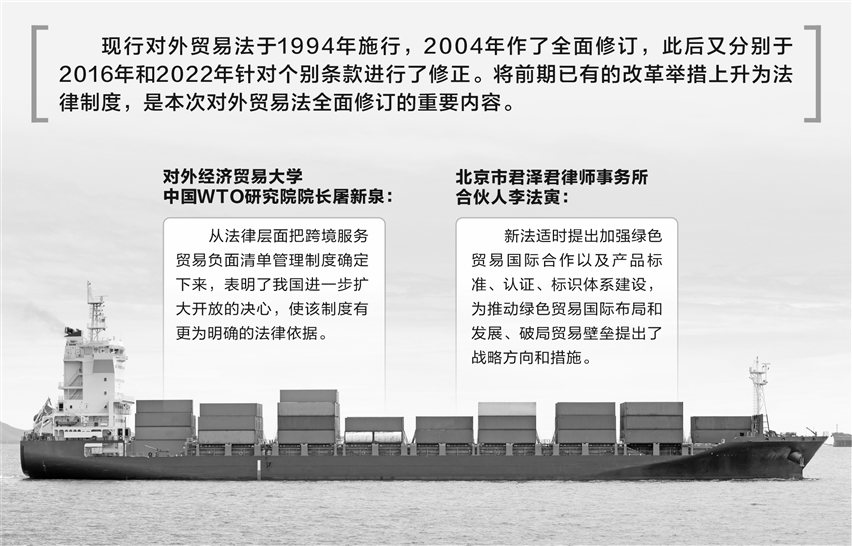
Core Viewpoint - The newly revised Foreign Trade Law of the People's Republic of China will take effect on March 1, 2026, marking a significant overhaul aimed at enhancing the legal framework for foreign trade and expanding high-level openness in the sector [2][3]. Group 1: Legislative Changes - The new law consists of 11 chapters and 83 articles, establishing a negative list management system for cross-border service trade, reflecting China's commitment to opening up international service trade [3][4]. - The law incorporates previous reform measures into a legal framework, enhancing the stability and authority of policies related to cross-border service trade [5]. Group 2: Support for Small and Medium Enterprises - The law explicitly states that the government will support and facilitate small and medium-sized enterprises (SMEs) in engaging in foreign trade, providing conveniences in regulation, financing, and foreign exchange settlement [9]. - It also establishes a trade adjustment assistance system to support enterprises affected by trade remedy measures, enhancing their resilience [9][10]. Group 3: Promotion of Green Trade - The new law emphasizes the establishment of a green trade system, encouraging the export of green low-carbon products and promoting international cooperation in green trade [6][7]. - It aims to address trade barriers related to green products, providing strategic directions for international collaboration and standardization [6][7]. Group 4: Digital Trade and New Business Models - The law recognizes the importance of new business models such as cross-border e-commerce and supports the use of electronic documents and international mutual recognition of digital certificates and signatures [8]. - This legal backing is expected to facilitate the development and transformation of digital trade, ensuring compliance with international standards [8].

全国商务工作会议部署今年八项重点任务 深入实施提振消费行动 推动零售业创新发展
Zheng Quan Shi Bao· 2026-01-11 16:55
Group 1 - The national business conference held on January 10-11 outlined eight key tasks for the national business system by 2026, focusing on consumption, trade innovation, foreign investment, and international economic cooperation [1] - The conference emphasized the implementation of a special action to boost consumption, aiming to create the "Buy in China" brand and enhance service consumption potential [1] - It was highlighted that there will be efforts to optimize the implementation of the old-for-new consumption policy and to develop an international consumption environment [1] Group 2 - The conference called for the promotion of trade innovation, including the launch of the "Export China" brand and the development of service trade and digital trade [2] - There is a focus on enhancing foreign investment attractiveness by expanding service sector openness and improving investment promotion levels [2] - The need for effective management of foreign investments was stressed, including the establishment of a comprehensive overseas service system and deepening cooperation under the Belt and Road Initiative [2]
外贸“基本法”大修,跨境服务贸易纳入负面清单管理
Zheng Quan Shi Bao· 2026-01-11 13:22
Core Viewpoint - The newly revised Foreign Trade Law of the People's Republic of China, effective from March 1, 2026, represents a significant overhaul aimed at enhancing the legal framework for foreign trade, particularly for small and medium-sized enterprises, while also adapting to current international trade dynamics [1][2]. Group 1: Legislative Changes - The new law consists of 11 chapters and 83 articles, establishing a negative list management system for cross-border service trade, reflecting China's commitment to opening up its international service trade [2][4]. - The law elevates previously successful reform measures to a legal status, including the removal of the requirement for foreign trade operators to register, which simplifies procedures and enhances convenience [2][3]. Group 2: Support for Trade Development - The law emphasizes the promotion of cross-border financial services and digital trade, including the international recognition of digital certificates and electronic signatures, to enhance the efficiency of foreign trade [6][8]. - It introduces provisions for establishing a green trade system, encouraging the import and export of green low-carbon products, and promoting international cooperation in green trade [6][7]. Group 3: Support for SMEs - The law explicitly states that the government will support and facilitate small and micro enterprises in conducting foreign trade, providing conveniences in regulation, financing, and foreign exchange settlement [9][10]. - It also establishes a trade adjustment assistance system to support enterprises affected by trade remedy measures, enhancing their resilience against international trade challenges [10][11]. Group 4: Risk Management and Policy Stability - The law includes mechanisms for trade policy assessment to respond to changes in the international trade environment, ensuring a proactive approach to trade risks [10][11]. - By formalizing the negative list management for cross-border services, the law aims to increase policy stability and authority, thereby improving the implementation of related policies [4][5].
外贸“基本法”大修,跨境服务贸易纳入负面清单管理
证券时报· 2026-01-11 13:10
Core Viewpoint - The newly revised Foreign Trade Law of the People's Republic of China, effective from March 1, 2026, represents a significant overhaul aimed at enhancing the legal framework for foreign trade, particularly for small and medium-sized enterprises, and reflects China's commitment to high-level openness in international trade [1][3]. Group 1: Legislative Changes - The new law includes 11 chapters and 83 articles, establishing a negative list management system for cross-border service trade, indicating China's open attitude towards international service trade [3][5]. - The law aims to elevate previously successful reform measures to a legal status, enhancing the legal basis for cross-border service trade and ensuring better coordination with other relevant laws [6][4]. Group 2: Support for Trade Development - The law emphasizes the importance of promoting cross-border financial services, supporting digital trade development, and establishing a green trade system, which includes product standards and international cooperation [8][9]. - It recognizes the strategic position of green trade in China's foreign trade development, aiming to reduce global transition costs while enhancing international collaboration on green products [9][10]. Group 3: Support for SMEs - The law specifically supports small and micro enterprises in foreign trade by providing conveniences in regulation, financing, and foreign exchange settlement [12][13]. - It establishes a trade adjustment assistance system to support enterprises affected by trade remedy measures, enhancing their resilience against international trade challenges [13][14]. Group 4: Risk Management and Policy Stability - The law includes provisions for a warning and emergency mechanism to assess trade policies of relevant countries, allowing for timely responses to trade environment changes [14]. - It aims to enhance the stability and authority of policies related to cross-border service trade, ensuring a more transparent and predictable regulatory environment [5][6].

开创合作共赢新局面
Jing Ji Ri Bao· 2026-01-09 22:04
Group 1: Core Perspectives - Expanding high-level opening-up is a strong driving force for promoting high-quality development, as emphasized in the 2025 Central Economic Work Conference [1] - The importance and urgency of expanding high-level opening-up are increasingly prominent as the international economic and trade landscape continues to evolve [1] Group 2: Trade Agreements and Economic Zones - The Regional Comprehensive Economic Partnership (RCEP) has been in effect for four years, significantly benefiting companies like Yunnan Hongta Plastic Co., which enjoyed over 600,000 yuan in tariff reductions by 2025 [2] - China has signed 24 free trade agreements with 31 countries and regions, with trade with free trade partners accounting for approximately 44% of total foreign trade [2] - The Hainan Free Trade Port officially commenced full island closure operations by the end of 2025, resulting in 1,972 new foreign trade registered enterprises in its first week [2] Group 3: Digital Trade Development - The Fourth Global Digital Trade Expo attracted 1,812 participating companies, achieving a total investment and trade intention signing amount exceeding 160 billion yuan [5] - In the first half of 2025, China's digitally deliverable service imports and exports reached 1.5 trillion yuan, while cross-border e-commerce imports and exports hit 1.3 trillion yuan, both setting historical highs [5] Group 4: Green Trade Initiatives - Green trade is becoming a crucial aspect of China's participation in global climate governance, with a focus on industrial greening and low-carbon products [4] - By 2025, China's exports of new energy vehicles and lithium-ion batteries continued to grow, with green products gaining international recognition [4] - The development of green trade is deeply rooted in the national "dual carbon" strategy and green development philosophy [4] Group 5: Belt and Road Initiative - High-quality co-construction of the Belt and Road Initiative is a vital path for expanding high-level opening-up and creating win-win cooperation [7] - In 2025, the China-Europe Railway Express operated 20,022 trains, with a total value exceeding 67.7 billion USD, connecting 128 cities in China and 232 cities in 26 European countries [7] - China has signed 16 free trade agreements with 22 Belt and Road countries, enhancing trade cooperation efficiency [8]
向“新”而聚 开年外贸稳健起步展活力
Shang Hai Zheng Quan Bao· 2026-01-09 18:41
Core Viewpoint - The opening of new foreign trade routes, such as the direct shipping line from Qingdao to Australia, is expected to enhance logistics efficiency and reduce costs for businesses, contributing to the overall vitality of China's foreign trade in 2026 [1][2]. Group 1: New Trade Routes - The first foreign trade route of 2026 from Qingdao to Australia has been launched, significantly shortening shipping times to Brisbane (approximately 20 days) and Sydney (approximately 25 days) [1]. - The new route connects major domestic ports with Australian hubs, enhancing the logistics network and reducing overall logistics costs for businesses [1][2]. - Qingdao Port now has six direct routes to Australia, reinforcing its position as a key international shipping hub in Northeast Asia [2]. Group 2: Logistics Efficiency - The new routes are characterized by "premium" and "fast" features, aiming to improve shipping efficiency and reliability while reducing costs associated with inventory and defaults [3]. - The expansion of premium routes and inland fast lines is focused on creating a highly efficient logistics system that connects manufacturing bases directly to global networks [3]. Group 3: Emergence of New Business Models - The rise of digital trade and other new business models is providing a "soft power" boost to foreign trade, with significant developments in compliance and efficiency in cross-border services [4][5]. - The Hainan Digital Trade Association is actively building channels for digital content distribution in ASEAN, facilitating local partnerships for businesses [5]. Group 4: Policy Support for Trade - A series of policies aimed at promoting high-quality foreign trade have been implemented, providing a stable and transparent environment for businesses [6]. - The revised Foreign Trade Law will establish a negative list management system for cross-border services, legalizing support for new business models, including digital and green trade [6]. Group 5: Future Outlook - Experts predict that in 2026, China's foreign trade will continue to show resilience, driven by market diversification, structural upgrades, digitalization, and deepening institutional openness [7].
成都海关税政建议获采纳 锂电池用再生黑粉关税税率降至3%
Zhong Guo Xin Wen Wang· 2026-01-08 09:21
Group 1 - The import tariff for recycled black powder used in lithium-ion batteries will be reduced from 6.5% to 3%, which is expected to strengthen the recycling industry in Sichuan and promote the development of a green trade for lithium batteries [1][2] - Recycled black powder is derived from retired lithium-ion batteries and contains valuable active components, contributing to the establishment of a comprehensive lifecycle industry cluster for lithium resources [1] - The production capacity of bio-aviation fuel in Sichuan is projected to reach 1 million tons by 2027, with current capacities reported at 385,000 tons by Sichuan Jinshang Environmental Protection Company and 200,000 tons by Sichuan Tianzhou Company [1] Group 2 - The adjustment of the tariff schedule will establish a separate tax code for bio-aviation fuel, marking a significant milestone for the industry and enhancing the efficiency of customs clearance [2] - This new classification will allow for precise tracking of bio-aviation fuel import and export data, facilitating more effective and targeted industry policies [2]
新《对外贸易法》赋能开放新局
Xin Lang Cai Jing· 2026-01-08 03:31
Core Viewpoint - The newly revised Foreign Trade Law, effective from March 1, marks a significant adjustment in China's foreign trade legal framework, aiming to enhance the country's trade management towards a new phase of "safe and controllable + institutional openness" [1] Group 1: Legislative Framework - The core breakthrough of the new Foreign Trade Law is the establishment of a framework that balances "security and openness, innovation and regulation," incorporating national sovereignty, security, and development interests into its objectives [2] - The law aligns with China's transition from a major trading nation to a trading power, emphasizing a top-level logic of "security-development-power" [2] - It adapts to international high-standard trade rules, elevating measures like the negative list management for cross-border service trade to legal status, and addresses emerging fields such as digital and green trade [2] Group 2: Addressing Current Trade Challenges - The revised law directly addresses pain points in current foreign trade, introducing a negative list system for cross-border service trade, which enhances transparency and predictability [3] - It supports international mutual recognition of digital certificates and accelerates the establishment of a green trade system, providing legal support for new business models like cross-border e-commerce [3] - The law enriches the toolkit for external struggles, allowing trade restrictions against foreign entities that threaten national sovereignty, and strengthens trade control during wartime and emergencies [3] Group 3: Impact on Trade Development - The implementation of the new law is expected to stabilize market expectations and shift foreign trade from "scale expansion" to "quality improvement," particularly benefiting small and medium-sized enterprises [4] - The establishment of a trade adjustment assistance system reflects a governance philosophy focused on development for the people, helping to mitigate the impact of trade environment changes on specific industries and groups [4] - The revision signals China's proactive alignment with international high-standard trade rules, enhancing its voice and credibility in global economic governance [4]
助力服务贸易迈入制度型开放新阶段
Xin Lang Cai Jing· 2026-01-08 03:30
Core Viewpoint - The new Foreign Trade Law systematically upgrades international service trade by establishing a negative list management system for cross-border service trade, providing legal support for emerging fields such as digital trade and finance [1][2] Group 1: Legal Framework and Implementation - The new law incorporates the negative list management system for cross-border service trade, marking a significant step in China's institutional opening in the service trade sector [1][3] - This legal framework aligns with international high-standard trade rules, such as the Comprehensive and Progressive Agreement for Trans-Pacific Partnership (CPTPP) and the Digital Economy Partnership Agreement (DEPA) [1] - The law reflects China's commitment to fulfilling obligations under the Regional Comprehensive Economic Partnership (RCEP), transitioning from a positive list to a negative list management model for service trade [2] Group 2: Focus on Cross-Border Service Trade - The negative list in the new law specifically targets cross-border service trade, applying uniformly to both foreign and domestic enterprises, thus creating a unified regulatory framework [2][3] - The law signifies a shift from an "element flow type" to a "rules and system type" in service trade, enhancing the legal certainty and operational scope for businesses [3] Group 3: Support for Digital and Green Trade - Digital trade and green trade are explicitly included in the legal framework, with the law supporting the development of new business models such as cross-border e-commerce and overseas warehouses [3][4] - The law mandates the establishment of corresponding rule systems for digital trade and green trade, promoting international recognition of digital certificates and electronic signatures [3][4] Group 4: Compliance and Regulatory Requirements - The new law emphasizes compliance through "full-chain supervision," requiring businesses to adhere to strict regulations regarding cross-border service trade activities [5] - Companies must ensure compliance with data security and intellectual property regulations, as the law outlines specific obligations related to data protection and the handling of intellectual property rights [5]