
资产配置多元化

Search documents
多家机构预期2026年美元资产吸引力减弱 金价继续上涨
Xin Hua Wang· 2025-12-25 06:38
Group 1 - Multiple international financial institutions predict a continued trend of using gold to hedge against risks associated with dollar-denominated assets, with gold prices expected to rise further by 2026 [1] - Schroders analyst Patrick Brenner highlights that the U.S. is facing "policy uncertainty, fiscal fragility, and increasing investor doubts about the long-term role of U.S. Treasuries and the dollar," making gold a preferred choice for asset diversification due to its safe-haven properties and low correlation with traditional assets [1] - Goldman Sachs forecasts that gold prices will reach approximately $4,900 per ounce by the end of 2026, driven by strong structural demand from central bank purchases and cyclical support from potential Federal Reserve rate cuts [1] - JPMorgan anticipates that gold prices could rise to $5,055 per ounce by Q4 2026, with the possibility of further increases to $6,000 per ounce, indicating a clear long-term trend of gold allocation by official reserves and investors [1] - Forbes notes that global trade tensions initiated by the U.S., the rise of "de-dollarization" transactions to avoid dollar depreciation, increased demand for gold from private investors and cryptocurrency funds, and ongoing central bank purchases are significant drivers for the upward movement of gold prices [1] Group 2 - The U.S. dollar index has declined by 9% since the beginning of 2025, potentially marking its worst annual performance in eight years [2] - The market widely expects that the new Federal Reserve chairman may lean towards a dovish monetary policy stance, which could further weaken the dollar and reduce the attractiveness of dollar-denominated assets for investors [2]
多家机构预期2026年黄金价格或进一步上涨
Xin Hua She· 2025-12-25 06:37
Group 1 - Multiple international financial institutions predict a continued trend of using gold to hedge against risks associated with dollar-denominated assets, with gold prices expected to rise further by 2026 [1] - Schroders analyst Patrick Brenner highlights that the U.S. is facing "policy uncertainty, fiscal fragility, and increasing investor doubts about the long-term role of U.S. Treasury and the dollar," making gold a preferred choice for asset diversification due to its safe-haven properties and low correlation with traditional assets [1] - Goldman Sachs forecasts that gold prices will reach approximately $4,900 per ounce by the end of 2026, driven by strong structural demand from central bank purchases and cyclical support from potential Federal Reserve rate cuts [1] Group 2 - JPMorgan anticipates that gold prices could rise to $5,055 per ounce by Q4 2026, with potential further increases up to $6,000 per ounce, indicating a clear long-term trend of official reserves and investor allocations towards gold [1] - Forbes notes that global trade tensions initiated by the U.S., the rise of "de-dollarization" transactions to avoid dollar depreciation, increased demand for gold from private investors and cryptocurrency funds, along with ongoing central bank purchases, are significant drivers for the upward movement of gold prices [1] - The U.S. dollar index has declined by 9% since the beginning of 2025, potentially marking its worst annual performance in eight years, with expectations that the new Federal Reserve chair may adopt a dovish monetary policy stance, further weakening the dollar and reducing the attractiveness of dollar-denominated assets [2]
多家机构预期2026年美元资产吸引力减弱金价继续上涨
Sou Hu Cai Jing· 2025-12-25 06:33
Group 1 - Multiple international financial institutions predict a continued trend of using gold to hedge against risks associated with dollar-denominated assets, with gold prices expected to rise further by 2026 [1] - Schroders analyst Patrick Brenner highlights that the U.S. is facing "policy uncertainty, fiscal fragility, and increasing investor doubts about the long-term role of U.S. Treasuries and the dollar," making gold a preferred choice for asset diversification due to its safe-haven properties and low correlation with traditional assets [1] - Goldman Sachs forecasts that gold prices will reach approximately $4,900 per ounce by the end of 2026, driven by strong structural demand from central bank purchases and cyclical support from potential Federal Reserve rate cuts [1] - JPMorgan anticipates that gold prices could rise to $5,055 per ounce by Q4 2026, with the possibility of further increases to $6,000 per ounce, indicating a clear long-term trend of gold accumulation by official reserves and investors [1] - Forbes notes that global trade tensions initiated by the U.S., the rise of "de-dollarization" transactions to avoid dollar depreciation, increased demand for gold from private investors and cryptocurrency funds, and ongoing central bank purchases are significant drivers for the upward movement of gold prices [1] Group 2 - The U.S. dollar index has declined by 9% since the beginning of 2025, potentially marking its worst annual performance in eight years [2] - The market widely expects that the new Federal Reserve chairman may lean towards a dovish monetary policy stance, which could further weaken the dollar and reduce the attractiveness of dollar-denominated assets for investors [2]
债主“分道扬镳”:日本持仓创新高,中国减持不止,英国悄然补位
Sou Hu Cai Jing· 2025-12-21 14:54
Core Insights - Japan's holdings of U.S. Treasury bonds have surpassed $1.2 trillion, while China's holdings have decreased to a 17-year low of $688.7 billion, indicating a stark contrast in asset allocation strategies between the two countries [1][3] - The U.S. Treasury Department reported a slight decline in total foreign holdings of U.S. debt, down by $5.8 billion to $9.24 trillion as of October [1][3] Japan's Position - Japan has increased its U.S. Treasury bond holdings for the tenth consecutive month, adding $10.7 billion in October, reaching a new high since July 2022 [1][3] - Year-to-date, Japan has accumulated an additional $138.5 billion in U.S. debt, representing a 13% increase compared to the end of the previous year [3] - The Bank of Japan's ongoing monetary easing has led to a weaker yen, making U.S. Treasury bonds more attractive due to relatively higher yields [3][4] China's Strategy - In contrast, China has reduced its U.S. Treasury holdings by $11.8 billion in October, marking the second consecutive month of reductions following a $0.5 billion decrease in September [3][4] - Since reaching a peak of over $1.3 trillion in 2013, China has been gradually decreasing its U.S. debt holdings, shifting towards a more diversified reserve asset strategy [3][4] Other Countries' Movements - The UK has overtaken China as the second-largest holder of U.S. Treasury bonds, increasing its holdings by $13.2 billion to $877.9 billion in October [3] - Canada has seen a significant reduction in its U.S. Treasury holdings, decreasing by $56.7 billion to $419.1 billion, marking its third major cut this year [4] - France, Singapore, and Hong Kong have opted to increase their U.S. Treasury holdings, with net purchases of $13.8 billion each [4] Market Context - The U.S. capital market faced unique challenges in October, including a government shutdown that lasted 43 days, the longest in U.S. history [4][5] - During this period, the U.S. experienced a net capital outflow of $3.73 billion, a significant reversal from a net inflow of $18.43 billion in September [5] - Analysts suggest that the government shutdown and rising debt levels may have undermined investor confidence in U.S. Treasury bonds [5]


国信证券“洞见α”金牛私募下午茶活动“燃”遍全国,搭建高端客户深度对话平台
Zhong Guo Zheng Quan Bao - Zhong Zheng Wang· 2025-12-17 04:24
Group 1 - The core idea of the news is that Guosen Securities has launched the "Guosen Wealth Baichuan Plan - 'Insight α' Golden Bull Private Equity Afternoon Tea National Series" to meet the increasing demand for professional wealth management services among high-net-worth individuals in a challenging capital market environment [1][3]. - The series of events has already reached over 60 sessions across more than 20 cities, including Shanghai, Guangzhou, and Shenzhen, attracting thousands of high-net-worth clients [1][4]. - The events aim to provide timely and professional investment insights and asset allocation concepts to clients through an interactive and immersive afternoon tea format [3][5]. Group 2 - The series features renowned private equity fund managers who have won the "Golden Bull Award," likened to the "Oscar" of the private equity industry, ensuring high-quality investment research and insights [5]. - Each event emphasizes the importance of rational investment principles, including long-termism, risk control, and diversified asset allocation, to help clients build investment portfolios that align with their risk tolerance [6]. - The ongoing educational efforts aim to enhance the financial literacy of high-net-worth clients, fostering a deeper understanding of market dynamics and investment strategies for long-term wealth growth [6].


特朗普2.0时代的又一赢家:新兴市场货币!
Jin Shi Shu Ju· 2025-12-15 14:51
Core Viewpoint - The Hungarian Forint has seen a significant increase in trading volume, more than doubling since January 2017, driven by U.S. President Trump's policies and the overall strong performance of emerging market currencies in 2023 [1][2]. Group 1: Trading Volume and Currency Performance - The daily trading volume of the Hungarian Forint has increased significantly, with a 20% appreciation against the U.S. dollar this year, potentially marking its best annual performance in 25 years [2]. - The MSCI Emerging Markets Currency Index reached a historical high in July, with an overall increase of over 6% this year, indicating a strong performance for emerging market currencies [2][5]. Group 2: Market Dynamics and Investor Behavior - The strengthening of emerging market currencies is attributed to increased volatility and a weakening U.S. dollar, prompting investors to reassess their exposure to dollar-denominated assets [5]. - Investors are diversifying their asset allocations, betting on the appreciation of currencies from developing countries like South Africa and Hungary [5]. Group 3: Risks and Economic Implications - The International Monetary Fund (IMF) has warned about risks in the currency market, noting that a significant portion of forex trading is dominated by a few large banks, which could lead to market shocks if they reduce trading activities [8]. - The appreciation of local currencies can impact a country's export competitiveness while enhancing its ability to borrow and service debt [5]. Group 4: Future Trends and Predictions - Analysts expect the positive trend for emerging market currencies to continue into 2026, with increased demand for hedging and rising volatility [11]. - The Mexican Peso and Brazilian Real are also among the best-performing emerging market currencies this year, supported by robust central bank policies and high-interest rates [12].

年内理财子参与REITs产品比例高达79%
Huan Qiu Wang· 2025-12-13 03:05
Core Viewpoint - The public REITs market is rapidly developing, with wealth management subsidiaries becoming significant participants, reflecting a growing interest in stable returns and long-term asset appreciation [1][3]. Group 1: Market Overview - As of December 12, a total of 78 public REITs have been issued, with a cumulative issuance scale of 201.75 billion yuan. This year, 19 new REITs were issued, totaling 38.6 billion yuan [1]. - Wealth management products have significantly increased their participation in newly issued REITs, with 15 products receiving strategic allocations or offline subscriptions, representing a participation rate of 79% [1]. Group 2: Investment Strategies - Public REITs are typically issued through three methods: strategic placement, offline issuance, and public issuance. Wealth management subsidiaries primarily engage through the first two methods to secure shares and participate in long-term allocations [3]. - Several wealth management subsidiaries have actively entered the REITs sector this year, with three institutions participating in the placement of 15 products, indicating a strong interest in assets that offer stable returns and long-term growth potential [3]. Group 3: Market Dynamics - The acceleration of wealth management funds entering the REITs market is driven by the need for diversified asset allocation, particularly in the context of declining interest rates and increased market volatility. The stable cash flows and dividend returns from underlying assets like infrastructure and logistics align well with the goals of wealth management funds seeking steady returns [3]. - Regulatory support encouraging long-term capital participation in REITs investments has also provided a favorable environment for wealth management subsidiaries [3]. - Despite a slowdown in the number and scale of REITs issued this year compared to last year, institutional participation remains strong. Wealth management subsidiaries can acquire shares at lower costs through strategic placements, enhancing the competitiveness of their product returns [3].

大额存单“一票难求”!专家:多样稳健类投资方式可替代长期储蓄
Sou Hu Cai Jing· 2025-12-04 06:19
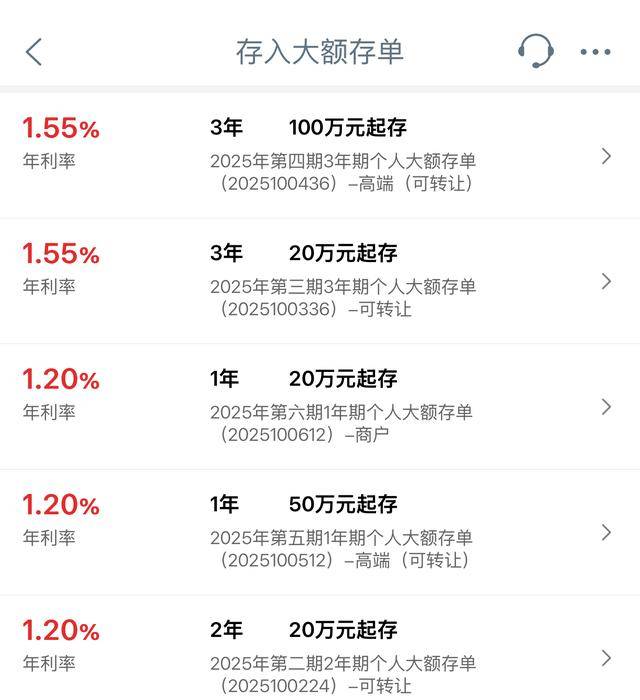
Core Viewpoint - The recent adjustments by state-owned banks regarding large-denomination certificates of deposit (CDs) have drawn market attention, with a notable shift in the availability and minimum deposit amounts for these products [1][2]. Group 1: Changes in Large-Denomination CDs - All six major state-owned banks have removed five-year large-denomination CDs from their mobile banking platforms and websites, with the longest available term now being three years [2]. - Some banks, such as Citic Bank and China Merchants Bank, have reduced the maximum term for their large-denomination CDs to two years, offering an annual interest rate of 1.40% [2]. Group 2: Minimum Deposit Adjustments - The minimum deposit amount for large-denomination CDs has been significantly adjusted, with some banks setting the threshold at 1 million yuan for certain products, while others maintain a lower threshold of 200,000 yuan [3]. - This adjustment is seen as a normal operation for banks managing their liabilities, aiming to balance growth, cost reduction, and risk management [3]. Group 3: Market Implications and Expert Opinions - Experts suggest that the primary driver behind these adjustments is the pressure from narrowing net interest margins in the banking sector, which aligns with policy directions to allow banks to respond more flexibly to the needs of the real economy [7]. - The removal of five-year large-denomination CDs is viewed as a rational choice for banks to optimize their liability structure and shift focus from scale expansion to quality and efficiency [7]. Group 4: Shifts in Consumer Behavior - As the availability of long-term CDs decreases, consumers are encouraged to diversify their asset allocation strategies, moving away from reliance on long-term deposits [8]. - A survey indicates that 18.5% of residents are inclined to invest more, with non-guaranteed bank wealth management products being the most favored investment option at 36% [8]. Group 5: Alternative Investment Suggestions - Financial experts recommend that consumers consider various investment strategies, such as staggered deposits across different terms to balance yield and liquidity [9]. - Other low-risk investment options include government bonds, low-risk wealth management products, and specialized deposit products from smaller banks, which may offer competitive rates [10].




黄金及贵金属 2026 年将持续闪耀-Global Precious Metals Comment_ Gold & precious metals to keep shining in 2026
2025-11-25 01:19
ab 20 November 2025 Global Research Global Precious Metals Comment Gold & precious metals to keep shining in 2026 New highs still to come as gold nears the last innings of the current bull cycle While no bull run lasts forever, the foundations of gold's ascent - particularly the structural shift in private and official sector demand - suggest that price risks remain skewed to the upside over the next 12 months in the face of ongoing global uncertainty. Gold's strong performance, in our view, is a reflection ...
调研报告:近半数投资者股票资产集中在1-2个行业
3 6 Ke· 2025-11-19 11:22
Group 1 - The report indicates that nearly 70% of respondents have a good level of financial health, but there are shortcomings in financial control, money management, investment future capabilities, and risk prevention among some residents [1][2] - The survey shows that a significant portion of residents exhibit behavioral biases in investment, such as over-trading, short-term holding, and concentrated asset allocation, which are attributed to insufficient financial literacy and investment experience [2][3] Group 2 - The report emphasizes the importance of diversifying asset allocation through participation in equity markets to enhance residents' financial health, as the traditional asset allocation has been heavily weighted towards real estate [2][3] - It is noted that the proportion of property income in disposable income for Chinese residents is only 8.1%, compared to about 20% in the US, indicating a need for greater exploration of equity products [3] Group 3 - Recommendations for improving financial health include enhancing financial literacy, seeking professional support, optimizing asset allocation, and strengthening financial management for small and medium-sized enterprises [4]