
财富管理

Search documents
对话汇丰张凯:穿越变局,锚定亚洲及中国投资机遇
21世纪经济报道· 2025-09-16 10:27
Core Viewpoint - HSBC emphasizes the importance of wealth management in navigating the current economic uncertainties and aims to leverage its global capabilities to empower Chinese clients in seizing structural growth opportunities [1]. Group 1: Global Economic Landscape - The global economic landscape is undergoing reconstruction, with heightened policy and geopolitical risks, leading to a potential moderate slowdown in economic growth [1]. - HSBC views Asia, particularly China, as a key area for wealth management, with significant opportunities arising from the region's consumer market and ongoing industrial upgrades [3]. Group 2: Wealth Management Growth in Asia - Boston Consulting Group projects that from 2023 to 2028, global financial wealth will increase by $92 trillion, with nearly 30% of this growth originating from Asia [3]. - Hong Kong is expected to become the largest offshore wealth management center by 2029, with offshore assets projected to reach $27 trillion by 2024, an increase of approximately $230 billion from 2023 [3]. - Singapore is also emerging as a significant offshore wealth management hub, with assets expected to grow to $19 trillion by 2024, reflecting a $200 billion increase [3]. Group 3: Onshore Wealth Opportunities - China and India, as the world's most populous countries, are experiencing rapid growth in their onshore wealth markets, with China holding approximately $26 trillion and India $4 trillion in onshore liquid assets by 2025 [5]. - HSBC's wealth management business in Asia saw a 22% revenue growth in the first half of the year, attracting $44 billion in new investment assets, with $27 billion (60%) coming from Asia [5]. Group 4: Strategic Focus in China - HSBC's strategy in China is encapsulated in three Cs: Continuum, Connectivity, and Collaboration, focusing on providing comprehensive services across various stages of client relationships [8]. - The Chinese middle-income group, exceeding 400 million people, presents a stable client base for wealth management, transitioning from real estate investments to diversified asset allocations [7]. Group 5: Digital Transformation and Talent Acquisition - HSBC is focusing on attracting and retaining talent, particularly in fintech, to enhance its service offerings and digital capabilities [12]. - The bank is investing in AI and digital technologies to improve customer experience and operational efficiency while balancing cost and risk management [13].



青农商行(002958) - 002958青农商行投资者关系管理信息20250916
2025-09-16 08:44
Group 1: Retail Intermediate Business Growth - The growth in retail intermediate business income is primarily driven by wealth management services, which remain a significant source of income for the bank [2] - The bank has focused on building a comprehensive wealth management system, enhancing product support, team support, service support, and technology support to improve overall wealth management capabilities [2] - There is an emphasis on targeted customer segmentation, enhancing service strategies, and increasing wealth product allocation to boost income from wealth management [2] Group 2: Stability of Personal Deposits - The bank has implemented a customer segmentation strategy to enhance the quality of customer management, focusing on high-end, marginal, and lost customer groups [2] - Efforts to optimize deposit product issuance mechanisms and improve service levels have led to a significant increase in personal deposits, which surpassed CNY 230 billion in the first half of the year [2] - The bank is actively integrating online and offline channels to enhance customer acquisition and retention amidst declining deposit rates [2] Group 3: Growth in Trading Financial Assets - The bank's trading financial assets grew by 7.11%, outpacing the overall asset growth rate by 5.05 percentage points [3] - This growth is attributed to the bank's capabilities as a market maker for various financial instruments and an increase in bond holdings due to expanded underwriting business [3]

专业选手实战大赛丨哪些ETF备受“牛人”青睐?9月16日十大买入ETF榜、十大买入金额ETF榜出炉
Xin Lang Zheng Quan· 2025-09-16 08:17
Group 1 - The "Second Golden Unicorn Best Investment Advisor Selection" event is currently ongoing, with over 3,000 professional investment advisors participating in simulated trading competitions [1] - The event aims to provide a platform for investment advisors to showcase their capabilities, expand services, and enhance skills, thereby promoting the healthy development of China's wealth management industry [1] Group 2 - The top ten most frequently bought ETFs on September 16 include the Robot ETF, Tourism ETF, and Hong Kong Securities ETF, indicating strong interest in sectors like robotics and tourism [2] - The top ten ETFs by purchase amount on the same day also feature the Robot ETF and the Korean Semiconductor ETF, highlighting significant investment in technology and robotics [3] Group 3 - The data for the top bought stocks/ETFs is based on the frequency of purchases by all participating advisors, while the purchase amount data reflects the total investment amounts [4] - The competition includes categories for stock simulation, on-site ETF simulation, and public fund simulation, with specific trading rules regarding holding proportions, maximum drawdown, and rebalancing frequency [4]
对话汇丰张凯:穿越变局,锚定亚洲及中国投资机遇
2 1 Shi Ji Jing Ji Bao Dao· 2025-09-16 06:07
Core Insights - HSBC emphasizes the importance of wealth management in navigating global economic uncertainties and the ongoing transformation of the Chinese economy [2][3] - The bank aims to leverage its long-standing presence in Asia to provide diversified global investment opportunities for its clients [2][3] Group 1: Wealth Management Opportunities in Asia - HSBC identifies Asia as a key growth area, with projections indicating that nearly 30% of the $92 trillion in new global financial wealth from 2023 to 2028 will originate from the region [3] - Hong Kong is projected to become the largest offshore wealth management center by 2029, with an estimated offshore asset management scale of $2.7 trillion in 2024, reflecting a growth of approximately $230 billion from 2023 [3][4] - Singapore is also emerging as a significant offshore wealth management hub, with its offshore asset scale expected to reach $1.9 trillion in 2024, an increase of $200 billion [3][4] Group 2: Domestic Wealth Management in China and India - China and India are experiencing rapid growth in their onshore wealth markets, with China's onshore liquid assets estimated at $26 trillion and India's at $4 trillion by 2025 [5] - HSBC's wealth management business in Asia saw a 22% revenue growth in the first half of the year, attracting $44 billion in new investment assets, with $27 billion (60%) coming from Asia [5] Group 3: Strategic Focus in China - HSBC's strategy in China is encapsulated in three key areas: Continuity, Connectivity, and Collaboration [8][9] - The bank aims to provide comprehensive services across various stages of client relationships, leveraging its global network to connect clients with international opportunities [8][9] - HSBC is enhancing its private banking services and has introduced integrated banking services for entrepreneurs, combining personal and corporate wealth management [10] Group 4: Product and Talent Development - HSBC is expanding its product offerings by collaborating with leading asset management firms to provide a wider range of investment options across various sectors [11] - The bank is also focused on building a strong talent pool, particularly in fintech, to support its growth in wealth management [12][14] Group 5: Digital Transformation and AI Integration - HSBC is investing in digital technologies, including AI, to enhance customer experience and operational efficiency in wealth management [13][15] - The bank emphasizes the importance of balancing cost, customer experience, and risk management in its digital transformation efforts [14][15]
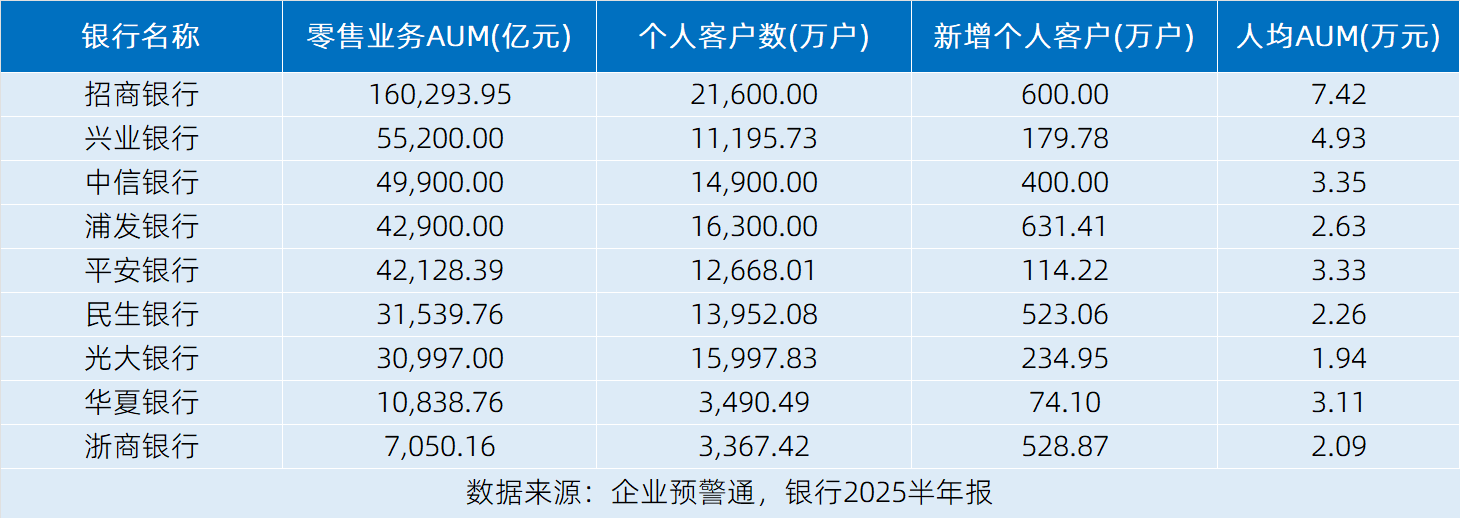
透视9家上市股份行零售金融业务:招商银行、浦发银行、光大银行个人客户数位列前三
Jin Rong Jie· 2025-09-16 03:54
Core Viewpoint - The retail transformation in the financial industry emphasizes personal financial services as a key strategy for banks to adjust their business structure and build differentiated competitive advantages [1] Group 1: Personal Financial Asset (AUM) - China Merchants Bank leads the industry with a retail AUM of 16.03 trillion yuan, significantly ahead of its competitors by over 1 trillion yuan [3] - Industrial Bank ranks second with a retail AUM of 5.52 trillion yuan, showing an 8% increase from the previous year [3] - CITIC Bank, with a retail AUM of 4.99 trillion yuan, has adopted a "retail first strategy" and achieved a 6.52% growth [4] Group 2: Number of Personal Customers - China Merchants Bank has the largest personal customer base with 216 million customers, enhancing its cross-selling opportunities [5] - Shanghai Pudong Development Bank follows with 163 million customers, leveraging online and offline channels for customer acquisition [5] - China Everbright Bank ranks third with 160 million customers, utilizing precise marketing strategies to attract specific customer segments [5] Group 3: New Personal Customer Acquisition - Shanghai Pudong Development Bank leads in new customer acquisition with 6.31 million new customers, continuing its online and offline customer acquisition strategy [6] - China Merchants Bank ranks second with 6 million new customers, indicating a lower growth rate relative to its existing customer base [6] - Zhejiang Commercial Bank reported a growth of 5.29 million new customers, focusing on various targeted customer segments [6] Group 4: Average AUM per Customer - China Merchants Bank has the highest average AUM per customer at 74,200 yuan, reflecting its strong wealth management capabilities [7] - Industrial Bank ranks second with an average AUM of 49,300 yuan, maintaining a strong position in customer asset management [7] - CITIC Bank, Ping An Bank, and Huaxia Bank have average AUMs ranging from 30,000 to 40,000 yuan, indicating a need for improvement in high-net-worth service capabilities [8]




财富自由的黄金三角:赚钱、省钱、理财缺一不可
Sou Hu Cai Jing· 2025-09-16 02:44
Group 1 - The core concept emphasizes the importance of the "iron triangle" of wealth management: earning, saving, and investing, which must work together to achieve financial freedom [1][9] - Earning is the starting point of wealth accumulation, but it is not the endpoint; enhancing value creation ability is crucial [2][9] - Saving is not merely about frugality but involves rational planning and distinguishing between needs and wants, providing a safety net for investments [3][7] Group 2 - Investing acts as an accelerator for wealth growth, relying on proper asset allocation and the power of compounding [4][7] - The synergy between earning, saving, and investing creates a robust financial ecosystem; the absence of any one element can lead to imbalances in wealth accumulation [7][9] - Common misconceptions about wealth management need to be addressed, highlighting the necessity of balancing all three components for financial success [7][9] Group 3 - The art of balance involves adjusting priorities based on life stages, focusing on earning in youth, managing risks in middle age, and securing capital before retirement [8][11] - A dynamic approach to wealth management is essential, with a focus on long-term strategies and the interplay between active income and passive income [8][9]

专业选手实战大赛丨哪些ETF备受“牛人”青睐?9月15日十大买入ETF榜、十大买入金额ETF榜出炉
Xin Lang Zheng Quan· 2025-09-15 09:53
Group 1 - The "Second Golden Unicorn Best Investment Advisor Selection" event is currently ongoing, with over 3,000 professional investment advisors participating in simulated trading competitions [1] - The event aims to provide a platform for investment advisors to showcase their capabilities, expand services, and enhance skills, thereby promoting the healthy development of China's wealth management industry [1] Group 2 - The top ten most frequently bought ETFs as of September 15 include Communication ETF, Broker ETF, and Sci-Tech Chip ETF, indicating strong interest in these sectors [2] - The top ten ETFs by purchase amount include the China Concept Internet ETF and Broker ETF, suggesting significant capital flow into these investment vehicles [3] Group 3 - The data for the top bought stocks/ETFs is based on the frequency of purchases by all participating advisors, while the purchase amount data reflects the total investment amounts in the top ten stocks/ETFs [4] - The competition includes categories for stock simulation, on-site ETF simulation, and public fund simulation, with specific trading rules regarding holding proportions, maximum drawdown, and rebalancing frequency [4]
香港财库局:当局已助力逾200间家办来港落户 彰显香港亚洲财管中心魅力
Zhi Tong Cai Jing· 2025-09-15 06:29
Group 1 - The Hong Kong government has successfully assisted over 200 family offices to establish or expand their operations in the region, surpassing the performance target set in the 2022 Policy Address, reinforcing Hong Kong's status as a leading cross-border private wealth management center in Asia and a global hub for family offices [1][2] - The government introduced eight key measures in March 2023, including tax incentives and the "New Capital Investor Entry Scheme," to create a competitive environment for family office-related industries [1][2] - The FamilyOfficeHK team has expanded its functions and established a new network of family office service providers to offer comprehensive services and support to family offices [1][2] Group 2 - The "New Capital Investor Entry Scheme" has gained popularity among high-net-worth individuals, with enhancements made to the eligibility criteria, allowing investors who reside in Hong Kong for seven years or more to apply for permanent residency [2][3] - The total asset management value in Hong Kong is projected to exceed HKD 35 trillion by the end of 2024, reflecting a year-on-year growth of 13%, with net capital inflow increasing over 80% to HKD 705 billion [2] - The Hong Kong government aims to continue optimizing policies, including tax incentives for funds and single family offices, to sustain the growth momentum of family offices [3][4] Group 3 - Hong Kong's family office ecosystem is thriving, contributing to the capital market, professional services, and talent development, creating a positive feedback loop [4] - The government plans to further enhance tax incentives for funds and single family offices, while the Investment Promotion Agency will continue to collaborate with business associations and service providers to promote Hong Kong as a leading family office hub [4]
景顺长城携手工商银行,第六届“828·工银财富季”开启
Xin Lang Ji Jin· 2025-09-15 06:03
Group 1 - The core event is the launch of the sixth "828 Wealth Season" by Industrial and Commercial Bank of China (ICBC), aiming to enhance wealth management experiences for customers through product supply, online investment services, and educational resources [1] Group 2 - ICBC has upgraded and expanded its "Tian Tian Ying" cash management service, now offering 106 associated money market funds to meet higher liquidity demands, along with automatic purchase and redemption services for easier fund management [2] - The scale of the "Tian Tian Ying" service has exceeded 120 billion [3] Group 3 - ICBC collaborates with fund companies to analyze market trends and monthly select fund product allocation strategies, launching activities to help customers grasp market rhythms and choose suitable investment tools [4] Group 4 - A new "Bond Fund" section has been introduced to optimize product display and selection, along with a "Wish Investment" feature that allows customers to choose from various investment products for a more personalized investment experience [5] Group 5 - ICBC has enhanced its gold asset allocation services, allowing customers to accumulate gold through active saving or investment plans, with exclusive discounts during the wealth season [6] Group 6 - The "Wealth Accompaniment" themed activity has been launched, utilizing interactive and educational formats to engage over 6 million customers, while also providing insights into financial product risk-return characteristics and historical performance [7]

现在到底是现金为王还是资产为王?告诉大家答案,早了解早受益
Sou Hu Cai Jing· 2025-09-14 23:41
Group 1 - The core debate in wealth management for 2024 revolves around whether to prioritize cash or diversify into assets, with individuals like Aunt Li facing dilemmas in their investment strategies [1][3] - The macroeconomic environment in 2024 is prompting a reevaluation of wealth management strategies among the public, emphasizing the need for personalized approaches based on individual circumstances [3][5] Group 2 - Cash is highlighted for its liquidity and stability, with data showing that as of 2024, household savings in China reached 143.8 trillion yuan, growing at a rate of 7.8% [5][6] - The potential income from cash holdings is illustrated, with a million yuan yielding 32,000 yuan in interest at a 3.2% annual rate, emphasizing the low risk of capital loss [5][6] - However, inflation poses a risk to cash's purchasing power, with the CPI increase at 2.4% in 2024, indicating a gradual erosion of cash value [6] Group 3 - Asset allocation is presented as a strategy to combat inflation and enhance value, with historical data showing that stocks, real estate, and gold have outperformed inflation over the past decade [7][8] - Real estate, despite recent price adjustments, has an average annual growth rate of 8.7% over the last twenty years, indicating its long-term investment value [8] - The stock market shows significant variability, with some stocks reaching new highs while others decline, underscoring the importance of stock selection and long-term investment [8] Group 4 - Gold has performed well in 2024, with prices rising from $2,000 to $2,180 per ounce, a 9% increase, reflecting its status as a safe-haven asset amid economic uncertainty [8] - The mutual fund industry has grown significantly, with total public fund assets reaching 28.7 trillion yuan by 2024, providing diverse investment options for ordinary investors [10] Group 5 - Different age groups exhibit distinct preferences for cash versus assets, with younger individuals favoring higher-risk investments, while older individuals tend to prefer cash and low-risk products [11] - Income levels also influence asset allocation strategies, with higher-income individuals diversifying more, while lower-income households tend to hold more cash [11] Group 6 - A recommended "core-satellite" investment strategy suggests maintaining 6 to 12 months of living expenses in cash while diversifying the rest into stocks, funds, and real estate [12] - The "100 minus age" rule is proposed as a guideline for asset allocation, adjusting the proportion of risk assets based on age [12] Group 7 - Investment knowledge and experience are crucial, with a recommendation for those less familiar with investing to maintain a higher cash ratio while gradually increasing asset allocation [13] - Market timing is emphasized, suggesting that increasing asset allocation during downturns and cash during booms can yield better returns [13] Group 8 - Liquidity needs, tax implications, and inflation expectations are critical factors in asset allocation decisions, with a focus on maintaining sufficient cash for upcoming large expenses [14] - Economic cycles should inform investment strategies, with risk assets performing well in expansion periods and cash becoming more valuable during contractions [14] Group 9 - Policy changes can significantly impact asset performance, necessitating regular reviews and adjustments to investment strategies based on evolving regulations [15] - Personal circumstances, such as income changes or health issues, should prompt reassessment of asset allocation [15] Group 10 - Successful wealth management often involves a combination of clear financial goals, reasonable asset allocation, and a commitment to continuous learning [16] - Technological advancements are transforming wealth management, making it more accessible and efficient [16] Group 11 - Investing in education and health is increasingly recognized as vital, with returns on knowledge investments potentially surpassing traditional financial assets [17] - Building and maintaining a strong social network can also yield unexpected opportunities and benefits [17] Group 12 - The most effective wealth managers adapt their strategies flexibly to changing environments, avoiding extremes of cash hoarding or asset liquidation [18] - Diversification is a key principle, with recommendations against concentrating investments in a single asset type [18] Group 13 - A practical investment strategy for Aunt Li involves allocating 200,000 yuan in cash for emergencies, 200,000 yuan in stable mixed funds, and 100,000 yuan in gold ETFs, balancing liquidity and growth potential [19] - This gradual approach to investing is encouraged as a learning process, emphasizing the importance of patience and strategy refinement over time [19]
