食品安全

Search documents
X @外汇交易员
外汇交易员· 2025-11-07 11:08
Industry Regulation & Compliance - The State Administration for Market Regulation (SAMR) guided 8 online food trading third-party platform enterprises to jointly initiate and sign the "Self-Discipline Convention on Food Safety Management of Online Food Trading Third-Party Platforms" [1] - The 8 platforms include: JD, Meituan, Pinduoduo, Douyin E-commerce, Xiaohongshu, Taobao, WeChat Mini Programs, and Kuaishou E-commerce [1]
中方:将继续加强对日本水产品输华监管
Zhong Guo Xin Wen Wang· 2025-11-07 07:49
Core Viewpoint - China will continue to strengthen the regulation of Japanese seafood imports to ensure food safety for its citizens, particularly in light of concerns regarding the Fukushima nuclear wastewater [1] Group 1: Regulatory Actions - China has announced that it will maintain strict monitoring of Japanese seafood imports, particularly in relation to the Fukushima nuclear wastewater [1] - The Chinese authorities will implement necessary import restrictions immediately if any risks are detected [1] Group 2: International Cooperation - China emphasizes the importance of ongoing international monitoring and independent sampling of the Fukushima nuclear wastewater by Japan [1] - The Chinese government will work with the international community to urge Japan to fulfill its commitments regarding the monitoring of the nuclear wastewater [1]
麻六记新开业洛杉矶店有顾客称用餐后腹泻,官方热线回应
Xin Lang Cai Jing· 2025-11-07 05:30
Core Insights - The new Chinese restaurant brand "Ma Liu Ji" in Los Angeles has faced food safety controversies shortly after its opening, with multiple reports of customers experiencing stomach issues after dining there [1] - The restaurant, which opened on October 28, 2025, features a menu focused on spicy Sichuan dishes and has a dining area of approximately 200 square meters [1] Company Overview - "Ma Liu Ji" was founded by Wang Xiaofei in 2020, initially focusing on traditional Sichuan dishes such as spicy hot pot and boiled fish [2] - In 2022, the brand expanded into online retail, developing a range of products including instant food, snacks, sauces, and prepared dishes, leading to the creation of its signature spicy sour noodles [2] - The first physical store for the spicy sour noodles opened in Chengdu in January 2024, followed by the launch of a delivery model in May 2024, covering dine-in, takeout, and delivery options [2] Recent Issues - The brand previously faced a mold controversy in July 2023, with customers in multiple cities reporting moldy products purchased from Costco, prompting urgent product recalls [2] - The manufacturing partner, Bai Jia A Kuan, acknowledged that the mold issue was due to insufficient sanitation during production, affecting specific batches dated June 16 and June 18, 2025 [2] - In response to these incidents, the brand's parent company, Beijing Shitongda Technology Development Co., Ltd., issued an apology and committed to enhancing supply chain management and quality control measures [2]
海关总署署长孙梅君率团访问荷兰
Di Yi Cai Jing· 2025-11-06 12:29
Core Points - The visit of the General Administration of Customs of China led by Sun Meijun to the Netherlands focused on enhancing customs cooperation and capacity building [1] - The establishment of a joint training center for customs between China and the Netherlands was a significant outcome of the visit [1] - The 25th anniversary of customs cooperation between Shanghai and Rotterdam was celebrated during the visit [1] Customs Cooperation - Discussions were held with the Dutch Customs Director, Mrs. Selwyn, on advancing smart customs initiatives and international cooperation [1] - Relevant cooperation documents were signed to formalize the agreements reached during the meetings [1] Agricultural and Food Safety - Meetings with the Dutch Minister of Agriculture, Fisheries, and Food Safety, Mr. Rumen, addressed issues related to plant health, animal health, and food safety [1] - A cooperation document on inspection and quarantine was signed to enhance collaboration in these areas [1] Diplomatic Engagement - The delegation engaged in work discussions with representatives from the Chinese Embassy in the Netherlands, indicating a broader diplomatic effort alongside the customs discussions [1]
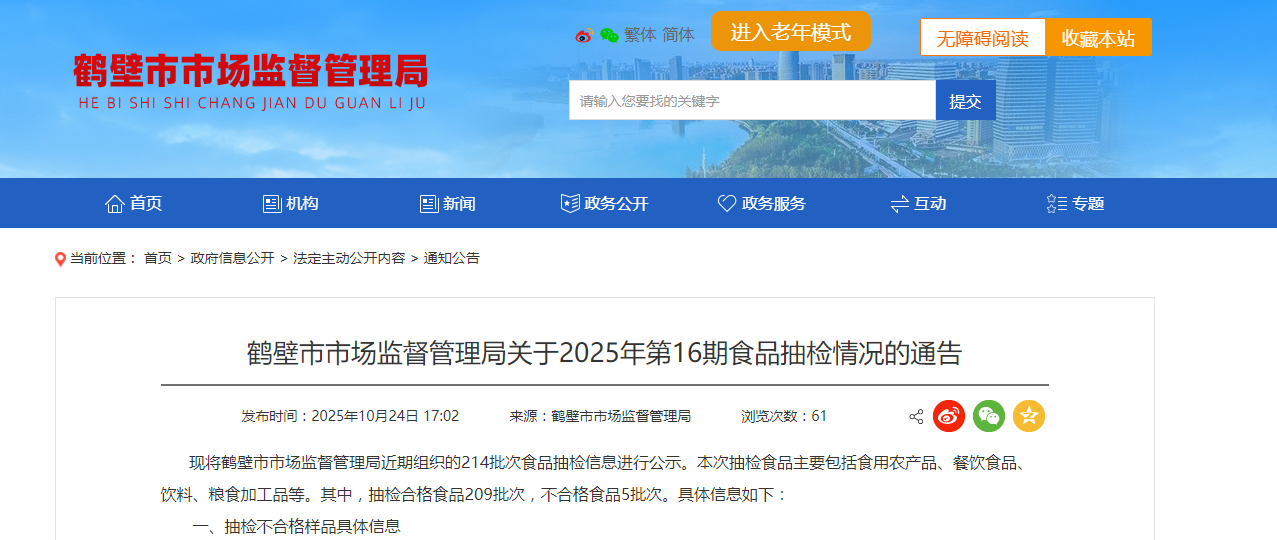
河南省鹤壁市市场监督管理局关于2025年第16期食品抽检情况的通告
Zhong Guo Zhi Liang Xin Wen Wang· 2025-11-06 09:08
Summary of Key Points Core Viewpoint - The recent food safety inspection in Hebi City revealed that out of 214 food samples tested, 209 were compliant while 5 were found to be non-compliant, highlighting ongoing concerns regarding food safety standards in the region [2]. Non-Compliant Samples - Five specific non-compliant food samples were identified, including bananas and ginger, with pesticide residues exceeding safety limits [2][3][4]. - The non-compliant items included: 1. Bananas from a local market with pesticide residue of Thiamethoxam [2]. 2. Celery from a supermarket with pesticide residue of Chlorpyrifos [2]. 3. Bananas from a fruit store with pesticide residue of Imidacloprid [2]. 4. Ginger from a vegetable market with pesticide residue of Imidacloprid [2]. 5. Ginger from a supermarket with pesticide residue of Phorate [2]. Pesticide Residue Information - Thiamethoxam is a neonicotinoid insecticide used for various crops, with potential long-term health impacts if consumed in excess [3]. - Chlorpyrifos is an organophosphate insecticide with moderate acute toxicity, and long-term exposure may pose health risks [3]. - Imidacloprid is an insecticide that can be absorbed by plants, and excessive consumption may lead to health issues over time [3]. - Phorate is a highly toxic insecticide, with strict maximum residue limits established for food products [4]. Regulatory Actions - The Hebi City Market Supervision Administration is conducting follow-up investigations and has urged consumers to report food safety issues [4]. - The administration has initiated a regular food inspection program to enhance consumer safety and encourage public participation in food safety monitoring [4].

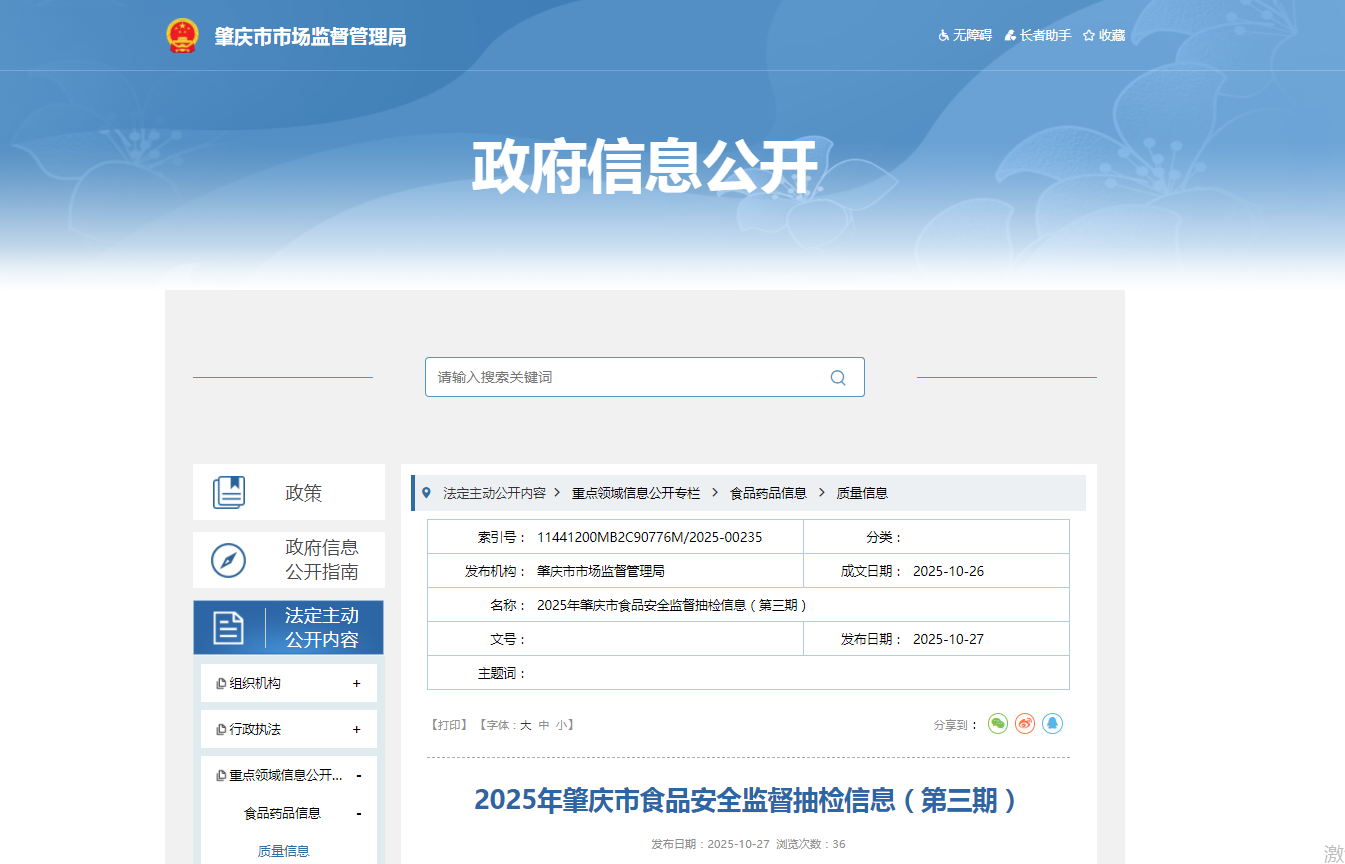
2025年广东省肇庆市食品安全监督抽检信息(第三期)
Zhong Guo Zhi Liang Xin Wen Wang· 2025-11-06 08:57
Overall Situation - Zhaoqing City Market Supervision Administration conducted a supervision sampling of 267 batches of food across 14 categories, including edible agricultural products, catering food, tea and related products, alcoholic beverages, grain products, meat products, edible oils, beverages, aquatic products, vegetable products, soybean products, food additives, bee products, and special dietary foods [2]. - Out of the 267 batches, 252 were qualified, while 15 were found to be unqualified, indicating a qualification rate of approximately 94.4% [2]. Breakdown of Unqualified Products - Among the 172 batches of edible agricultural products, 9 were unqualified [2]. - For 14 batches of catering food, 3 were unqualified [2]. - In the tea and related products category, all 22 batches were qualified [2]. - The alcoholic beverages category had 3 batches, all of which were qualified [2]. - Grain products had 3 batches, all qualified [2]. - Meat products included 10 batches, with no unqualified samples [2]. - Edible oils and related products had 5 batches, all qualified [2]. - The beverage category had 2 batches, both qualified [2]. - Aquatic products included 11 batches, with no unqualified samples [2]. - Vegetable products had 8 batches, with 3 unqualified [2]. - Food additives had 3 batches, all qualified [2]. - Soybean products included 7 batches, all qualified [2]. - Bee products had 3 batches, all qualified [2]. - Special dietary foods included 5 batches, all qualified [2]. Handling of Unqualified Products - Zhaoqing City Market Supervision Administration has mandated relevant local market supervision departments to investigate and handle unqualified food products and their producers promptly [4]. - Companies are required to trace the distribution of unqualified products, recall them, and analyze the reasons for non-compliance to implement corrective actions [4]. - Businesses must take immediate measures such as removing unqualified food from shelves to control risks and face legal consequences [4].
新莱应材涨2.07%,成交额6.37亿元,主力资金净流出5437.36万元
Xin Lang Cai Jing· 2025-11-06 03:18
Core Viewpoint - New Lai Ying Material has shown significant stock price fluctuations, with a year-to-date increase of 109.95% but a recent decline of 11.96% over the past five trading days [1] Company Overview - New Lai Ying Material, established on July 12, 2000, and listed on September 6, 2011, is located in Kunshan, Jiangsu Province. The company specializes in the production and sales of self-developed clean stainless steel integrated system key components [1] - The main revenue composition includes: sterile packaging materials (48.63%), high-purity and ultra-high-purity application materials (31.30%), clean application materials (13.83%), and food equipment (6.25%) [1] Financial Performance - For the period from January to September 2025, New Lai Ying Material achieved operating revenue of 2.255 billion yuan, representing a year-on-year growth of 4.31%. However, the net profit attributable to shareholders decreased by 26.66% to 145 million yuan [2] - Cumulative cash dividends since the A-share listing amount to 185 million yuan, with 85.065 million yuan distributed over the past three years [3] Shareholder Structure - As of September 30, 2025, the number of shareholders increased to 56,400, with an average of 5,098 circulating shares per person, a decrease of 4.09% from the previous period [2] - The top ten circulating shareholders include Hong Kong Central Clearing Limited as the third-largest shareholder, holding 7.3725 million shares, an increase of 5.5328 million shares from the previous period [3]

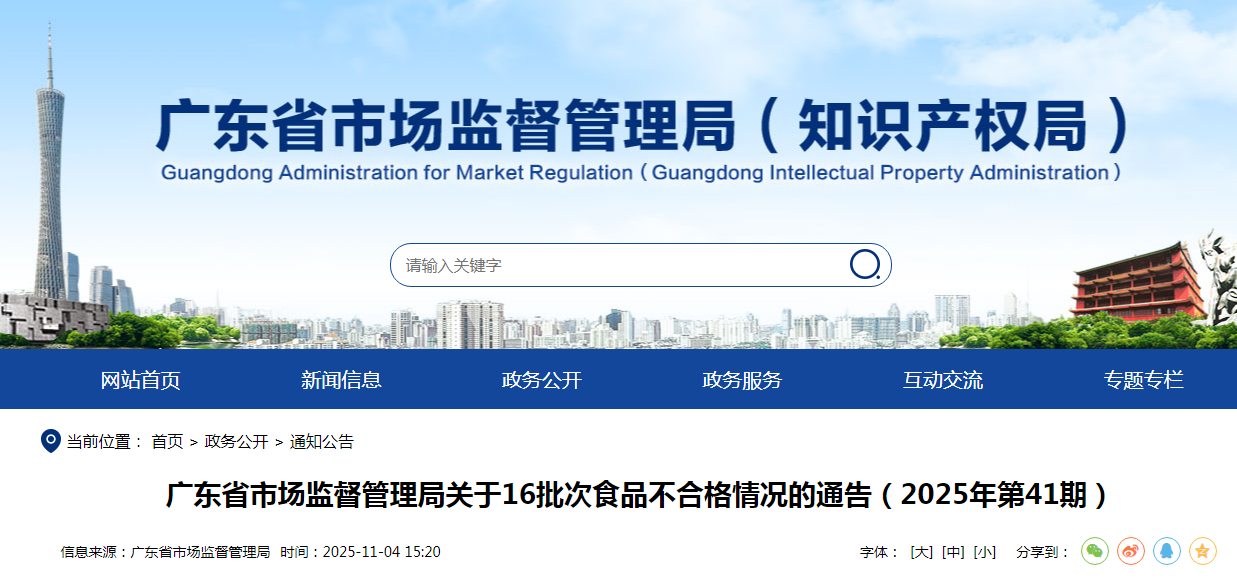
广东省市场监督管理局关于16批次食品不合格情况的通告(2025年第41期)
Zhong Guo Zhi Liang Xin Wen Wang· 2025-11-05 08:37
Core Points - Guangdong Province Market Supervision Administration conducted a food safety inspection, revealing 16 batches of food products that did not meet safety standards out of 1246 samples tested, indicating a compliance rate of approximately 98.7% [2] Microbial Contamination Issues - Several food products were found to have microbial contamination, including: - Longguang packaged drinking water from Zhongshan Ming Shi Drinking Water Co., which failed to meet standards for Pseudomonas aeruginosa [4] - Various food establishments using utensils that did not meet standards for coliform bacteria [4] Pesticide Residue Issues - Multiple products were flagged for pesticide residue violations, including: - Sweet and sour hawthorn from Huai Ji Fu Xing Food Factory, which exceeded the allowable limits for sulfur dioxide [3] - Local peppers and other vegetables that contained unacceptable levels of pesticides such as thiamethoxam and chlorpyrifos [4] Heavy Metal Contamination Issues - Heavy metal contamination was identified in several products, including: - Lead contamination in preserved plums from Chaozhou Zhongtai Food Co. and fresh ginger from Foshan [4] Food Additive Violations - Certain products were found to exceed the permissible limits for food additives, such as: - Red sugar from Guangdong Hengqing Health Industry Technology Co., which contained impurities not compliant with safety standards [3] Regulatory Actions - The Guangdong Province Market Supervision Administration has mandated local regulatory bodies to investigate the non-compliant food products and their producers, requiring actions such as product recalls and risk control measures [5] - Consumers are advised to purchase food from reliable sources and to check for proper labeling and compliance with safety standards [5]
山东省东营市市场监督管理局食品安全监督抽检信息通告(2025年第8期)
Zhong Guo Zhi Liang Xin Wen Wang· 2025-11-05 08:14
Core Viewpoint - The Dongying Market Supervision Administration conducted food safety inspections, revealing that 11 out of 106 samples failed to meet safety standards, primarily due to pesticide residues, excessive use of food additives, and contamination issues [3]. Food Additive Issues - Pork sold by Jian Mountain Fresh Meat Store in the Hekou District was found to contain enrofloxacin, which does not comply with national food safety standards [5]. - The self-made roasted pork from Dongying Development Zone Zhi Er Barbecue Shop was found to have benzo[a]pyrene levels exceeding national food safety standards [5]. Pesticide Residue Issues - Various vendors were cited for exceeding pesticide residue limits, including: - Green onions from Sisters Vegetable Store in Guangrao County with thiamethoxam at 1.1 mg/kg (standard ≤0.3 mg/kg) [7]. - Green onions from Xiao Chen Vegetable and Fruit Store in Dongying Development Zone with thiamethoxam at 0.41 mg/kg [8]. - Bananas from Xinmei Food Business Department with imidacloprid at 0.065 mg/kg [8]. - Green onions from Guangrao Blue Ocean Junhua Hotel with thiamethoxam [7]. Contaminant Issues - The roasted pork from Dongying Development Zone Zhi Er Barbecue Shop was found to have benzo[a]pyrene at 22.1 µg/kg, exceeding the standard of 5.0 µg/kg [8]. - Various food products, including eight treasure rice dumplings and black sesame mooncakes, were found to contain excessive levels of food additives such as acesulfame K and sodium dehydroacetate [7]. Summary of Non-compliant Products - A total of 11 products were identified as non-compliant, including: - Pork with enrofloxacin [9]. - Roasted pork with benzo[a]pyrene [5]. - Various vegetables and fruits with pesticide residues exceeding limits [7][8].

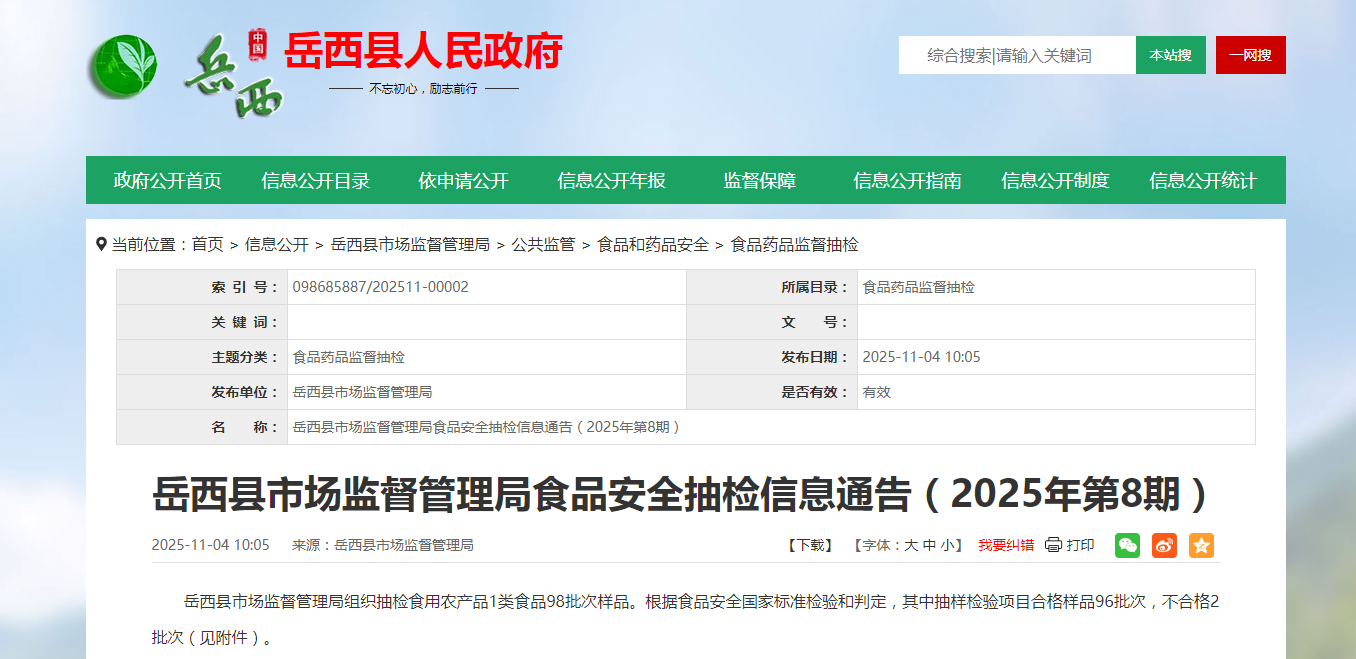
安徽省安庆市岳西县市场监督管理局食品安全抽检信息通告(2025年第8期)
Zhong Guo Zhi Liang Xin Wen Wang· 2025-11-05 07:01
Core Points - The article reports on the food safety inspection results conducted by the Yuexi County Market Supervision Administration, highlighting that out of 98 batches of food samples tested, 96 were compliant with national food safety standards, while 2 batches were found to be non-compliant [1][2]. Group 1: Inspection Results - A total of 98 batches of food samples were tested, with 96 passing and 2 failing the safety standards [1][2]. - The non-compliant products included longan with excessive sulfur dioxide residue and guifei mango with pesticide residue exceeding the standard [2]. Group 2: Actions Taken - The Yuexi County Market Supervision Administration has initiated immediate investigations and actions to address the non-compliant products, including product recalls and removal from shelves [2]. - Legal actions will be taken against any violations found during the inspections [2].