
量子科技

Search documents
中原证券晨会聚焦-20260105
Zhongyuan Securities· 2026-01-05 00:34
Key Insights - The report highlights the steady growth of the animation film industry, with animated films accounting for nearly 50% of the total box office in 2025, driven by successful titles like "Nezha 2" and "Zootopia 2" [36] - The aerospace software industry is leading the A-share market, indicating a positive trend in this sector [5][8] - The low-altitude economy in Shanghai is projected to reach a scale of approximately 80 billion yuan by 2028, establishing a complete industrial chain for new aviation vehicles [5][8] - The gaming industry continues to show steady growth, with a focus on AI applications enhancing operational efficiency [16][17] - The semiconductor sector is experiencing significant growth, with global sales increasing by 27.2% year-on-year, indicating strong demand [24] Domestic Market Performance - The Shanghai Composite Index closed at 3,968.84, with a slight increase of 0.09%, while the Shenzhen Component Index decreased by 0.58% [4] - The A-share market is characterized by a mixed performance across various sectors, with aerospace, software development, and non-ferrous metals showing positive trends [5][8] Industry Analysis - The animation film sector has seen a substantial increase in box office revenue, with animated films making up a significant portion of the top-grossing films [36] - The gaming industry is expected to maintain its growth trajectory, supported by advancements in AI technology [16][17] - The semiconductor industry is witnessing robust growth, with China’s semiconductor sales reaching $19.53 billion, reflecting a year-on-year increase of 18.5% [24] Investment Recommendations - Investors are advised to focus on sectors with strong fundamentals and stable earnings, such as aerospace, gaming, and semiconductor industries, which are expected to benefit from ongoing technological advancements and favorable policy environments [22][23][24] - The report suggests monitoring the performance of leading companies in the animation and gaming sectors, as they are likely to capitalize on the growing market demand [16][36]
我国成为创新力上升最快的经济体之一
Ren Min Ri Bao· 2026-01-04 22:42
Group 1 - Innovation is the primary driving force for development, with China transitioning from "catching up" to "keeping pace" and now "leading" in innovation [1] - China has risen to 10th place in the global innovation index, marking a 25-place increase since 2013 [1] - Significant breakthroughs in artificial intelligence, quantum technology, manned spaceflight, and deep space exploration have been achieved, showcasing China's shift from isolated breakthroughs to systemic capability enhancement [1] Group 2 - Since the 18th National Congress, China has prioritized technological innovation, with R&D expenditure increasing from 1.03 trillion yuan in 2012 to 3.63 trillion yuan in 2024, maintaining the second position globally [2] - The vast domestic market of over 1.4 billion people provides a unique testing ground for innovation, allowing companies to refine products and technologies to meet diverse demands [2] - China has 24 innovation clusters ranked among the top 100 globally, with the Shenzhen-Hong Kong-Guangzhou cluster projected to rank first by 2025 [2] Group 3 - The rapid enhancement of China's innovation capability is a successful practice of systematic engineering, although challenges remain in high-end chips, industrial software, and precision instruments [3] - The global competition in technology is intensifying, necessitating a focus on achieving strong and stable innovations, particularly in original breakthroughs [3] - China's rise as one of the fastest-growing economies in innovation is both a milestone and a new starting point for future advancements [3]
竞逐新赛道,都有啥新招?
Xin Lang Cai Jing· 2026-01-04 22:08
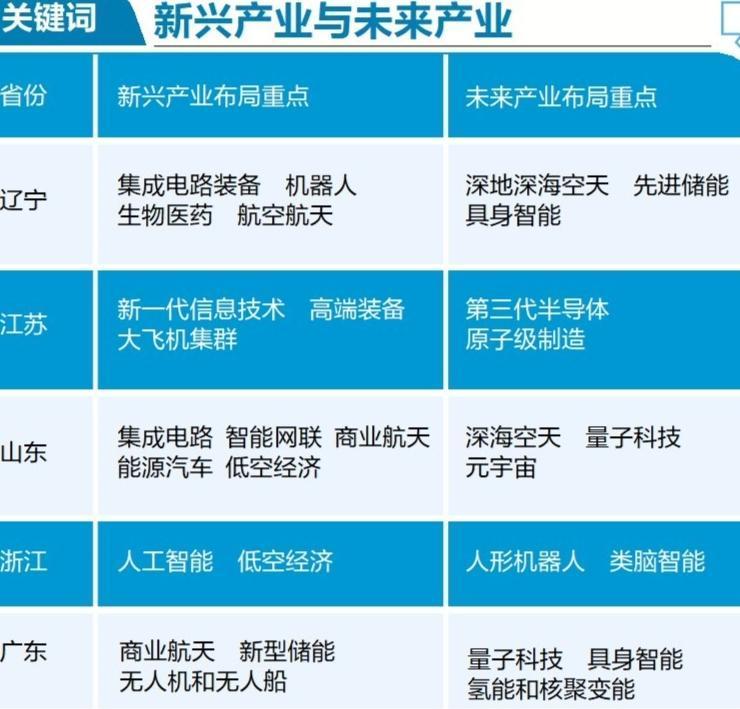
Group 1: Emerging and Future Industries - Various provinces are focusing on emerging and future industries, with specific emphasis on sectors like integrated circuits, robotics, and advanced energy storage [1][6] - Jiangsu aims to deepen integration into the Yangtze River Delta's aircraft manufacturing cluster and emphasizes atomic-level manufacturing [6] - Provinces like Shandong and Guangdong are prioritizing sectors such as quantum technology and hydrogen energy, indicating a trend towards high-tech and sustainable industries [1][7] Group 2: Digital Development - Provinces are actively developing digital infrastructure, with Liaoning focusing on data annotation industries and integrating AI into traditional industries [2][9] - Beijing aims to become a global benchmark city for digital economy, emphasizing core technologies like high-end chips and software [2][9] - Guangdong is enhancing its data trading platforms to foster industrial clusters, showcasing a strong market-driven approach [2][9] Group 3: Marine Economy - Coastal provinces are shifting their focus to marine economies, with Guangdong and Shandong aiming to create comprehensive marine industry ecosystems [8][19] - Liaoning and Jiangsu are leveraging their industrial bases to upgrade traditional marine industries towards high-end and green solutions [8][19] - The emphasis on marine economic development reflects a strategic pivot towards utilizing ocean resources for economic growth [8][19] Group 4: Consumption and Economic Growth - Guangdong is promoting the establishment of international consumption centers, aiming to enhance service industry standards and consumer environments [10][11] - Provinces like Beijing and Jiangsu are emphasizing high-energy consumption innovations, focusing on cultural and tourism integration to stimulate local economies [11][15] - The strategies aim to release local market potential and enhance consumer confidence through improved infrastructure and services [11][15] Group 5: Strategic Technology and Talent Development - Provinces are prioritizing the establishment of national laboratories and major scientific facilities to strengthen strategic technological capabilities [12][14] - There is a focus on integrating education, technology, and talent development to foster innovation and address regional needs [13][14] - Collaborative efforts across provinces aim to enhance the overall effectiveness and resilience of the national innovation system [12][14]

2026,产业奔涌向“新”
Xin Lang Cai Jing· 2026-01-04 20:03
Core Viewpoint - Chengdu is focusing on the construction of a modern industrial system by promoting the efficient transformation and deep integration of technological and industrial innovation, aiming to enhance its comprehensive competitiveness by 2026 [1] Group 1: Economic Development Goals - The Chengdu Municipal Party Committee has set a clear economic development blueprint for 2026, emphasizing the need for continuous efforts to deepen the integration of technology and industry [1] - The city aims to transform its industrial base into a manufacturing powerhouse, aligning with the national strategy of building an advanced manufacturing base [1] Group 2: Industry Focus Areas - The series of reports will focus on three main areas: revitalizing traditional advantageous industries, tackling challenges in emerging industries such as artificial intelligence and digital economy, and exploring future industries like low-altitude economy and quantum technology [1] - The initiative aims to observe how Chengdu is strategically positioning itself in cutting-edge fields to foster new growth areas [1] Group 3: Implementation Strategy - The transition from planning to execution is highlighted, with Chengdu's industrial advancements serving as a solid foundation for stable development [1] - The city is committed to turning the municipal directives into tangible outcomes, showcasing its industrial progress [1]
科研追光者的破壁之路
Xin Lang Cai Jing· 2026-01-04 19:01
Group 1: Quantum Technology - China's scientific community is making significant strides in quantum communication, with advancements in stabilizing signals from quantum satellites to the ground [1][2] - The successful launch of the world's first quantum science satellite, "Mozi," in 2016 has enabled the establishment of a quantum communication network, including ground and satellite links [2] Group 2: Advanced Manufacturing - The production of "hand-tear steel," a critical material for various high-tech applications, has reached a capacity of approximately 3 tons per day, marking a significant achievement in China's manufacturing capabilities [3][4] - The thickness of "hand-tear steel" has been reduced to 0.015 mm, setting a new world record and demonstrating China's innovation in high-end manufacturing [3][4] Group 3: Marine Biomedicine - The research team at the Qingdao Marine Biomedical Research Institute is developing new marine drugs, including the first marine polysaccharide-based immunotherapy drug, BG136, which has entered Phase II clinical trials [5][6] - The institute has established a robust pipeline of potential new drugs targeting various health conditions, leveraging advanced technologies like supercomputing and artificial intelligence [6] Group 4: Industrial Innovation - Jiangsu Province has implemented a "combined investment and financing" project management approach to enhance the commercialization of scientific research, addressing initial funding challenges [7][8] - The development of a molecular sieve membrane capable of efficiently extracting helium from natural gas has positioned Jiangsu as a leader in high-end technology and resource utilization [7][8]
习近平总书记关切事·嘱托|科研追光者的破壁之路
Xin Hua She· 2026-01-04 14:53
Core Viewpoint - China's independent innovation efforts are proving to be highly promising, with scientists and researchers making significant strides in various fields, particularly in quantum technology, advanced materials, and marine pharmaceuticals [1][2][6]. Quantum Technology - Researchers at the University of Science and Technology of China are working on stabilizing quantum signals from satellites, which is crucial for enhancing quantum communication networks [1][2]. - The successful launch of the world's first quantum science satellite, "Mozi," in 2016 has enabled the development of a quantum communication network that includes both ground and satellite-based systems [2]. - The team aims to expand the quantum communication network further, with plans for new satellite launches in the near future [3]. Advanced Materials - China's Baowu Steel Group has achieved mass production of "hand-tear steel," a critical material used in various high-tech applications, with production now reaching approximately 3 tons per day [3][4]. - The thickness of this steel has been reduced to 0.015 mm, setting a new world record and showcasing the company's commitment to innovation in high-end manufacturing [3][5]. - The product line has expanded from a single type to over 20 varieties, indicating significant advancements in material science [4]. Marine Pharmaceuticals - The Qingdao Marine Biological Pharmaceutical Research Institute is focused on developing marine drugs, with a notable candidate, BG136, entering Phase II clinical trials as the first marine polysaccharide-based anti-tumor drug [6][7]. - The research team is also working on multiple new drugs aimed at treating hepatitis B and chronic obstructive pulmonary disease, leveraging advanced technologies like supercomputing and artificial intelligence [7]. Industry Integration - Jiangsu Province has implemented a "拨投结合" project management method to enhance the integration of technology and industry, addressing initial funding challenges for technology commercialization [8][9]. - The development of a molecular sieve membrane capable of efficiently separating helium from natural gas has emerged from this initiative, significantly reducing reliance on imports [8][9]. - The Jiangsu Provincial Institute of Industrial Technology has fostered collaborations with leading enterprises to create an innovation ecosystem that bridges scientific research and market needs [9].
中金上汽新兴产业基金2025年度运营情况汇报会顺利召开
Xin Lang Cai Jing· 2026-01-04 11:30
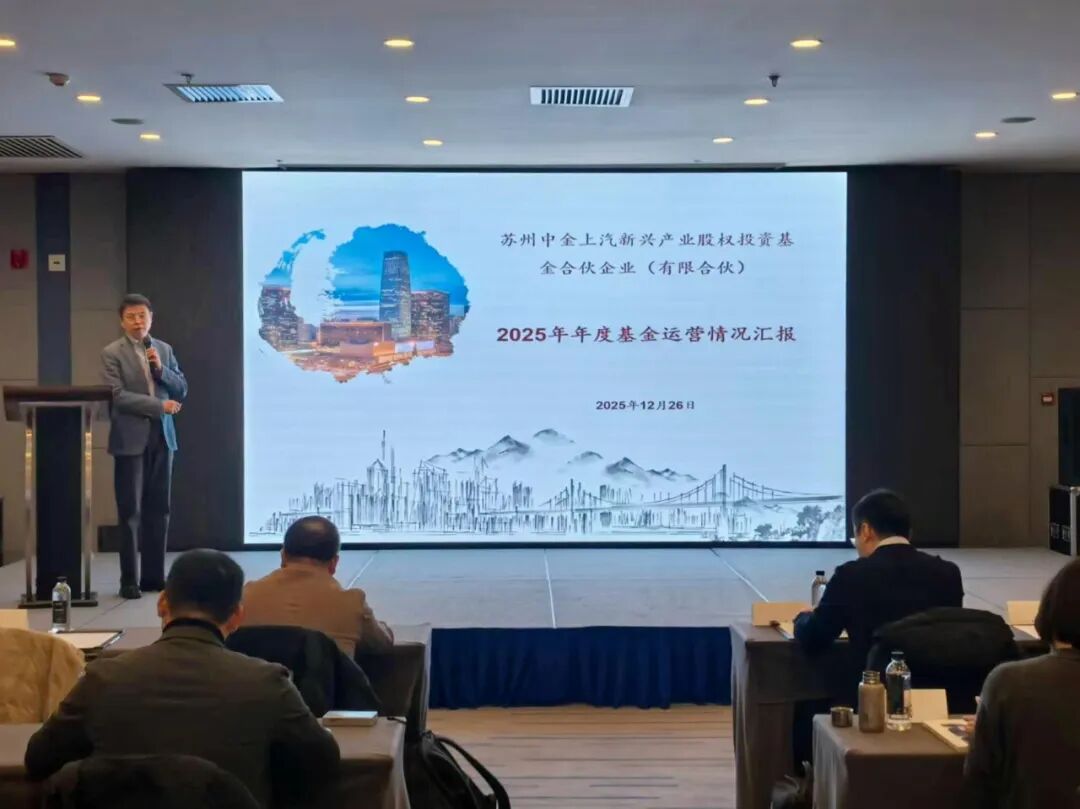
Core Insights - The annual operation report meeting of the CICC SAIC Emerging Industries Fund for 2025 was successfully held in Xi'an, focusing on future industries and transformation upgrades [1][13] - The fund has a subscribed scale of 5 billion yuan and has shown stable and healthy operations in 2025, with excellent business performance [3][15] - The fund's investment portfolio covers advanced manufacturing and strategic emerging industries, including sectors like semiconductors, robotics, new energy, artificial intelligence, commercial aerospace, and quantum technology [3][15] Fund Performance - Three star portfolio companies, Zhengli New Energy (03677.HK), Dongyangguang Pharmaceutical (06887.HK), and Muxi Co., Ltd. (688802.SH), successfully went public in 2025 [3][15] - Several portfolio companies have applied for IPOs on A-shares or Hong Kong stocks, including MiniMax, Magnesium Technology, Shenghe Jingwei, and Lingong Heavy Machinery [3][15] - An additional five portfolio companies are expected to apply for IPOs in the first half of 2026 [3][15] Industry Trends - The CICC Capital's representative highlighted key emerging industries and international development trends, including aerospace, quantum technology, nuclear fusion energy, and embodied intelligence [3][15] - The analysis of artificial intelligence development indicated that China's AI industry has formed a systematic and phased development path, with advantages in large model open-source ecosystems and application scenarios [5][17] - The commercial aerospace sector has seen validated business feasibility with the growth of SpaceX, while the low-altitude economy is still in the introduction phase but has clear policy support [7][19] Investment Strategy - The investment strategy emphasizes long-term growth potential in future industries, despite facing uncertainties, compared to mature industries where new entrants face significant challenges [11][23] - The CICC Capital and partners will continue to strengthen collaboration and systematically advance investments in cutting-edge technology fields to support industrial upgrades and development [11][23] - The meeting participants agreed that deepening industry engagement, forward-looking layouts, and open collaboration are essential to navigate changes and embrace a new chapter in Chinese innovation and manufacturing [12][24]
2025年科尔尼行业系列回顾|科技创新
科尔尼管理咨询· 2026-01-04 09:50
Core Insights - The article highlights a structural shift in industry focus from "can it be done" to "can it be scaled" as generative AI begins to penetrate the core of enterprise IT and operations, indicating a move towards system capability building and efficiency enhancement [1] Group 1: AI-Driven IT - Artificial intelligence is transforming IT functions from a maintenance role to an efficiency and innovation engine, with a decrease in the proportion of Keep The Lights On (KTLO) activities and an acceleration of Agentic Workflows and Generative AI [2][3] - This transformation signifies a shift of IT from a cost center to a scalable value delivery platform [3] Group 2: Quantum Strategy - Quantum technology has been officially integrated into national future industry core layouts, with post-quantum encryption, quantum computing, and quantum communication becoming key long-term competitive advantages [4] - Although general quantum computing is not yet mature, the demand for security and specific application scenarios is prompting companies to prepare in advance [4] Group 3: Evolving Computing Landscape - The ongoing AI boom has led to a reassessment of computing costs and hardware concentration, with Nvidia still holding a dominant position but the AI hardware market transitioning from a single-pole to a multi-pole competition, indicating the emergence of a "warring states" era [5][6] Group 4: 5G Value Realization - The commercialization of 5G has entered an "impact period," shifting the industry focus from network coverage to monetization capabilities [6] - Applications such as private networks, Multi-access Edge Computing (MEC), and APIs are beginning to yield returns, with the core competition among operators shifting to "how well it is used" rather than "how quickly it is built" [6]

公司问答丨高华科技:公司已建立与中国运载火箭技术研究院、蓝箭航天等下游重点客户的配套合作 目前在手订单充足 预计未来交付有序
Ge Long Hui· 2026-01-04 09:48
Core Viewpoint - The company is leveraging its technological advantages in the Long March rocket series and its early entry into the commercial aerospace sector to steadily advance its business, with a strong order backlog and plans for future growth in 2026 [1] Group 1: Commercial Aerospace - The company has established partnerships with key downstream clients in the commercial aerospace sector, including China Academy of Launch Vehicle Technology, Shanghai Academy of Spaceflight Technology, and several others [1] - The company anticipates a steady increase in orders for commercial aerospace by 2026, focusing on seizing industry opportunities and enhancing technological research and development [1] Group 2: Robotics and AI - The company is actively monitoring developments in humanoid robotics, quantum technology, and AI hardware, indicating a commitment to innovation in these fields [1] - A collaboration has been signed with Southeast University to establish a "Joint Laboratory of Intelligent Force Sensing Technology," aimed at advancing key technologies in embodied intelligence applications [1] Group 3: Mergers and Acquisitions - The company will adhere to strict decision-making and information disclosure procedures for any future merger and acquisition plans, with specific details to be announced as necessary [1]
未来五年,八大领域将站上风口
Guo Ji Jin Rong Bao· 2026-01-04 08:53
Core Themes - The "15th Five-Year Plan" emphasizes the construction of a modern industrial system, promoting technological innovation and self-reliance, and expanding domestic demand, particularly in consumption [1][2]. Commercial Aerospace - The commercial aerospace sector is recognized as a strategic emerging industry cluster in the "15th Five-Year Plan," marking its elevation to a national strategic level [2]. - Key investment areas include the commercial rocket industry chain and satellite manufacturing and application chain, which are expected to benefit from increased launch demand and technological advancements [2][3]. - The commercial aerospace industry is entering a critical phase of scale and commercialization, with over 600 companies projected by 2025 and an expected market size of 2.5 to 2.8 trillion yuan [3]. Low-altitude Economy - The low-altitude economy is defined as activities in the airspace of 1,000 to 3,000 meters, utilizing drones and eVTOLs, with applications in logistics, tourism, and emergency rescue [5]. - The industry is projected to reach a market size of 2 trillion yuan by 2030, with a compound annual growth rate of 34.2% [5]. - As of November 2025, there are over 97,000 companies in the low-altitude economy sector, with significant growth in regions like Guangdong and Shandong [5][6]. Embodied Intelligence - The embodied intelligence sector is experiencing rapid development, with a market size of approximately 5.295 billion yuan in 2025, accounting for 27% of the global market [8]. - The sector is expected to grow to over 1 trillion yuan by 2035, with significant investment activity, including over 500 billion yuan in financing by October 2025 [8][9]. - Companies are advancing towards commercialization, with applications expected to transform household cleaning and other sectors [10]. 6G Technology - The "15th Five-Year Plan" includes a forward-looking layout for 6G technology, which is anticipated to enhance communication, perception, and intelligence integration [10][11]. - The 6G market is projected to reach a scale of 1 trillion yuan by 2035, with significant advancements in technology and standardization expected during the "15th Five-Year Plan" period [12]. Artificial Intelligence - The core AI industry in China is expected to exceed 1 trillion yuan by 2025, with a focus on deep integration with various sectors [14]. - The government aims for AI applications to achieve over 70% penetration in key areas by 2027 and over 90% by 2030 [14][15]. - Infrastructure upgrades and a comprehensive computing network are critical for supporting AI innovation and application [15]. Quantum Technology - Quantum technology is prioritized in the "15th Five-Year Plan," with expectations for significant growth and application across various industries [16][17]. - The global quantum industry is projected to reach approximately 239.1 billion dollars by 2030, with a compound annual growth rate of 65% [16][17]. Cultural and Tourism Industry - The tourism industry is undergoing a quality revolution, with a focus on high-quality tourism products and services as outlined in the "15th Five-Year Plan" [18][19]. - Domestic tourism is recovering, with nearly 50 billion trips recorded in the first three quarters of 2025, reflecting a shift towards deeper consumption and experience upgrades [18]. - The plan emphasizes enhancing inbound tourism services and integrating technology to improve visitor experiences [19]. New Consumption - Consumption is a key driver of economic growth, with retail sales expected to grow from 39.1 trillion yuan in 2020 to 48.3 trillion yuan by 2024 [20][21]. - The government aims to support new consumption models and expand consumer goods supply structures, targeting several trillion-yuan sectors by 2027 [21].