
A股市场

Search documents
中金公司李求索:A股上行趋势仍将延续 三大主线投资机遇值得重视
Zhong Guo Zheng Quan Bao· 2025-09-22 23:54
Market Overview - The A-share market has shown strong resilience this year, with significant increases in trading activity and margin financing balances, leading to a robust upward trend [1][2] - As of September 22, the Shanghai Composite Index has risen by 23.64%, the Shenzhen Component Index by 40.51%, and the ChiNext Index by 71.97% since April 8 [1] Economic and Performance Drivers - The market's strength is supported by a resilient macroeconomic environment, positive corporate earnings, attractive global valuations, and improved liquidity [2] - China's economy has demonstrated stability despite internal adjustments and external trade challenges, with manufacturing resilience being a key contributor [2] - A-share companies are expected to achieve approximately 3% growth in earnings for the year [2] Valuation and Investor Sentiment - A-share valuations remain attractive compared to global markets, with the Shanghai Composite and CSI 300 indices still at relatively low levels [2] - Continuous policy support for economic growth and improving investor sentiment are crucial for maintaining market stability and liquidity [2][4] Capital Flow and Margin Financing - The margin financing balance has reached nearly 2.4 trillion yuan, indicating a healthier market structure compared to previous years [4] - The current margin financing balance represents about 2.4% of the A-share market's circulating value, which is close to historical averages [4] - Recent trends show a more diversified allocation of margin financing towards emerging industries such as pharmaceuticals, electronics, and high-end manufacturing [5] Sector Performance and Investment Focus - The market has experienced diverse sector rotations, with growth sectors like AI, innovative pharmaceuticals, and high-end manufacturing leading the way [7] - Future investment focus should be on industries with solid fundamentals, such as telecommunications, semiconductors, and defense [8] - The financial sector, particularly insurance and brokerage firms, is expected to benefit from improved market sentiment [7][8]

A股上行趋势仍将延续 三大主线投资机遇值得重视
Zhong Guo Zheng Quan Bao· 2025-09-22 22:31
Core Viewpoint - The A-share market has shown strong resilience in 2023, supported by macroeconomic stability, improving corporate earnings, attractive global valuations, and enhanced liquidity [1][2][3] Market Performance - Since April 8, 2023, the Shanghai Composite Index has risen by 23.64%, the Shenzhen Component Index by 40.51%, and the ChiNext Index by 71.97% [1] - The market is expected to maintain an upward trend due to robust macroeconomic data and positive corporate earnings growth, with a projected 3% increase in earnings for A-share companies this year [2][3] Investment Drivers - Key drivers for the market's future growth include the restructuring of the global monetary order, which is expected to benefit RMB assets and continue the revaluation of Chinese assets [3] - The improvement in the funding environment has led to increased investor confidence and liquidity in the market, with foreign capital beginning to flow back into A-shares [4][5] Funding Structure - As of September 19, 2023, the margin trading balance has reached approximately 2.4 trillion yuan, indicating a healthier funding structure compared to previous years [4] - The current margin trading balance represents about 2.4% of the A-share market's circulating market value, which is close to the historical average since 2014 [4] Sector Focus - The market is expected to focus on three main themes: technology innovation, overseas expansion advantages, and high-quality dividend stocks [1][7] - Growth sectors such as AI, innovative pharmaceuticals, high-end manufacturing, and military industries are anticipated to continue attracting investment [6][7] Short-term and Long-term Outlook - In the short term, the recovery of capital market sentiment is expected to boost the performance of the financial sector, particularly insurance and brokerage firms [7] - In the long term, industries with solid fundamentals, such as telecommunications, semiconductors, and defense, are recommended for investment [7]
A股何时上攻3900点?今天市场给出了明确信号!
Sou Hu Cai Jing· 2025-09-22 11:24
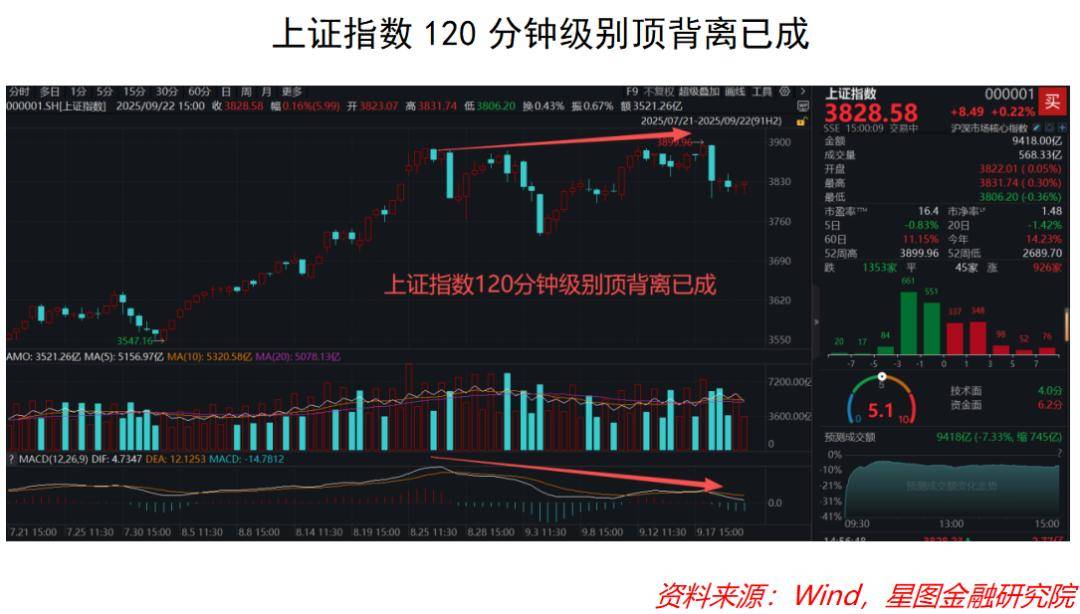
Market Overview - The A-share market saw all three major indices rise today, with the Shanghai Composite Index up 0.22%, Shenzhen Component Index up 0.67%, and ChiNext Index up 0.55% [1] - The total trading volume was 21,425 billion yuan, a decrease of 2,069 billion yuan from the previous day, with over 2,100 stocks in the green [1] - Key sectors that performed well included precious metals, consumer electronics, semiconductors, and liquid-cooled servers, while sectors like film and television, tourism and hotels, paper, energy metals, liquor, and pesticides underperformed [1] Market Sentiment - Following the Federal Reserve's interest rate cut last Thursday, the market briefly reached a new high of 3,899.96 points, just shy of the 3,900-point mark, but faced a sharp decline due to weakness in the financial sector [1] - The market has shown signs of temporary stabilization over the past two days, despite the reduced trading volume [1] Trading Volume Analysis - The core observation indicator for market momentum is the trading volume, which is essential for sustaining a bull market [3] - Continuous high trading volume indicates strong market participation and bullish sentiment, while declining volume suggests a lack of interest and potential downward pressure [3] Reasons for Low Trading Volume - The "pre-holiday effect" is influencing market activity, as investors tend to reduce holdings before holidays to avoid systemic risks, leading to decreased trading volume [5] - There is a lack of new major news catalysts in the short term, which has contributed to the market's inability to rally [6] - Technical indicators suggest a potential top formation in the market, which may further dampen buying interest and reinforce a cautious sentiment among investors [7] Market Outlook - The market is expected to remain in a consolidation phase before the National Day holiday, with limited upward movement anticipated [9] - Investors are advised to lower positions and wait for clearer signals before increasing exposure, while those looking to trade can consider buying near the lower end of the trading range and selling near the upper end [10] - Long-term bullish sentiment remains intact, with significant policy signals expected from the upcoming 20th Central Committee meeting in October, which could provide new direction for the market [14]

一图看懂历年国庆前后A股市场表现
天天基金网· 2025-09-22 09:06
Group 1 - The core viewpoint indicates that the A-share market shows a low probability of rising in the five trading days before the National Day holiday, but the last trading day before the holiday has a 70% probability of an increase, while the market tends to rise after the holiday [1][6] - Historical data from 2015 to 2024 shows that the Shanghai Composite Index has a 70% probability of rising on the first trading day after the holiday and a 60% probability of rising in the following five trading days [2][6] - The leading sectors in the A-share market before and after the National Day holiday exhibit significant rotation, covering various fields such as consumption, pharmaceuticals, and technology [6][7] Group 2 - The leading sectors for the five trading days before the holiday from 2020 to 2024 include Food & Beverage, Social Services, and Defense & Military, while the sectors leading after the holiday include Electronics, Automotive, and Pharmaceuticals [4][6] - The market is expected to maintain a volatile pattern before the holiday, influenced by factors such as the Federal Reserve's interest rate decisions and potential profit-taking by investors [6][7] - The financing trend typically shows a pattern of "contraction before the holiday and explosion after," indicating a shift in risk appetite post-holiday [7]

吴清:“十四五”上证综指年化波动率15.9%,较“十三五”下降2.8个百分点
Di Yi Cai Jing Zi Xun· 2025-09-22 08:13
Core Viewpoint - The resilience and risk resistance capability of the A-share market have significantly improved during the "14th Five-Year Plan" period, with the Shanghai Composite Index's annualized volatility decreasing compared to the previous five-year period [1] Group 1 - The annualized volatility of the Shanghai Composite Index is reported at 15.9% [1] - This represents a decrease of 2.8 percentage points compared to the "13th Five-Year Plan" period [1]
吴清:A股5年分红回购十万亿,科技板块市值占比已超25%
Nan Fang Du Shi Bao· 2025-09-22 08:07
Core Insights - The A-share technology sector now accounts for over 25% of the total market capitalization, with the number of technology companies in the top 50 increasing from 18 at the end of the 13th Five-Year Plan to 24 currently [2][5] - During the 14th Five-Year Plan, listed companies distributed a total of 10.6 trillion yuan through dividends and buybacks, representing an increase of over 80% compared to the 13th Five-Year Plan, and is 2.07 times the amount raised through IPOs and refinancing during the same period [2][5] Market Development - The total market capitalization of the A-share market surpassed 100 trillion yuan for the first time in August this year, indicating significant growth [4] - The financing through stock and bond markets reached 57.5 trillion yuan over the past five years, with the proportion of direct financing increasing by 2.8 percentage points to 31.6% [5] Regulatory Environment - The regulatory framework has been comprehensively restructured, with over 60 supporting rules introduced following the "New National Nine Articles" issued by the State Council last year, laying a solid institutional foundation for the stable development of the capital market [4] - The China Securities Regulatory Commission has imposed 2,214 administrative penalties related to financial fraud, market manipulation, and insider trading during the 14th Five-Year Plan, with fines totaling 41.4 billion yuan, reflecting increases of 58% and 30% respectively compared to the 13th Five-Year Plan [5] Market Resilience - The resilience and risk resistance of the A-share market have significantly improved, with the annualized volatility of the Shanghai Composite Index during the 14th Five-Year Plan at 15.9%, a decrease of 2.8 percentage points from the previous period [5]
吴清最新发声!A股市场韧性和抗风险能力明显增强 含“科”量进一步提升
Xin Lang Zheng Quan· 2025-09-22 07:49
Group 1 - The core viewpoint is that the Chinese capital market has achieved significant stability and development during the "14th Five-Year Plan" period, supported by a robust regulatory framework and market mechanisms [1][2][3] - A comprehensive regulatory system has been established, with over 60 supporting rules introduced following the new "National Nine Articles," laying a solid foundation for market stability [1] - The multi-layered market system has been enhanced, with the A-share market's total market value surpassing 100 trillion yuan in August, and a diverse range of financial products being developed [1][2] Group 2 - The coordination between investment and financing functions has improved, with total financing through stock and bond markets reaching 57.5 trillion yuan over the past five years, and the direct financing ratio increasing by 2.8 percentage points [2] - The technology sector's market capitalization now accounts for over 25% of the A-share market, with the number of technology companies in the top 50 increasing from 18 to 24 [2] - Companies have shown a stronger commitment to returning value to investors, with over 10.6 trillion yuan distributed through dividends and buybacks, an increase of over 80% compared to the previous five-year period [2] Group 3 - The market environment has become fairer, with 2,214 administrative penalties issued for financial misconduct, resulting in fines totaling 41.4 billion yuan, reflecting increases of 58% and 30% respectively compared to the previous five-year period [3] - The resilience and risk resistance of the A-share market have improved, with the annualized volatility of the Shanghai Composite Index decreasing by 2.8 percentage points to 15.9% [2][3] - The achievements during the "14th Five-Year Plan" period are seen as a solid foundation for high-quality development in the "15th Five-Year Plan" [3]
吴清:A股市场韧性和抗风险能力明显增强
证券时报· 2025-09-22 07:37
吴清在国新办新闻发布会上表示,国务院去年出台新"国九条",证监会又会同相关方面相继出台了60余 项配套规则,基础制度和监管底层逻辑得到全方位重构,为资本市场稳定发展打下制度基础。 吴清:5年来上市公司通过分红、回购派发"红包"合计超过10.6万亿元 9月22日,在介绍"十四五"时期金融业发展成就时,中国证监会主席吴清在国新办新闻发布会上表示, 这五年,上市公司通过分红、回购派发"红包"合计超过10.6万亿元,比"十三五"增长超过8成,相当于 同期股票IPO和再融资金额的2.07倍。 吴清:A股市场韧性和抗风险能力明显增强 上证综指年化波动率15.9% 9月22日,在介绍"十四五"时期金融业发展成就时,中国证监会主席吴清在国新办新闻发布会上表 示,"十四五"期间,A股市场韧性和抗风险能力明显增强,上证综指年化波动率15.9%,较"十三五"下 降2.8个百分点。 吴清:近五年交易所市场股债融资合计达57.5万亿元 作者:孙璐璐 贺觉渊 程丹 国务院新闻办公室于今日下午3时,举行"高质量完成'十四五'规划"系列主题新闻发布会,中国人民 银行行长潘功胜,金融监管总局局长李云泽,中国证监会主席吴清,中国人民银行副行长、 ...

不对劲!A股在等什么?系好安全带了
Sou Hu Cai Jing· 2025-09-22 07:17
Market Overview - The current market is characterized by a lack of direction, with funds being scattered across various sectors without a cohesive movement [1][3] - The main board is experiencing a sideways trend, and if it does not rebound, the overall index may struggle to rise further [1][3] Investor Sentiment - Large funds are waiting for a significant positive catalyst to justify a market rally, leading to a cautious trading environment [3][4] - There is a growing skepticism about the bull market, with many investors feeling trapped or sidelined [4][6] Trading Volume and Activity - Trading volume has decreased significantly, dropping from 3 trillion to 2 trillion, indicating a decline in market interest [6][8] - Despite a broad increase in individual stocks, the overall index remains stagnant, suggesting a disconnect between stock performance and index movement [3][4] Future Outlook - The market is anticipated to experience a reversal in an unexpected manner, with a higher likelihood of an upward movement compared to a sharp decline [6] - The sentiment among retail investors has cooled, with many preferring to wait for better opportunities post-holiday [8]

股指结构牛,债市持续震荡
Chang Jiang Qi Huo· 2025-09-22 05:46
Group 1: Report's Core View - The short - term A - share market may continue to fluctuate upwards, but short - term volatility should be watched out for. The style may become more balanced in the future, and a defensive allocation is recommended, focusing on opportunities in technology sector rotation, high - dividend, and cyclical sectors. The bond market is expected to be volatile and bearish [6]. - The "watch - the - stock - to - trade - bonds" principle dominates short - term trading, and the bond market is difficult to decline significantly before the stock market cools down [8]. Group 2: Stock Index Strategy Stock Index Trend Review - Last week, the A - share market showed a significant divergence. The Shanghai Composite Index representing large - cap blue - chips fell, while the Shenzhen Component Index, ChiNext Index, and STAR Market Index rose. The weakness of financial and real - estate sectors dragged down the Shanghai - related indices, while the growth - style sectors provided support for relevant indices [6]. Technical Analysis - The market maintained a differentiated pattern last week. The ChiNext and STAR Market indices were strong, while the SSE 50 was weak. After a ground - volume rebound on a certain day in August, there was a significant volume decline on Thursday, forming a divergence with the previous up - volume. The short - term profit - taking pressure was prominent [6]. Strategy Outlook - Reasonably control positions and pay attention to policies and sector rotation rhythms [6]. Group 3: Treasury Bond Strategy Treasury Bond Trend Review - The bond market oscillated last week. Although the central bank made a net injection, liquidity did not loosen significantly due to tax - period disturbances. Rumors of the central bank's bond - buying operation and the Fed's interest - rate cut provided some support [9]. Technical Analysis - The T - contract K - line oscillated upwards, with the MACD yellow and white lines intertwined, and the BOLL lines still opening downwards [9]. Strategy Outlook - The bond market is expected to be volatile and bearish. It is recommended to reduce positions in a timely manner [9]. Group 4: Key Data Tracking PMI - In July, the manufacturing PMI dropped to 49.3%, weaker than market expectations and seasonal trends. Both supply and demand sides weakened, with external demand falling more significantly on the demand side and production slowing on the supply side. Upstream non - ferrous and steel industries improved, while downstream export - oriented industries were suppressed [13]. Inflation - In a certain month, the year - on - year CPI was flat, and the month - on - month CPI rose by 0.4%. The year - on - year PPI decreased by 3.6%, and the month - on - month PPI decreased by 0.2%. There were positive changes in prices, but the year - on - year CPI and PPI remained sluggish [16]. Industrial Added Value - The year - on - year growth rate of industrial added value in a certain month dropped to 5.7%, and the growth rate of the service production index dropped to 5.8%. The decline in industrial added value was mainly due to the export - oriented industries such as automobiles, electronics, textiles, and electrical machinery [19]. Fixed - Asset Investment - The estimated year - on - year growth rate of fixed - asset investment in a certain month turned negative to - 5.2%. The reasons were complex, including short - term factors like extreme weather and statistical method issues, medium - term factors such as export - expectation decline and policy implementation, and long - term factors like the shrinking real - estate investment [22]. Social Retail Sales - The year - on - year growth rate of social retail sales in a certain month dropped to 3.7%, and that of above - quota retail sales dropped to 2.8%. The decline was mainly reflected in low - level fluctuations in catering revenue, weak sales of state - subsidized products, and a decline in real - estate - related consumption [25]. Social Financing - In a certain month, new social financing was 1.2 trillion yuan, and new RMB loans were negative. At the end of the month, the year - on - year growth rate of social financing stock was 9.0%, and that of M2 was 8.8%. Although the credit growth was negative, the growth rates of social financing, M1, and M2 improved. In the future, the social financing growth rate may peak and decline, and policies may be adjusted according to the situation [28]. Import and Export - In a certain month, China's exports were $3217.8 billion, imports were $2235.4 billion, and the trade surplus was $982.4 billion. The import and export performance was stronger than expected, mainly due to the "rush" behavior under the threat of US tariffs on semiconductors and pharmaceuticals [31]. Group 5: Weekly Focus - The report lists a series of US economic indicators to be focused on, including the second - quarter core PCE price index, personal consumption expenditure, real GDP, and initial jobless claims [33].