
大模型

Search documents
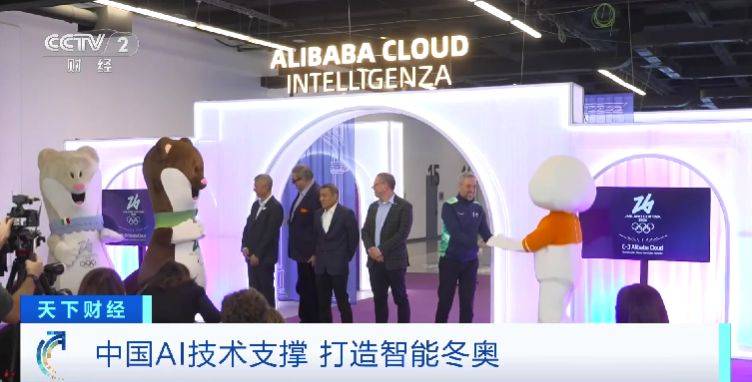
中国AI助力冬奥会智能化:官方大模型、“子弹时间”提升赛事体验
Sou Hu Cai Jing· 2026-02-06 12:18
Core Insights - The 25th Winter Olympics opening ceremony is set to take place at 3 AM Beijing time on February 7, featuring the first official large model in Olympic history, enhancing the event's intelligence [1] Group 1: Technological Innovations - The International Olympic Committee (IOC) has introduced an official large model supported by Chinese technology, which is operational in both professional event management and public services [3] - The "National Olympic Committee AI Assistant" allows team members to ask questions in their native language, significantly improving collaboration efficiency during preparations [3] - The "Olympic AI Assistant" provides real-time, accurate answers to global audiences regarding event rules and Olympic history [3] Group 2: Enhanced Viewing Experience - AI technologies, including "bullet time," have been deployed in 10 core venues of the Milan Winter Olympics, covering over two-thirds of the competition events such as alpine skiing, snowboarding, and ski jumping, enhancing the viewing experience for global audiences [7] - The Chief Technology Officer of the Olympic Broadcasting Services emphasized the dynamic nature of winter sports and the importance of technology in capturing athletes' performances from various angles to help audiences better understand the sports [9] Group 3: Acknowledgment of Contributions - The IOC President expressed gratitude for the Chinese technology that has made the Milan Winter Olympics one of the most intelligent in history, opening new possibilities for the Olympic movement [5]

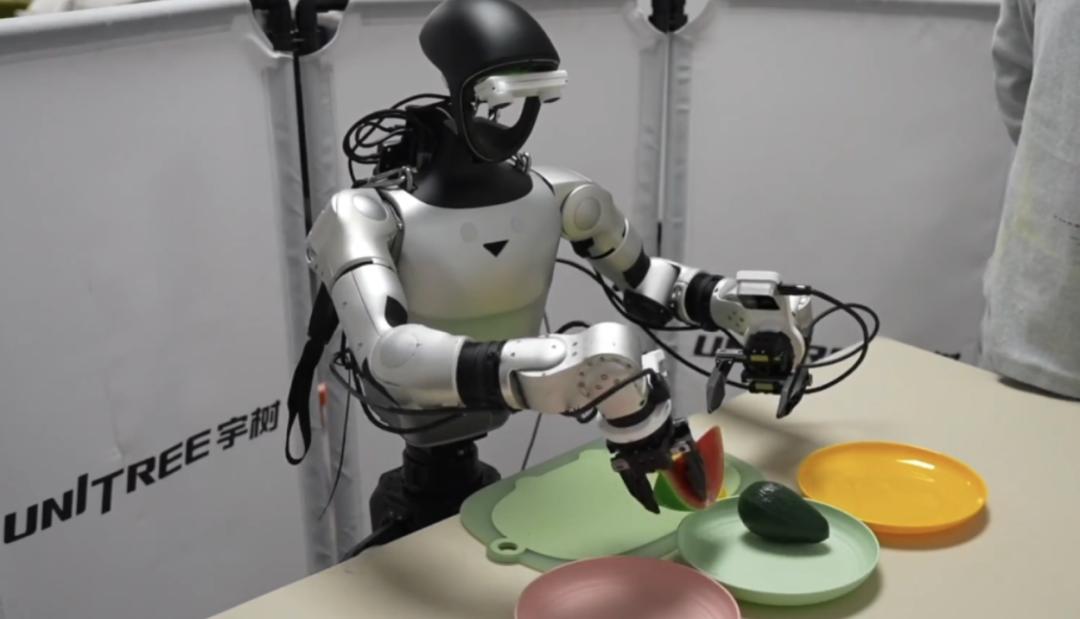
人形机器人告别“本体时代”?
3 6 Ke· 2026-02-06 12:11
Core Insights - The distinction between "pure body" and "body + large model" factions in humanoid robotics is becoming increasingly blurred, indicating a shift in industry focus towards intelligent interaction rather than just hardware capabilities [1][2][4] Group 1: Industry Trends - Industry leaders are recognizing the importance of integrating advanced models into humanoid robotics, with a notable shift in narrative as traditional "body" manufacturers begin to emphasize the significance of "brains" [2][5] - The competition is evolving from merely enhancing production capacity to a new battleground focused on intelligent interaction and model development [4][10] Group 2: Strategic Collaborations - Several body manufacturers are actively pursuing partnerships to enhance their model capabilities, such as the strategic collaborations between Songyan Power and Huichen, and Zhongqing Robotics with Fengwu Technology [6][8] - The launch of various models by companies like Yushu Technology and Ant Group reflects a rapid development in the foundational technology for embodied intelligence [8][9] Group 3: Market Dynamics - The humanoid robotics market is maturing, with over 140 companies and more than 330 products released, indicating that humanoid robots are no longer rare [10][13] - The production capabilities have significantly improved, with a new platform capable of producing 5,000 units annually, highlighting the industry's transition from a challenging task to a mature industrial capability [11][13] Group 4: Opportunities and Challenges - The shift towards model integration presents both challenges and opportunities, as companies must compete with established players while also developing their own model capabilities [14][15] - The market is not closing opportunities for smaller companies, as flexibility and targeted approaches can still lead to breakthroughs in niche areas [15][16] Group 5: Valuation and Investment Landscape - The valuation of companies in the embodied intelligence sector is heavily influenced by their model capabilities, with leading firms being those that are model-driven or utilize a dual approach [16][17] - The industry's focus is shifting from mere production to a comprehensive system capability, emphasizing the need for both physical and intelligent components to succeed [19][20]



Meta(Meta.O)2025年四季度业绩点评:AI商业化兑现持续,CapEx持续增长,建议关注模型能力提升
Guolian Minsheng Securities· 2026-02-06 10:45
Investment Rating - The report maintains a "Buy" rating for Meta, indicating a strong outlook for the company's stock performance relative to the benchmark index [11]. Core Insights - Meta's Q4 2025 performance exceeded expectations, with revenue reaching $59.9 billion, a 24% year-over-year increase, and GAAP EPS of $8.88, significantly surpassing market forecasts [2]. - The company has provided a strong revenue guidance for Q1 2026, estimating between $53.5 billion and $56.5 billion, alongside a substantial increase in capital expenditures for 2026, projected at $115 billion to $135 billion, primarily focused on AI capabilities and infrastructure [2][5]. - The Family of Apps segment generated $58.9 billion in revenue for Q4 2025, up 25% year-over-year, driven by a 24% increase in advertising revenue [2]. - Reality Labs reported $955 million in revenue for Q4 2025, a 12% decline year-over-year, with future investments shifting towards AI glasses and wearable devices [2]. Business Performance and User Metrics - In Q4 2025, the Family of Apps had over 3.5 billion daily active users, with Facebook, Instagram, and WhatsApp showing steady growth [3]. - Instagram Reels saw over a 30% increase in viewing time year-over-year, while Threads experienced a 20% increase in user engagement due to improved recommendation systems [3]. AI Integration and Business Impact - AI continues to enhance core business operations, with advertising and content recommendations entering a "model scaling" phase [4]. - The GEM advertising model and new sequence learning architecture contributed to a 3.5% increase in Facebook click-through rates and over 1% improvement in Instagram conversion rates in Q4 [4]. - Meta has integrated large language models (LLMs) into its recommendation systems, significantly improving content understanding and user interest [4]. Capital Expenditure and Profit Outlook - Meta has raised its capital expenditure guidance for 2026 to $115 billion to $135 billion, reflecting a significant year-over-year increase [5]. - Despite the rise in capital expenditures, the company expects absolute operating profits in 2026 to exceed those of 2025, supported by improved AI advertising efficiency and core business growth [5]. - The report expresses confidence in Meta's long-term growth potential driven by AI, with a clear path for revenue and profit enhancement [5].
昨夜,OpenAI 与 Anthropic 双雄打擂台,专家:2026 年 Agent 将在产业里遍地开花
3 6 Ke· 2026-02-06 10:43
Core Insights - The AI industry is at a critical juncture, with current research paths yielding diminishing returns, necessitating a paradigm shift for the next leap forward [1][2] - The year 2026 is anticipated to be pivotal for the large-scale deployment of AI agents, marking a significant transition from concept to real-world application [1][2] AI Development Overview - AI is experiencing a platform period of stepwise evolution, with the marginal returns of existing technology paths decreasing [5][6] - The core competitive gap between China and the US lies not in technical routes but in high-quality data and computational resources [2][11] Industry Application and Trends - There exists a time lag between technological breakthroughs and industry adoption, similar to historical technological revolutions [12][13] - AI's current industry penetration is high, but its contribution to GDP remains limited, indicating a need for better integration of AI capabilities into practical applications [12][13] Future Directions in AI - The next generation of breakthroughs may involve addressing the limitations of current AI paradigms, such as enhancing memory and continuous learning capabilities [7][10] - New training paradigms and methodologies inspired by neuroscience and innovative data sources are being explored [7][10] AI Agents and Coding Agents - AI agents are seen as foundational models that enhance intelligence and productivity, with significant advancements expected in 2026 [8][10] - Coding agents are revolutionizing software development, allowing individuals to rapidly create multiple products, thus changing traditional development paradigms [15][16] Competitive Landscape - The development of general large models is becoming increasingly mature, with companies like OpenAI and Anthropic leading the way [18][19] - The focus on domain-specific models may be limited, as general models demonstrate superior performance across various applications [18][19] Talent Development and Research Focus - The emphasis on cultivating AI talent is crucial, with a focus on mathematical and engineering skills, as well as the ability to identify and solve complex problems [21][22] - Research efforts are directed towards creating predictive models that can assist in decision-making across various sectors [20][24]
港股异动 | 博泰车联(02899)涨超4%再破顶 公司携手平安财险重构智慧出行保险生态
智通财经网· 2026-02-06 06:52
Core Viewpoint - Botai Carlink (02899) has seen a significant increase in stock price, reaching a new high of 282 HKD, driven by a strategic partnership with Ping An Insurance to innovate insurance services through AI and connected vehicle technology [1] Group 1: Company Developments - Botai Carlink's stock rose over 4% in the afternoon session, with a trading volume of 10.42 million HKD [1] - The company announced a framework cooperation agreement with Ping An Insurance, aiming to integrate AI, connected vehicle technology, and insurance services to enhance user experience and transform the insurance ecosystem [1] Group 2: Technological Advancements - Botai Carlink is accelerating the commercialization of its technological achievements in smart cockpits, large models, and embodied intelligence [1] - A comprehensive strategic partnership was established with SenseTime in October 2025, focusing on the deep application of AI large models in smart cockpits and exploring future avenues such as humanoid robots and integrated cockpit-driving systems [1]

一家“上天下海”的科技公司,将机器人请上台办了个演唱会|最前线
3 6 Ke· 2026-02-06 06:46
编辑 | 邓咏仪 作者 | 王欣逸 2月4日,在苏州奥体中心体育场,"敢梦敢为·追觅之夜"演唱会开幕,追觅科技以演唱会的形式举办了公司年会。会上,追觅展示了其在市场上的优异成绩 和全生态产品阵容,抽出近千件追觅旗下产品,包括扫地机器人、洗地机、大家电等多个品类。魔法原子机器人也亮相演唱会现场,表演了一段舞蹈和单手 倒立炫技动作。 自成立以来,追觅科技持续加大技术研发投入,已经在全球范围内申请了超万项专利。目前,追觅科技的业务已覆盖全球120多个国家和地区,全球实体门 店超过6500家,累计服务家庭超4200万户。 追觅旗下多项核心业务稳居全球行业前三,其扫地机器人在30个国家市场占有率位居第一,洗地机业务在17个国家和地区排名第一,部分市场市占率突破 70%。 成立于2017年的这家公司,如今也远远不只是定位为高端电子消费及智能制造公司。 2026年,追觅始终保持着极高的话题度。 开年,追觅就在海外刷了波存在感,在CES大会上率先出圈,发布了X60系列扫地机器人新品,能带着扫地机上下楼的仿生爬楼机Cyber X以及带机械臂的扫 地机器人Cyber10 Ultra首次展出。 值得一提的是,和追觅同出于清华"天空 ...

闭源美国,开源中国!Kimi代码称王,通义数学夺冠,这份榜单必须转发
Xin Lang Cai Jing· 2026-02-06 00:30
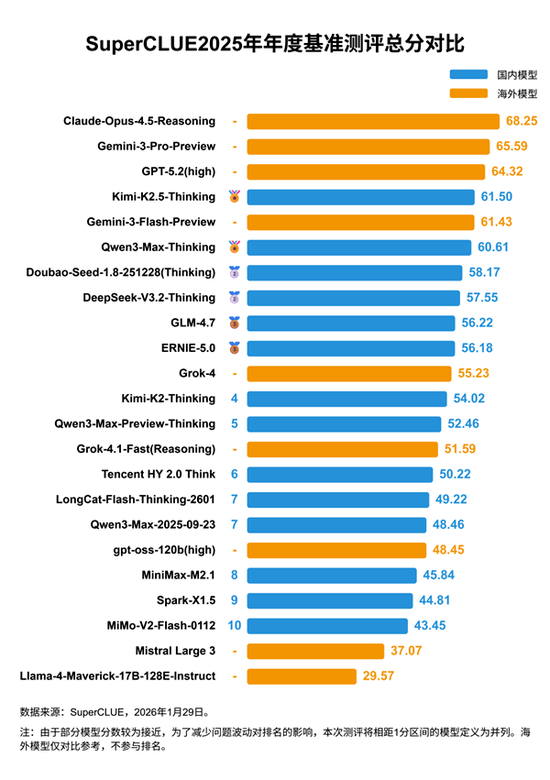
Core Insights - The SuperCLUE report for 2025 highlights significant advancements in Chinese AI models, indicating a shift from "follower" to "peer" status in the global AI landscape, particularly in code generation and mathematical reasoning [1][11][12] Group 1: Global Model Rankings - The top three global models are closed-source, with Anthropic's Claude-Opus-4.5-Reasoning scoring 68.25, Google's Gemini-3-Pro-Preview at 65.59, and OpenAI's GPT-5.2 at 64.32 [2][12] - The highest-ranked Chinese model, Kimi-K2.5-Thinking, achieved 61.50, placing it fourth overall, while Qwen3-Max-Thinking from Alibaba Cloud secured the sixth position with 60.61 [2][12] Group 2: Performance in Specific Domains - In the code generation category, Kimi-K2.5-Thinking scored 53.33, surpassing both GPT-5.2 and Gemini-3-Pro, showcasing its strong potential in algorithm logic and cross-language adaptability [5][15] - In mathematical reasoning, Qwen3-Max-Thinking and Google's Gemini-3-Pro-Preview tied for first place with a score of 80.87, marking a significant achievement for Chinese models in complex reasoning tasks [5][15] Group 3: Open Source Model Dominance - All top five open-source models are from China, with Kimi-K2.5-Thinking leading the pack, demonstrating substantial advancements in scientific reasoning and knowledge application [6][16] - The rise of Chinese open-source models is seen as a victory for the AI ecosystem, providing low-cost and high-control AI solutions for various sectors [6][16] Group 4: Evolution of Chinese AI Models - The Chinese AI industry has transitioned from a focus on "parameter competition" to "capability enhancement," emphasizing precision, stability, and safety [6][17] - Innovations in model architecture and data processing are driving this evolution, supported by national standards in AI safety and compliance [7][17]
硬碰硬!刚刚,Claude Opus 4.6与GPT-5.3-Codex同时发布
机器之心· 2026-02-05 23:45
Core Insights - The article discusses the recent releases of advanced AI models by Anthropic and OpenAI, specifically Claude Opus 4.6 and GPT-5.3-Codex, highlighting their significant improvements in performance and capabilities [2][15]. Summary of Claude Opus 4.6 - Claude Opus 4.6 represents a major upgrade for Anthropic's flagship AI model, featuring a more cautious planning approach and the ability to maintain longer autonomous workflows [5]. - The model introduces a context window of 1 million tokens, allowing it to process and reason with significantly more information than previous versions [6]. - It includes a "smart agent team" feature, enabling multiple AI agents to work on different aspects of coding projects simultaneously [6]. - Opus 4.6 outperformed competitors in various assessments, achieving the highest scores in Terminal-Bench 2.0 and leading in the "Humanity's Last Exam" [7]. - In GDPval-AA, Opus 4.6 scored approximately 144 Elo points higher than OpenAI's GPT-5.2 and 190 points higher than its predecessor, Claude Opus 4.5 [7]. - The model's performance in MRCR v2 testing showed a score of 76%, significantly higher than Sonnet 4.5's 18.5%, indicating a qualitative leap in context utilization [9]. Summary of GPT-5.3-Codex - OpenAI's GPT-5.3-Codex claims to have the best coding performance to date, achieving record scores in multiple benchmarks, including 56.8% in SWE-Bench Pro and 77.3% in Terminal-Bench 2.0 [16][19]. - The model integrates the advanced coding capabilities of GPT-5.2-Codex with enhanced reasoning and expertise from GPT-5.2, resulting in a 25% speed improvement [19][20]. - GPT-5.3-Codex is designed to function as a comprehensive work assistant, capable of handling tasks across the software lifecycle, including debugging, deployment, and user research [25]. - The model allows for real-time interaction, enabling users to guide and supervise multiple working agents without losing context [27]. - OpenAI emphasizes that the advancements in GPT-5.3-Codex have fundamentally changed the workflow of their research and engineering teams, enhancing productivity and interaction quality [28][29]. Conclusion - The article concludes that the competitive landscape of AI models is intensifying, with both Anthropic and OpenAI making significant strides in capabilities and performance, setting the stage for further developments in the industry [31].

全面AI化,腾讯C端超级入口争夺战大反击
2 1 Shi Ji Jing Ji Bao Dao· 2026-02-05 13:18
Core Insights - Tencent is launching a significant initiative in AI, emphasizing its strategic importance within the company [1][3] - The company is actively promoting its AI application "Yuanbao" through a large-scale marketing campaign, including a cash red envelope initiative during the Spring Festival [2][4] Group 1: AI Strategy and Initiatives - Tencent's AI strategy is gaining momentum, with "Yuanbao" becoming a central focus for consumer-facing AI applications [2][4] - The Spring Festival campaign aims to replicate the success of the WeChat red envelope phenomenon, leveraging social media to drive user engagement [4] - "Yuanbao" has quickly risen to the top of the App Store rankings, indicating effective market penetration [4] Group 2: Competitive Landscape - Tencent faces stiff competition from ByteDance's "Doubao" and other emerging AI applications, which are rapidly gaining user traction [9] - As of September 2025, "Doubao" has reached approximately 172 million monthly active users, surpassing Tencent's offerings [9] Group 3: Product Development and Features - The "Yuanbao" application has introduced new features like "Yuanbao Pai," which enhances group interactions using AI capabilities [4] - Another AI application, "ima," targets knowledge-intensive scenarios and has been integrated with DeepSeek technology, showcasing Tencent's commitment to diverse AI applications [5][6] Group 4: Infrastructure and Investment - Tencent is investing heavily in AI infrastructure, with capital expenditures reaching a historical high of 76.7 billion yuan in 2024, accounting for 12% of total revenue [12] - The company is also focusing on building partnerships and investing in AI chip startups to enhance its technological capabilities [13] Group 5: Future Outlook and Challenges - Tencent is exploring the integration of AI into its flagship WeChat application, aiming to create a unique AI agent that enhances user experience [14] - Despite the potential, challenges remain, including privacy concerns and the need for significant investment in AI capabilities [14][15]

广日股份:公司在人工智能方面主要布局大视觉等关键技术的研发与应用
Zheng Quan Ri Bao Wang· 2026-02-05 11:14
证券日报网讯2月5日,广日股份(600894)在互动平台回答投资者提问时表示,公司在人工智能方面主 要布局大视觉、大数据、大模型、具身智能等关键技术的研发与应用,已经形成了广日物道智能物联网 平台、广日物语边缘计算设备两大产品体系,为电梯、照明、空调等多类产品装上了"智慧大脑",实现 对设备的实时监测与反馈调节,使楼宇、园区等场景管理更精准、更有效。 ...
