
中美贸易博弈

Search documents
中国反制美国大豆,特朗普破防怒发小作文,引美国资本市场遭震荡
Sou Hu Cai Jing· 2025-10-19 15:06
Core Viewpoint - The recent adjustments in China's soybean procurement from the U.S. have caused significant concern for the Trump administration, leading to market volatility, highlighting the strategic depth of the ongoing U.S.-China trade conflict [1][3][21] Group 1: China's Countermeasures - China's countermeasures have been targeted, starting with special port fees on U.S. vessels, increasing operational costs for American shipping companies [3] - The introduction of rare earth export controls directly impacts U.S. high-end industries, as over 90% of U.S. rare earth needs are met through imports [3] - The combination of these measures has led to panic in the U.S., with significant market repercussions, including a chaotic stock market response [3][5] Group 2: U.S. Response and Market Implications - Trump's reaction to China's soybean procurement changes has been notably intense, indicating deeper implications beyond just agricultural interests [5][7] - The U.S. soybean market is currently facing an oversupply due to reduced Chinese purchases, disrupting the usual price signals in the futures market [13] - Speculation arises that Trump's family may be positioned to profit from these market fluctuations, suggesting a financial motive behind his public statements [13][19] Group 3: Broader Economic Impact - The ongoing trade conflict is not merely a dispute over agricultural products but reflects a broader struggle over industrial security and financial stability between the two nations [21] - Trump's public comments risk undermining the stability of U.S. financial markets, which are crucial for the credibility of the dollar [19] - The strategic nature of China's countermeasures demonstrates a calculated approach to target vulnerabilities in the U.S. economy, indicating a sophisticated level of economic warfare [21]

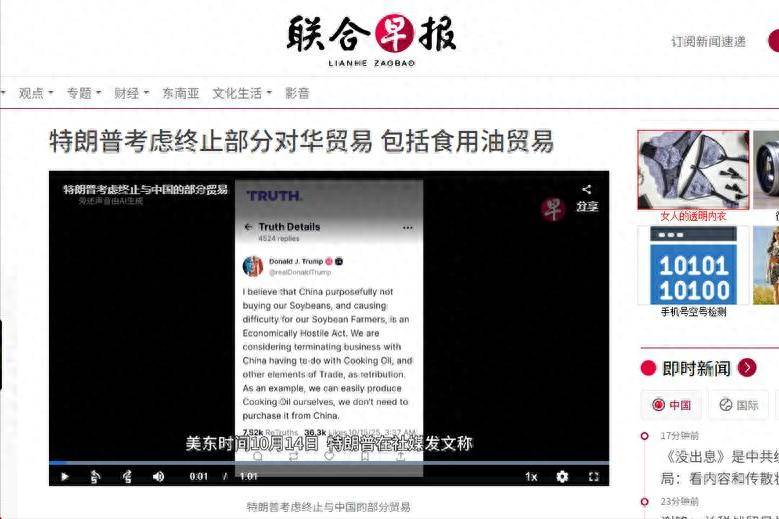
中国用三个信号正告美国,对特朗普失去耐心,中方会越打越强硬?
Sou Hu Cai Jing· 2025-10-19 11:24
Core Viewpoint - China has shifted from negotiation to a hardline stance against the U.S., indicating a loss of patience with the Trump administration's trade policies [1][3][24] Group 1: China's Stance and Strategy - China has clearly demonstrated a confrontational position against the U.S., showing no easy path for compromise, reflecting confidence in its own strength in the trade war [3][24] - The Chinese government has consistently implemented reciprocal measures in response to U.S. tariffs, indicating a firm resolve to resist pressure [3][21] - The strategic use of rare earth controls serves as a significant countermeasure, impacting U.S. high-tech and military industries due to China's central role in the global rare earth supply chain [5][19] Group 2: Economic Impact and Market Diversification - The U.S. tariff measures are expected to negatively affect the domestic economy, as evidenced by the backlash from U.S. agricultural states against the Trump administration [5][19] - China's export market diversification has been effective, with the share of exports to the U.S. dropping from 19.2% in 2018 to an anticipated 10% by 2025, while exports to Europe, Russia, and other developing countries are on the rise [10][19] - The automotive sector, particularly electric vehicles, has seen significant growth, with exports exceeding 1.75 million units in the first three quarters of 2025, marking a nearly 90% year-on-year increase [10] Group 3: Technological Independence and Strategic Adjustments - China's advancements in technology, particularly in semiconductors, have led to a reduction in reliance on U.S. imports, with domestic alternatives emerging in response to U.S. export restrictions [13][19] - The strategic shift towards energy import diversification has strengthened China's position, reducing dependence on U.S. energy supplies and enhancing energy security [19][21] Group 4: Response to U.S. Actions - China's recent measures, including the escalation of rare earth controls, are seen as a logical response to the U.S.'s increasing pressure and sanctions [15][19] - The ongoing trade conflict is characterized by a series of U.S. measures aimed at China, which have prompted China to enhance its resilience and risk management strategies [15][19] - The outcome of this prolonged conflict will depend on the determination and preparedness of both sides, with China having established a comprehensive response system over the years [24]

美国邮轮获得豁免,挂靠中国港口不用缴纳特别港务费,怎么回事?
Sou Hu Cai Jing· 2025-10-19 06:57
Core Viewpoint - The ongoing U.S.-China trade tensions have led to the introduction of a special port fee for U.S. vessels docking in China, reflecting China's strategic response to U.S. sanctions and trade policies [1][3]. Group 1: Special Port Fee Implementation - Starting from October 14, 2025, all vessels related to the U.S. must pay a special port fee, which is a direct response to the U.S. 301 investigation and aims to protect China's trade interests [3]. - The fee will be charged based on the vessel's net tonnage, starting at 400 RMB per net ton from October 14, 2025, and increasing to 1,120 RMB per net ton by April 17, 2028 [5]. - U.S. cargo ships have already begun docking in Chinese ports and paying the special port fee, as evidenced by the "Manukau" container ship from Matson Navigation Company, which incurred a fee of 4.46 million RMB [5]. Group 2: Impact on Cruise Industry - The three major luxury cruise companies—Norwegian Cruise Line, Royal Caribbean Group, and Carnival Corporation—hold over 75% of the global market share and face significant challenges due to the high special port fees when docking in China [7]. - Two main strategies have emerged for U.S. cruise lines: canceling planned stops in China to avoid fees, as seen with the "RIVIERA" cruise ship, which would have incurred a fee of 11.67 million RMB [9], and applying for fee exemptions [9]. - The "Spectrum of the Seas" cruise ship from Royal Caribbean successfully obtained an exemption, allowing it to dock in China without incurring the fee, which would exceed 67 million RMB per stop by 2028 [12]. Group 3: Conditions for Exemption - To qualify for the exemption, U.S. cruise ships must primarily serve Chinese tourists and operate from Chinese ports, demonstrating China's flexible and consumer-oriented approach in enforcing the special port fee [13]. - The operation of the "Spectrum of the Seas" not only provides quality travel experiences for Chinese tourists but also stimulates domestic consumption, highlighting its importance in the Chinese market [15]. - For U.S. vessels that do not meet the exemption criteria, China will strictly enforce the special port fee policy, emphasizing that the fee is a countermeasure against U.S. maritime pressure rather than a financial necessity [15].

川普放狠话:中国再不卖稀土,就禁买地沟油!转身美股蒸发4500亿
Sou Hu Cai Jing· 2025-10-19 05:32
Core Insights - The recent statements by President Trump regarding the termination of trade cooperation with China in the edible oil sector are misleading, as he refers to "edible oil" as waste cooking oil, known as "gutter oil," which is crucial for producing biodiesel and sustainable aviation fuel [2][4][6] - The import of gutter oil from China to the U.S. has surged from less than 90,000 tons in 2020 to 1.27 million tons in 2024, marking a 14-fold increase, with the U.S. accounting for 43% of China's gutter oil exports [4][6] - Trump's threats to stop purchasing gutter oil could lead to significant consequences, including rising biofuel prices, increased costs in the aviation and transportation sectors, and a decline in the competitiveness of green energy in the U.S. [6][10] Industry Dynamics - China is expanding its market for gutter oil to Europe and Southeast Asia while developing its own sustainable aviation fuel industry, thereby building a self-sufficient supply chain [8][10] - The trade dynamics for soybeans have shifted, with China investing in infrastructure in Brazil and Argentina, resulting in a 56% year-on-year decrease in soybean imports from the U.S. in the first nine months of 2025 [8][10] - The U.S. is increasingly reliant on China for critical resources, including battery materials and rare earth elements, indicating a shift in the global trade landscape [10][12] Market Reactions - Following Trump's announcement, the U.S. stock market saw a loss of $450 billion in market value, while agricultural, biofuel, and technology stocks rose, reflecting investor skepticism about the feasibility of U.S. self-sufficiency in edible oil [6][12] - The market's quick response indicates a recognition that the U.S. cannot easily replace the imports of gutter oil from China [6]

被中国拒绝通话,美贸易代表破大防:忍不了,中国在教美国做人
Sou Hu Cai Jing· 2025-10-17 12:43
Core Viewpoint - The intensifying trade conflict between China and the U.S. has led to significant retaliatory measures from China, particularly affecting critical sectors such as rare earth materials, high-tech industries, and military applications [1][3]. Group 1: U.S. Response - President Trump criticized China on social media, suggesting a potential 100% tariff increase, which resulted in a loss of $1.65 trillion in U.S. stock market value [3]. - U.S. Vice President Pence expressed a desire for rational negotiations with China, while Treasury Secretary Mnuchin indicated that the 100% tariff may not be implemented, highlighting a complex relationship [3]. - U.S. Trade Representative Lighthizer stated that the decision to impose tariffs depends on China's actions, reflecting a sense of arrogance and a belief in U.S. dominance in global trade [7][10]. Group 2: China's Position - China has firmly rejected U.S. attempts to negotiate under current conditions, emphasizing that high tariffs are not an acceptable approach to dealing with them [10]. - The Chinese government has indicated that it will not easily back down in the face of U.S. pressure, suggesting a shift towards a more aggressive stance in the trade conflict [12].

中国是稀土精炼大国,可为什么稀土价格却不由中国说了算?
Hu Xiu· 2025-10-17 09:01
Core Insights - Rare earths have become a key bargaining chip in the current US-China trade conflict, with China's export controls on critical raw materials directly influencing the outcome of subsequent negotiations [1] - Despite China holding over 90% of global rare earth refining capacity and the US relying on China for nearly 60% of refined products, global rare earth prices are not dictated by China [1] Group 1 - Rare earths are essential materials that play a significant role in various high-tech industries [1] - The importance of rare earths is underscored by their strategic value in the context of international trade and geopolitical tensions [1]
美抛出更大筹码,换中方在稀土让步,中国这一关,美国恐怕过不了
Sou Hu Cai Jing· 2025-10-17 05:11
Core Viewpoint - The U.S. government is attempting to pressure China into concessions in the rare earth sector by proposing an extension of the tariff "truce," but this strategy may not succeed in overcoming China's firm stance [1][3][4] Group 1: U.S. Strategy and Actions - U.S. Treasury Secretary Yellen proposed extending the tariff truce to negotiate concessions from China regarding rare earth exports, which are crucial for various industries [1][3] - The U.S. has shown increased anxiety in its negotiations, as evidenced by the lack of public announcements regarding upcoming talks, indicating a potential shift in strategy [1][3] - The U.S. is also seeking discussions on China's soybean purchases, highlighting its reliance on the Chinese market [1][3] Group 2: China's Response and Position - China has demonstrated a strong unwillingness to compromise, implementing stricter rare earth export controls and imposing special port fees on U.S. vessels [4] - The Chinese government has maintained a consistent message of resolving disputes through dialogue, which the U.S. has often overlooked [4] - China's firm stance is further illustrated by its actions against U.S. companies, such as investigations into Qualcomm, signaling a robust response to U.S. pressures [4]

研究所晨会观点精萃-20251017
Dong Hai Qi Huo· 2025-10-17 02:07
Report Industry Investment Rating No relevant content provided. Core View of the Report - Overseas, the weakness of regional banks and the remarks of multiple Fed officials have led to a decline in the US dollar index and US bond yields, and an increase in risk aversion. Domestically, economic growth has accelerated, and multiple industry stabilization and growth plans have been introduced, increasing policy support and boosting domestic risk appetite. The short - term macro - upward drive has strengthened, and attention should be paid to the progress of Sino - US trade negotiations and the implementation of domestic incremental policies. In terms of assets, the stock index is short - term oscillating strongly, and short - term cautious long positions are recommended; treasury bonds are short - term oscillating, and cautious waiting is recommended; among commodity sectors, black is short - term oscillating, and short - term cautious waiting is recommended; non - ferrous metals are short - term adjusted, and short - term cautious long positions are recommended; energy and chemicals are short - term oscillating, and cautious waiting is recommended; precious metals are short - term strongly oscillating at high levels, and cautious long positions are recommended [3]. Summary by Directory Macro Finance - **Macro**: Overseas, the weakness of regional banks and Fed officials' remarks have led to a decline in the US dollar index and US bond yields, and an increase in risk aversion. Domestically, economic growth has accelerated, and policies have increased support, boosting risk appetite. The short - term macro - upward drive has strengthened, and attention should be paid to Sino - US trade negotiations and domestic incremental policies. For assets, the stock index is short - term oscillating strongly, treasury bonds are short - term oscillating, black is short - term oscillating, non - ferrous metals are short - term adjusted, energy and chemicals are short - term oscillating, and precious metals are short - term strongly oscillating at high levels [3]. - **Stock Index**: Driven by sectors such as coal, banking, insurance, and port shipping, the domestic stock market rose slightly. With the acceleration of domestic economic growth and the increase in policy support, risk appetite has increased. Short - term cautious long positions are recommended [4]. - **Precious Metals**: The precious metals market continued to rise. With the increase in risk aversion and the expectation of Fed rate cuts, spot gold reached a record high. Short - term, precious metals are strongly running, and the medium - and long - term upward pattern remains unchanged. Short - term, long positions can be held or reduced on rallies; medium - and long - term, buy on dips [4]. Black Metals - **Steel**: The domestic steel spot market was weak on Thursday, but the futures price rebounded slightly. Market expectations have improved due to the approaching Fourth Plenary Session and expectations for the APEC meeting. The real demand has improved marginally, and steel supply may decline stage - by - stage. The steel market is expected to oscillate in a range in the short term [6]. - **Iron Ore**: On Thursday, the spot price of iron ore rebounded slightly, while the futures price declined. Iron production is still high, and steel mills' restocking has ended. With the narrowing of profits, the willingness to cut production may increase. The global iron ore shipment volume has decreased, and the port inventory has increased. A bearish view is recommended for iron ore prices [8]. - **Silicon Manganese/Silicon Iron**: On Thursday, the spot prices of silicon iron and silicon manganese were flat, and the futures prices rebounded from the bottom. The demand for ferroalloys has decreased due to the decline in steel production. The supply of silicon manganese has decreased, and the Lanzhou charcoal market is stable. The futures prices of silicon iron and silicon manganese are expected to continue to oscillate in a range [9]. - **Glass**: On Thursday, the glass futures contract oscillated weakly in a range. Supply has increased marginally, and there is an expectation of anti - involution, forming a bottom support. Demand has improved marginally during the traditional peak season but is currently slowing down. It is expected to run weakly in a short - term range [10]. Non - ferrous Metals and New Energy - **Copper**: From January to September, Kazakhstan's refined copper production increased by 1.2% year - on - year. Copper social inventory is at a relatively high level. The global copper mine output growth rate is expected to be high in 2026. The US economy has uncertainties, which are potential risk points. In the short - and medium - term, domestic electrolytic copper production is high, demand is facing a test, and de - stocking is less than expected [11]. - **Aluminum**: On Thursday, aluminum prices were strong. Aluminum social inventory decreased significantly, and aluminum rod inventory decreased slightly. The smelting profit is high, supply is rigid, imports are high, and demand is weakening marginally. It is expected to oscillate in a range in the short term [12]. - **Tin**: The supply of tin ore is tightening globally. The demand has improved slightly but remains weak. The price is expected to oscillate at a high level, with support from low smelting start - up and peak - season expectations, but the upside is limited by high - price consumption suppression and macro risks [13]. Energy and Chemicals - **Crude Oil**: Trump's statement about meeting with Putin and the upcoming high - level Sino - US and Russia - US talks have raised expectations of increased Russian oil supply. Western sanctions and Sino - US trade tensions have also affected demand. Crude oil prices are expected to decline [14]. - **Asphalt**: As crude oil prices test support, the probability of asphalt breaking through support has increased. Demand is nearing the end, inventory pressure is increasing, and it is difficult for asphalt to have a strong upward drive [14][15]. - **Carbonate Lithium**: On Thursday, the carbonate lithium futures contract rose. With the approach of the contract change - over, the short - term trend is oscillating strongly [14]. - **Industrial Silicon**: On Thursday, the industrial silicon futures contract rose slightly. Production has reached a new high, and the 2511 contract faces the pressure of warehouse receipt digestion. It is expected to oscillate in a range [14]. - **Polysilicon**: On Thursday, the polysilicon futures contract rose. With the approach of the contract change - over, the short - term trend is oscillating strongly due to rumors of storage and capacity regulation [14]. - **PX**: PX is weakly oscillating. Although it gets some demand support from PTA's high - start, it is likely to continue to oscillate weakly following the polyester sector [15]. - **PTA**: After the decline of crude oil prices, polyester is in a low - level oscillation. Downstream demand is weak, supply is high, and inventory is increasing. PTA prices will continue to run weakly [15]. - **Ethylene Glycol**: The sentiment of ethylene glycol is weak. Port inventory is rising, demand is weakening, and supply is increasing. It is expected to continue to be in an oversupply situation in late October [16]. - **PP**: The PP market shows a pattern of both supply and demand increasing. New capacity and restarted devices bring supply pressure, and the price is expected to be weak [18]. - **LLDPE**: The supply of LLDPE is increasing, demand recovery is slow, and the price is expected to continue to oscillate weakly [19]. - **Urea**: The urea market is rising slightly. It is currently in a situation of strong supply and weak demand. The short - term price is under pressure, and its future trend depends on the implementation of export policies [19]. Agricultural Products - **US Soybeans**: Overnight, the CBOT November soybean contract rose. Strong domestic demand offset trade concerns, and the September soybean crushing volume reached a record high [20]. - **Soybean and Rapeseed Meal**: The trading volume of soybean meal increased, and the start - up rate returned to normal. However, the oil mill inventory is under pressure, and the fourth - quarter soybean supply may be loose. Without guidance from US soybeans, it may oscillate at a low level. Attention should be paid to Sino - Canadian trade dynamics for rapeseed meal [20]. - **Soybean and Rapeseed Oil**: With the visit of the Canadian foreign minister, the short - term risk of rapeseed oil has decreased. Soybean oil prices may be relatively weak due to inventory pressure [21]. - **Palm Oil**: Southeast Asian palm oil has entered the production - reduction cycle. In October, Malaysian palm oil production increased, suppressing prices, but exports also increased, providing some support [21]. - **Pigs**: The supply of pigs has increased, leading to a continuous decline in pig prices to a record low. Although there are signs of second - fattening, the quantity is small. With the decrease in temperature and the recovery of consumption, pig prices may stabilize [21][22].
东兴证券晨报-20251016
Dongxing Securities· 2025-10-16 14:39
Core Insights - The report highlights the resilience of the A-share market amidst external shocks, indicating a sustained upward trend in the medium term despite recent volatility [4][5] - The banking sector is experiencing a recovery with positive relative returns, driven by improved dividend yields and stable fundamentals [7][8] - The commercial aerospace industry, particularly in rocket technology, presents investment opportunities in engine component suppliers and testing service providers [12][15] Economic News - China's scientists have made significant advancements in solid-state lithium batteries, potentially doubling the range of electric vehicles from 500 km to over 1000 km [2] - The National Development and Reform Commission has launched a three-year plan to double the service capacity of electric vehicle charging facilities by 2027, aiming for 28 million charging stations [2] - TSMC reported a record net profit growth of 39% in Q3 2025, with optimistic projections for the AI market and a capital expenditure increase [2] Company Insights - XPeng Motors achieved a remarkable 79.4% year-on-year increase in exports in September 2025, with total exports exceeding 29,723 units in the first nine months [3] - Tianhao Energy signed an investment agreement for a natural gas development project, enhancing energy security in the Southwest region [3] - Xiaomi launched a new ad-free short drama app, indicating a strategic move into content distribution [3] Banking Sector Analysis - The banking sector's PB valuation stands at 0.67x, indicating a favorable position compared to historical averages, with several banks showing positive stock performance [7][8] - The report anticipates stable net interest income growth due to a stabilization in interest margins and a resilient banking sector despite external pressures [9] - Mid-term dividend announcements from banks are expected to attract long-term capital, enhancing the sector's appeal [10] Commercial Aerospace Industry - The report emphasizes the importance of engine components and testing services in the commercial rocket industry, particularly referencing SpaceX's development of the Falcon 1 rocket [12][15] - Key suppliers in the domestic market, such as Sui Rui New Materials and Guoji Precision, are highlighted for their roles in providing critical components for rocket engines [16]






研究所晨会观点精萃-20251016
Dong Hai Qi Huo· 2025-10-16 01:49
Group 1: Report Industry Investment Ratings - Not provided in the given content Group 2: Core Views of the Report - Overseas, the Fed's Beige Book shows a slight decline in consumer spending and generally weak labor demand. Fed Governor Milan calls for a faster pace of interest rate cuts, which leads to a decline in the US dollar index and US Treasury yields, and an overall increase in global risk appetite. Domestically, economic growth has accelerated, and with the release of restrained statements from both China and the US, domestic risk appetite has rebounded. Multiple industry stabilization and growth plans have been introduced, strengthening the short - term upward macro - drive. The market's trading logic focuses on domestic incremental stimulus policies and China - US games [3]. - In the asset market, the stock index is short - term oscillating strongly, and short - term cautious long positions are recommended; treasury bonds are short - term oscillating, and cautious waiting and watching are advised; among commodity sectors, black commodities are short - term oscillating, short - term cautious waiting and watching; non - ferrous metals are short - term adjusted, short - term cautious long positions; energy and chemicals are short - term oscillating, cautious waiting and watching; precious metals are short - term strongly oscillating at high levels, cautious long positions [3]. Group 3: Summary by Related Catalogs Macro - finance - Overseas: The Fed's Beige Book indicates a slight decline in consumer spending and weak labor demand. Fed Governor Milan calls for faster rate cuts, with two more cuts this year being realistic. This causes the US dollar index and US Treasury yields to fall, and global risk appetite to rise. Domestic: Economic growth accelerates, and with China - US restraint, domestic risk appetite rebounds. Multiple industry support policies are introduced, enhancing the short - term upward macro - drive. Focus on China - US trade talks and domestic incremental policies. Asset suggestions: short - term long for stock indices, cautious waiting for treasury bonds, different strategies for different commodity sectors [3]. Stock Index - Driven by sectors such as automobiles, consumer electronics, and airport shipping, the domestic stock market rises significantly. With economic growth accelerating, China - US restraint, and policy support, domestic risk appetite rebounds. Short - term long positions are recommended [4]. Precious Metals - The precious metals market continues to rise. Driven by Fed rate - cut expectations and geopolitical tensions, spot gold reaches new highs with increased short - term volatility. Short - term long positions can be held or reduced at high prices, and long - term buying on dips is advised [4]. Black Metals Steel - The domestic steel futures and spot markets remain weak, with low trading volumes. The fundamentals are weak, with inventory rising and apparent consumption falling. Although production is falling, mills have weak willingness to cut production. The market may continue to be weak in the short term [6]. Iron Ore - Futures and spot prices of iron ore continue to fall. With high iron - water output and shrinking mill profits, the willingness to cut production may increase. Supply shows a decline in global shipments and an increase in arrivals, and port inventory rises. A bearish view is recommended [7][8]. Silicon Manganese/Silicon Iron - Spot and futures prices of silicon iron and silicon manganese rebound slightly. Demand decreases due to a slight decline in steel production. Manganese ore prices are weak. Supply shows a decrease in the开工 rate and daily output of silicon manganese. Prices are expected to oscillate in a range [9]. Non - ferrous Metals and New Energy Copper - Copper prices rise and then fall. In 2026, global copper mine output growth is expected to be high, and the Panama Cobre copper mine may restart. US economic uncertainties are a risk. Domestically, electrolytic copper production is high, but demand is facing challenges, and inventory reduction is below expectations [11]. Aluminum - Aluminum prices rise slightly as trade - tension concerns ease. Inventory is increasing, supply is rigid, demand is weakening, and it is expected to oscillate in a range in the short term [12]. Tin - Supply is tight globally due to Indonesia's crackdown on illegal mining and policy adjustments. Demand improvement is limited. Prices are expected to oscillate at high levels, with support from tight supply and limited upside due to consumption suppression and macro risks [12]. Lithium Carbonate - Battery - grade lithium carbonate is priced at 73,150 yuan/ton. With trade conflicts and potential spot selling pressure, the short - term upward drive is insufficient, and it is expected to oscillate in a range [13]. Industrial Silicon - The price of industrial silicon is stable. With high production and no significant inventory accumulation, it is expected to oscillate in a range, and attention should be paid to the cost support [13]. Polysilicon - Polysilicon prices are stable. With increasing warehouse receipts and supply - demand imbalance, it is expected to oscillate in a range, and attention should be paid to the spot price support [14]. Energy and Chemicals Crude Oil - Despite Fed rate - cut signals, oil prices are under pressure due to OPEC+ production increases. US key price indicators fall, and some market indicators weaken. Oil prices will test lower levels, and macro risks should be monitored [15]. Asphalt - Oil prices are low, and asphalt oscillates at the bottom. Demand is near the end, inventory pressure is increasing, and it is necessary to monitor the cost support from crude oil [15][16]. PX - PX oscillates weakly, with demand support from PTA high - level operation. It is likely to continue to oscillate weakly with the polyester sector [16]. PTA - Polyester products oscillate at low levels. With high supply, increasing inventory, and weakening demand, PTA prices will continue to be weak [16]. Ethylene Glycol - Ethylene glycol sentiment is weak. With rising inventory, new production expectations, and weak demand, it is expected to accumulate inventory in late October and trade at low levels [17]. Short - fiber - Short - fiber adjusts with the polyester sector. With limited terminal orders and inventory accumulation, it is expected to oscillate weakly in the short term [17]. Methanol - Methanol prices oscillate weakly. Supply growth exceeds demand recovery, and high inventory suppresses prices. Attention should be paid to US sanctions on Iran [18]. PP - PP prices fall. The market has a pattern of increasing supply and demand, but new capacity and trade conflicts lead to a bearish view [19]. LLDPE - LLDPE prices adjust. Supply pressure is increasing, demand recovery is slow, and with weak oil prices and trade conflicts, it is expected to oscillate weakly [20][21]. Urea - Urea prices are stable. The market is in a supply - strong and demand - weak situation. Although Indian tenders are a potential positive, export policies are unclear. Prices are expected to be under pressure in the short term [21]. Agricultural Products US Soybeans - CBOT November soybeans rise slightly. US soybean crushing in September reaches a high level, with significant month - on - month and year - on - year increases [22]. Soybean Meal/Rapeseed Meal - After the National Day, the market sentiment improves, but oil - mill inventory pressure remains high. With sufficient soybean supply in the fourth quarter, soybean meal may oscillate at low levels. Attention should be paid to China - Canada trade for rapeseed meal [22]. Soybean Oil/Rapeseed Oil - With the visit of the Canadian foreign minister, short - term rapeseed oil risk weakens. Soybean oil inventory pressure remains, and prices may be weak [22]. Palm Oil - Southeast Asian palm oil enters the production - reduction cycle. October production in Malaysia increases, suppressing prices, while exports also increase, providing some support. The implementation of Indonesia's B50 is expected to be in the second half of next year, and short - term demand growth is unlikely [22]. Live Pigs - Pig supply increases in September and October, leading to a continuous decline in pig prices to a record low. Although there are signs of second - fattening, it is not enough to support prices. With the expectation of increased consumption in autumn and winter, pig prices may stabilize [23][24].