品牌力

Search documents
酒鬼酒SKU压减50%,淘汰销量占比低且无增长潜力产品,称内参品牌短期不追求量大幅提升
Cai Jing Wang· 2025-05-27 08:40
Core Viewpoint - The company aims to enhance sales quality by focusing on brand strength, product strength, channel strength, and system strength in 2025, with a core strategy of "everything for high-quality sales" [1][4]. Group 1: Sales Strategy - The company has identified that government consumption currently represents a minimal portion of its product sales, indicating that related policies have a limited impact on the company [1]. - The company plans to implement a "2+2+2" strategic product system, which includes two strategic products, two key products, and two basic products, while reducing its SKU by 50% to eliminate low-performing products [1][3]. - The company is focusing on a full-chain layout to drive scale breakthroughs and enhance channel dynamics, with a target of establishing 24,000 effective core terminals [1]. Group 2: Market Dynamics - The high-end liquor market is experiencing a significant decline in demand due to industry weakness, leading to increased competition and price pressure from leading companies [2]. - The company is actively developing small liquor products in response to strong market performance in Hunan [3]. - The company has seen a notable increase in both distribution and sales volumes since the implementation of the BC linkage marketing model, with both metrics exceeding 100% in 2024 [3][4]. Group 3: Product Development - The company is upgrading its "Neican" brand with the launch of the "Neican Jiachen" version, which is expected to support overall sales but will take time to establish [4]. - The company has streamlined its distributor network, focusing on improving the quality of distributors and discontinuing contracts with low-performing ones [4]. Group 4: Future Outlook - The management team is committed to enhancing consumer engagement through increased promotional spending and improving the product value chain, which has already shown positive results in terminal sales [4]. - The company emphasizes the importance of safety, efficiency, innovation, and competitiveness in its operations to drive improvements across all areas [4].

当企业面临灾难,你要抢救什么?
创业家· 2025-05-15 09:57
Core Viewpoint - The article emphasizes the importance of reputation as a critical asset for businesses, especially during challenging times such as trade wars and economic uncertainties [1]. Group 1 - The article raises questions about the duration of trade wars and the inevitability of global decoupling, highlighting the challenges faced by small and medium-sized enterprises [1]. - It suggests that businesses need to adapt and find new opportunities, particularly through the use of AI and strategic positioning [1]. - The article promotes the "2025 Black Horse Camp" as a platform for entrepreneurs to gain insights from various industry leaders on how to evolve or face extinction in the current business landscape [1]. Group 2 - The event is scheduled for June 6-8 in Shanghai, offering a three-day immersive experience [1]. - The original price for participation is 12,800 yuan per person, with an early bird price of 9,800 yuan, indicating a limited number of spots available [1].


谷雨冲刺“美白第一股”,国产美妆品牌加速IPO是“求生存”还是“谋增长”?
3 6 Ke· 2025-05-09 12:34
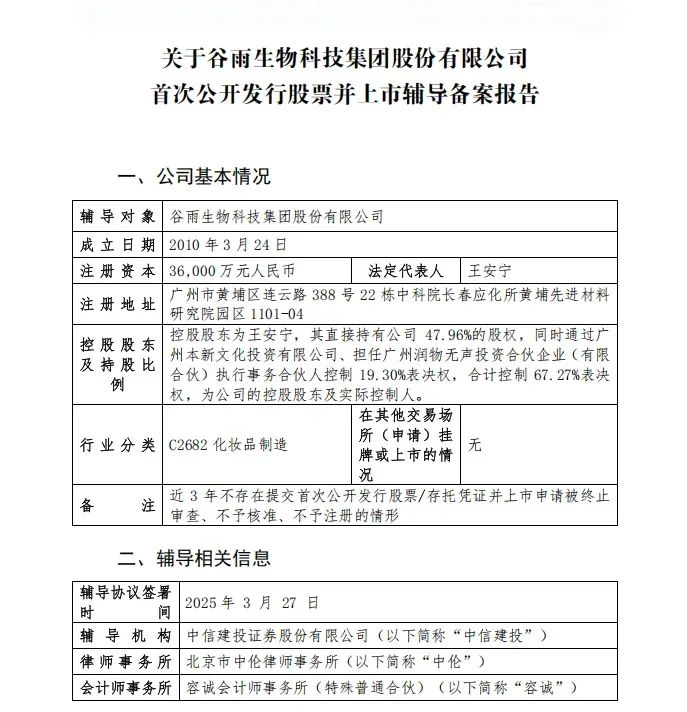
Core Viewpoint - The domestic skincare brand Gu Yu is set to launch its IPO process in A-shares, aiming to become the "first whitening stock" in the beauty market, despite facing challenges such as brand loyalty and high online sales ratio [1][3][25]. Company Overview - Gu Yu was established in March 2010 and has a registered capital of 36 million RMB. The company is headquartered in Guangzhou and is primarily engaged in cosmetics manufacturing [2]. - The company has shown rapid growth, with GMV reaching 10 billion RMB in 2010, and projected sales of 35 billion RMB in 2023 and over 50 billion RMB in 2024 [1][3]. Market Position - Gu Yu's sales growth positions it among leading domestic beauty brands, with competitors like Proya and Shiseido achieving significant revenue milestones [1][32]. - The brand's online sales ratio is projected to be 93% in 2024, indicating a heavy reliance on e-commerce channels [22]. Competitive Landscape - The domestic beauty market is experiencing intensified competition, with many brands accelerating their IPO processes as a survival strategy [25][26]. - Gu Yu has successfully leveraged various online platforms for marketing, including early adoption of live streaming on Taobao and collaborations with influencers on platforms like Xiaohongshu and Douyin [4][6]. Challenges and Risks - Despite its rapid growth, Gu Yu faces challenges such as insufficient brand loyalty, a lack of a diversified brand matrix, and the need to establish a stronger brand identity [3][14][20]. - The brand's reliance on a single product line and the potential for market saturation pose risks to its long-term sustainability [20][23]. Future Outlook - To succeed in the competitive landscape, Gu Yu must enhance its brand power and explore new product lines beyond its current offerings [20][30]. - The company aims to establish a more robust brand presence and diversify its product portfolio to mitigate risks associated with market fluctuations and consumer preferences [20][30].
一个新消费品从业者的五年创业思考
虎嗅APP· 2025-05-03 13:02
Core Viewpoint - 2024 is projected to be the most challenging year in the past decade for the industry, with many entrepreneurs facing significant difficulties in sustaining their businesses [3][4]. Group 1: Industry Overview - 90% of small and medium-sized enterprises in China do not survive beyond three years, indicating a high failure rate in the entrepreneurial landscape [6]. - The pet food industry has a compound annual growth rate (CAGR) that ranks second among consumer goods, with significant growth potential as pet ownership continues to rise in China [15]. - The industry concentration ratio (CR10) for the pet food sector was only 24% in 2022, suggesting a relatively low level of market maturity compared to other sectors like infant formula, which has a CR10 of 70% [18][17]. Group 2: Entrepreneurial Journey - The company was founded in 2020 during the pandemic, with the founder emphasizing the importance of committing fully to entrepreneurship without a fallback plan [23]. - Initial challenges included logistical issues and the need to learn e-commerce from scratch, leading to significant hands-on experience in operations [30][25]. - The first product launch was met with unexpected success, driven by organic marketing through podcasts and social media, resulting in a loyal customer base [31][48]. Group 3: Market Dynamics - The pet industry is perceived as a booming market, attracting many new entrants, but existing players often struggle with intense competition and market fragmentation [38]. - The company chose to focus on high-quality pet food, despite pressures to enter more lucrative segments like snacks or lower-end products, driven by a commitment to quality and consumer trust [40][41]. - The company has faced challenges in scaling and marketing, particularly in a landscape where traditional advertising methods are becoming less effective [49][56]. Group 4: Strategic Insights - The company has adopted a cautious approach to product development, launching only ten SKUs in five years, prioritizing quality and transparency in sourcing [41][46]. - The marketing strategy has evolved to include partnerships with pet influencers and adapting to changes in social media platforms, particularly the shift towards live streaming and short-form content [55][57]. - The company recognizes the importance of building a brand over time, emphasizing that true brand status requires a solid user base and market penetration [62][68]. Group 5: Challenges and Reflections - The founder reflects on missed opportunities for aggressive growth during favorable market conditions, noting that a more risk-tolerant approach could have led to greater scale [70][71]. - The competitive landscape is increasingly characterized by price wars, which threaten the sustainability of quality-focused brands [75][80]. - The company aims to maintain its commitment to quality and ethical practices, despite the pressures of a rapidly changing market environment [86][87].

一季度营收17.32 亿元,净亏损3614.86万元,良品铺子降价也卖不动了?
Sou Hu Cai Jing· 2025-04-29 13:45
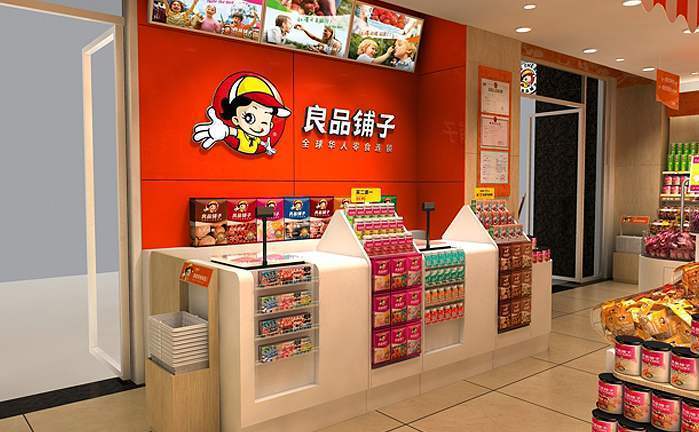
出品|搜狐财经 作者|柴鑫洋 编辑|李文贤 4月28日晚, 良品铺子发布的2024年年报及2025年一季报。 去年年报显示,公司2024年营业收入为71.59亿元,同比下降11.02%;净亏损4610.45万元,同比下降 125.57%;扣非净亏损7476.14万元,同比下降214.77%。 4月28日晚, 良品铺子发布的2024年年报显示,公司2024年营业收入为71.59亿元,同比下降11.02%; 净亏损4610.45万元,同比下降125.57%;扣非净亏损7476.14万元,同比下降214.77%。 其中2024年第四季度,公司收入16.79亿元,净亏损6549.48万元,扣非后净亏损7161.55万元。 年报显示,2024年末良品铺子门店数为2704家,报告期内共闭店794家。 2025年一季度,公司实现营收17.32 亿元,同比下降29.34%;净亏损3614.86万元,同比下降157.85%; 扣非后净亏损为4018.22万元,同比下降173.21%。 对于良品铺子当前存在的问题,大消费行业分析师杨怀玉认为:"良品铺子当前亟需跳出"价格战内 卷",构建以品牌力为核心的质量竞争壁垒。此前降价策略初 ...

走访300+消费公司后,我发现了一个超级品牌的共性
Hu Xiu· 2025-04-10 06:35
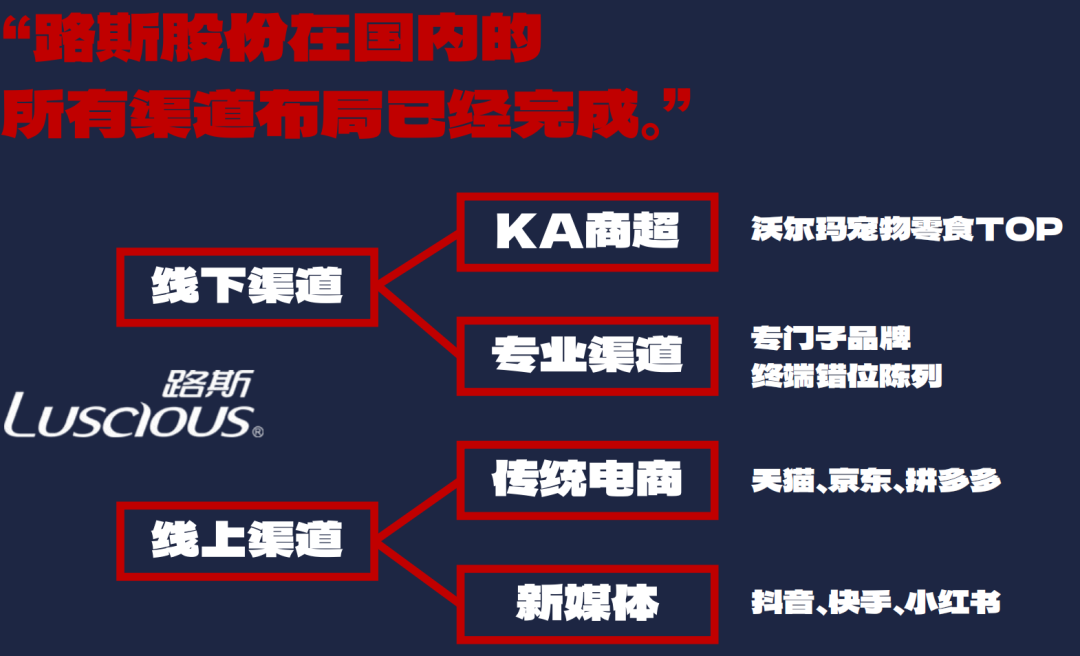
Core Insights - The core barrier for consumer goods and retail across cycles is the development of channels and brands, with a focus on how companies leverage these elements to create sustainable growth. Group 1: Channel Development - Super channels incubate super brands, with successful brands like Coca-Cola and Nestlé relying heavily on channel strength [2][10] - Companies like Lusi Co., which initially focused on international markets, have shifted to domestic markets by building strong channel networks rather than solely relying on social media platforms [5][8] - Lusi Co. has established a comprehensive channel presence, including major retail systems and online platforms, to support its brand growth [6][7][8] Group 2: Product Focus - The concept of "super products" is crucial, as seen in brands like Mixue Ice City and Luckin Coffee, which focus on strategic single products to drive brand recognition [11][12] - The case of "Boss Loves Fish" illustrates how focusing on a single product can lead to brand success, emphasizing the importance of product quality and differentiation [17][12] Group 3: Brand Power - The essence of consumer goods barriers lies in brand strength rather than just channel or product power, as highlighted by historical examples from Coca-Cola [40][41] - The evolution of brand competition has transitioned from product competition to marketing competition, emphasizing the importance of storytelling and content in brand development [43][50] Group 4: Content Strategy - Effective content strategy is essential for brand growth, with a focus on creating engaging narratives that resonate with consumers [51][62] - Brands must adapt their content to different platforms, understanding that each medium has unique characteristics and audience expectations [106][100] - Successful brands like Banmu Huatian have leveraged targeted content strategies across platforms to achieve significant sales growth [108][110] Group 5: Market Trends - The rise of new media platforms has transformed consumer engagement, with brands needing to adapt their strategies to remain relevant in a rapidly changing market [106][125] - The case of Zibo barbecue demonstrates how viral marketing can create significant brand awareness and consumer interest [70][72] Group 6: Case Studies - The example of "Ren Yang Yi Tou Niu" illustrates how storytelling and community engagement can enhance brand value and consumer loyalty [168][171] - The strategic use of KOLs (Key Opinion Leaders) in marketing campaigns can effectively drive brand recognition and sales [120][119]