
国资国企改革

Search documents
从“物理聚合”到“化学反应” 泉州国企改革“改”出新活力
Xin Lang Cai Jing· 2026-01-13 20:53
Core Viewpoint - The integration and restructuring of state-owned enterprises (SOEs) in Quanzhou, Fujian Province, is seen as a key strategy to enhance the efficiency of state capital allocation and drive high-quality economic development during the 14th Five-Year Plan period [1]. Group 1: Economic Indicators and Goals - By the end of 2025, the total assets of enterprises funded by the Quanzhou State-owned Assets Supervision and Administration Commission (SASAC) are expected to exceed 500 billion yuan, with operating income surpassing 80 billion yuan, both indicators projected to double during the 14th Five-Year Plan [1]. Group 2: Market-oriented Integration and Restructuring - The Quanzhou SASAC has initiated multiple rounds of integration and restructuring to transform small, scattered enterprises into larger, more competitive entities, enhancing the efficiency and core competitiveness of state capital [1][2]. - The successful establishment of Quanzhou International Trade Group in early 2024 is a result of three rounds of restructuring, addressing the issues of small, weak, and homogeneous competition among trade enterprises [2]. Group 3: Strategic Support and Public Services - Quanzhou's transportation and construction groups are focusing on professional integration to enhance the strategic support capabilities of state-owned enterprises, while also forming a grain and oil operation company to improve urban construction and resource allocation [2]. - The restructuring of Quanzhou Water Group into an urban operation company aims to improve the quality and efficiency of public service supply, addressing the community's needs for a better quality of life [2]. Group 4: Mechanism Reform and Internal Development - The reform of the governance structure and market-oriented mechanisms is crucial for activating the internal development dynamics of state-owned enterprises, with a focus on labor, personnel, and distribution systems [3][4]. - The implementation of a modern corporate governance system includes the appointment of external directors and the establishment of clear responsibilities, enhancing decision-making processes and accountability [3][4]. Group 5: Transition from Asset Management to Capital Management - The ongoing reforms signify a transition from managing assets to managing capital, with a focus on modern governance, market-oriented operations, and risk prevention [5]. - The Quanzhou SASAC aims to consolidate the achievements of the two rounds of SOE reform actions, further guiding state capital to play a significant role in local strategic services, industry leadership, and public welfare [5].
压实责任深化国资国企改革推动发挥好经济“顶梁柱”作用
Zhong Yang Ji Wei Guo Jia Jian Wei Wang Zhan· 2026-01-12 00:18
Group 1 - The core viewpoint emphasizes the importance of state-owned enterprises (SOEs) as a crucial support for the ruling party and the need for strict supervision and reform to enhance their competitiveness and functionality [2][3] - The year 2025 is highlighted as the deadline for deepening SOE reforms, with a focus on political supervision to ensure the implementation of key tasks [3][4] - Various local governments, such as Yunnan and Gansu, are actively engaging in supervision and monitoring to ensure the effective execution of SOE reforms and address specific issues within the enterprises [3][4] Group 2 - The supervision aims not only to identify problems but also to promote solutions and facilitate development, as seen in Qinghai's efforts to revitalize idle assets and improve operational efficiency [5] - Mechanisms are being established to address common issues in SOE operations, particularly in procurement processes, to mitigate corruption risks [6] - The importance of case-driven reforms is underscored, with local authorities implementing measures to strengthen internal controls and prevent future misconduct based on lessons learned from specific cases [7][8]
央国企重组提速 产业上下游协同加强
Zheng Quan Ri Bao· 2026-01-09 16:45
Core Viewpoint - The restructuring and mergers of state-owned enterprises (SOEs) in key sectors such as energy and high-end equipment manufacturing are intensifying, focusing on strengthening and supplementing industrial chains as part of China's economic strategy for the 14th Five-Year Plan [1] Group 1: Central SOEs Restructuring - China Petroleum & Chemical Corporation (Sinopec) and China Aviation Oil Group are merging, which will enhance Sinopec's competitive edge in the aviation fuel sector by creating a complete industrial chain from crude oil import to airport refueling [2] - China National Machinery Industry Corporation (Sinomach) is acquiring a 21.72% stake in Gansu Blue Science and Technology High-end Equipment Co., which will allow Sinomach to consolidate its position in the energy equipment sector [3] Group 2: Local SOEs Restructuring - Nanjing Chemical Fiber Co. is undergoing a major asset restructuring to shift from traditional fiber production to high-end equipment manufacturing, aligning with national priorities for core component production [4] - Southern Black Sesame Group has transferred its controlling stake to Guangxi Travel Health Industry Group, indicating a strategic partnership in the "cultural tourism + health" sector [5] Group 3: Policy and Market Trends - The restructuring of SOEs is increasingly aligned with national security and aims to create efficient supply chain ecosystems, enhancing self-sufficiency and stability [4] - Local SOEs are facing challenges in entering new productive sectors, including asset disposal and technology adaptation, but are supported by local policies aimed at upgrading traditional industries [6]
中国石化与中国航油实施重组,释放哪些信号?
Zhong Guo Hua Gong Bao· 2026-01-09 09:40
Core Viewpoint - The restructuring of China Petroleum & Chemical Corporation (Sinopec) and China Aviation Oil Holding Company marks the first major state-owned enterprise (SOE) restructuring in 2026, signaling the beginning of deeper reforms in China's state-owned economy [1] Group 1: Restructuring Details - The merger aims to enhance the integration of aviation fuel production and sales, allowing Sinopec to streamline its operations and improve inventory management, thereby reducing costs and increasing efficiency [2] - The restructuring is expected to strengthen the competitive position of SOEs in the global market, particularly in response to complex international environments [1][2] Group 2: Market Potential - With the rapid development of new energy sources, demand for aviation kerosene is projected to grow, with estimates suggesting a need of approximately 50 million tons by 2030, reflecting an average annual growth rate of about 4% during the 14th Five-Year Plan [2] - China has the potential for significant growth in air travel frequency, currently at 0.6 trips per person per year, compared to developed countries, indicating a robust future demand for aviation fuel [2] Group 3: Sustainable Aviation Fuel (SAF) - The restructuring will facilitate the entire supply chain for sustainable aviation fuel (SAF), positioning the companies to capitalize on the global shift towards low-carbon solutions [3] - Sinopec is recognized as the first Asian company to develop and commercialize bio-jet fuel production technology, while China Aviation Oil plays a crucial role in the promotion and application of SAF [3]

六大优势产业投资同比激增53%
Xin Lang Cai Jing· 2026-01-08 23:08
本报讯(四川日报全媒体记者 陈秋吉)1月7日,记者从2025年度省属企业党委书记抓基层党建工 作述职评议会议上获悉,2025年省属企业在六大优势产业投资同比增长53%,有力发挥了经济"顶 梁柱"作用。 2025年,四川国资国企以高质量党建引领高质量发展,加快推进国企改革深化提升行动收 官,"1+8"重点领域改革取得重要成果,省属企业在六大优势产业、战略性新兴产业投资同比分别 增长53%、13.7%;截至11月底,全省地方国企资产总额达22.92万亿元、所有者权益达7.27万亿 元、营业总收入达2.12万亿元,实现利润总额977亿元,上缴税费总额1357亿元。 省国资委相关负责人表示,要坚持党建工作与生产经营深度融合,切实把党建优势转化为发展优 势,科学规划重大项目、重点任务和关键指标,系统制定实施进一步深化国资国企改革方案,扎 实推进国企改革、优化布局、科技创新、对外开放等重点工作,确保实现"十五五"良好开局。 ●省属企业在六大优势产业、战略性新兴产业投资同比分别增长53%、13.7% ●截至11月底,全省地方国企资产总额达22.92万亿元,实现利润总额977亿元 同时,四川国资国企积极履行社会责任,深入推进 ...
稳中求进、提质增效 实现“十五五”良好开局丨坚持改革攻坚,增强高质量发展动力活力
Ren Min Ri Bao· 2026-01-07 02:12
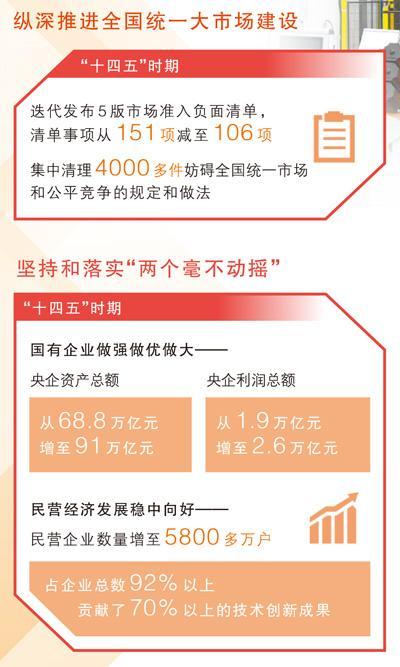
Group 1: Economic Reform and Development - The core objective of the "14th Five-Year Plan" is to further deepen reforms and achieve breakthroughs in economic and social development [4] - The Central Economic Work Conference emphasizes policies to enhance high-quality development through reforms in various sectors, including the establishment of a unified national market and the deepening of state-owned enterprise reforms [4][8] - The construction of a unified national market is essential for creating a new development pattern and enhancing international competitiveness [7] Group 2: Industry-Specific Developments - The automotive industry, along with sectors like photovoltaics and logistics, is witnessing a collaborative effort to reduce internal competition and improve market conditions [5] - The price decline in photovoltaic equipment, lithium-ion batteries, and new energy vehicles indicates a narrowing of the year-on-year decrease, reflecting the effectiveness of measures against "involution" competition [7] - The establishment of a unified market framework aims to enhance market access, fair competition, and quality standards, thereby improving the overall economic cycle [8] Group 3: State-Owned Enterprises and Capital - The integration of state-owned enterprises in the cruise industry has led to the establishment of Asia's largest cruise operation platform, showcasing the benefits of professional integration [9] - By the end of 2025, state-owned enterprise reforms are expected to focus on enhancing quality and efficiency, with significant investments directed towards core business areas [10] - The management structure of central enterprises is being streamlined, with a focus on reducing management levels and improving governance [10][11] Group 4: Private Sector Growth - The implementation of the "Private Economy Promotion Law" marks a significant step in legally protecting the rights of private enterprises, with a focus on equal treatment [13] - In 2025, private enterprises accounted for over 92% of total enterprises, contributing significantly to exports, tax revenue, and urban employment [13] - Future initiatives will focus on expanding market access, enhancing support for private investment projects, and strengthening legal protections for private enterprises [14]

坚持改革攻坚,增强高质量发展动力活力(稳中求进、提质增效 实现“十五五”良好开局)
Ren Min Ri Bao· 2026-01-07 00:37
Group 1: Economic Reform and Development - The core objective of the "14th Five-Year Plan" is to further deepen reforms to drive economic and social development [6] - The Central Economic Work Conference emphasizes enhancing high-quality development through reforms, including the establishment of a unified national market and the deepening of state-owned enterprise reforms [6][8] - The construction of a unified national market is essential for promoting high-quality development and gaining an advantage in international competition [8] Group 2: Industry-Specific Developments - The automotive and photovoltaic industries have seen a collaborative effort to reduce "involution" competition, with significant price reductions in manufacturing [7] - The central enterprise cruise operation platform, China International Cruise Co., has become the largest in Asia, showcasing the results of professional integration among state-owned enterprises [9] - The central enterprises' main business investment ratio reached 98% by November 2025, indicating a focus on core business areas [9] Group 3: Support for Private Enterprises - The implementation of the "Promotion Law for Private Economy" in 2025 marks a significant legal framework for the protection and development of private enterprises [12] - Private enterprises account for over 92% of all companies, contributing more than 50% to imports and exports and 80% to urban employment [12] - The government plans to enhance market access, strengthen support for private enterprises, and protect their legal rights [13]
坚持改革攻坚,增强高质量发展动力活力(稳中求进、提质增效 实现“十五五”良好开局) ——着力推进全年经济工作八大重点任务③
Ren Min Ri Bao· 2026-01-06 23:28
Group 1: Reform and Economic Development - The core viewpoint emphasizes that reform is the fundamental driving force for national development, with the "14th Five-Year Plan" aiming for breakthroughs in comprehensive deepening of reforms [2] - The central economic work conference proposed a series of policy measures to enhance high-quality development through reforms, focusing on building a unified national market, deepening state-owned enterprise reforms, and promoting the growth of the private economy [2][4] Group 2: Unified National Market - The construction of a unified national market is essential for creating a new development pattern and enhancing international competitiveness, with a focus on "five unifications and one openness" [3][5] - The State Statistics Bureau reported that the ratio of social logistics costs to GDP was 14% in the first three quarters of 2025, maintaining the lowest level since records began [4] Group 3: State-Owned Enterprises and Capital - The integration of state-owned enterprises (SOEs) has led to the establishment of Asia's largest cruise operation platform, showcasing the results of professional integration among SOEs [6] - By the end of 2025, the central enterprises' main business investment accounted for 98%, indicating a strong focus on quality and progress in SOE reforms [6] Group 4: Private Economy Development - The year 2025 is marked by significant legal and policy advancements for the private economy, including the implementation of the "Private Economy Promotion Law" and a series of judicial cases aimed at protecting private enterprises [10][12] - Private enterprises account for over 92% of the total number of enterprises, contributing more than 50% to imports and exports and 80% to urban employment [10] Group 5: Future Directions for Private Economy - Future efforts will focus on expanding market access, enhancing support for private enterprises, and strengthening the legal framework to protect the rights of private businesses [11][12]
重庆建工集团股份有限公司 第五届董事会第五十一次会议决议公告
Zhong Guo Zheng Quan Bao - Zhong Zheng Wang· 2026-01-05 16:54
■ 重庆建工集团股份有限公司 第五届董事会第五十一次会议决议公告 本公司董事会及全体董事保证本公告内容不存在任何虚假记载、误导性陈述或者重大遗漏,并对其内容 的真实性、准确性和完整性承担个别及连带责任。 一、董事会会议召开情况 重庆建工集团股份有限公司(以下简称"公司")于2025年12月26日发出召开第五届董事会第五十一次会 议的通知。公司第五届董事会第五十一次会议于2025年12月31日以通讯方式召开。会议应参与表决的董 事8人,实际参与表决的董事8人。 本次会议的召集、召开、审议程序符合《中华人民共和国公司法》等有关法律法规及《重庆建工集团股 份有限公司章程》的有关规定。会议的召集、召开及所作决议合法有效。 表决结果:同意8票,反对0票,弃权0票。 二、董事会会议审议情况 特此公告。 (一)审议通过了《关于公司机构调整的议案》 为深入推进国资国企改革,提升公司战略执行力、运营管控力和市场竞争力,董事会同意对公司总部内 设机构进行优化调整。 表决结果:同意8票,反对0票,弃权0票。 (二)审议通过了《关于公司全资子公司设立子公司的议案》 为实施已中标的沙特阿拉伯工程项目,董事会同意所属全资子公司重庆工业设 ...

2026年是“十五五”开局之年 今年宏观经济十大看点汇总
Zheng Quan Shi Bao· 2026-01-05 00:34
Group 1: Fiscal Policy - The fiscal deficit and government bond issuance scale are expected to increase in 2026 to support economic activities during the start of the "14th Five-Year Plan" [3] - The fiscal deficit is projected to be no less than 4.06 trillion yuan, maintaining a deficit rate of at least 4% [3] - New special bonds may rise from 4.4 trillion yuan in 2025 to nearly 5 trillion yuan in 2026 to support major project construction [3] Group 2: Monetary Policy - Monetary policy is expected to remain moderately loose to promote reasonable price recovery, with a CPI target set around 2% for 2026 [4] - Traditional monetary policy tools like reserve requirement ratio cuts and interest rate reductions will have flexible timing and rhythm [4] - Structural monetary policies will focus on expanding domestic demand, supporting technological innovation, and aiding small and medium enterprises [4] Group 3: Consumption and Income - Expanding domestic demand, particularly boosting consumption, is a primary task for 2026 [5] - The "Urban and Rural Residents Income Increase Plan" aims to enhance consumer capacity and willingness [6] - Policies will be optimized to adapt to changing consumption structures, directing subsidies towards service consumption areas [6] Group 4: Investment and Infrastructure - Fixed asset investment growth is targeted to stabilize, with infrastructure investment expected to accelerate due to new major projects [7] - Government investment will increase through various funding sources, including special bonds and policy financial tools [7] - Manufacturing investment, particularly in high-tech and equipment manufacturing, is anticipated to grow rapidly [7] Group 5: Real Estate Market - The real estate market will focus on "de-stocking" as a primary task, with policies to support both supply and demand [8] - Local governments will adjust real estate policies to remove unreasonable purchase restrictions and enhance housing fund support [8] - Efforts will be made to improve the market supply-demand relationship through better management of existing properties [8] Group 6: Capital Market Reforms - Comprehensive reforms in the capital market will focus on supporting technological innovation and enhancing market inclusivity [9][10] - Policies will aim to create a multi-layered market system to meet diverse investor needs and promote long-term investments [10] - Regulatory measures will be strengthened to prevent financial misconduct and enhance market stability [10] Group 7: Unified Market and Competition - The construction of a unified national market will accelerate, with new regulations to address "involution" in competition [11] - Capacity regulation in key industries will be enhanced to phase out outdated capacities and support new quality capacities [11] - Local government economic activities will be standardized to prevent irregularities in investment incentives [11] Group 8: Technological and Industrial Innovation - The integration of technological and industrial innovation will be a key focus, with an emphasis on practical applications of new technologies [12] - The expansion of international technology innovation centers in major regions will facilitate resource integration and innovation [12] - Regional coordinated development will be promoted to enhance new quality productivity across different areas [12] Group 9: State-Owned Enterprise Reforms - A new round of state-owned enterprise reforms will focus on optimizing the layout of state-owned economies and modernizing corporate governance [13][14] - Strategic mergers and acquisitions will be promoted to enhance resource allocation efficiency [14] - Digital transformation initiatives will be launched to support innovation in key industries [14] Group 10: Social Welfare and Employment - Employment will be prioritized, with policies aimed at stabilizing jobs and increasing labor income [15] - Measures will include expanding loans for job retention and enhancing unemployment insurance [15] - The income distribution system will be improved to raise labor compensation and establish a more robust social safety net [15]