
套利

Search documents
“数”看期货:近一周卖方策略一致观点-20251028
SINOLINK SECURITIES· 2025-10-28 14:20
Group 1: Stock Index Futures Market Overview - The four major index futures contracts experienced an overall increase, with the CSI 500 index futures showing the largest gain of 3.46%, while the SSE 50 index futures had the smallest gain of 2.63% [3][12] - Average trading volumes for the current, next, and seasonal contracts of IC, IF, and IH decreased, with IF showing the largest decline of 23.95% [3][12] - As of last Friday's close, the annualized basis rates for the current contracts of IF, IC, IM, and IH were -2.93%, -9.59%, -12.00%, and -0.18%, respectively, indicating a narrowing of the basis for IF, IC, and IH, while IM's basis deepened [3][12] Group 2: Cross-Period Price Differences - The cross-period price difference rates for the current contracts of IF, IC, IM, and IH were at 62.10%, 49.10%, 63.90%, and 40.40% percentiles since 2019 [4][13] - Currently, there are no arbitrage opportunities for the IF main contract based on the closing prices [4][13] - The estimated impact of dividends on the index points for the CSI 300, CSI 500, SSE 50, and CSI 1000 indices over the next year is projected to be 78.04, 84.14, 69.75, and 64.41, respectively [4][13][42] Group 3: Market Expectations - With the main dividend period concluded, the impact of dividends on the four major index futures contracts is minimal, and the basis changes are closely related to investor trading sentiment [5][14] - The valuation level of the SSE 50 index is in a historically high percentile range, suggesting that using long-term contracts may offer better value, although liquidity risks should be monitored [5][14] Group 4: Recent Sell-Side Strategy Insights - A consensus among 10 brokerages indicates that the A-share market is expected to continue its upward or slow bull trend, supported by policy expectations and deployments [6][40] - The technology growth, non-ferrous metals, power equipment, and consumer recovery sectors are viewed positively, benefiting from policy support, industrial upgrades, and improved supply-demand dynamics [6][40][43] - There are differing views on the sustainability of cyclical trends, with some brokerages expressing concerns over short-term inventory pressures that may weaken resilience [6][40][43]

投资的道是什么?
集思录· 2025-10-27 14:33
Core Viewpoint - The article emphasizes the interconnectedness of life principles and investment strategies, advocating for a non-discriminatory approach to both people and investment varieties, suggesting that those who cannot embrace the former are unlikely to succeed in the latter [1]. Group 1: Investment Philosophy - The essence of investment is seen as arbitrage, with a belief that only highly skilled individuals can share in the growth dividends of enterprises [3]. - A stable dividend is considered the only justification for stock trading, and maintaining a low expectation is crucial for a healthy mindset [4]. - The financial market is likened to a large breeding ground, where only a small percentage of participants (5%) manage to survive and maintain equilibrium [9]. Group 2: Market Behavior and Psychology - Many investors mistakenly attribute their financial success to personal ability, overlooking the role of luck and external factors [11]. - The article suggests that most individuals view the market from a self-centered emotional perspective, rather than understanding the underlying logic and behavior of capital [12]. - It highlights the importance of learning from masters and maintaining humility, as even simple insights can provide profound understanding [13].


太火爆!白银基金,限购升级
Zhong Guo Ji Jin Bao· 2025-10-19 14:09
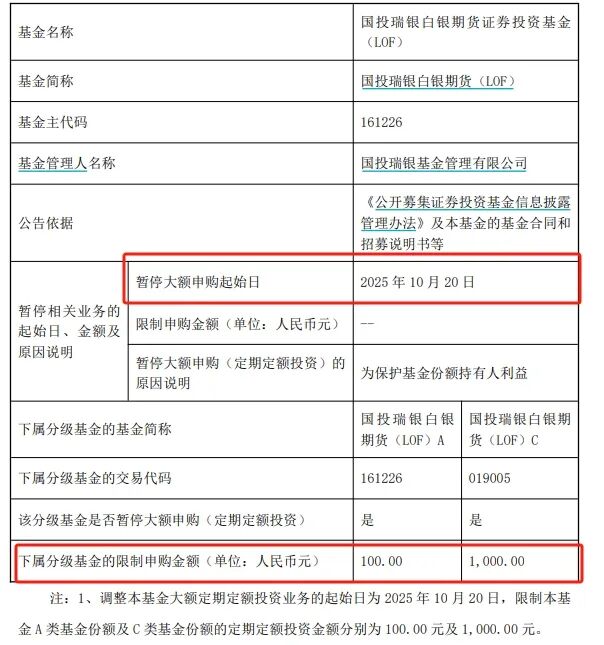
Core Viewpoint - The only silver futures fund in the market, Guotou Ruijin Silver Futures (LOF), has upgraded its purchase limits due to a surge in precious metal prices and increased market activity, aiming to protect the interests of fund holders [1][3][5]. Fund Purchase Limit Upgrade - Starting from October 20, the fund has set new purchase limits for its A and C class shares at 100 yuan and 1,000 yuan respectively, significantly lower than previous limits [1][3][5]. - This is the second time the fund has implemented purchase limits within a short period, having previously set limits of 6,000 yuan for A class and 40,000 yuan for C class shares on October 15 [5]. Market Context - The global precious metals market has seen a significant rally, with gold prices surpassing 4,200 USD per ounce and silver prices reaching historical highs, driven by factors such as trade tensions and expectations of interest rate cuts by the Federal Reserve [5][7]. - As of October 17, the A class unit net value of Guotou Ruijin Silver Futures has increased by 58.10% year-to-date, outperforming gold-related funds [5]. Fund Management Considerations - The upgrade in purchase limits is attributed to increased volatility in silver prices and a rise in speculative trading behavior, prompting the fund management to ensure stable operations and protect investor interests [6]. - The fund is a passive product that closely tracks the main silver futures contracts, maintaining high positions without active timing strategies, which has contributed to its returns amid rising silver prices [5][6]. Market Dynamics and Risks - The silver market has experienced a 79% increase year-to-date, outpacing gold's 62% rise, making it an attractive asset for investors [7]. - Analysts caution that the current bullish sentiment may be waning, with many positive factors already priced in, and potential headwinds from U.S.-China trade negotiations and interest rate expectations [8][9].
顺势高低切换!组合开始向低位方向调仓了
Sou Hu Cai Jing· 2025-10-17 22:00
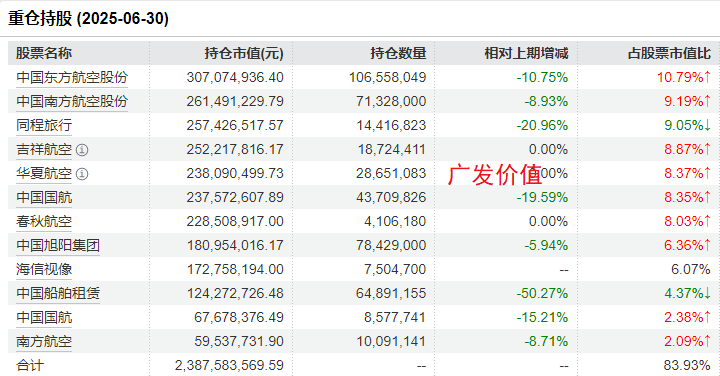
Core Viewpoint - The investment strategy involves reallocating funds into the Guangfa Value Leading Mixed Fund, which focuses on sectors with potential for recovery, particularly in tourism and aviation, despite recent market downturns [1]. Fund Reallocation - The reallocation targets the Guangfa Value Leading Mixed Fund, which is characterized as a fund focused on the "airline + OTA platform" sector, effectively functioning like an index ETF while being actively managed [1]. - The rationale for this reallocation is to take profits from funds that have appreciated significantly and invest in those with lower growth, aiming to control portfolio drawdowns [1]. Sector Analysis - **Aviation Sector**: - The aviation industry faces challenges due to a decline in business travel and reduced consumer spending, impacting passenger numbers [5]. - Factors such as currency exchange rates, fuel costs, and aircraft supply are seen as favorable for the aviation sector, with a potential for recovery if consumer demand improves [6][12]. - Recent data indicates a strong willingness among consumers to travel, with domestic travel during the recent holiday period reaching 888 million trips, a 16% increase year-on-year [12]. - **Tourism Sector**: - The tourism sector is divided into four sub-sectors: duty-free (China Duty-Free Group and Shanghai Airport), attractions (Songcheng Performance and Overseas Chinese Town), airlines (Eastern Airlines, Southern Airlines, Air China, Spring Airlines), and hotels (Jinjiang and Shouqi) [4]. - The duty-free segment is struggling with declining consumer purchasing power, leading to reduced profit margins [4]. - The attractions sector is volatile, with visitor numbers fluctuating significantly, impacting financial stability for many companies [4]. - The hotel industry is facing intense competition, with new entrants emerging post-pandemic, leading to continued market saturation [4]. Investment Outlook - The aviation and duty-free sectors are viewed as having potential investment value, contingent on a recovery in consumer spending [5]. - The overall sentiment suggests that while the tourism and hotel sectors may present risks, the aviation sector could see significant upside if consumer demand is stimulated through effective policy measures [12].

LME CEO: Most copper price action driven by supply side
Youtube· 2025-10-14 12:30
Core Insights - The current commodities market, particularly for copper, is experiencing supply tightness, which is influencing spot prices to rise above futures prices, indicating backwardation [1][2][14] - The London Metal Exchange (LME) operates under a duty unpaid contract structure, which allows for a global baseline price unaffected by tariffs, contrasting with the duty paid prices seen in New York [3][4] - There is a medium-term demand driver for copper across various applications, but current price actions are primarily influenced by supply-side disruptions [6][7] Supply and Demand Dynamics - Supply disruptions have been noted, including tragic incidents affecting the supply chain, highlighting its fragility [7] - Despite a growing Chinese economy, the demand for copper has not matched previous levels, leading to a surplus in the market [8][9] - The establishment of delivery warehouses in Hong Kong aims to facilitate the arbitrage between short-term supply and medium-term bullish expectations [10] Market Structure and Trading Opportunities - The LME is focusing on enhancing transparency and diversity in supply chains by introducing new brands from various regions [17] - There is a conversation around the need for the West to reinvest in smelting capacity to ensure supply chain diversity [18] - The LME has introduced reports to improve market visibility, such as the off warrant stock report, to democratize trading [21] Speculation and Market Governance - The LME is committed to enhancing market transparency to prevent speculative manipulation, although concerns about price manipulation in the copper market persist [19][22] - The governance of the LME copper contract is viewed as robust, with ongoing efforts to shine a light on broader market activities [22][23]

X @憨巴龙王
憨巴龙王· 2025-10-11 04:26
Risk Management - The industry emphasizes the importance of avoiding cyclical loans, even when annualized returns on the chain are 100% [3] - The industry suggests that current market conditions are often designed to target arbitrage strategies due to the large capital and positions involved, making it difficult to replenish margin or reduce positions quickly enough [3] - The industry warns against underestimating the complexities of financial management, especially in 2025 [3] Trading Strategies - The individual previously separated trading positions from arbitrage positions for clarity [1] - The individual's previous strategy involved simultaneously buying 1,000 units and shorting 900 units for arbitrage and long positions [2] - The individual's current strategy involves buying 1,000 units and shorting 1,000 units, with a separate account holding a long position of 900 units [2] Market Observations - The individual's smaller account, primarily used for trading smaller cryptocurrencies with moderate leverage, experienced significant losses due to the near-zero value of many of these cryptocurrencies [2] - The individual failed to replenish margin during a market downturn [3] - The industry notes that USDT interest rates exceeding 12% would have resulted in even greater losses [3]
X @𝘁𝗮𝗿𝗲𝘀𝗸𝘆
𝘁𝗮𝗿𝗲𝘀𝗸𝘆· 2025-10-10 04:05
#Crypto看到好多自己落后版本又不愿意承认别人更强的酸味太好笑了😂在我看来 meme 的本质就是年轻人不买茅台,年轻人发现自己能坐庄,就再也不会去接老阴谋集团的老盘。真要比肮脏程度,meme 比 vc 可干净太多了。我们套利党登味最少,我们衷心希望所有人所有流派都发财,让我们跟着赚一点。Aoke Quant 奥克队长🚩 (@aoke_quant):冷思考的文章透露着一股老人味儿。大部分老登都是从小登学习、实践、经过多次归零成长来的。当然不乏起步就有很好资源以及能忍住不经历梭哈归零的小登,但这些都是万中挑一的人。币安发射台有个最重要的属性就是公平,当然有小部分坏蛋们在里面搞银茂集团。meme 把中间化交易所项目方 TGE https://t.co/zSvkdxpDMx ...
外汇储备飙到3.34万亿美元,人民币却意外贬值,套利窗口来了?
Sou Hu Cai Jing· 2025-10-09 05:43
Core Viewpoint - The recent increase in China's foreign exchange reserves to $3.34 trillion contrasts sharply with the depreciation of the RMB against the USD, raising questions about the effectiveness of reserve accumulation in stabilizing the currency [2] Group 1: Data Paradox - The growth in reserves is accompanied by concerns over structural imbalances, with the proportion of USD assets falling to 58% from a peak of 73% in 2014, while holdings in EUR, JPY, and gold have increased to 32% [2] - The opportunity cost of holding USD assets is significant, with a yield of 2.3% compared to 4.8% for 10-year US Treasury bonds, resulting in an annualized opportunity cost exceeding $15 billion [2] - The RMB depreciation is driven by three main factors: widening interest rate differentials, narrowing trade surpluses, and diverging policy expectations [2] Group 2: Arbitrage Opportunities - The onshore-offshore price gap for the RMB has widened, creating an arbitrage opportunity with a potential annualized return of 1.9% [2] - The offshore RMB liquidity has tightened, as indicated by the spike in CNH Hibor to 13.4%, the highest since 2013, increasing the cost of arbitrage [2] - The derivatives market shows a 2.1% arbitrage opportunity between NDF and DF rates, with a significant increase in foreign institutional trading volume [2] Group 3: Policy Responses - The central bank has reactivated counter-cyclical factors in the exchange rate management model, adjusting the counter-cyclical coefficient to 0.8 to limit depreciation [2] - Capital controls have been tightened, requiring banks to conduct thorough reviews of large foreign exchange transactions, particularly in technology and real estate sectors [2] - The central bank has signaled stability by emphasizing the adequacy of reserves to manage short-term fluctuations and has increased gold holdings to diversify reserve assets [2] Group 4: Underlying Contradictions - Concerns about the quality of reserves are rising, particularly regarding the liquidity risks associated with the $1.1 trillion in US Treasury bonds held by China [2] - The balance between market-driven and interventionist approaches in exchange rate formation is challenged, with a significant increase in direct interventions by the central bank [2] - The real effective exchange rate has appreciated by 23% since 2015, impacting export competitiveness and increasing import costs for key commodities [2] Group 5: Future Outlook - Short-term arbitrage opportunities are expected to narrow by Q4 2025 as the US Federal Reserve nears the end of its rate hike cycle [2] - Long-term reforms are anticipated, including optimizing reserve structures and enhancing the flexibility of the RMB exchange rate [2] - The need for a new balance in reserve management, exchange rate mechanisms, and industrial upgrades is emphasized to ensure sustainable financial security [2]

X @憨巴龙王
憨巴龙王· 2025-10-08 20:56
Market Analysis & Risk Assessment - Arbitrage opportunities arise from mechanism vulnerabilities, but are inherently risky, often leading to losses for early participants and gains for later ones [1] - High-yield arbitrage in 2025 carries significant risk [1] - Bybit's lack of limit orders in contracts can lead to 400% premiums, but implementing limit orders is not a guaranteed solution, as manipulation can still occur [1] - All mechanisms are susceptible to manipulation; imperfect mechanisms create opportunities [1] - Manipulators are not infallible and can also incur losses; participants can choose to avoid or align with manipulators [1] Case Studies & Examples - Recent liquidations on Bybit involving tokens like $SERAPH, $RFC, and $GROK resulted in over $10 million in customer losses [1] - OKEx's FIL futures in 2020 and STAR in 2023 experienced manipulation where limit orders prevented stop-loss execution [1] Investor Behavior & Platform Responsibility - Individuals should not blame platforms for losses incurred during arbitrage attempts if the platform mechanisms have vulnerabilities [1] - The article is a good analysis of the recent Bybit liquidations [1]
X @憨巴龙王
憨巴龙王· 2025-10-07 01:51
Market Manipulation & Trading Strategies - Prior to 2021, retail investors primarily engaged in long positions, freely utilizing high leverage in altcoins [1] - By 2022, retail investors began shorting, leading market makers to manipulate altcoin prices by pumping them to induce short positions and then continuously raising spot prices [1] - As of 2025, with retail investors aware of the risks of shorting altcoins, market makers have shifted to exploiting arbitrage opportunities [1] Risk Management & Liquidation - Large-scale liquidations, such as the "pumpbtc" event, exemplify the risks of arbitrage, where a significant price surge led to substantial losses for leveraged traders [1] - Market makers are allegedly targeting large accounts with substantial margin to trigger liquidations by manipulating prices [3] - Even with high leverage (e g, 100x), smaller accounts can manage risk by quickly cutting losses, but larger accounts face challenges in reducing positions due to the potential for accelerated price movements and targeted liquidations [3] Examples of Exploitation - Examples of arbitrage exploitation include Hype on XPL and Seraph on Bybit [2]