家族办公室

Search documents
达里欧“清仓”桥水,家办是他的新主场
Hu Xiu· 2025-08-01 08:09
Core Points - Ray Dalio has officially sold his remaining shares in Bridgewater Associates and stepped down from the board, marking the end of his leadership era at the firm [2][3][12] - The transition of ownership at Bridgewater, which has been in process for over a decade, is now complete, simplifying the company's governance structure and allowing it to refocus on investment performance [3][13] Group 1: Ownership Transition - Dalio's complete exit signifies the conclusion of a 14-year succession plan initiated in 2011, which faced complexities and challenges along the way [8][9] - Bridgewater recently repurchased Dalio's remaining shares and issued new shares to the Brunei Investment Agency, making it a significant shareholder with nearly 20% ownership [14][15] - The firm currently manages assets totaling $92.1 billion, a decline from $168 billion at the end of 2019, partly due to a strategic decision to limit the size of its flagship fund, Pure Alpha [4][6] Group 2: Fund Performance - In 2024, Pure Alpha achieved a return of 11.3%, with further improvement in the first half of 2025, recording a 17% return [7] - The positive performance in the first half of 2025 has contributed to overall gains for the firm's main funds [7] Group 3: Dalio's Future Focus - Following the transfer of control, Dalio is now concentrating on managing his family office, which supports entrepreneurial ventures and philanthropic efforts [18][19] - The family office has expanded its global presence, with new offices in Singapore and Abu Dhabi, focusing on investments and charitable activities [21][20] - Dalio has expressed excitement about the future of Bridgewater without his involvement, indicating confidence in the new leadership [5][26]


瑞银:39%亚太家族办公室未来一年计划增加中国内地投资
Guo Ji Jin Rong Bao· 2025-07-30 09:13
Group 1 - The core viewpoint of the report indicates that since 2020, the net worth of global family offices has been on the rise, with a focus on long-term investment goals and diversification [1] - Family offices are reducing cash holdings and increasing investments in developed market equities, while also raising allocations to private debt to enhance returns and diversify portfolios [1] - Nearly half (48%) of Asia-Pacific family offices plan to increase their allocation to developed market equities, and 40% intend to raise their exposure to emerging market equities [1] Group 2 - The proportion of family offices planning to increase allocations to gold and precious metals has reached a historical high of 21%, up from 10%-16% in the previous years [2] - North America and Western Europe remain the most favored investment destinations, with nearly four-fifths (79%) of global family office assets allocated to these regions [2] - In the Asia-Pacific region, 39% of family offices plan to increase investments in mainland China, with healthcare/pharmaceuticals (33%) and generative AI (28%) being the most familiar sectors [2] Group 3 - Major geopolitical conflicts and global trade tensions are the top concerns for family offices, with 61% expressing worries about geopolitical conflicts and 53% anxious about a global economic recession [3] - Climate change is viewed as one of the top three risks by 49% of Asia-Pacific family offices, while debt crises and financial market crises are also significant concerns [3] Group 4 - To mitigate risks, family offices are advised to diversify their investments, with 40% relying on investment managers for selection or active management [4] - The use of hedge funds is prevalent among nearly one-third (31%) of family offices, while 27% are increasing allocations to illiquid assets [4] - Family offices are rapidly evolving as a wealth management sub-industry, with a growing need for succession planning among Chinese entrepreneurs [4]
聚焦家办 | 监管趋严也挡不住富豪移居新加坡?家办或新增近700家
彭博Bloomberg· 2025-07-23 03:58
Core Viewpoint - The number of family offices in Singapore is expected to grow significantly, driven by regulatory changes and the influx of wealth from high-net-worth individuals, particularly from the UK due to tax reforms [2][6]. Group 1: Family Office Growth - In 2024, Singapore approved 600 family office applications, doubling the number from 2023, with an expected total of 2,000 family offices by the end of the year, marking a 43% increase [3][4]. - The growth trend is anticipated to continue, with an additional 600 to 700 family offices expected to be established in the coming years, supported by tax incentives set to expire in 2029 [2][4]. Group 2: Regulatory Environment - Singapore's regulatory framework is tightening, with stricter anti-corruption reviews and more rigorous tax exemption standards, yet this has not deterred the establishment of family offices, as the focus shifts to quality over quantity [2][4]. - The potential expansion of Singapore's tax exemption investment list could further bolster family offices by 2026, despite recent regulatory measures aimed at enhancing compliance and transparency [4]. Group 3: Wealth Inflow from the UK - The UK is set to lose wealth as tax exemptions for non-citizens are being revoked, with an estimated 10,800 millionaires leaving the UK in 2024, representing a 37% increase since 2014 [6]. - In contrast, the number of millionaires residing in Singapore has surged by 62%, indicating a significant shift in wealth towards Singapore as a favorable destination [6]. Group 4: Benefits for Financial Institutions - DBS Group is well-positioned to benefit from the new regulations and the wealth transfer, as it services over one-third of Singapore's single-family offices [8]. - The launch of DBS's Multi-Family Office Foundry aims to attract clients seeking alternative wealth management solutions, potentially increasing the bank's client base [8]. Group 5: Sustainable Investment and Philanthropy - Singapore is expected to enhance its image as a hub for sustainable investments, with family offices required to allocate a portion of their assets to local climate-related initiatives while still qualifying for tax benefits [10]. - New regulations mandating family offices to employ non-family members may stimulate local employment and reinforce Singapore's position as a global leader in philanthropy [10].

资管规模突破30万亿港元,高净值人群为何选择香港?
2 1 Shi Ji Jing Ji Bao Dao· 2025-07-16 12:40
Group 1: Core Insights - Hong Kong is increasingly becoming a key hub for wealth management in Asia, driven by the growing number of high-net-worth individuals (HNWIs) in the region [1][2] - The Swiss bank Pictet's report indicates that despite Hong Kong being one of the most expensive cities globally, its investment immigration program is attracting significant interest from HNWIs in mainland China and worldwide [1][2] - The influx of capital into Hong Kong is evidenced by a strong rebound in the IPO market and the active participation of foreign private banks [1][4] Group 2: Wealth Migration Trends - The Henley & Partners report highlights that the UK is expected to experience a net outflow of 16,500 wealthy individuals by 2025, while Hong Kong is projected to see a net inflow of 800 [2] - UBS's survey reveals that 53% of respondents view global economic recession as the primary risk, while 46% are concerned about rising tax policies, making low-tax regions like Hong Kong attractive [2][3] Group 3: Market Dynamics - The KPMG report indicates that after two years of declining net inflows, Hong Kong's wealth management sector saw a turnaround in 2023, with net inflows reaching nearly three times that of 2022 [4] - Data from Wind shows that by mid-2025, southbound capital from mainland China into Hong Kong's stock market exceeded HKD 710 billion, significantly higher than previous years [4] Group 4: Investment Immigration Program - As of June 2023, Hong Kong's new investment immigration program received over 1,500 applications, expected to bring in over HKD 46 billion in investments [5] - The program aims to enrich the talent pool and attract more funds to enhance Hong Kong's asset and wealth management sector [5] Group 5: Private Banking Sector Growth - The Hong Kong Securities and Futures Commission reported that the asset management scale of the private wealth management industry surpassed HKD 30 trillion by the end of 2023 [6] - The number of family offices in Hong Kong has nearly doubled compared to Singapore, with over half managing assets exceeding USD 5 million [6] Group 6: Institutional Strategies - Foreign institutions are actively expanding in Hong Kong, with UBS planning to double its assets under management for millionaires in Greater China over the next 3-5 years [7] - Chinese banks are also accelerating their private banking services in Hong Kong to cater to cross-border wealth management needs [7][8]
德林控股(01709.HK):家办业务厚积薄发 AI金融探索持续深化
Ge Long Hui· 2025-07-02 18:33
Company Overview - Derlin Holdings, formerly Derlin Securities, was established in 2011 and has expanded its service offerings, completing a reverse merger and rebranding in 2020 [1] - The company aims to create a comprehensive financial service ecosystem for high-net-worth individuals and currently holds licenses from the Hong Kong Securities and Futures Commission [1] - As of March 31, 2025, the company expects to achieve a revenue of HKD 190 million, a year-on-year decrease of 6.4%, while net profit is projected to be HKD 137 million, a year-on-year increase of 36.9% [1] Market Potential - The demand for wealth management among high-net-worth individuals is diversifying, creating opportunities for family offices [2] - Hong Kong's private wealth management industry has an AUM of HKD 9 trillion as of 2023, with favorable policies for establishing family offices compared to other international financial centers [2] - Derlin's family office services generated approximately HKD 58.08 million in service fees for the fiscal year 2023, up from HKD 18.7 million in 2022, with expectations to reach 200 clients and USD 10 billion AUM by 2026 [2] Technological Innovation - Derlin Holdings is focused on making services more accessible and intelligent, with AI and finance as core strategies [3] - The company launched Asia's first AI family office (DLiFO) at the end of 2023 to enhance service delivery to a broader range of investors [3] - The flagship project, Synapse Technology, aims to create an intelligent financial ecosystem, allowing licensed financial experts to share knowledge through AI technology [3] Financial Forecast - For the fiscal years 2026-2028, Derlin Holdings is projected to achieve net profits of HKD 138 million, HKD 153 million, and HKD 165 million, with year-on-year growth rates of 0.81%, 11.18%, and 7.84% respectively [4] - Expected earnings per share for the same period are HKD 0.09, HKD 0.10, and HKD 0.11, with corresponding PE ratios of 35, 31, and 29 [4] - The company is viewed positively due to its "AI + family office + cross-border finance" strategy, receiving an "overweight" rating [4]
瑞士,正在“败下阵”来
Hu Xiu· 2025-07-02 07:13
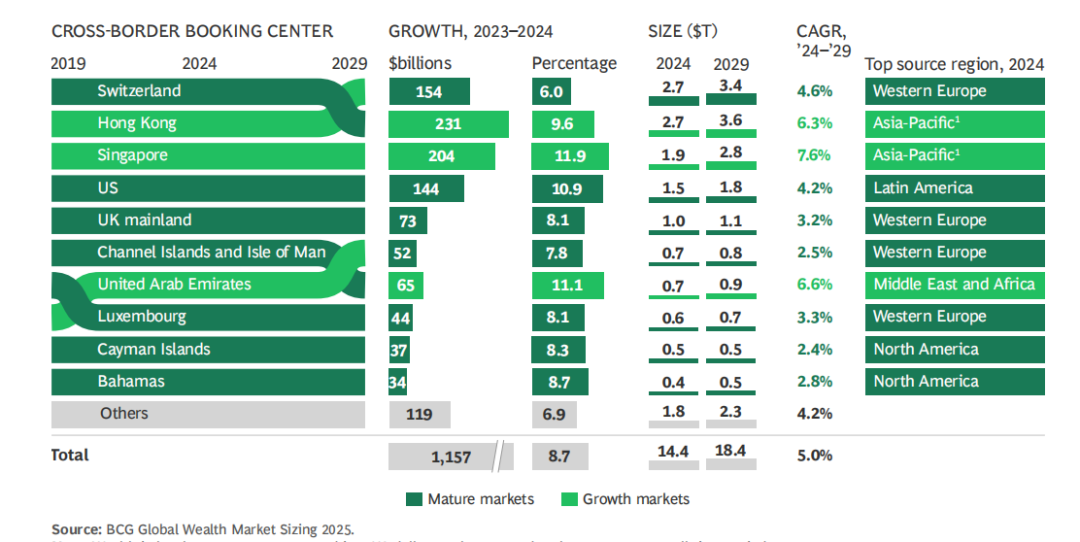
Group 1 - The core argument of the article is that Switzerland's status as a premier wealth management center is being challenged by emerging financial hubs in Asia, particularly Hong Kong, Singapore, and Dubai, leading to a shift in global wealth management dynamics [3][19][54] - Historically, Switzerland has been synonymous with wealth preservation and security, serving as a safe haven for global elites and offshore assets [2][19] - Recent trends indicate a significant outflow of wealthy individuals and families from Switzerland to other regions, driven by factors such as regulatory changes, loss of privacy, and geopolitical tensions [5][9][22][23] Group 2 - According to the Boston Consulting Group's Global Wealth Report 2025, Switzerland's growth in cross-border wealth management is slowing, with a projected growth rate of only 4.6% from 2024 to 2029, compared to 6.3% for Hong Kong and 7.6% for Singapore [15][16] - The upcoming Swiss referendum on taxing large inheritances and gifts has created uncertainty, prompting some wealthy individuals to reconsider their presence in Switzerland [11][30] - The article highlights that the traditional Swiss banking model is under pressure due to increased competition from more flexible and client-friendly wealth management services in Asia [52][53] Group 3 - The article notes that the number of family offices in Hong Kong is expected to grow significantly, with estimates suggesting it could surpass 3,000 by 2025, indicating a shift in wealth management preferences [37][38] - Singapore is also emerging as a key player in the wealth management space, with a substantial increase in family offices and a favorable tax regime attracting high-net-worth individuals [38][40] - The Middle East, particularly Dubai, is becoming a new hub for family offices, with a projected growth in ultra-high-net-worth individuals and favorable business conditions [42][47]

800亿蔡崇信,选秀夜震动NBA
36氪· 2025-07-01 10:22
Core Viewpoint - The article highlights the significant investments and strategic moves made by Joe Tsai in the sports industry, particularly focusing on his ownership of the Brooklyn Nets and New York Liberty, as well as his recent record-breaking draft selections in the NBA [4][5][9]. Group 1: NBA Draft and Team Ownership - Joe Tsai's Brooklyn Nets made history by selecting five rookies in a single draft, marking the first time any team has achieved this feat [5][17]. - Tsai's family, controlling the New York Liberty, has also seen success in the WNBA, with the team currently holding a strong position in the league [6][26]. - The Liberty's valuation increased significantly after Tsai and his wife acquired the team at a low price, transforming it into a competitive franchise [19][26]. Group 2: Financial Investments and Acquisitions - Tsai's net worth is reported at $11.2 billion, approximately 80 billion RMB, allowing him to make substantial investments in sports [9]. - He acquired a 12% stake in the luxury sneaker brand Golden Goose through Blue Pool Capital, indicating a strategic interest in the intersection of sports and luxury goods [11][33]. - Tsai sold 15% of BSE Global, the parent company of the Nets, for nearly $700 million, reflecting a profitable exit strategy [14][15]. Group 3: Management and Strategic Vision - Tsai emphasizes the importance of discipline and resilience learned from sports, applying these principles to his business ventures [16]. - The Liberty's management, led by Tsai's wife, has focused on enhancing the team's infrastructure and performance, aiming to build a billion-dollar women's sports franchise [26][27]. - Blue Pool Capital, Tsai's family office, is expanding its operations, recently raising a $500 million fund to invest in hedge funds and private credit, showcasing a broader investment strategy [34].

800亿蔡崇信,选秀夜震动NBA
商业洞察· 2025-06-30 09:06
Core Viewpoint - The article highlights the significant achievements and investments of Joe Tsai in the sports industry, particularly in the NBA and WNBA, showcasing his strategic approach to sports management and investment opportunities [2][8]. Group 1: NBA Investments - Joe Tsai's Brooklyn Nets made history by selecting five rookies in a single draft, marking the first time any team has done so in NBA history [3][4]. - Tsai's wealth, estimated at $11.2 billion, allows him to make substantial investments in sports, including signing multiple high-value rookie contracts [12][11]. - He previously acquired a 49% stake in the Brooklyn Nets for $1 billion in 2018 and later purchased the remaining 51% for $1.35 billion, totaling over $3.5 billion for the team's assets [22][24]. Group 2: WNBA Success - The New York Liberty, co-owned by Tsai and his wife, has seen a remarkable turnaround, achieving a record of 11 wins and 4 losses, placing them first in the Eastern Conference as of June 29 [6][41]. - The team was initially undervalued but has since gained popularity, leading to increased ticket demand and sponsorships, with over 50 sponsors by the end of 2024, a 61% increase [40][42]. - The Liberty plans to build a new training facility costing $80 million, expected to open in 2027, to further enhance its operations [43]. Group 3: Strategic Management - Tsai's wife, Wu Minghua, plays a crucial role in managing the Liberty, leveraging her extensive experience in corporate management to revitalize the team [31][34]. - The couple's investment strategy includes acquiring stakes in other sports entities, such as a 12% stake in the luxury sneaker brand Golden Goose [14][17]. - Their family office, Blue Pool Capital, is expanding its investment strategy to include external clients, focusing on hedge funds and private credit funds, with a new fund of $500 million announced [54][56].

800亿蔡崇信,选秀夜震动NBA
2 1 Shi Ji Jing Ji Bao Dao· 2025-06-30 03:51
Core Insights - The article highlights the significant achievements of Joe Tsai in the NBA and WNBA, particularly his record-setting draft of five players in a single round and the success of the New York Liberty team [1][2][4]. Group 1: NBA Achievements - Joe Tsai's Brooklyn Nets made history by selecting five rookies in one draft, marking the first time any team has done so in NBA history [1]. - Tsai's investment in the Nets has been substantial, totaling over $3.5 billion for acquiring the team and its assets [12]. - The Nets' parent company, BSE Global, saw a partial stake sold for nearly $700 million, indicating a profitable exit strategy for Tsai [12][13]. Group 2: WNBA Success - The New York Liberty, under the management of Tsai and his wife, has achieved a strong performance, currently ranking first in the Eastern Conference [4]. - The Liberty's sponsorships have increased significantly, with over 50 sponsors by the end of 2024, a 61% year-on-year growth [19]. - The team plans to build a new training facility costing $80 million, expected to open in 2027, to further enhance its operations [20]. Group 3: Investment Strategy - Tsai's family office, Blue Pool Capital, is actively investing in sports and luxury brands, including a 12% stake in the Italian sneaker brand Golden Goose [9][21]. - The family office is transitioning towards a more institutionalized wealth management model, recently raising a $500 million fund to invest in hedge funds and private credit [22]. - Tsai's approach to sports investment reflects a blend of passion and strategic business acumen, focusing on long-term growth rather than immediate financial returns [13][14].
想像富豪一样投资?只靠ETF也能“变身”家族办公室!
Sou Hu Cai Jing· 2025-06-29 03:25
Core Insights - Family offices are experiencing explosive growth in Australia, with at least 2,000 currently operating, representing over 150% growth in the last decade [1] - The entry threshold for establishing a family office is at least 10 million AUD in liquid assets, often significantly more [1] - Ordinary investors can mimic the investment strategies of wealthy individuals through a combination of ETFs and a target annual return of 8% [1][3] Investment Strategy - The primary appeal of family offices lies in their customized asset allocation tailored to each family's unique financial situation, risk tolerance, and spending needs [3] - The long-term goal for family offices is to achieve stable annual returns of 6% to 8% over decades [3] - An 8% annual return is considered the "golden standard" for wealth preservation and transfer, offering more flexibility than merely tracking indices [3] ETF Comparisons - Two ETF providers, Betashares and VanEck, were invited to design asset portfolios targeting an 8% annual return over 30 years, compared to Australia's Future Fund [4] - The asset allocation for VanEck and Betashares includes various categories such as Australian equities, global equities, private equity, and alternatives, with VanEck focusing on a diversified risk premium strategy [4] Risk and Liquidity - Achieving an 8% annual return corresponds to a volatility range of 12%-18%, indicating the necessity for investors to withstand asset fluctuations [5] - Betashares has excluded private assets from its portfolio to mitigate liquidity mismatch risks, opting for more liquid equity products [7] - Both ETF providers suggest allocating 1%-2% of the portfolio to Bitcoin as an alternative asset to enhance diversification and return potential [7] Cost Considerations - Family offices typically charge a management fee of 1%, which translates to 100,000 AUD annually for assets of 10 million AUD, while ETFs have significantly lower annual fees [8] - Family offices provide comprehensive services beyond investment, including legacy planning and family governance, which adds value to their offerings [8] Conclusion - While ETFs may not fully replicate the services of a family office, they can effectively simulate a family office's asset allocation strategy for investors who are clear about their goals, can tolerate volatility, and prioritize long-term returns [9]