
改革创新

Search documents
李强主持召开国务院“十五五”规划《纲要草案》编制工作领导小组会议强调 深入学习贯彻习近平总书记重要讲话精神 进一步做好“十五五”规划纲要编制工作
智通财经网· 2025-12-22 12:38
新华社北京12月22日电 12月22日,中共中央政治局常委、国务院总理李强主持召开国务院"十五五"规 划《纲要草案》编制工作领导小组会议,深入研究《纲要草案》编制工作。 李强强调,《纲要草案》编制要充分发扬民主,广泛凝聚共识,认真听取并吸纳各方面意见建议,汇集 各方智慧,形成发展合力。 何立峰、张国清、刘国中、王小洪、吴政隆参加会议。(完) 本文转载自"新华社",智通财经编辑:陈筱亦。 中共中央政治局常委、国务院副总理丁薛祥出席。 会上,国家发展改革委就《纲要草案》编制进展情况作了汇报,与会同志进行了讨论。李强说,编 制"十五五"规划纲要是当前一项重要任务,习近平总书记在中央经济工作会议上对做好规划纲要编制工 作提出明确要求,我们要深入学习领会、认真贯彻落实,进一步做好《纲要草案》编制工作。 李强指出,目前《纲要草案》的编制已经有了较好基础,下一步要集中力量、精益求精做好修改完善工 作。要着眼于更好发挥规划引领作用,紧紧围绕推动高质量发展这个主题来设定指标、安排政策、谋划 项目,推动经济实现质的有效提升和量的合理增长。致力于发展新质生产力,在推动科技创新、加快培 育新动能、促进经济结构优化升级上取得突破性进展 ...
李强主持召开国务院“十五五”规划《纲要草案》编制工作领导小组会议强调 深入学习贯彻习近平总书记重要讲话精神 进一步做好“十五五”规划纲要编制工作 丁薛祥出席
Xin Hua She· 2025-12-22 12:31
新华社北京12月22日电 12月22日,中共中央政治局常委、国务院总理 李强 主持召开国务院"十五 五"规划《纲要草案》编制工作领导小组会议,深入研究《纲要草案》编制工作。 会上,国家发展改革委就《纲要草案》编制进展情况作了汇报,与会同志进行了讨论。 李强 说, 编制"十五五"规划纲要是当前一项重要任务, 习近平总书记 在中央经济工作会议上对做好规划纲要编 制工作提出明确要求,我们要深入学习领会、认真贯彻落实,进一步做好《纲要草案》编制工作。 何立峰、张国清、刘国中 、 王小洪 、 吴政隆 参加会议。(完) 李强 指出,目前《纲要草案》的编制已经有了较好基础,下一步要集中力量、精益求精做好修改 完善工作。要着眼于更好发挥规划引领作用,紧紧围绕推动高质量发展这个主题来设定指标、安排政 策、谋划项目,推动经济实现质的有效提升和量的合理增长。致力于发展新质生产力,在推动科技创 新、加快培育新动能、促进经济结构优化升级上取得突破性进展。要进一步明确任务举措,围绕"十五 五"规划建议明确的战略任务做好细化实化工作,使规划内容更加贴近发展需要。谋划一批能够带动全 局的重大工程、重大项目、重大载体,既为未来发展积聚新动能、 ...
凝心聚力促发展 古城新韵展新姿
Xin Lang Cai Jing· 2025-12-19 22:31
Core Viewpoint - The article highlights the significant economic and social development achievements of Xixiu District in Anshun City during the "14th Five-Year Plan" period, emphasizing high-quality development and structural optimization in various sectors [3][4][7]. Economic Growth - The district's GDP increased from 39.404 billion to 48.501 billion from 2020 to 2024, with expectations to surpass 50 billion this year [3]. - Overnight tourist arrivals reached 5.8 million in the past two years, generating overnight tourism revenue of 13.685 billion [3]. - Per capita disposable income for urban residents rose from 35,984 to 44,313, while rural residents' income increased from 14,304 to 19,292 [3]. Industrial Development - The industrial structure improved from 10.55:33.41:56.04 to 10.51:30.41:59.08, indicating a more balanced development [3]. - Xixiu District has attracted 33 aviation-related projects with a total investment exceeding 11.6 billion, establishing a strong industrial base [4]. - The annual growth rate of industrial investment reached 17.9% [4]. Agricultural Modernization - The area under cultivation increased from 372,000 acres in 2020 to 434,000 acres [4]. - The processing rate of agricultural products improved from 56% to 70%, with 31 green organic and geographical indication products recognized [4]. Tourism and Cultural Integration - Xixiu District received accolades such as "Top Ten Summer Tourist Cities in China" and "Best Recommended Climate Health Destination in Guizhou for 2024" [5]. - The core scenic area of Tunpu culture saw a 52.39% increase in visitors year-on-year [5]. - The district welcomed 14.6994 million tourists from January to October 2025, generating a total tourism revenue of 16.635 billion, marking a year-on-year growth of 12.94% and 18.64% respectively [6]. Urban and Rural Development - The district secured over 5.379 billion in special national bonds and central budget funds for urban renewal projects [7]. - The urbanization rate increased from 59.77% to 61.07%, with significant improvements in urban infrastructure [7]. - Rural living conditions improved with the completion of 4,757 household toilet renovations and full coverage of waste management facilities [7]. Ecological and Environmental Progress - The sewage treatment rate improved from 95.73% in 2020 to 98.93% in 2024, with solid waste treatment rates exceeding 95% [9]. - The forest coverage rate remained at 54.49%, with the establishment of six provincial-level forest towns and 100 forest villages [9]. Social Welfare and Public Services - Urban and rural residents' disposable income grew at annual rates of 5.3% and 7.8% respectively [10]. - Over 80,000 new urban jobs were created during the "14th Five-Year Plan" period, with 50,000 rural laborers finding employment [10]. - The district expanded educational facilities, adding 48 new or renovated schools and 17,730 new educational slots [10].


国元证券:政策迈向三个再平衡
Zheng Quan Ri Bao Wang· 2025-12-16 06:53
Group 1 - The core viewpoint of the news is that the Central Economic Work Conference held on December 10-11 in Beijing outlines the focus and rhythm of economic work for 2026, emphasizing a framework centered on expanding domestic demand, driven by reform and innovation, and guided by high-quality development [1][2] - Guoyuan Securities indicates that the first priority is the "internal" and "external" rebalancing of policy focus, with a cautious judgment on "international economic and trade struggles," suggesting that the current external environment provides a window for focusing on domestic tasks such as boosting internal demand and fostering new growth drivers [1] - The rebalancing of the policy cycle from "short-term support" to "medium- and long-term structural optimization" is highlighted, with a shift in real estate policy from ensuring stability to reforming the housing provident fund system, while maintaining space for incremental adjustments in response to changing circumstances [1] Group 2 - In terms of policy orientation, Guoyuan Securities notes a rebalancing between "stability" and "progress," indicating a trend towards "progress" while maintaining a foundation of "stability," which aligns with the transition of the economy from high-speed growth to high-quality development [2] - The economic policy orientation reflects the resilience of the economic fundamentals and the continuous activation of new growth drivers, consistent with the objective reality of China's economic development [2]

管涛:明年经济工作要坚持政策支持与改革创新并重
Di Yi Cai Jing· 2025-12-14 12:25
本次会议将去年底提出的五个"必须统筹"改为新五个"必须"。 明年预算赤字率或继续维持在4%左右,但新增政府债务规模(包括赤字、专项债和特别国债)或超过 今年11.86万亿元的水平。 关于适度宽松的货币政策,会议强调把促进经济稳定增长、物价合理回升作为货币政策的重要考量,灵 活高效运用降准降息等多种政策工具。人民银行主要负责人在会后接受媒体采访时表示,央行将继续实 施好适度宽松的货币政策,把握好政策实施的力度、节奏和时机,为经济稳定增长和金融市场稳定运行 创造良好货币金融环境。由此可见,货币政策的支持性立场不会改变,但期待大幅宽松是不现实的。明 年重点是要在优化结构性货币政策工具运用、加强与财政政策协同的基础上,进一步畅通货币政策传 导,统筹做好五篇金融"大文章"。会议连续四年提出"保持人民币汇率在合理均衡水平上的基本稳定", 这表明防止汇率超调仍是当前宏观调控的重中之重。 日前召开的中央经济工作会议(下称"会议")对2026年经济工作做出了重大部署。2026年是"十五五"开 局之年,会议通稿内容与《中共中央关于制定国民经济和社会发展第十五个五年规划的建议》(下 称"'十五五'规划建议")一脉相承,是从"写意画 ...
坚定信心用好优势 不断巩固拓展经济稳中向好势头——韩文秀解读中央经济工作会议精神
Xin Hua Wang· 2025-12-14 01:29
Core Viewpoint - The recent Central Economic Work Conference outlines the economic work for 2025 and 2026, emphasizing the need to maintain confidence and leverage advantages to address challenges, ensuring a stable and positive economic momentum [1][2]. Economic Performance and Goals - The economic and social development goals for 2025 are expected to be achieved smoothly, with a projected GDP growth of around 5% year-on-year, making China the largest engine of global economic growth [2][3]. - The "14th Five-Year Plan" is nearing completion, with 20 key indicators set to be met, showcasing resilience and vitality in the face of challenges such as the pandemic [2][3]. Key Challenges - The economy faces persistent issues, including weak domestic demand and risks in key sectors, which are seen as challenges that can be addressed through concerted efforts [2][3]. Five Imperatives for Economic Work - The conference highlighted five essential strategies for economic work: 1. Fully explore economic potential by expanding consumption, investment, and regional development [3][4]. 2. Combine policy support with reform innovation to address intertwined economic issues [4]. 3. Balance deregulation with effective governance to enhance productivity while maintaining market order [4]. 4. Invest in both physical and human capital to promote comprehensive development and improve public welfare [4]. 5. Strengthen internal capabilities to face external challenges and enhance self-innovation [5]. Economic Work for 2026 - The economic work for 2026 will focus on maintaining stable growth, ensuring employment and price stability, and promoting income growth alongside economic growth [6][7]. - A proactive fiscal policy will be implemented, maintaining necessary fiscal deficits and optimizing expenditure structures to support strategic initiatives [6][7]. - A moderately loose monetary policy will be adopted to ensure liquidity and support key sectors such as technology and small enterprises [7][8]. Eight Key Tasks for 2026 - The conference identified eight key tasks for economic work in 2026, including: 1. Prioritizing domestic demand and building a strong domestic market. 2. Accelerating innovation and nurturing new growth drivers. 3. Enhancing high-quality development through reform. 4. Promoting cooperation in various fields through openness. 5. Coordinating urban-rural integration and regional development. 6. Leading with carbon neutrality to drive green transformation. 7. Focusing on people's livelihoods and addressing practical issues. 8. Safeguarding against risks in key areas [9][10]. Employment and Risk Management - Employment remains a priority, with policies aimed at stabilizing job markets for key demographics such as graduates and migrant workers [10]. - Measures will be taken to stabilize the real estate market and manage local government debt risks, ensuring no systemic risks arise [10].
中国经济年会:必须坚持投资于物和投资于人紧密结合
Bei Jing Shang Bao· 2025-12-13 04:37
Core Insights - The central economic work meeting emphasizes the need for a comprehensive understanding of economic work under new circumstances, highlighting the "five musts" for future economic development [1][2] Group 1: Economic Potential and Growth - It is essential to fully tap into economic potential, leveraging the characteristics of a large economy to foster independent and self-reliant growth [1] - The focus should be on expanding consumption and investment, developing technology and industries, and promoting urban-rural integration and regional coordinated development to create new growth points [1] Group 2: Policy Support and Reform - A dual approach of policy support and reform innovation is necessary to address the intertwined cyclical, structural, and institutional issues in the economy [1] - Strengthening macroeconomic regulation while deepening reforms is crucial to enhance internal growth dynamics [1] Group 3: Market Regulation and Government Role - The goal of deregulation is to eliminate institutional barriers to productivity, not to allow unchecked market behavior [1] - It is important to establish a socialist legal economy and credit economy, ensuring proper market order while maximizing the market's role in resource allocation [1] Group 4: Investment in People and Resources - Investment in both physical assets and human resources should be closely integrated to promote comprehensive human development and enhance public welfare [2] - Effective investment in the real economy and technological innovation must be balanced with human capital development to achieve mutual empowerment [2] Group 5: Internal Strength and External Challenges - To face external challenges, it is vital to focus on strengthening and optimizing the real economy and enhancing independent innovation capabilities [2] - Building internal strength is essential for maintaining a competitive edge in international cooperation and competition [2]
以进一步深化改革融通江苏发展新动能
Xin Hua Ri Bao· 2025-12-02 05:48
Group 1 - The core viewpoint emphasizes that Jiangsu must leverage reform as a key driver for high-quality development, focusing on "integration" to break down institutional barriers and enhance the flow of critical elements such as talent, technology, capital, and data [1] - The "14th Five-Year Plan" period requires Jiangsu to address existing barriers between technology, education, and talent through reform practices, enhancing their interaction to support industrial upgrades and future development [2] - Establishing a dual-channel mechanism for industry professors and technology vice presidents aims to integrate academic and industry expertise, enhancing the practical application of research in enterprises [3] Group 2 - The emphasis on regional collaboration highlights the need for Jiangsu to create a complementary and high-quality regional economic layout, leveraging its strategic position in the Yangtze River Delta [5] - The "1+3" functional area reform is identified as a key strategy to address development imbalances and enhance overall competitiveness within Jiangsu [5] - The proposal to optimize the "flying economy" and establish a shared benefits mechanism aims to stimulate cooperation between regions and enhance innovation [6] Group 3 - The focus on market system construction aims to eliminate obstacles to the establishment of a unified national market, enhancing supply and demand dynamics through institutional reforms [8] - Jiangsu's strong supply capacity for intermediate products necessitates reforms to elevate its position in the value chain, promoting high-value-added segments [8] - The introduction of a public demand-driven technology iteration mechanism aims to address challenges in urban governance, healthcare, and environmental protection [9] Group 4 - Jiangsu's large population of 85 million presents an opportunity to convert its market potential into effective demand, driving high-quality supply [10] - The exploration of new consumption incentives linked to sustainable behaviors aims to create a circular consumption market [10] - The establishment of a skills-based compensation guideline is intended to ensure that skill enhancements directly reflect in income growth [10] Group 5 - The need for a platform-driven approach to enhance the market-oriented allocation of factors is emphasized, promoting the integration of technology, data, and governance [11] - The establishment of a data aggregation hub aims to clarify rights and responsibilities in data development and usage, ensuring equitable benefit sharing [11] - The introduction of a collaborative and efficient system for assessment will shift focus from GDP to indicators of factor integration, linking results to resource allocation [12]
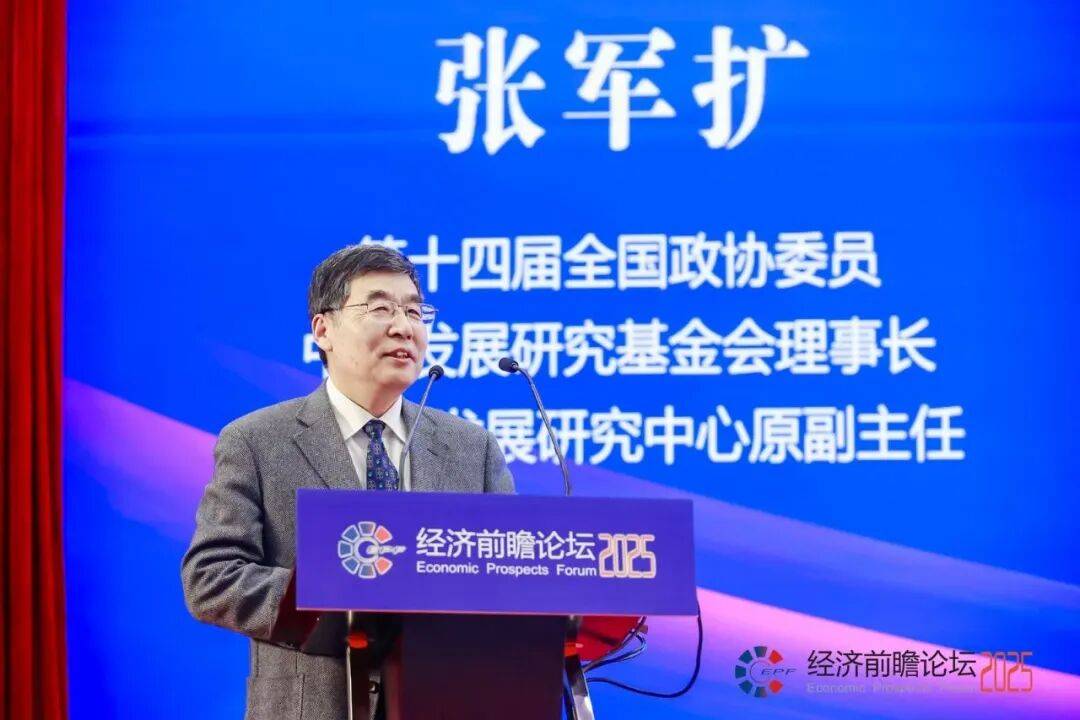
经济前瞻论坛2025丨张军扩:应深刻认识和把握“十五五”的三项重要战略方针
Sou Hu Cai Jing· 2025-11-29 13:07
Group 1 - The core viewpoint emphasizes the need for a deep understanding of three strategic guidelines during the 14th Five-Year Plan period, focusing on economic construction, high-quality development, and expanding domestic demand [2][3] - The 14th Five-Year Plan highlights the importance of economic construction as the central task, indicating that economic work remains the focus of the entire party and nation [3] - The plan aims for a per capita GDP of over $20,000 by 2035, requiring an average annual GDP growth of approximately 4.17% during the 14th and 15th Five-Year Plan periods [4] Group 2 - The plan stresses the importance of reform and innovation as fundamental drivers, aiming for breakthroughs in comprehensive reforms and creating a market-oriented, law-based, and international business environment [4][6] - The transition from follower innovation to frontier innovation is deemed essential, focusing on solving technological bottlenecks and enhancing basic research capabilities [6] - Policies to boost consumption and effective investment are outlined, emphasizing counter-cyclical measures, improving social security for low-income groups, and optimizing regulatory policies [7] Group 3 - The plan identifies the need to balance interests among various stakeholders to fully unleash investment potential, particularly in real estate and private investment [7] - The unique advantages of China's economic development are highlighted, suggesting that adherence to central policies will lead to significant achievements in high-quality development [8]
从“黑涌臭涌”到美丽河湖,广州东濠涌的变身带来哪些启示?
Zhong Guo Huan Jing Bao· 2025-11-09 23:24
Core Viewpoint - The successful restoration of Donghao Stream in Guangzhou serves as a model for urban river management and ecological restoration, showcasing a comprehensive approach to environmental governance and community engagement [1][4][7]. Group 1: Ecological Transformation - Donghao Stream, once a vital waterway, faced severe pollution due to urbanization, leading to its classification as a black and smelly river [2][3]. - The stream's water quality improved from Class V to Class III, with a daily replenishment of over 100,000 tons of water, meeting ecological and recreational needs [3][4]. - The restoration efforts included the construction of a deep-layer drainage system and a series of ecological measures, resulting in a healthier aquatic ecosystem with the return of fish and sensitive species [3][6]. Group 2: Governance and Management - Guangzhou adopted a systematic governance model for the entire river basin, emphasizing long-term planning and phased implementation of restoration projects [4][5]. - The city established a three-tier river management network, utilizing digital tools for real-time monitoring and efficient governance [6][7]. - Community involvement was prioritized, with public consultation committees ensuring local voices were heard in the decision-making process [5][6]. Group 3: Cultural and Economic Revitalization - The restoration project included the transformation of historical sites into cultural assets, such as a water-themed museum, enhancing the cultural significance of the area [3][7]. - New public spaces and recreational facilities along the stream have improved the quality of life for residents, promoting a vibrant local economy [3][5]. - The project has fostered a sense of community ownership and environmental stewardship, contributing to the long-term sustainability of the river's ecosystem [7][8].