数字黄金

Search documents
稳定币发行商买了上百吨黄金
Bei Jing Shang Bao· 2025-11-27 14:25
Core Insights - Tether, a major player in the cryptocurrency market, has emerged as a significant buyer of gold, holding 116 tons valued at approximately $14 billion, surpassing some national central banks [3][4] - The price of gold has surged by 56% in 2025, with Tether's purchases coinciding with this increase, particularly during the second wave of price growth from mid-August to mid-October [3][4] - The rise of gold-backed stablecoins is gaining traction, with Tether's USDT and XAUt contributing to this trend, reflecting a shift in the stablecoin market [4][7] Tether's Gold Purchases - Tether's gold purchases accounted for about 2% of global gold demand in Q3 and 12% of known central bank purchases during the same period [3] - In Q2, Tether's gold buying represented 14% of global central bank purchases, indicating its growing influence in the gold market [3] - Tether holds 104 tons of gold as reserves for USDT and an additional 12 tons for XAUt, suggesting a strategic move to bolster its asset backing [4] Market Dynamics - The gold price increase has occurred in two phases, with the first phase seeing a nearly $1,000 rise before April and the second phase mirroring this increase from August to October [3] - Tether's demand for gold may have tightened supply and influenced market sentiment, driving speculative investments into gold [4][6] - The stablecoin market is evolving, with gold-backed stablecoins becoming a new category, currently valued at $1.6 billion, representing 0.67% of the total stablecoin market [7] Regulatory Considerations - Tether's use of gold as a reserve asset contrasts with new U.S. regulations that prohibit compliant issuers from using gold as backing, leading Tether to plan a new stablecoin, USAT, that will not be gold-backed [5] - The intertwining of gold and cryptocurrency ecosystems raises questions about the stability and regulatory compliance of such assets [5][6] Future of Digital Gold - The development of digital gold is seen as timely, with potential for innovation in financial products, provided regulatory frameworks are established [7][8] - Challenges remain in ensuring transparency and security in the issuance and tracking of digital gold, as well as maintaining sufficient physical gold reserves [8] - The future landscape may see digital gold complementing physical gold rather than replacing it, enhancing the overall gold market [8]


德银:“五重冲击”齐袭!本轮比特币暴跌的逻辑,和过去完全不一样
美股IPO· 2025-11-25 03:40
Core Viewpoint - Deutsche Bank believes that the recent decline in Bitcoin is driven by five major shocks, including macroeconomic headwinds, hawkish signals from the Federal Reserve, stagnation in regulatory progress, outflows of institutional funds, and profit-taking by long-term holders, indicating a fundamental shift in Bitcoin's investment logic and an unprecedented emphasis on risk management [1][2][4]. Group 1: Five Major Shocks - **Shock One: High Correlation with Tech Stocks** The recent decline in Bitcoin is synchronized with the drop in U.S. stocks, indicating that Bitcoin has not yet established its function as a defensive hedge [3]. - **Shock Two: Increased Uncertainty in Monetary Policy** The uncertainty surrounding the Federal Reserve's monetary policy is a key driver of Bitcoin's decline, with a strong negative correlation between Bitcoin prices and Fed interest rates [10][11]. - **Shock Three: Stagnation of Regulatory Key Legislation** The momentum for regulatory frameworks has stalled, hindering the integration of Bitcoin into investment portfolios and liquidity deepening [13][15]. - **Shock Four: Institutional Fund Outflows and Liquidity Drain** A vicious cycle of liquidity drain and institutional fund outflows has exacerbated the price drop, with significant net outflows from Bitcoin ETFs recently [17][18]. - **Shock Five: Profit-Taking by Long-Term Holders** Unlike previous crashes driven by new or leveraged traders, this adjustment has seen long-term holders selling off over 800,000 Bitcoins, marking the highest level since January 2024 [20][21]. Group 2: Market Dynamics and Future Outlook - **Market Dynamics** The correlation between Bitcoin and major stock indices has surged, reaching levels similar to those during the market stress of the COVID-19 pandemic [5][6]. - **Future Outlook** The ability of Bitcoin to stabilize post-adjustment remains uncertain, but regulatory reforms and increased interest from governments and central banks may enhance institutional confidence and market liquidity [23]. - **Risk Management Importance** As the cryptocurrency market evolves, implementing strict risk management measures is crucial due to the potential for increased price volatility driven by uncertainty and leverage effects [23].

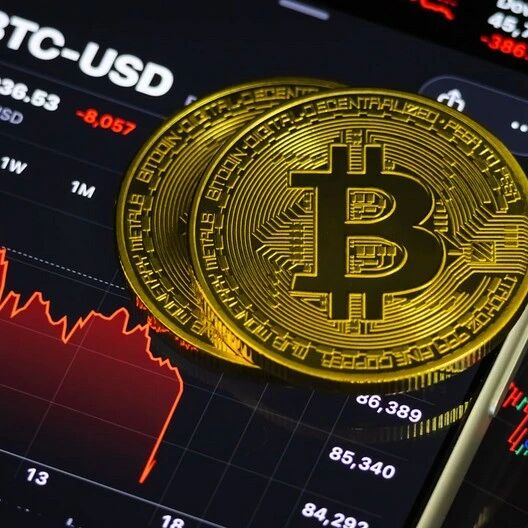
比特币持续暴跌加密货币该何去何从?
Sou Hu Cai Jing· 2025-11-24 08:41
Group 1: Market Trends - The global financial market is experiencing significant divergence, with gold prices retreating to $4040 per ounce and Bitcoin dropping below the critical support level of $90,000 from its July peak [1] - The strong rise in gold is attributed to escalating geopolitical tensions, central bank purchases, and a return to traditional safe-haven assets, while Bitcoin's decline is influenced by regulatory uncertainties, institutional fund outflows, and a cooling speculative sentiment [1][2] - Ethereum has also faced a sharp decline, dropping over 25% from its July peak, officially entering a technical bear market [1] Group 2: Institutional Perspectives - Peter Schiff emphasizes Bitcoin's relative weakness compared to gold, noting that Bitcoin has fallen 30% when priced in gold since its July high, indicating a deep bear market for Bitcoin [2] - Schiff argues that gold's physical scarcity and historical monetary attributes provide intrinsic value, while Bitcoin relies on market sentiment and speculation, lacking a solid value anchor [2][3] - Institutional investors have significantly increased their allocation to gold ETFs in 2024, while Bitcoin ETFs have seen continuous net outflows, highlighting a shift in asset allocation preferences [3] Group 3: Market Dynamics - The recent market crash triggered a chain reaction, with over $1.2 billion in forced liquidations across major exchanges, predominantly in Bitcoin and Ethereum derivatives [2] - Whale accounts, holding over 1,000 Bitcoins, have accelerated their selling, contributing to market declines and reflecting a need for asset rebalancing among institutional investors [5] - Bitcoin ETFs have experienced seven consecutive weeks of net outflows, the longest streak since 2023, contrasting sharply with the ongoing inflows into gold ETFs [5] Group 4: Challenges for Crypto Companies - Companies that heavily invest in cryptocurrencies, like MicroStrategy, face significant challenges as their stock prices have plummeted over 65% from yearly highs, raising concerns about their financing strategies [4] - The business model of crypto asset reserve companies is under severe strain, with many companies now trading at a discount to their held cryptocurrency values [6] - The mNAV valuation metric for MicroStrategy has dropped from above 3.0 to just 1.1, indicating a loss of confidence in the crypto asset reserve model [6] Group 5: Future Outlook - The narrative of Bitcoin as "digital gold" is being re-evaluated, with the need for Bitcoin to demonstrate resilience in adverse conditions to gain equal market status with traditional safe-haven assets [7] - Analysts suggest that while the market faces challenges, the fundamental aspects of Bitcoin, such as active addresses and hash rate, remain strong, indicating potential long-term value [6][7]
主权基金抄底比特币!“数字黄金”成战略储备新选择?
Sou Hu Cai Jing· 2025-11-20 10:18
Core Insights - The perception of Bitcoin as merely a speculative tool is changing, as sovereign institutions like Abu Dhabi and Luxembourg are beginning to view it as a strategic complement to traditional reserve assets, thereby altering the global investment landscape [1][11] Group 1: Sovereign Fund Actions - Luxembourg's first sovereign fund, FSIL, announced in October that it would allocate 1% of its assets (approximately €7 million) to Bitcoin, viewing it as a hedge against inflation and currency risk [3] - The Abu Dhabi Investment Authority (ADIC) significantly increased its holdings in a Bitcoin trust fund, investing $518 million to acquire 8 million shares, completing this investment just before a 20% market drop, indicating a long-term value belief rather than short-term speculation [4] Group 2: Bitcoin's Performance and Risk - From 2023 to 2025, Bitcoin's annualized returns are expected to significantly outperform gold, the S&P 500, and U.S. Treasury bonds, despite its volatility being twice that of 51 sovereign currencies [6] - Research indicates that even a small allocation of Bitcoin in a portfolio can enhance risk-adjusted returns, showcasing the strategic advantage for sovereign funds to exchange controllable risks for higher returns [6] Group 3: Market Dynamics and Innovations - Sovereign funds currently allocate 32% to equities and 28% to fixed income, with commodities like gold only making up 0.8%. The emergence of spot ETFs has resolved classification issues, allowing funds to incorporate Bitcoin as a compliant financial instrument [7] - During a market downturn in 2025, U.S. spot Bitcoin ETFs experienced redemptions of up to $523 million, highlighting the challenges faced by the industry. However, innovations like institutional-grade custody services and stablecoin lending are helping to mitigate these risks [9] Group 4: Strategic Diversification - The traditional reliance on gold and bonds for sovereign reserves is evolving towards diversification in response to complex economic conditions. Bitcoin is not intended to replace gold but to serve as a complementary asset, enhancing portfolio resilience [11]

比特币跌破9万美元创七个月新低 贝莱德旗下比特币ETF(IBIT.US)创成立以来最大单日撤资记录
Zhi Tong Cai Jing· 2025-11-19 22:21
Core Insights - The iShares Bitcoin ETF (IBIT.US) experienced a record net outflow of approximately $523 million, marking the largest single-day redemption since its launch in January 2024, coinciding with Bitcoin's price dropping below $90,000, the lowest in seven months [1][4] - IBIT, as the largest spot Bitcoin ETF, has been a central player in the crypto ETF boom, but recent rapid declines in Bitcoin's price have led to significant redemption pressures, indicating a challenging market environment for risk assets [4] - In contrast to Bitcoin's decline, gold has remained relatively stable, raising questions about Bitcoin's role as a hedge or "digital gold," with some analysts suggesting investors are reducing Bitcoin exposure in favor of gold [4] - The crypto market has been losing momentum since August, with previous demand largely driven by leveraged funds, and profit-taking by long-term holders has intensified market pressure [4] - Over the past year, Bitcoin treasury companies have accumulated nearly $50 billion in Bitcoin, but many related company stocks have fallen below their Bitcoin net asset values, raising concerns about their ability and willingness to continue buying [4] - Some prominent investors warn that valuations across various asset classes, including cryptocurrencies, appear elevated, contributing to a market environment lacking speculative sentiment [7] - As of this quarter, IBIT, with assets exceeding $73 billion, has seen a cumulative decline of approximately 19% [7]
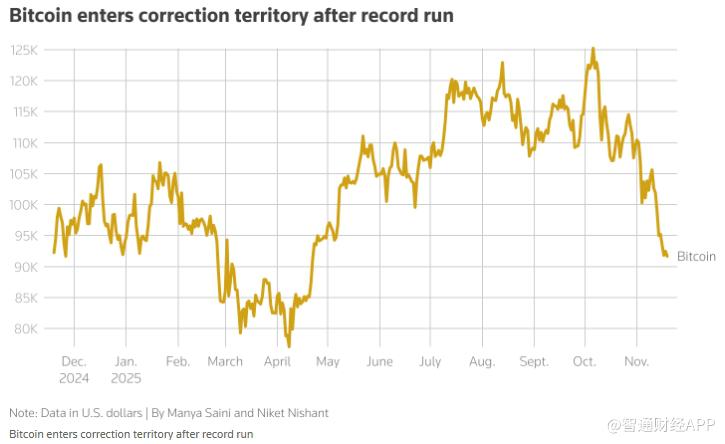
比特币失守9.5万美元!10万人爆仓,巨鲸+ETF集体出逃,牛市泡沫已经破裂?
Sou Hu Cai Jing· 2025-11-17 17:16
Core Viewpoint - Bitcoin has officially entered a technical bear market following a significant price drop, with a decline of over 25% from its historical high in October 2025, driven by macroeconomic factors and market dynamics [1][8]. Market Performance - On November 16, 2025, Bitcoin's price fell to a low of $93,778.6, marking a drop of over 5% from the previous day and the first time it fell below the $95,000 psychological level since October 10 [3]. - The overall cryptocurrency market experienced a widespread decline, with Ethereum dropping below $3,200 and a monthly decline of 20% [3]. - The total market capitalization of cryptocurrencies evaporated by over $1 trillion within 24 hours, reflecting significant losses since the October peak [4]. Liquidation and Trading Dynamics - Nearly 100,000 investors faced liquidation in the past 24 hours, with total liquidation amounts reaching approximately $2.51 billion [5][6]. - Long positions accounted for over 70% of the liquidations, indicating a significant market shift [6]. Macroeconomic Context - The decline in Bitcoin's price is linked to a shift in U.S. monetary policy expectations, with the market's optimism for a Federal Reserve rate cut dissipating [8]. - Strong employment data and consumer spending in the U.S. have led to a reassessment of the likelihood of rate cuts, causing investors to withdraw from high-risk assets like Bitcoin [8]. Institutional and Whale Activity - Institutional investors and long-term holders have shifted from buying to selling, leading to a sharp decline in market buying power [10]. - Bitcoin ETFs in the U.S. have seen a net outflow of $311.3 million in the week ending November 16, marking the longest streak of outflows since March [11]. - Long-term holders sold approximately 815,000 Bitcoins in the past 30 days, the highest level of selling activity since early 2024 [12]. Market Sentiment and Narrative Shift - The narrative surrounding Bitcoin as "digital gold" and an inflation hedge has been challenged, as it has not performed as a safe haven during market volatility [18]. - The anticipated "halving" event, which typically boosts prices, has not provided the expected support, leading to profit-taking by investors [18]. - Recent events, including the U.S. Department of Justice's seizure of 127,000 Bitcoins, have undermined the perception of security in cryptocurrency transactions [19].

比特币抹去今年以来全部涨幅,一度跌破9.4万美元
Sou Hu Cai Jing· 2025-11-17 02:16
Group 1 - Bitcoin price has experienced a significant drop, falling to $93,778.6, erasing its 30% year-to-date gain, with the current price at $94,886.2, down 0.2% [1] - The primary driver of this decline is the change in liquidity expectations due to higher-than-expected U.S. inflation data, leading to decreased confidence in a Federal Reserve rate cut in December, with the probability of a 25 basis point cut dropping to 44.4% [1] - Institutional outflows have intensified market pressure, with a noticeable slowdown in inflows to U.S. spot Bitcoin ETFs, indicating a weakening appetite for cryptocurrency among institutions [1] Group 2 - Morgan Stanley's latest report suggests that if the Federal Reserve maintains its current stance in December, the marginal tightening of dollar liquidity will suppress the performance of non-yielding assets, including Bitcoin [2] - Analysts warn that if Bitcoin remains below $100,000, it could trigger more aggressive sell-offs, with a potential target near $74,000, indicating about 30% downside from current levels [4] - Despite market volatility, some institutions are still entering the market, with Strategy Company recently purchasing 397 Bitcoins for approximately $45.6 million, bringing their total holdings to 641,205 Bitcoins at an average cost of $74,057 each [4]

105018美元!比特币昨夜突破关键点位,有人狂欢,有人沉默
Sou Hu Cai Jing· 2025-11-11 18:45
Core Insights - Bitcoin has surged to $105,000, but market sentiment is divided, with significant sell orders at this level causing volatility [1] - The price has fluctuated between $100,000 and $113,000 over the past month, even dipping below $99,000, marking a five-month low [1] Institutional Dynamics - The core conflict driving price volatility is the battle between institutions and long-term holders, with MicroStrategy increasing its Bitcoin holdings to 7390 coins at an average price of $103,500, totaling 576,000 coins valued at $59.2 billion [3] - Institutions like Metaplanet and Mubadala are accumulating Bitcoin, contributing to a trend of "institutional hoarding" [3] - The U.S. Bitcoin Strategic Reserve Act has incorporated 198,000 confiscated Bitcoins into national reserves, freezing 6% of the circulating supply [3] - Long-term holders have also been active, with 405,000 previously dormant Bitcoins moved to exchanges in the past month, indicating profit-taking by large holders during price spikes [3] Market Influences - Bitcoin's price movements are closely tied to global financial market dynamics, with geopolitical tensions in the Middle East amplifying market volatility [5] - The Federal Reserve's monetary policy continues to influence capital flows, with a weakening dollar during rate cuts driving some funds towards Bitcoin as a "digital gold" [5] - Traditional financial markets are also competing for capital, impacting Bitcoin's price stability [6] Technological Developments - Bitcoin's value is supported not only by its financial attributes but also by technological advancements, such as a 140% increase in Lightning Network nodes to 18,000 and over 1 million payment channels, with total locked funds reaching $420 million [8] - These upgrades facilitate small payments, exemplified by support from convenience stores in Tokyo [8] - However, competition is intensifying, with Ethereum struggling to maintain the $3,000 mark and new projects like HYPE and RTX emerging [8] Market Sentiment and Historical Trends - The Bitcoin market is characterized by extreme volatility, with a historic sell-off in October resulting in a $1.2 billion market cap evaporation, breaking a seven-year trend of October gains [8] - Despite this, November has historically been a "lucky month" for Bitcoin, with an average increase of over 19% in the past decade [8] - Technical indicators reveal retail investor anxiety, with potential support levels identified at $94,200 following a drop below the 200-day moving average [10] - The contrasting perspectives on Bitcoin's future—ranging from a vision of digital civilization to concerns of a bubble—highlight the ongoing uncertainty in the market [10]

金价看涨至5000美元
第一财经· 2025-11-11 09:16
Core Viewpoint - The article discusses the recent surge in gold prices, driven by weak U.S. economic data and expectations of interest rate cuts by the Federal Reserve, with predictions that gold could reach $5,000 per ounce by the end of the year [7][10]. Group 1: Gold Price Trends - Gold prices rose nearly 3% recently, surpassing $4,100 per ounce, marking a two-week high due to weak U.S. employment data that bolstered demand for non-yielding assets [7]. - The Challenger report indicated that over 150,000 job cuts occurred in October, the highest for this period in over 20 years, signaling a slowdown in the U.S. labor market [7]. - The consumer confidence index for November dropped significantly to 50.3, below market expectations, indicating economic concerns [7]. - Market expectations for a December interest rate cut by the Federal Reserve are at 64%, with a 77% chance for January [7]. Group 2: Economic and Political Influences - The U.S. Senate is advancing a measure to reopen the government, which could lead to the release of more economic data and further enhance expectations for a December rate cut [8][9]. - Concerns over the deteriorating U.S. fiscal outlook are expected to shift market focus back to gold and other precious metals [9]. - Since peaking at $4,380 per ounce in mid-October, gold has declined about 6%, but remains up over 56% for the year [9]. Group 3: Future Predictions - Analysts predict gold prices could reach between $4,200 and $4,300 per ounce by year-end, with further increases to $5,000 in the first quarter of next year [9][10]. - Morgan Stanley forecasts gold prices could rise to $5,200 to $5,300 by the end of 2026, driven by central bank purchases, particularly in emerging markets [10]. Group 4: Gold Token Market - The rise in gold prices has led to an increase in gold tokens, which are backed by physical gold and aim to track gold prices closely [11]. - Tether's gold token, Tether Gold (XAUT), saw its market value increase by 60% in October, reaching nearly $2.1 billion [11]. - Gold tokens currently represent about 1% of the stablecoin market, with a total market value of approximately $3 billion compared to $300 billion for dollar-backed stablecoins [11]. Group 5: Risks of Gold Tokens - There are concerns regarding the risks associated with gold tokens, including issues related to delivery, long-term reliability, and the ability to redeem physical gold [13]. - Critics argue that while gold tokens may offer advantages, they still carry counterparty risks, unlike Bitcoin, which eliminates such risks [13]. - Recent reports indicate that even stablecoins pegged to the dollar can break their peg during extreme market stress, raising questions about the reliability of gold tokens [13].

“数字黄金”神话破灭?CS2机制调整致饰品市场蒸发20亿美元
2 1 Shi Ji Jing Ji Bao Dao· 2025-10-29 13:15
Core Viewpoint - A recent update to the CS2 game by Valve has significantly disrupted the virtual item market, leading to a loss of over $2 billion in market valuation within two days due to changes in the rarity and value of in-game items [1][2]. Market Reaction - The update allowed players to combine five red items to create a gold item, drastically reducing the perceived scarcity of gold items, which were previously considered "digital gold" [2][10]. - The virtual item market index dropped from 1663 points to 510 points, a decline of nearly 70%, before recovering slightly to 875 points [2][10]. - High-value items like the Butterfly Knife and Sports Gloves saw daily price drops exceeding 50% on major trading platforms [6]. Player Impact - Many players experienced significant financial losses, with some reporting losses of over $20,000, while others managed to sell their items to mitigate losses [9][11]. - The trading rules imposed a "T+14" lock period, preventing players from selling newly acquired items immediately, exacerbating their losses [9][11]. Economic Analysis - The change in item synthesis rules has led to a supply shock, diluting the previous "scarcity premium" associated with high-end items [10][12]. - The market's rapid decline indicates that a substantial portion of item prices was based on speculative expectations rather than intrinsic value [13]. Future Considerations - Experts suggest that the incident highlights the need for a more stable economic model for virtual items, emphasizing the importance of predictable supply mechanisms and protective measures against extreme market fluctuations [14]. - Recommendations include establishing a buffer for extreme market conditions, creating a more predictable supply path, and differentiating items with cultural significance to maintain their value [14].