
新三样

Search documents
上半年阿布扎比房地产交易额超140亿美元 丁祖昱:海外房地产投资应锚定区域中心城市
Zhong Guo Jing Ying Bao· 2025-09-28 06:19
Group 1 - The "2025 Middle East Real Estate Investment Summit" was successfully held in Shanghai, organized by CRIC, highlighting the company's focus on the UAE real estate market [1] - CRIC released the "2025 Mid-Year UAE Residential Market Trend Report," marking its second in-depth research on the UAE real estate market this year [1] - CRIC plans to release white papers covering global hot regions to support Chinese enterprises and individual investors in making informed decisions [1] Group 2 - ALDAR, a leading real estate developer in the UAE, operates with a diversified and sustainable business model, focusing on ALDAR Development and ALDAR Investment [2] - The UAE's core cities, Dubai and Abu Dhabi, are identified as key investment locations in the Middle East, with Abu Dhabi projected to surpass Dubai in population by 2024 [2] - In the first half of 2025, Abu Dhabi's residential transaction value reached 21.853 billion dirhams, a 30% year-on-year increase, with average residential prices rising by 17% [2] - Dubai's real estate market saw 98,726 transactions in the first half of 2025, a 22% increase, with total transaction value reaching 326.9 billion dirhams, a 40% year-on-year surge [2] Group 3 - The collaboration between China and the UAE is supported by China's "three new" advantages, aligning with the energy transition needs of Arab countries [3] - ALDAR's CEO noted that the UAE government has optimized the investment environment through policies like the Golden Visa, attracting nearly 3,000 companies to Abu Dhabi [3] - In the first half of 2025, Abu Dhabi's real estate transaction volume exceeded 14 billion USD, a 39% increase year-on-year, with ALDAR's foreign buyer proportion rising significantly [3]
前8个月张家港外贸进出口1832.6亿元 连续20个月出口正增长
Su Zhou Ri Bao· 2025-09-26 00:37
Core Insights - Zhangjiagang's foreign trade import and export total reached 183.26 billion yuan in the first eight months of the year, with exports of 104.37 billion yuan, marking a year-on-year growth of 10.1% [1] - The ASEAN region remains Zhangjiagang's largest trading partner, with a total trade value of 30.58 billion yuan, a year-on-year increase of 19%, accounting for 16.7% of the total foreign trade [1] - The export of traditional industries is adapting to new trends, with "new three categories" showing vitality, including clothing, furniture, and home appliances, as well as electric vehicles, lithium batteries, and photovoltaic products [1] Trade Structure - The export of clothing and accessories reached 12.36 billion yuan, accounting for 11.8% of the total export value, with a year-on-year growth of 0.6% [1] - Furniture and home appliance exports grew by 11.6% and 22.9%, respectively, demonstrating the sustained vitality of traditional manufacturing [1] - The "new three categories" collectively exported 8.37 billion yuan, accounting for 8% of total exports, with a year-on-year growth of 3.7%, becoming a new driving force for exports [1] Key Product Categories - The export of electromechanical products maintained a high growth rate, totaling 33.84 billion yuan, a growth of 17.3%, representing 32.4% of the total export value [2] - Specific categories such as electrical equipment, general machinery, and packaging machinery saw significant growth, with export values of 1.84 billion yuan, 1.12 billion yuan, and 1.03 billion yuan, respectively, with year-on-year growth rates of 39.3%, 46.3%, and 42.8% [2]
1—8月杭州外贸出口增长10.9% “新三样”产品表现强劲
Hang Zhou Ri Bao· 2025-09-22 03:16
Core Insights - Hangzhou's foreign trade import and export value reached 568.3 billion yuan from January to August, a year-on-year increase of 7.8%, accounting for 15.4% of the province's total import and export value [1] - Exports amounted to 408.05 billion yuan, growing by 10.9%, maintaining the eighth position among cities nationwide; imports were 160.25 billion yuan, with a growth of 0.7% [1] - The export of electromechanical products was 199.74 billion yuan, representing 49.0% of the city's total exports, with a growth of 11.1% [1] - The "new three samples" products, including lithium batteries, electric passenger vehicles, and solar cells, saw a strong export performance of 15.76 billion yuan, growing by 65.5% [1] Product and Market Analysis - From January to August, exports to the EU and ASEAN were 80.78 billion yuan and 58.25 billion yuan, with growth rates of 13.2% and 22.2% respectively [2] - Exports to countries and regions involved in the Belt and Road Initiative reached 202.04 billion yuan, an increase of 18.5% [2] - Private enterprises played a significant role in foreign trade, with 17,980 enterprises engaged in import and export activities, a 9.6% increase [2] - Private enterprises' import and export value was 397.87 billion yuan, growing by 12.3%, with exports of 323.11 billion yuan, accounting for 79.2% of Hangzhou's total exports [2]
“新三样”释放出口新动能 锂电池领跑
Si Chuan Ri Bao· 2025-09-16 22:12
Core Insights - Sichuan's foreign trade demonstrated resilience and vitality, achieving a historical high in import and export scale, with total trade reaching 683.2 billion yuan, a year-on-year increase of 2.5% [1][2] - The export of "new three items" products, including electric vehicles, lithium batteries, and solar cells, reached 20.11 billion yuan, marking a significant year-on-year growth of 77.6% [2][3] - The number of enterprises engaged in import and export activities in Sichuan exceeded 8,500, reflecting a year-on-year increase of 9.2%, with advanced certified enterprises (AEO) contributing significantly to the trade volume [3] Export Performance - Exports from Sichuan reached 410.05 billion yuan, with a year-on-year growth of 5.3%, marking the first time exports surpassed 400 billion yuan in the historical context [1][2] - The export of photovoltaic products and lithium-ion batteries saw remarkable growth, with increases of 277.8% and 1170.9% respectively [2] Import Dynamics - Sichuan's imports totaled 273.15 billion yuan, showing a year-on-year decline of 1.5%, while consumer goods imports increased by 7.8%, with specific categories like fresh shrimp and salmon experiencing significant growth [1][2] Industry Development - Yibin, known as China's battery capital, has established a complete lithium battery industry chain, supported by rich lithium resources and green hydropower [3] - Major companies like CATL have signed multiple projects in Yibin, with a total investment of 64 billion yuan and an annual production capacity of 180 GWh [3] Regional Trade Growth - Chengdu played a pivotal role in driving Sichuan's foreign trade growth, with a total import and export value of 566.98 billion yuan, a year-on-year increase of 4.9% [3] - Seven cities in Sichuan achieved double-digit growth in trade, indicating a positive development trend across the region [3]

中国“新三样” 造福全世界
Yang Shi Wang· 2025-09-14 02:06
Core Viewpoint - The Chinese government is actively promoting new industrialization during the "14th Five-Year Plan" period, focusing on the development of competitive industries such as new energy vehicles, photovoltaic products, and lithium batteries [1] Group 1: Industry Growth - During 2023, the export of China's "new three products" (new energy vehicles, photovoltaic products, and lithium batteries) exceeded 1 trillion yuan for the first time [1] - The export of these products is expected to maintain a positive trend in 2024, with a year-on-year growth of 12.7% in the first half of 2025 [1] Group 2: Global Leadership - China has become the world's first country to achieve an annual production of over 10 million new energy vehicles, maintaining the top position in global production and sales for 10 consecutive years [1] - The international market share of China's lithium-ion batteries ranks first globally, with over 70% of the world's lithium batteries produced in China [1] - China has held the top position in photovoltaic module production for 16 consecutive years, supplying 70% of the global photovoltaic modules and 60% of wind power equipment [1]
向新而行|中国“新三样” 造福全世界
Yang Shi Wang· 2025-09-12 23:57
Core Insights - The "14th Five-Year Plan" emphasizes the promotion of new industrialization, focusing on competitive industries such as new energy vehicles, photovoltaics, and lithium batteries [1] - In 2023, exports of the "new three products" exceeded 1 trillion yuan for the first time, with a continued positive trend expected in 2024 [1] - By the first half of 2025, exports of these products are projected to grow by 12.7% year-on-year [1] Industry Highlights - China has become the first country to achieve an annual production of over 10 million new energy vehicles, maintaining the world's largest production and sales for 10 consecutive years [1] - The international market share of lithium-ion batteries produced in China ranks first globally, accounting for over 70% of the world's production [1] - China has led the world in photovoltaic module production for 16 consecutive years, supplying 70% of global photovoltaic components and 60% of wind power equipment [1]
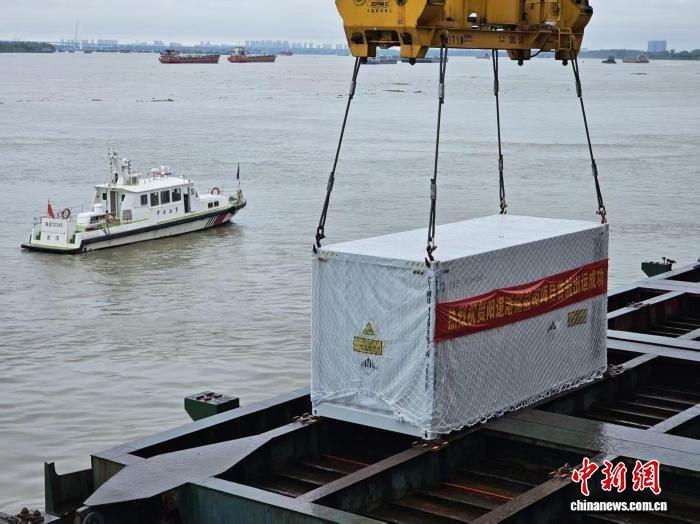
“武汉—太仓”“新三样”货物江海联运首航启运
Zhong Guo Xin Wen Wang· 2025-09-12 07:15
Core Viewpoint - The launch of the "Wuhan-Taicang" new three types of goods water-sea intermodal transport marks a significant advancement in the logistics of high-value, hazardous goods like lithium-ion battery systems, enhancing the global competitiveness of Hubei-made products [1][2]. Group 1: Logistics and Transportation - The first voyage of the "Yuan Da Xian Feng" ship from Wuhan Yangluo Port carried a batch of export lithium-ion battery systems to North America, indicating the successful first launch of Hubei's battery systems in a water-sea intermodal transport model [1]. - Previously, the transportation of Hubei's new energy and storage products relied mainly on land transport, which was costly and posed safety risks [2]. - The new "one box system" emphasizes collaboration between the maritime departments of the starting and transfer ports, allowing for data sharing and mutual recognition of regulations, which reduces unnecessary inspections and lowers costs for businesses [2]. Group 2: Cost and Efficiency Improvements - Compared to traditional road transport, the waterway export of Hubei's energy storage cabinets has reduced the shipping cost by over 10,000 yuan per container, decreased shipping time by 1 to 2 days, and lowered logistics costs by 30% [2].

“新三样” 领跑出口
Mei Ri Shang Bao· 2025-09-11 22:15
Core Insights - Zhejiang's foreign trade achieved a total import and export value of 3.68 trillion yuan in the first eight months, marking a year-on-year growth of 5.5%, with exports reaching 2.79 trillion yuan, an increase of 7.7%, both setting historical records for the same period [1] Group 1: Emerging Markets - The growth resilience of Zhejiang's foreign trade is significantly attributed to the deep exploration of emerging markets, with exports to ASEAN, Latin America, the Middle East, and Africa all achieving double-digit growth [2] - Exports to ASEAN reached 390 billion yuan, up 16.7%, while exports to Latin America were 316.7 billion yuan, increasing by 10.7% [2] - The total import and export value to countries along the Belt and Road reached 2.10 trillion yuan, growing by 8.6%, accounting for 57% of the province's total foreign trade [2] Group 2: Private Enterprises - Private enterprises are the main force in Zhejiang's foreign trade, with 109,000 private companies contributing to 82% of the province's total import and export value [3] - The total import and export value of private enterprises reached 3.02 trillion yuan, a year-on-year increase of 7.1%, with exports amounting to 2.41 trillion yuan, growing by 8.7% [3] Group 3: Specialized Enterprises - Specialized and innovative private enterprises are emerging as new forces in foreign trade, with over 1,000 national-level "little giant" enterprises engaged in foreign trade [4] - A notable example is Kebaite Filter Material Co., which successfully navigated the complexities of processing trade to fulfill a long-term procurement demand from a European medical device company [4] Group 4: New Products - Zhejiang's "new three samples" products, particularly electric vehicles, are leading export growth, with electric vehicle exports surpassing 40,000 units in August, a year-on-year increase of 137.8% [5] - The export of lithium-ion batteries reached 3.29 billion yuan in August, growing by 43.7%, maintaining a double-digit growth for 11 consecutive months [5] - Traditional advantage products also showed steady growth, with labor-intensive products exporting 829.42 billion yuan, up 4%, and high-tech products exporting 231.87 billion yuan, up 8.2% [5]
前8月长江干线新能源汽车出口增长167%
Ren Min Ri Bao· 2025-09-11 00:54
Core Viewpoint - The implementation of the "one box system" for container transportation of "new three types" goods, including electric vehicles, lithium batteries, and photovoltaic products, significantly streamlines the export process and reduces costs for companies [1] Group 1: New Transportation Model - The "one box system" allows for a single declaration at the originating port, replacing the previous requirement for separate declarations at both the originating and transshipment ports [1] - Cargo inspection is now conducted at the packing stage, with mutual recognition of results between the originating and transshipment ports [1] - The new model has reduced container port time by 35%, saving companies over 100 million yuan annually [1] Group 2: Export Growth - In the first eight months of this year, exports of electric vehicles via the Yangtze River increased to 386,000 units, a year-on-year growth of 167% [1] - Exports of lithium batteries reached 23,700 TEUs, marking a 110% year-on-year increase [1] Group 3: Multi-Modal Transport Development - The maritime authorities are actively promoting multi-modal transport to support the rapid development of the "new three types" industry [1] - Initiatives include the creation of water-water, rail-water, and public-water transport systems to enhance the export capabilities of these goods [1]
长江干线新能源汽车出口增长167%
Ren Min Wang· 2025-09-10 22:21
Core Insights - The article highlights the launch of the first container ship, "Jianghaitong 189," transporting 375 electric vehicles to Poland, marking a significant step in the implementation of the "one box system" for water-to-water transfer of "new three types" goods [1] - The "one box system" simplifies the declaration process for exports, reducing the time containers spend in ports by 35% and saving companies over 100 million yuan annually [1] - There has been a remarkable increase in the export of "new three types" goods via the Yangtze River, with electric vehicle exports reaching 386,000 units, a year-on-year increase of 167%, and lithium battery container exports at 23,700 TEUs, up 110% [1] Industry Developments - The maritime authorities are actively promoting multimodal transport to support the rapid growth of the "new three types" industry, enhancing the efficiency of water-to-water, rail-water, and public-water transport systems [1] - The implementation of the "one box system" is expected to inject stronger momentum into China's foreign trade exports, particularly in the sectors of electric vehicles, lithium batteries, and photovoltaic products [1]